live_tv
Livestream Starting Soon
00
Hours
:
00
Minutes
:
00
Seconds
Up next in 10


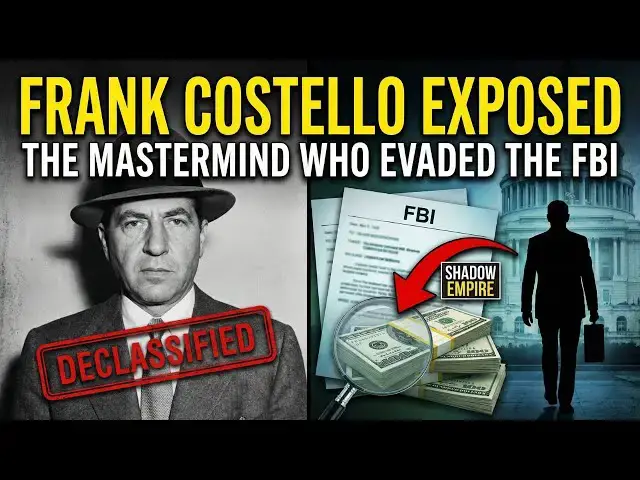
The most powerful crime boss in American history didn't work alone—and the men who actually built his empire have been buried in classified files for decades.
This documentary exposes the shadow cabinet behind Frank Costello's four-hundred-million-dollar criminal enterprise. We're pulling back the curtain on the financial engineers, legal strategists, political fixers, and operational masterminds who made the "Prime Minister of the Underworld" genuinely untouchable for thirty years.
You'll discover the accountant who created money laundering structures so sophisticated that the IRS developed an entire task force just to crack his code. The attorney who got seventeen arrests dismissed and never let his client serve a day. The Southern operator who turned New Orleans into a gold mine without firing a single shot. And the shocking truth about the mayor who pretended to fight organized crime while secretly serving as Costello's most valuable asset.
This investigation draws from FBI surveillance transcripts declassified in the 1990s, sealed grand jury testimonies, and forensic financial records that took investigators years to reconstruct. Every claim is anchored in documented evidence.
For the complete cinematic deep-dive into organized crime history, explore our 100-episode master series on the main channel, Global Mafia Universe. Link in description.
Who do you think was Costello's most valuable asset? Drop your answer in the comments.
#FrankCostello #MafiaHistory #OrganizedCrime #CrimeDocumentary #MobSecrets #CriminalEmpire #TrueCrime #MafiaDocumentary #CostelloEmpire #MobBoss #GlobalMafiaUniverse #HiddenHistory
-~-~~-~~~-~~-~--~-~~-~~~-~~-~--~-~~-~~~-~~-~-
🕵️♂️ Global Mafia Universe - https://www.youtube.com/@GlobalMafiaUniverse?sub_confirmation=1
-~-~~-~~~-~~-~--~-~~-~~~-~~-~--~-~~-~~~-~~-~-
⚠️ Content Disclaimer
This video is created solely for educational and informational purposes.
We do not glorify, promote, or encourage any kind of criminal behavior or illegal activity.
Show More Show Less View Video Transcript
0:00
What if the most powerful crime boss in
0:02
American history wasn't the true genius
0:04
behind his empire? Frank Costeo, the
0:08
prime minister of the underworld,
0:09
commanded a criminal enterprise worth
0:12
over $400 million at its peak. His
0:15
operations stretched from the slot
0:16
machines of New Orleans to the backrooms
0:18
of Tam Hall. Politicians answered his
0:21
phone calls. Judges attended his dinner
0:24
parties. FBI agents couldn't touch him
0:27
for decades. But here's what the history
0:29
books leave out. Castello wasn't just a
0:32
brilliant criminal. He was a brilliant
0:34
recruiter. Behind every move he made
0:36
stood a shadow cabinet of geniuses.
0:39
Accountants who could hide money in
0:41
plain sight. Lawyers who rewrote the
0:43
rules of the legal game. Strategic
0:45
partners who turned regional rackets
0:48
into national empires.
0:50
These weren't hired hands. These were
0:53
architects. Think about what it takes to
0:55
run an operation generating $30 million
0:58
annually in pure profit during the
1:00
1940s.
1:02
That's over $400 million in today's
1:04
money every year without a single
1:07
conviction sticking without losing a
1:09
territory war.
1:11
Without the IRS ever finding the real
1:14
books, one man couldn't do that alone.
1:16
Nobody cool. The official story gives
1:20
Costello all the credit. The official
1:22
story is incomplete behind the silk
1:25
suits and the whispered conversations
1:27
sat minds that rival any Fortune 500
1:30
executive team. Financial engineers,
1:34
legal strategists, political fixers,
1:37
operational masterminds, each one
1:39
brought a piece of the puzzle that made
1:41
Costello's empire not just powerful, but
1:44
nearly immortal. Who were these shadow
1:46
architects?
1:48
What did they actually do? and how did
1:50
their combined brilliance create the
1:52
template that organized crime still uses
1:54
today? These questions have answers.
1:58
Answers that have been buried in court
2:00
transcripts, sealed testimonies, and the
2:02
memories of men who never talked until
2:05
now. Today, we're opening the vault.
2:08
These are the secrets they thought were
2:10
buried forever. The name Frank Costello
2:13
conjures images of a lone wolf operator,
2:16
a self-made criminal mastermind who bent
2:18
cities to his will through sheer force
2:21
of personality. That narrative sells
2:23
newspapers. It fills documentary hours.
2:26
It also misses the point entirely.
2:29
Castello understood something that
2:30
separated him from every other mob boss
2:32
of his era. He knew the limits of his
2:35
own genius. More importantly, he knew
2:38
how to identify genius in others. His
2:41
empire wasn't built on fear or violence.
2:44
It was built on talent acquisition. He
2:46
recruited the best minds in their
2:48
respective fields and gave them room to
2:50
operate. The men we're about to examine
2:52
didn't just work for Castello. They
2:54
expanded the very definition of what
2:56
organized crime could accomplish. They
2:58
pioneered financial structures that
3:00
legitimate businesses wouldn't adopt for
3:03
decades. They created political
3:05
influence networks that survived
3:07
multiple administrations. They built
3:09
legal defense strategies that
3:11
fundamentally changed how criminal
3:13
trials were conducted. What you're about
3:15
to hear comes from FBI surveillance
3:17
transcripts declassified in the 1990s
3:20
grand jury testimonies sealed for 50
3:23
years. Financial records that forensic
3:25
accountants spent years reconstructing
3:27
and interviews with federal
3:29
investigators who spent their careers
3:31
trying to dismantle what these men
3:33
built. The deeper we go, the more you'll
3:36
understand. Frank Costello was the face
3:38
of the empire. But the brains, the
3:41
brains were something else entirely.
3:44
First up, the man who turned crime into
3:47
a corporation. Meerlansky didn't look
3:50
like a gangster standing 5'4 with the
3:53
build of an accountant. He could walk
3:55
into any boardroom in America and blend
3:58
in perfectly. That was precisely the
4:00
point. In 1936, Lansky sat across from
4:03
Costello in a Manhattan restaurant and
4:06
sketched out a financial structure on a
4:08
napkin. That napkin was worth more than
4:10
most bank faults. The concept was
4:13
revolutionary. Instead of running
4:14
gambling operations as isolated cash
4:17
businesses vulnerable to raids and
4:19
prosecution, Lansky proposed layering
4:21
them through legitimate corporate
4:23
shells. Revenue would flow through a
4:25
series of holding companies, each in a
4:27
different state, each with its own board
4:29
of directors filled with respectable
4:30
citizens who had no idea what they were
4:32
fronting. Numbers don't lie. By 1942,
4:36
this structure was processing over $20
4:38
million annually through Costello's
4:40
operations alone. The IRS couldn't
4:43
follow the money because the money
4:44
didn't exist in any single traceable
4:46
form. It fragmented, reconstituted, and
4:49
emerged clean. On the other end, Lansky
4:52
brought something else to the table that
4:54
Costello desperately needed. Legitimate
4:57
business relationships through his
4:58
connections in the garment industry and
5:00
real estate development. Lansky
5:02
introduced Costello to bankers who
5:04
didn't ask questions. By 1945, Costello
5:08
had access to credit lines totaling over
5:10
$8 million through banks in Miami, New
5:13
Orleans, and New York. Try getting that
5:16
kind of financing for illegal gambling
5:18
operations today. The partnership
5:20
between these two men created the
5:22
financial architecture of modern
5:24
organized crime. Every money laundering
5:26
operation that followed owes something
5:28
to those napkin sketches. Every shell
5:30
company structure traces back to their
5:32
innovation.
5:34
Lansky didn't just manage Costello's
5:36
money. He invented an entirely new way
5:39
to make criminal proceeds invisible.
5:42
Their system had another crucial
5:44
advantage. It created legitimate tax
5:47
returns. Costello paid taxes on
5:49
substantial income throughout the 1940s
5:52
and early 1950s.
5:54
Not on his real income, of course, but
5:56
on enough income to explain his
5:58
lifestyle without triggering the kind of
6:00
investigation that would later destroy
6:02
other mob figures. This wasn't tax
6:04
evasion. This was tax theater. And
6:07
Lansky wrote the script. The real genius
6:11
showed itself in crisis moments. When
6:13
investigators got close to one shell
6:15
company, the entire structure could shed
6:17
that company like a lizard dropping its
6:20
tail. Assets would already be
6:22
transferred, records would already be
6:24
destroyed, and a new shell would already
6:26
be in place to assume the functions. The
6:29
Hydra couldn't be killed because it was
6:31
designed to sacrifice its heads. But
6:34
that's nothing compared to what comes
6:35
next. Coming in at number five, the man
6:38
who made gambling respectable. Frank
6:41
Ericson operated the largest bookmaking
6:43
operation in American history from a
6:46
suite of offices on East 72nd Street in
6:48
Manhattan. At his peak in 1947, Ericson
6:52
processed over $12 million in bets
6:54
annually. His client list included
6:57
senators, industrialists, and Hollywood
6:59
stars, and every dollar of his
7:01
protection came from one man. Costello
7:04
and Ericson met in the 1920s during
7:07
Prohibition. What Castello recognized
7:09
immediately was Ericson's gift for
7:11
logistics.
7:13
Running a bookmaking operation isn't
7:15
about gambling. It's about information
7:17
management. Ericson developed a
7:19
communication network spanning 300
7:21
runners, 50 phone banks, and a system of
7:24
coded messages that let him adjust odds
7:26
in real time across the entire eastern
7:29
seabboard. The operational brilliance
7:32
went deeper. Ericson understood that
7:34
bookmaking's real enemy wasn't law
7:36
enforcement. It was mathematical
7:38
exposure. If too many bets concentrated
7:40
on one side of a line, the bookie faced
7:43
ruin. Ericson created the first
7:45
sophisticated layoff system, placing
7:47
counter bets with other bookmakers to
7:49
balance his exposure. This spread risk
7:51
across the entire underground gambling
7:54
economy. Costello provided what Ericson
7:56
couldn't generate himself.
7:58
Political protection. Through Costello's
8:00
Tamhole connections, Ericson's operation
8:03
received advanced warning of raids. More
8:06
importantly, any arrests resulted in
8:09
minimal bail and dismissed charges.
8:11
Between me Novicento
8:14
in 1950, Erikson was arrested 17 times.
8:18
He never served a single day. The money
8:21
flowed both directions. Ericson paid
8:23
Costello between $3 and $400,000
8:26
annually for protection and territorial
8:29
rights. But he also provided something
8:31
equally valuable.
8:34
Intelligence.
8:36
Ericson's client list gave Castello
8:38
leverage over some of the most powerful
8:40
people in New York. When a state senator
8:43
owed $60,000 in gambling debts, that
8:46
senator became cooperative on
8:48
legislation affecting Costello's other
8:50
interests. This arrangement revealed
8:52
Costello's sophisticated understanding
8:54
of power. Violence was expensive and
8:57
attracted attention.
8:59
debt was quiet and created loyalty.
9:02
Through Ericson, Costello accumulated
9:04
IUS across New York's political and
9:07
business elite. These IUs never appeared
9:10
on any balance sheet, but they generated
9:13
returns that made his gambling profits
9:15
look insignificant. Erikson's eventual
9:18
downfall came from the same IRS
9:20
attention that plagued the entire
9:22
organization. In 1950, he pleaded guilty
9:25
to bookmaking charges and paid fines
9:27
totaling $300,000.
9:30
But the system he built survived him.
9:32
The layoff networks, the communication
9:35
structures, the protection arrangements,
9:38
all continued under new management. The
9:40
brain had created something that didn't
9:42
need him anymore. The deeper you go, the
9:45
darker it gets. Number four takes us to
9:48
the courtroom. George Wolf walked into
9:50
federal court in 1943 wearing a three
9:53
suit and carrying a briefcase that
9:55
contained exactly what prosecutors
9:57
feared most. A legal mind that
9:59
understood their playbook better than
10:01
they did. Wolf would serve as Costello's
10:03
primary attorney for over two decades.
10:06
He would lose only one major case, and
10:09
even that loss was a strategic
10:11
masterpiece. Wol's background made him
10:13
uniquely dangerous. Before entering
10:15
private practice, he worked as an
10:17
assistant district attorney in
10:19
Manhattan. He knew how prosecutors built
10:21
cases. More importantly, he knew how
10:24
they cut corners. His defense strategy
10:27
relied on exploiting procedural errors
10:29
that other attorneys never noticed.
10:32
Considered the 1946 case against
10:34
Castello for illegal slot machine
10:36
operations. Prosecutors had wiretap
10:38
evidence, witnessed testimony, and
10:41
financial records. They had a conviction
10:43
wrapped up. Wolf discovered that the
10:45
wiretap warrant contained a clerical
10:47
error in the address. The entire
10:49
surveillance was conducted at 115
10:51
Central Park West. The warrant listed
10:54
115 Central Park East. Case dismissed.
10:58
This wasn't luck. Wol maintained a staff
11:01
of three investigators whose sole job
11:03
was finding procedural flaws in
11:05
prosecution cases. Every warrant was
11:08
examined. Every chain of custody was
11:10
traced. Every witness interview was
11:12
cross-referenced against the exact legal
11:14
requirements. The cost ran over $200,000
11:18
annually. The return on investment was
11:20
freedom. Wolf contributed something
11:22
beyond defense work. He restructured how
11:25
Costello conducted business to minimize
11:27
legal exposure. Meetings happened in
11:29
public restaurants where wiretaps were
11:31
impossible. Communications went through
11:34
intermediaries who could claim attorney
11:36
client privilege. Written records simply
11:39
didn't exist. When the CFO committee
11:41
subpoenaed Costello's business documents
11:43
in 1951, there were no documents to
11:46
produce. The famous Keover hearings
11:48
revealed Wolf's genius in real time.
11:51
Costello appeared before the committee
11:53
and famously only allowed cameras to
11:56
show his hands.
11:58
This wasn't vanity. This was legal
12:00
strategy. Wol understood that television
12:03
testimony could prejudice future juries.
12:06
By limiting visual exposure, he
12:08
preserved Costello's right to an
12:10
impartial trial. When Costello later
12:12
faced contempt charges, the conviction
12:14
was overturned on exactly these grounds.
12:17
Wol also managed Costello's public
12:19
relations. He arranged carefully
12:21
controlled interviews that presented his
12:23
client as a businessman unfairly
12:25
targeted by politically motivated
12:27
prosecutors. He cultivated relationships
12:30
with sympathetic journalists. He even
12:32
commissioned what we would now call
12:34
opposition research on key
12:36
investigators. The smear campaign
12:38
against Senator Keifer's personal life
12:41
originated from intelligence. Wolf
12:43
gathered what happened next changed
12:45
everything. Next on the list, the man
12:48
who conquered the South. Philip Castell
12:50
earned his nickname Dandy Phil through
12:52
his obsession with expensive clothing.
12:55
But beneath the silk pocket squares
12:56
operated a strategic mine that turned
12:58
New Orleans into a gold mine. Castell
13:01
didn't just manage Castello's southern
13:03
operations. He reimagined what a
13:05
criminal territory could be. When Castal
13:08
arrived in New Orleans in 1935, the
13:11
city's gambling scene was fragmented.
13:14
Dozens of small operators ran competing
13:16
establishments. Protection payments went
13:18
to local politicians who demanded
13:20
constantly increasing cuts. Enforcement
13:23
was inconsistent. Profits were
13:26
unpredictable. Within 5 years, Castell
13:28
had consolidated everything. His first
13:31
move was brilliant in its simplicity.
13:33
Rather than musling out competitors, he
13:36
bought them out. Castell offered fair
13:38
prices for existing operations, then
13:41
retained original owners as employees.
13:43
This eliminated warfare, maintained
13:45
existing customer relationships, and
13:48
created loyalty among the bought out
13:50
operators. Violence dropped to near zero
13:52
while revenue increased. The Beverly
13:54
Country Club became Kaiselle's
13:56
masterpiece. Located just outside New
13:59
Orleans city limits in Jefferson Parish,
14:01
the club offered legal loopholes that
14:03
Castell exploited relentlessly. He
14:06
transformed a modest roadhouse into a
14:08
world-class casino that attracted
14:10
tourists from across the country. Annual
14:13
revenue exceeded $4 million by 1948.
14:16
Castell understood marketing decades
14:18
before the casino industry adopted it.
14:20
He created complimentary transportation
14:23
from New Orleans hotels. He offered free
14:25
meals and entertainment. He extended
14:28
credit to high rollers. He sent
14:30
Christmas gifts to regular customers.
14:33
The Beverly wasn't just a casino. It was
14:36
an experience. And experiences commanded
14:39
premium prices. His relationship with
14:42
local politicians was equally
14:44
sophisticated. Rather than simple
14:46
bribery, Castell created legitimate
14:48
business relationships.
14:50
He invested in local real estate. He
14:53
contributed to political campaigns. He
14:55
hired relatives of key officials for
14:57
no-show jobs. When the inevitable
14:59
investigations came, there was nothing
15:01
illegal to find, just a successful
15:03
businessman with excellent political
15:05
connections. Costello's share of the
15:07
southern operation typically ran to 30%
15:10
of net profits. Through the 1940s, this
15:13
meant over $1 million annually flowing
15:16
north. More importantly, Castell created
15:19
a template for territorial expansion
15:21
that Castello would apply to other
15:23
regions. The combination of
15:25
consolidation, legitimization, and
15:28
political integration became the
15:30
playbook. And this is where things get
15:33
truly dangerous. Landing at number
15:35
three, the invisible accountant.
15:37
Irvingheim has been almost completely
15:39
erased from mob history. You won't find
15:41
him in documentaries. His name appears
15:43
in exactly three books about organized
15:46
crime. Yet Heim handled more money for
15:48
the Costello organization than any other
15:50
individual. His obscurity was by design.
15:53
Heim operated from a small office on
15:55
West 48th Street. The office had no name
15:58
on the door. He took no new clients
16:01
after 1940. His existing client list
16:04
numbered exactly 12 individuals. All 12
16:08
were connected to Costello's operation.
16:11
Heim managed their personal finances,
16:13
their business investments, and their
16:15
tax exposure. He was the central nervous
16:18
system of the empire's money. Federal
16:20
investigators spent years trying to
16:22
understand how Castello's organization
16:24
moved funds between entities. The answer
16:26
was Hay's filing system. He maintained
16:29
records in a personal code that combined
16:31
Yiddish abbreviations, numerical
16:34
ciphers, and references to fictional
16:36
accounts. Even when investigators
16:38
obtained his files through a 1952 raid,
16:41
they couldn't decipher them. The code
16:43
died with him in 1967. Hay's greatest
16:46
contribution was what forensic
16:48
accountants call beneficial ownership
16:50
structures. He created paper trails
16:52
where real owners were hidden behind
16:55
layers of nominees. A casino might be
16:57
owned by a corporation which was owned
16:59
by a trust which was administered by
17:02
another corporation which had
17:03
shareholders who were themselves holding
17:05
companies. Tracing actual ownership
17:08
required legal action in multiple
17:10
jurisdictions simultaneously. The IRS
17:13
eventually developed an entire task
17:15
force to penetrate these structures.
17:17
They called it the Heim problem
17:19
internally. Despite years of effort,
17:21
they never successfully traced more than
17:23
40% of the money that passed through his
17:25
office. The rest vanished into a maze of
17:28
his creation. He was also Costello's
17:31
personal financial adviser. He
17:33
diversified Costello's holdings into
17:35
legitimate investments that provided
17:37
genuine returns.
17:39
Real estate in Manhattan, oil wells in
17:41
Texas, stock portfolios managed by
17:44
reputable brokers. By the 1950s,
17:47
Castello had accumulated legitimate
17:49
wealth exceeding $5 million.
17:52
This money was completely clean. It
17:54
provided a lifestyle that illegal income
17:56
alone could never safely support. But
17:59
we're just scratching the surface.
18:01
Number two belongs to the political
18:03
engineer. Thomas Lucesi ran his own
18:06
crime family, but his most valuable
18:08
function was as Costello's primary
18:11
connection to the New York political
18:12
machine.
18:14
Lucazi didn't bribe politicians. He
18:17
manufactured them. The process began at
18:20
the local level. Lucazi's people
18:22
identified ambitious young men in
18:24
Italian and Jewish neighborhoods. Men
18:26
with education,
18:28
men with speaking ability, men with
18:30
clean records. These prospects received
18:33
financial support for their campaigns.
18:35
They received volunteers for their
18:37
canvasing. They received endorsements
18:39
from community organizations that Luces
18:41
controlled. By 1945, Lucazi had
18:44
sponsored the careers of three city
18:46
councilmen, two state assemblymen, and a
18:49
sitting judge. None of these officials
18:51
committed crimes. They didn't need to.
18:54
Their mere presence in office created
18:56
access. Their votes on seemingly minor
18:59
administrative matters created
19:01
opportunities. Their constituent
19:03
services helped businesses that paid for
19:05
the privilege. The relationship between
19:07
Lucai and Castello was symbiotic rather
19:10
than hierarchical. Lucesi needed
19:13
Castello's money and protection.
19:15
Castello needed Lucazy's political
19:18
network. Together they created an
19:20
influence machine that operated across
19:22
party lines. When Democrats controlled
19:25
city hall, Costello's interests were
19:27
protected. When Republicans made gains,
19:30
Lucesi had cultivated relationships
19:32
there, too. Their most audacious
19:34
operation targeted the New York
19:36
waterfront. Through political
19:37
connections, they gained control over
19:39
labor unions that dominated the docks.
19:42
This wasn't about union dues, though
19:44
those totaled millions annually. It was
19:46
about controlling what came into
19:48
America's largest port. Goods could be
19:50
expedited or delayed. Competitors could
19:54
be frozen out. Legitimate businesses
19:56
paid premiums for reliable shipping. The
19:58
waterfront became a toll booth that
20:01
every importer had to pass through. Luci
20:04
brought military precision to political
20:06
operations. He maintained detailed files
20:09
on every politician in the New York
20:11
metropolitan area. Voting records,
20:14
financial situations, personal
20:16
vulnerabilities,
20:18
family connections. These files allowed
20:21
targeted approaches. A politician with
20:23
gambling debts received a different
20:25
pitch than one with an unfaithful
20:26
spouse. Everyone had leverage points.
20:30
Lucaz found them. What comes next? Even
20:33
the FBI couldn't believe it. Position
20:35
one belongs to the man nobody suspected.
20:38
William Odwire served as district
20:40
attorney of Brooklyn, then as mayor of
20:43
New York City. He was elected as a crime
20:45
fighter. He built his career on
20:47
prosecuting the mob. And according to
20:49
sealed grand jury testimony declassified
20:52
in 1988, he was Frank Castello's most
20:55
valuable asset. The relationship began
20:57
in 1942 during Odere's investigation of
21:00
Murder Incorporated. Odoire successfully
21:03
prosecuted several key figures building
21:06
a reputation as untouchable. But the
21:08
investigation stopped abruptly before
21:10
reaching the top leadership. Key
21:12
witnesses died or recanted. Evidence
21:16
disappeared. The official explanation
21:18
was resource constraints. The real
21:20
explanation sat in an envelope
21:22
containing $50,000. Odwire s election as
21:26
mayor in 1945 transformed Castello's
21:29
operating environment. Police
21:31
investigations were redirected. Building
21:33
inspectors overlooked violations at
21:35
Castello connected properties. Liquor
21:37
licenses appeared for anyone who knew
21:39
the right people. The city government
21:41
became an extension of the criminal
21:43
empire. The arrangement was invisible
21:45
because Odwire was genuinely a complex
21:48
figure. He prosecuted enough criminals
21:50
to maintain credibility. He implemented
21:53
reforms that benefited ordinary New
21:55
Yorkers. He wasn't a puppet. He was a
21:58
partner. The sophistication of this
22:00
relationship made it impossible for
22:02
investigators to prove until decades
22:04
after both men had died. Costello met
22:06
with Odo repeatedly during his
22:08
mayorship. These meetings happened in
22:11
public places always with plausible
22:13
cover stories, political consultations,
22:16
charitable discussions,
22:18
urban planning reviews. The keoverver
22:20
committee eventually identified over 20
22:22
such meetings.
22:26
They couldn't prove what was discussed,
22:28
but the pattern was unmistakable.
22:30
Odwire's greatest service came in 1950
22:33
when the Kafra investigation was heating
22:35
up. He resigned as mayor and accepted
22:37
appointment as ambassador to Mexico.
22:40
This removed him from the committee's
22:42
direct jurisdiction from Mexico City. He
22:44
couldn't be compelled to testify about
22:46
his relationships with organized crime
22:48
figures. The timing was too perfect to
22:51
be coincidence. The truth about Odire
22:54
emerged slowly through the 1970s and
22:56
1980s.
22:58
Investigators found bank accounts in his
23:00
name that couldn't be explained by his
23:02
public salary. They found real estate
23:04
holdings purchased through
23:06
intermediaries connected to Castello.
23:08
They found witnesses who finally talked.
23:11
By then, both men were dead. Justice
23:14
came too late. What these six men
23:16
created together was unprecedented in
23:19
criminal history. They didn't build a
23:21
gang. They built an institution. An
23:24
institution with financial structures,
23:26
legal defenses, political protection,
23:28
and operational efficiency that rivaled
23:31
legitimate corporations. An institution
23:33
designed to survive the loss of any
23:35
individual component, including Castello
23:38
himself. The template they created
23:40
didn't die with their empire. Eat
23:43
evolbe. Every sophisticated criminal
23:45
organization that followed learned from
23:47
their innovations. The shell company's
23:50
structures, the political cultivation,
23:53
the legal defense strategies, the
23:55
territorial consolidation methods, all
23:58
of it traces back to the minds that
24:00
surrounded Frank Castello. History gives
24:02
Costello credit for building an
24:04
untouchable empire. History is half
24:06
right. He built it, but not alone. Never
24:10
alone. The true genius of Castello was
24:13
recognizing that criminal empires fail
24:15
when they depend on one mind. He
24:17
distributed intelligence across a
24:19
network. He created redundancy. He
24:23
ensured that losing one architect
24:25
wouldn't collapse the structure. This
24:27
organizational insight might be his
24:29
greatest contribution to criminal
24:31
methodology. These men have been dead
24:33
for decades. Their innovations live on.
24:37
Every time money moves through a layered
24:39
corporate structure to hide its origin,
24:41
Meerlansky's ghost smiles. Every time a
24:44
defense attorney exploits a procedural
24:46
flaw, George Wolf's methods are
24:49
vindicated. Every time a criminal
24:50
organization cultivates political
24:52
relationships instead of simply bribing
24:55
individuals, Thomas Lucazi's playbook is
24:58
in use. Frank Costello understood
25:00
something profound about power. It
25:02
doesn't come from individual strength.
25:05
It comes from surrounding yourself with
25:06
people smarter than you in their
25:08
specific domains, then trusting them to
25:11
execute, then protecting them when
25:13
things go wrong. This isn't just
25:16
criminal wisdom. It's organizational
25:18
wisdom. the kind they teach in business
25:21
schools today. Some mysteries remain. HS
25:24
coded records have never been fully
25:26
deciphered. Millions of dollars remain
25:28
unaccounted for. The full extent of
25:30
political penetration may never be
25:32
known. Files have been destroyed.
25:34
Witnesses have died. The truth gets
25:37
harder to recover with each passing
25:39
year. But what we do know is this. The
25:42
empire Frank Costello built wasn't a
25:44
one-man operation.
25:46
It was a conspiracy of intellects, a
25:48
partnership of specialists, a
25:50
corporation of crime that operated with
25:52
more efficiency and sophistication than
25:55
most legitimate businesses of its era.
25:57
And the men who made it possible deserve
26:00
recognition for what they achieved,
26:02
however dark that achievement may be. If
26:05
you want the full cinematic story of the
26:07
groups behind these secrets, check out
26:09
our 100 episode master series on our
26:12
main channel, Global Mafia Universe. The
26:15
link is in the description.
#Business & Industrial
#Finance
#Law & Government