Up next in 10



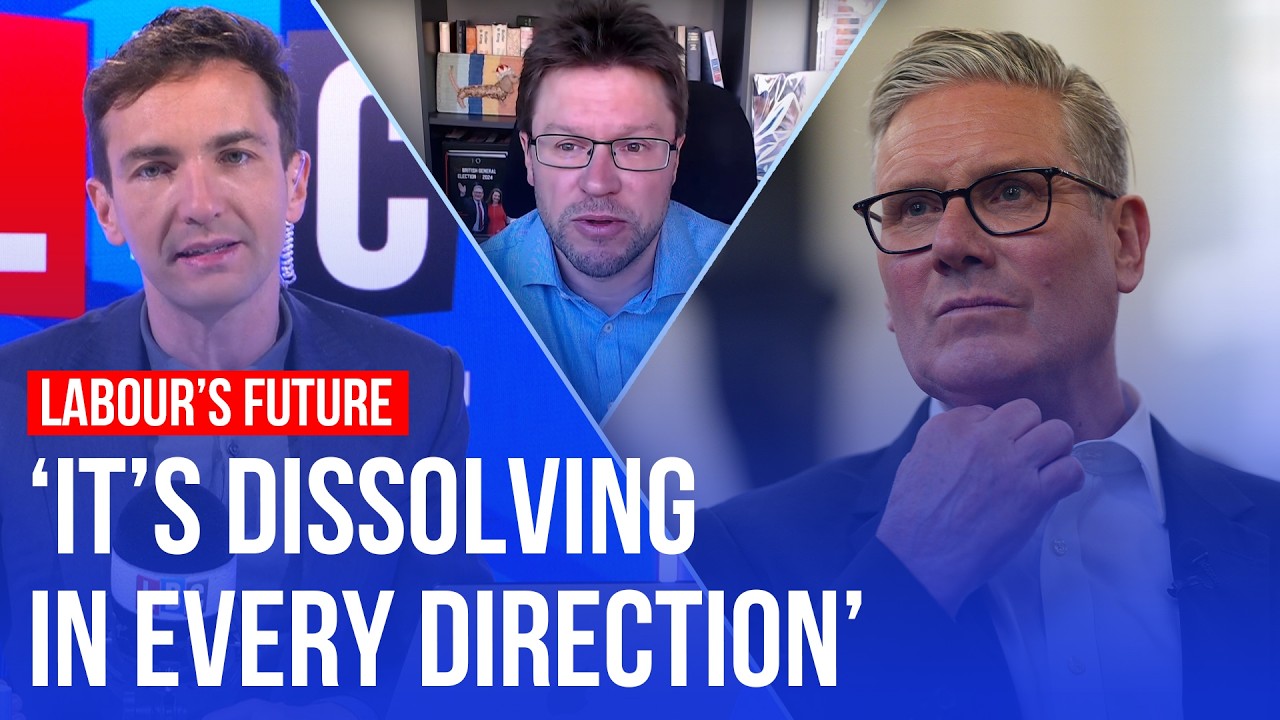
The local elections have left London with a dramatically altered political map, with Labour having lost 459 councillors. The Green Party made huge gains in former Labour strongholds, while Reform UK also won its first London council. Lewis Goodall is joined by Professor Rob Ford, Professor of Political Science at the University of Manchester, to discuss. Listen to the full show on the all-new LBC App: https://app.af.lbc.co.uk/btnc/thenewlbcapp #lewisgoodall #keirstarmer #LBC #ukpolitics #labour #debate #politics #news LBC is the home of live debate around news and current affairs in the UK. Join in the conversation and listen at https://www.lbc.co.uk/ Sign up to LBC’s weekly newsletter here: https://l-bc.co/signup
Show More Show Less View Video Transcript
0:00
It is a weekend where the Labour Party, not for the first time, not least because it is something of a speciality for the Labour Party
0:08
is wrestling with its future and wondering what its future might be, whether it even has one
0:15
Because the word that we heard in the very studio in which I'm sitting here in Westminster
0:19
that was used, first put forward by John McDonnell, the former shadow chancellor under Jeremy Corbyn
0:25
which more and more Labour MPs under their breath are saying is extinction
0:31
They are worried that this Labour government, the Labour government elected in 2024
0:36
may be the last Labour government. And on the basis of the results that we saw on Thursday night
0:42
in which the Labour Party's coalition was not just fraying, but dissolving in every direction
0:48
whether it is the inner city of London, places where increasingly, places like Hackney and Waltham Forest and Southwark and Lambeth
0:57
the sorts of places where over the last 15 years, Labour has been hegemonic
1:01
In fact, hegemonic for half a century in some places, losing to the Greens
1:06
losing voters on which they have relied for so long. And then in the rest of the country
1:12
the so-called Red Wall, now painted in a shade of teal or turquoise
1:18
reform blue from the northwest, from Cheshire to Merseyside to Sunderland to Gateshead
1:26
all across that ribbon of the north of England, in every direction, councils that the Labour Party
1:32
has had for 20, 30, 40, 50 years, in many cases where councils which have only ever been Labour
1:40
since their creation now have reform councils. And not just reform councils, but in many cases
1:47
reform won every single seat in these places in which they were contesting
1:52
Labour MPs are looking at their fallen comrades in local government and wondering, increasingly aloud, that could be me next
2:01
And not just me, but our party potentially relegated to minor miscellaneous status
2:08
And the question on their lips, the question that they are animating themselves with
2:13
in a thousand thousand WhatsApp messages and Labour MP groups is, what can be done, what should be done, and who should and can lead us out of this mess
2:25
And is it really the Prime Minister, Keir Starmer? Because however unpalatable as it may be however unfair or otherwise that it may be all those Labour MPs if they are speaking honestly will say the same thing That the Prime Minister in many cases was toxic on the doorstep
2:42
The Prime Minister is saying that the country needs change. For many Labour MPs, the change they think might be most effective is a change at the very top
2:53
A push which seems to be gathering some momentum this morning. Before we get the very latest on a potential leadership change in Downing Street, let's turn to Professor Rob Ford
3:02
Professor of Political Science at the University of Manchester, of course, co-author of the general election of 2024
3:09
Rob, we spoke last week about how bad these results might be for the Labour Party. How bad were they
3:17
Well, they were pretty bad, Lewis. I mean, actually, strange as it may be to say, given how apocalyptic it all looks
3:24
Some of the statistical projections last week suggested it could be even worse than this
3:29
But that's pretty cold comfort for the very many Labour councillors who are currently out of work
3:37
What has happened here in England in particular is that Labour have fallen into the valley of electoral death
3:46
So they face two distinct challenges from reform and the Greens particularly
3:51
So the reform wave was an evenly spread teal tidal wave. The reform were up 15, 20, 25 points, more or less everywhere
4:01
And in particular, everywhere in England that voted for leave 10 years ago swung very hard to reform
4:08
The green gain was much more concentrated and it was laser concentrated in the places where Labour have hitherto been the strongest
4:16
Manchester, London, other big cities. That is the nightmare scenario for the Labour government that relies on a coalition with two wings
4:26
They cannot afford to lose places like Sunderland and Barnsley to reform
4:30
but they also cannot afford to lose places like Manchester and Hackney to the Greens
4:35
And right now they're in a situation where they are losing both
4:40
where their efforts to appeal to socially conservative reform voters have fallen flat
4:45
so they lose and leave England, but their efforts to appeal to socially conservative reform voters
4:50
have seemingly inflamed socially liberal voters, and therefore they are losing to the Greens in the big cities
4:56
That is, in many ways, a kind of worst-case scenario under First Past the Post
5:01
because the key thing with First Past the Post is to come first and right now Labour is struggling to come first almost anywhere We haven even mentioned which of course we ought to the extraordinary fact that all of the nations the devolved nations
5:14
are now all being led by nationalist governments. And of course, in Wales, a country which Labour has won
5:19
in literally every election for a century, they are now relegated to minor party status
5:24
I suppose the real worry, Rob, in a way, one way to look at it, couldn't you
5:29
particularly the results in Northern England and the Midlands, in a way what reform appear to be doing is reassembling and then adding to the Boris Johnson coalition of that period
5:40
It is almost as if you could argue what happened in 2024, and this was borne out in lots of the results in the constituencies of that time
5:48
It's almost as if that coalition went into abeyance or at the very least essentially acquiesced to Labour taking place
5:54
by the fact that many of those same voters, more socially conservative Brexit backing voters
5:58
they either didn't vote or their vote was split between the Conservatives and reform in some cases
6:04
some of it going to Labour. But now that group in those places appears to be coalescing behind
6:09
reform in the way that they did coalesce in 2019 to Boris Johnson. Well, yes, absolutely. I mean
6:17
one corrective, though, Lewis, is the Boris Johnson coalition was 40 percent. The reform
6:21
coalition on the projections from the BBC and Sky is more like 26, 27 this year. But yet 26
6:28
27% projected across the country in a fragmented field is enough to win half or more of the seats
6:35
There were lots of councils this week where reform got maybe a third of the vote
6:39
and they've got half of the seats, two thirds of the seats, three quarters of the seats
6:43
This is first past the post turning from sandbag to springboard. This is the party system change scenario
6:50
Party system change for Labour, but also party system change for the Conservatives
6:54
As you mentioned, a lot of these places were Johnson Tory places in 2019, the famous Red Wall
6:59
Games. They are all now teal and they don't look like they're coming back because it's a very
7:03
solid reform vote. But the other half of that Johnson coalition, the
7:07
south-east of England, the poor relations of our five-party politics, the Liberal Democrats
7:12
even though their vote share went backwards this week, they gained hundreds
7:15
of seats. They took control of both new authorities in Surrey. I grew up in Surrey. Surrey has
7:21
for good reasons, quite a strong stereotype of being Tory-highline territory. Both of those Surrey councils are now Lib Dem super majorities
7:29
We are as you mentioned in your introduction in a scenario where it quite possible to imagine the next general election being one where the Conservatives and Labour don come first and second Maybe don even come third but they battling it out for fourth and fifth We should just mention talk briefly about you already mentioned Lib Dems
7:47
Is there any, any party right now, if we take the actual sweep of the parties at the moment
7:52
Rob, is there any party right now that can genuinely claim substantial political strength
7:59
rather than, as you say, simply being the top of a pretty kind of weak series of contenders
8:07
Or is it the case, and if that is the case, if none of them actually, even if reform support is a sort of mile wide and inch deep
8:13
does that mean therefore, in a sense, it is recoverable for any of the players, including Labour
8:19
Yes, I think so. I mean, lost amidst all of the sort of turmoil and chaos of these results
8:25
huge number of seats up. And of course, most of these seats reform didn't have candidates four years ago, five years ago when they were last up
8:32
So the gains look really staggering. But step back from that and look at the projected vote shares
8:36
And what you see is that reform are down somewhat on last year. They're down from just over 30 percent to probably about 27, 26 percent
8:44
And that fall is really very critical when we think about a Westminster general election
8:50
because once you're in the low 30s in a fragmented field, you can win a majority
8:54
That is indeed how Labour won its majority on 34% in 2024
8:58
If you're down in the mid-20s, it's a much dicier scenario. It's the zone where things really move very fast
9:07
Every percentage point you gain or lose is going to be lots of seats gained or lost if the map remains the same
9:13
So reform are no longer in a position where they can say they're definitely on some sort of a glide path to government
9:18
They're in that kind of zone of uncertainty now. They will need to expand the coalition they showed this week if they want to have a majority
9:26
But that's also sucker for all the other parties, because even in an election where all the votes at ward level were very fragmented, reform weren't dominant enough to necessarily win
9:35
And we can't assume that voters will be as fragmented next time because they will learn from these results, Lewis
9:43
if you're in a ward where reform of one of 32 percent and greens and labor got 25 percent each
9:49
you're going to say to yourself well half of us around here did not vote for that guy who's now
9:52
our counselor we need to coordinate next time so we don't end up with a reform mp2 and we've seen
9:58
that in by-elections already so the the point we are at now is not necessarily the point we will be
10:04
in a year or in three years even if the polling were not to change and of course it would be a
10:09
heroic assumption to say that the polling won't change given how much it's been moving in recent years
#news