Up next in 10



When speaking to Tom Swarbrick, Secretary of State for Work and Pensions Pat McFadden admitted that the current UK benefits system is 'flawed'.
Labour have stated that there will be 'no option for a life on benefits' under their rule, and that they will require the 851,000 people not in employment, education, or training (NEETs) to attempt to find work or face losing their payments.
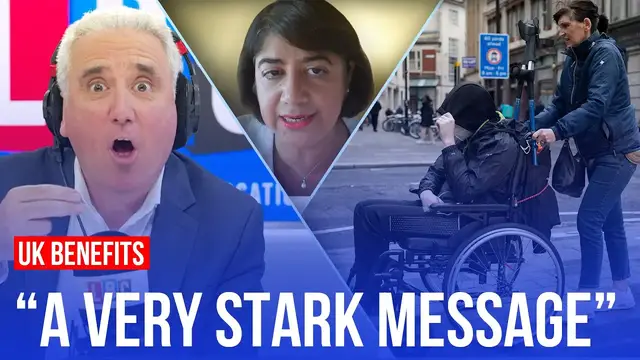
Simon Marks interrogates this idea alongside Labour MP for Feltham and Heston Seema Malhotra and 28-year-old PIP claimant Gigi El-Halaby.
How much compulsion to seek work should society require? Where would you draw the line?
Listen to the full show on the all-new LBC App: https://app.af.lbc.co.uk/btnc/thenewlbcapp
#TypeInPresenterName #TypeInTopic #LBC
LBC is the home of live debate around news and current affairs in the UK.
Join in the conversation and listen at https://www.lbc.co.uk/
Sign up to LBC's weekly newsletter here: https://l-bc.co/signup
Show More Show Less View Video Transcript
0:00
The number of NEATs, people aged 16 to 24, who are neither in education, employment nor training
0:07
has fallen below one million. Although there are still 981,000 of them out there
0:12
the fall in numbers will be welcome news for the Prime Minister on a day when the government was
0:18
promoting its jobs guarantee scheme, which it says is beginning to bear fruit. The government
0:24
is fully funding up to 25 hours of paid work for six months to get young people into work
0:31
and it's being rolled out in areas with some of the highest levels of youth unemployment
0:36
We've actually started to invite people to come forward and it's remarkable tens of thousands of
0:43
people have. That's Work and Pension Secretary Pat McFadden talking to Tom this morning here on LBC
0:48
And I can't stress the importance of the difference this makes to young people's lives
0:56
Some of the young people I met yesterday had only been in work for a matter of weeks
1:01
And already you had, for example, a young man telling me I'm going to use my first salary to start having driving lessons
1:07
Because if I get a driving license, it will improve my chances of getting more work in the future
1:14
And story after story like that. And it's a great difference that policy can make
1:18
So that is all good news. But Mr McFadden says he believes the universal credit system is too black and white in dividing people up between those who are deemed fit and unfit for work
1:31
And he indicated today that he thinks there should be more pressure put on some benefits claimants, particularly those with autism, ADHD and neurodiverse issues, to show willing to try and find work in order to continue receiving full benefits
1:48
but try as Tom Swarbrick did. He never found out exactly where Mr McFadden might want to draw the line
1:56
If you don't engage with a work programme by what point you'll lose your benefits
2:01
No, that's not what I'm saying. Right, so what are we saying? That's what you're saying. Are you going to compel them
2:05
Well, look, I want to not sign them off and write them off
2:10
I don't believe you'd have exactly the same conditionality system for those signed off sick and those who are standard unemployed
2:18
But I don't believe we should just forget about them either. This is not an easy issue
2:23
How do you want the government to handle it? They want to reduce the number of people claiming universal credit and PIP
2:29
They have to reduce the number of people claiming benefits if they are going to succeed
2:34
both in creating a path to work and simultaneously reducing public expenditure on benefits
2:41
But where do you want them to draw the line? How much compulsion to seek work
2:47
should society require from benefits claimants, especially those with health conditions that are themselves not always black and white
2:57
and may leave some people able to work a bit, but not necessarily full-time
3:03
If you're on Universal Credit, are you ready to step right up
3:06
and accept Mr Fadden's challenge to come forward for the jobs guarantee scheme
3:11
Maybe you're already trying it and can tell us about the experience
3:15
or maybe you'd like to tell us why you do not feel that you can accept the government's invitation
3:22
To begin our conversation this afternoon, I'm joined by Seema Malhotra, the Labour MP for Feltham and Heston
3:29
Seema Malhotra, thank you so much for being on the programme today. Where do you want the government to go with this
3:35
We all know that the benefits bill has got to be reduced
3:40
Pat McFadden makes no bones about that whatsoever. but the devil is going to be in the detail here how much compulsion do you think there should be
3:49
on people receiving universal credit to accept the jobs guarantee scheme or otherwise to demonstrate a willingness to find work if they want to carry on receiving full benefits Good afternoon Good afternoon and look thank you very much for the debate that you
4:06
initiating today. I think it is extremely welcome to have seen the announcement and the conversation
4:12
that's been started because one important aspect of what we're doing is to have a way in which as
4:21
part of a package of measures to once again support people having much more access to the
4:27
world of work is creating a lot more hope and optimism. You are right to highlight the issues
4:34
of ill health that have been a contributing factor to unemployment and particularly youth
4:40
unemployment and that was a very stark message from the Alan Milburn review that was done
4:46
and with that work in progress. And what it highlights, which is why this work is also sponsored
4:52
by the Department for Health, working with the Department for Work and Pensions
4:57
and the Department for Education, is recognising that you've got to have a way
5:00
in which you're dealing with ill health as a barrier to work too
5:05
What I see in my own constituency is young people, for example
5:09
with autism who have said to me that they want to have a job
5:13
But what's been difficult is to get access to work. I think we are absolutely in the space when we look at the structural changes that we have seen in the labour market and also in government policy
5:27
where apprenticeship starts have dropped by over 30 percent in nine years, that the work we're doing to turn that around is still in the right place
5:37
and I think that the debate about whether you need to have more compulsion
5:41
and it's got to be evidence-based and I do believe to make this point
5:46
that for many young people what I see is aspiration what this what having the the closing the gap between education and the world of work
5:55
which this is an announcement is an important announcement is part of what creates an alternative to being on benefits
6:01
and that's what we've got to focus on. I mean I take your point that the decision's got to be evidence-based
6:06
But if you listen to what Pat McFadden's been saying over the last 48 hours, this notion that universal credit was created with a setup that he believes is too black and white, the division between fit or unfit for work, certainly suggests that he's wandering down the road of considering some sort of compulsion
6:29
where i do think he is um moving is to recognize that there will be those for whom the long-term
6:39
health conditions they have and they're uh pretty much um a large kind of long-term inability to work
6:47
shouldn't be putting people through the really stressful periods of having to reapply
6:53
for benefits when actually your health conditions and your medical notes will confirm that your
7:01
conditions are unlikely to change for those and i would also put some of um uh the the levels of
7:08
anxiety and ill health that we have seen mental health being a real um concern obviously as you'll
7:15
know and your listeners will know is that you don't have a way in which that is a black and
7:22
white issue you can improve on on conditions with the right support and what we are learning from
7:29
evidence is that where you integrate health care along with the support to get into work you can
7:35
actually see people as I've seen my own constituency actually having that pathway which for them and
7:42
could be part-time work, it could be different opportunities to work in jobs that allow them
7:51
to have some flexibility based on their health conditions That actually moves us into a space where employers need to think differently too about how do we employ people that may have health conditions too That is where we get significantly more people off benefits and into work too
8:10
I get that you see people in your constituency of Feltham and Heston who want to get back into work
8:15
but do you also see people who don't want to get back into work and are comfortable
8:21
not that comfortable is the wrong word, are accepting of a situation in which they are receiving benefits without having to prove that they are engaged in efforts to find work as Pat McFadden appears to be contemplating
8:39
I think there will be people who will also be, for whatever reason, and it can well be, as I have heard as well, that people have lost hope
8:54
They have lost hope that there is going to be an opportunity for them. And I come back to somebody, a young person who did have, has had mental health conditions, who has said there's nothing for me
9:04
and and what i would say is that the the way in which we're working now in government thinking
9:10
about this as a cross-government effort looking at how the announcement we've made today with the
9:15
the jobs guarantee having employers coming around the table so we're working together
9:20
seeing new opportunities created and remember that the announcement today isn't just about
9:26
getting in getting into work and and having six months of employment it's the pre-employment work
9:31
that's going on into that. It's the tailored support. It's the mentoring
9:36
It's the support to get an income and learn how to live a life
9:40
in which you have a routine that is in work. And when you hear the stories of young people
9:45
as I know the Secretary of State also recounted today, you hear that lived experience
9:50
that is saying as the system changes, because that's also a very important starting point
9:55
Where are the failures? Where have they been in the system? Also very importantly highlighted
10:00
by the Alan Milburn work, which shows vacancies having dropped to entry-level jobs. What we're
10:06
seeing now is a shift that's got to say, we're giving you the fairest of chances, the best of
10:11
chances and the support around that. Now let's see how that can support people into work and what we
10:18
can learn from the programmes we've got, not just the jobs guarantee programme, but also the youth
10:24
jobs grant that will be an incentive to employers and as an example the announcement from
10:31
Sainsbury's yesterday which is about transforming work experience. Work experience is also a
10:38
stepping stone to work and what you will know I'm sure is that work experience that was once
10:43
compulsory was cut under the David Cameron government and in that first year there was
10:49
60,000 fewer work experience placements across the country. So actually pulling back from what we
10:55
almost the brink of seeing young people having opportunity pulled out from under their feet
11:00
We now have to have as a serious mission for our country, how we are supporting young people firstly
11:05
to have experience of work through work experiences. Secondly, to have the opportunities
11:11
to build the skills that will be right for their workplace, for the workplaces. And thirdly, to
11:16
have that access to opportunities in the workplace, which this work now with government and employers
11:22
in partnership is creating the opportunities to see that happen. Seema Malhotra, I'm very grateful
11:28
to you for joining us on the programme today. Labour MP for Feltham and Heston. We're also
11:33
joined on the programme this afternoon by Gigi Elhalabi, a mental health campaigner and 28-year-old
11:39
Pip Klayment, who has been diagnosed with chronic fatigue syndrome, along with other
11:44
health issues alongside other health issues that have left her unable to work full time
11:49
and sometimes unable to work at all Gigi Elhalabi thank you for joining us on the programme How do you react to this conversation Where do you think it heading When you hear Seema Malhotra saying you know we giving people the best of chances to find work
12:07
I mean, Pat McFadden seems to be thinking about a situation in which
12:11
if people don't avail themselves of those chances, they might have to give up
12:18
some of their benefits. Good afternoon to you. Good afternoon. Thank you so much for having me
12:23
And look, I think we can all agreed that it's not a black and white issue. That is something we can all agree on. And there
12:29
are certain things that Seema said that I do agree on that ultimately, as a young person
12:33
a lot of us are losing hope to be able to find work. The workplace environment is ultimately
12:37
very difficult. The job market is very, very difficult. And I want to move away from the
12:41
question of compulsion. I think that's slightly the wrong question. And think about this in total
12:46
the job guarantee and a few issues I think have come up for me. And a really big one is that jobs
12:52
need to be meaningful. And it can't just be going into any work. I think work can be good for your mental health
12:57
and bad work can be really terrible for it. And we also know that we're in a cost of living crisis
13:03
So we need to think about, are the jobs with good conditions
13:07
How much are people being paid? Are they getting the skills they want and need rather than being pushed into work for the sake of work
13:12
Can I ask you, what is a meaningful job? The Prime Minister and Pat McFadden
13:17
they went to Sainsbury's yesterday. They went to a Boots. Is that a meaningful..
13:21
what's your definition of a meaningful job? Well, I think my definition of a meaningful job
13:26
will be very different from someone else's definition of a meaningful job. So I think what we need to do
13:31
is take a more tailored, individualised approach to this. So for some people, maybe it will be a meaningful job
13:36
to want to work in Sainsbury's or to work in Boots, and it will be an accessible job
13:40
For other people, it won't be meaningful and it won't be fulfilling. And we do know that if the work is not meaningful and fulfilling
13:46
then it won't be good for mental health and ultimately it can lead to much worse mental health
13:50
and that's something I've personally experienced. OK, but with respect, I can hear lots of listeners out there saying, I go to work every day
13:56
I don't find my job particularly meaningful. And I'm sure they're sorry about the fact that they don't find their job particularly meaningful
14:04
But they go to work, they earn a wage, they come home, they pay their bills, they pay their tax
14:10
I mean, unfortunately, it is not possible for a society to create only jobs that every employee finds to be meaningful
14:21
Sure. Okay. So I do agree with that. But if we're talking about getting people who are mentally unwell to a better place
14:27
ultimately finding meaning and purpose in their life is going to be a really important part
14:31
to get them out of that hole. And not only that, we need to think about the workplace environment
14:37
I have been in many workplace environments where it has not been accessible for me
14:40
Ultimately, for example, working in boots is not an accessible job for me. And for some people, it will be
14:46
And I think we need to think about the workplace environment as well. And I just want to say one more thing
14:49
time and time again mental well-being is conflated with the ability to be economically productive and
14:55
i do think this is slightly wrong and dangerous i think for me being well means being happy calm
14:59
having agency and choice and meaningful life doesn't always have to center around work and
15:04
as seema said for some people on long-term health issues ultimately going to work is not the goal
15:10
and for some people work is part of that for some people going to work is going to be a fulfilling
15:14
thing and for others it's more harmful so i do think people's well-being needs to be prioritized
15:18
not necessarily their ability to work. Otherwise, pushing people to work too early
15:23
will ultimately make the problem much worse. Their mental health will exacerbate
15:27
and they may end up getting sicker and having to leave the workplace again. And then we get into a cycle
15:31
And putting a greater burden on society. Gigi Elhalabi, thank you very much indeed
15:35
for joining us on the programme. Mental health campaigner and 28-year-old PIP recipient
15:40
I think people are going to wonder what the search for meaningful employment looks like
15:47
in each and every case. And I think many of you might want to argue that perhaps that isn't the
15:54
way in which you prioritise getting off benefits, but I'll leave it to you
news