Up next in 10


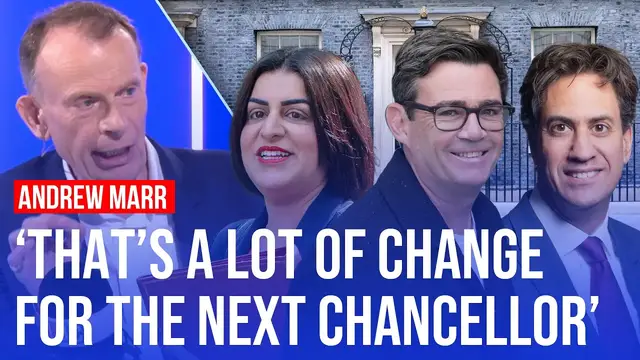
The incoming prime minister argued that the UK needs a ‘greater sense of fairness’. Andy Burnham has declined to rule out introducing a wealth tax and suggested the Government 'might be having to ask for a little more' at some point to balance Britain’s books. It comes as Shabana Mahmood is set to beat Ed Miliband in the race to become Burnham's chancellor. Andrew Marr is joined by former Downing Street Communications Director, Alastair Campbell, and Labour MP Liam Byrne to discuss what Burnham's first days as prime minister might look like. Listen to the full show on the all-new LBC App: https://app.af.lbc.co.uk/btnc/thenewlbcapp #andrewmarr #andyburnham #shabanamahmood #edmiliband #politics #ukpolitics #primeminister #labour #debate #downingstreet #uknews #LBC LBC is the home of live debate around news and current affairs in the UK. Join in the conversation and listen at https://www.lbc.co.uk/ Sign up to LBC’s weekly newsletter here: https://l-bc.co/signup
Show More Show Less View Video Transcript
0:00
Good evening. On a hot night and over a sweltering weekend, away from the cameras
0:06
the pressure is on Andy Burnham. To govern, they say, is to choose, and he now has to make
0:12
absolutely critical choices about the government he is going to lead. He said he wants to create
0:19
a balanced team, bringing in people from both wings of the Labour Party. But already, before
0:24
a single cabinet job has been announced, there is a growing hubbub of protest, particularly
0:30
from the left. Rumours that he wants to appoint Shabana Mahmood, the Home Secretary on the
0:36
right of the party, and a self-described fiscal hawk as his chancellor, rather than Ed Miliband
0:43
who's been close to him, are causing left-wingers to ask, what is really going to change
0:49
Behind the scenes, the mood is already getting very angry. Meanwhile, with migrants still
0:54
coming across the channel in boats in large numbers, and worries around the country about
0:59
street crime, who will get the nod to run the Home Office? One thing we do know about Andy
1:05
Burnham is that he's no expert in foreign affairs, and as Keir Starmer subtly reminded him today when
1:10
he laid a wreath for the fallen in Ukraine, that is another big part of the choices he must make
1:16
now. Who will be Foreign Secretary? Today, the Labour Party formally chooses its new leader
1:23
On Monday, we expect, first of all, Sir Keir to go to the King to resign
1:27
and then, a little later in the morning, Andy Burnham to follow to be made Prime Minister
1:33
After that, well, I assume a slew of announcements of the absolutely key jobs
1:39
a clearer sense of where we as a country are going, and, no doubt, small detonations of anger and disappointment from inside the Labour Party
1:48
Because, alongside the cliché about governing and choosing, There's another one about not being able to please all of the people all of the time
1:56
So let's talk first tonight with somebody who's had to negotiate transitions in the past and knows just how difficult it is
2:03
Alistair Campbell, co-host of The Rest is Politics podcast and, of course, former director of communications for Tony Blair
2:09
Alistair, you have sat through a lot of these moments when lots of people are waiting to see what the phone is going to tell them and they're getting angry and they're getting a bit overheated
2:18
It's particularly difficult this time, however, because there is an entire new cabinet to assemble in short order
2:24
And it's also been a very, very strange route to this. Normally, you might win a general election, as Keir Starmer did
2:30
You've got a shadow cabinet, most of whom then become the cabinet
2:36
Here, you've got somebody who until recently wasn't even in parliament, was mayor of Manchester, comes in
2:40
He's going to be the prime minister. And in a sense, he can work off a blank sheet of paper
2:44
And the problem with the blank sheet of paper approach, which is his right, is that to put new people on that he may be very fond of, may have worked with, may think will be better than what's there now
2:57
He's going to have to knock quite a lot off. Added to which, although I think they've done a pretty good job up to now of keeping things reasonably tight, the last few days, you've seen a little bit too much of the briefing, the soap opera, the up-down stuff
3:12
And that creates a lot of tension. And just in terms of the technically fiendishly difficult job of balancing you know men and women geographically etc but also left and right If for instance as they are saying at the moment everyone saying Shabhan and Mahmood from the
3:27
right of the party is promoted to Chancellor of the Exchequer, is that a danger in terms of the
3:32
soft left, you know, led in many ways by Ed Miliband, who might very well have expected that job
3:38
Well, he might have done. And there is a question of political balance always. And, you know, the
3:44
Prime Minister is first among equals, but you have to be conscious of the other political forces around you
3:50
both present and future, should you choose to eliminate some of the people that might be sort of seeking to cause you trouble
3:59
But I don't think that of itself should be, because don't forget, Andy Burnham is seen to some extent as soft left
4:05
So it may be that he's thinking, if it is Shabana Mahmood, he may be thinking
4:09
well, I can't, you know, have two soft left people, as it were, in the two most important jobs
4:14
I wonder whether he might ask Ed Miliband to take care of this Downing Street North, whether he might
4:21
Actually, one of the really big jobs that he'll be thinking about who to give to is the whole devolution agenda, because that's going to be a very, very big part
4:27
So whether that's Ed or Angela Rayner, I don't know. And there's also a foreign secretary
4:32
David Miliband's name has been attached to it, but it could be Ed Miliband. Yeah, I don't think the David Miliband thing was ever a runner
4:40
Well, I want to ask you about that because there's lots of people around. Ed Bores is another example who are out of politics
4:45
You think, ah, this is my moment and want to come back via the House of Lords
4:49
But that presumably creates a lot of bad feeling inside the parliamentary Labour Party
4:54
Well, I think people look at the way that David Cameron did it. And I think people feel that David Cameron came back as a former prime minister into the House of Lords as foreign secretary
5:03
And it felt kind of OK. but I think there's something a bit different about this
5:08
I'd be surprised if he goes down that road, he may do and don't forget as well
5:12
they've announced a whole new stack of fresh peers today so I think the idea of just stacking the House of Lords with more
5:20
just to sort of fill up a few cabinet spaces I'm not sure he'll go down that route
5:24
and in terms of again coming back to the problem of balance
5:28
he is seen by an awful lot of people outside the Labour Party
5:32
as a figure of the left How important is it, do you think, that he answers his critics outside politics, in business and so forth
5:39
Because on the other hand, you've got a lot of people on the left of the party already saying just on the basis of rumour and innuendo and gossip that he's selling out to the right
5:48
Well, what he says on Monday is going to be very, very important. He made that speech in Manchester and that was all kind of big picture and principles
5:54
That's all fine. and but very quickly he's going to have to have answers to very direct straight questions about
6:02
specific policy areas i've just an interview on the pm program where they they broke the news via
6:08
bloomberg of apparently announcements he's going to make about water and drilling in the north sea
6:15
now um let's just say and i've got no idea if that's true and i think we should all be very
6:20
very careful about all the because people just want to say they know. He has indicated that he'd go for oil and gas
6:25
He has. Now, that there may be, I think that would be a mistake on two levels. One I think
6:32
is don underestimate how many of the people that Andy Burnham hopes to want to bring back that Labour has lost they were lost to the Greens over Gaza So you need to think about how and he did a very interesting video about Gaza last week
6:49
And I think that was specifically about that. Now, if you then say, drill baby drill, because of pressure from some of the unions
6:57
because of the whole right-wing weaponisation of net zero, I think you'll be careful about that
7:03
If he was going that way, that risks sending Ed Miliband right out of the entire boat, I would have thought
7:10
Well, Ed is so closely identified with Zero. I don't know, but I think that Ed is clearly a big figure within the Labour Party
7:20
I don't think anybody... It would be interesting to see whether, in his putting his cabinet together, Andy does respond to pressure through the media
7:28
there's been pressure through the media I think from some of the people who keep saying
7:33
don't forget me, I've got a great legacy there's been pressure on the media
7:38
by the media right wing papers reliving all the redhead stuff and all the nonsense
7:43
I actually think Ed would be a good Chancellor but I can see where the policies might be difficult
7:47
He's certainly got the technical skills for it I want to come on to one of the big challenges
7:51
any Chancellor will have in just a second if you just stay there for a second Alison
7:54
we'll have a conversation about this because I want to talk about the next Chancellor
7:59
and we've mentioned a couple, but it could be Yvette Cooper, it could be Ed Balls, I've mentioned him as well, Douglas Alexander
8:04
There are lots of people who'd like the job, but whoever it is, there is going to be a big challenge over tax
8:09
Everybody at the moment is talking about a wealth tax. That's appeared in all the briefings around the place
8:14
and it's scaring some people and cheering other people. But Liam Byrne, former Treasury Minister, of course, yourself
8:20
you have made a real study of wealth taxes. I just wanted to start by asking, what do you think
8:25
which kind of wealth taxes could be introduced relatively quickly and with the least friction
8:32
Well, the fastest thing that you can do is to try and equalise capital gains tax and income tax
8:37
So if you think about the unfairness that we've got in the tax system today, it's lit up by Rishi Sunak's tax return
8:45
So like all prime ministers, Rishi Sunak published his tax return. The last one he published showed about two million in income and a tax rate of 23 percent
8:54
Now, most people listening to this will think, well, hang on, my tax rate is an awful lot higher than that and I'm not on two million a year
9:00
And of course, the reason for that is that Mr. Sunat got a lot of his gains from capital gains
9:06
So you can definitely put capital gains up a bit. Most people would say don't fully equalize it because you get a capital flight
9:13
You can also introduce national insurance contributions on investment income. That is another way to do it
9:20
And then, you know, the big idea that has been knocking around is a 2% net wealth tax on the 22,000 fortunes, which are worth over 10 million
9:28
That is a good as a one off idea. It's actually quite complicated to put in practice
9:33
And you would need to put in place some exit taxes. I was going to say, these people are quite mobile
9:38
So for people seeking to, you know, leave the country, you'd need to make sure that they paid their bill before they left the restaurant, so to speak
9:44
One thing Andy Burnham has mentioned, I think when he was sitting in the chair, Alistair is now in a couple of weeks ago, is the idea of a land tax
9:53
Yeah. Well, I mean, land tax is in principle a much better idea than council tax at the moment
9:58
So you going to pay more council tax in Blackpool than you are in Mayfair right now because of the inequities of the council tax system And actually if you equalise land taxes in the way that has been proposed
10:11
you could do some really virtuous things like get rid of stamp duty, for example
10:16
And again, you know, you can't we have this debate about what are the taxes that you should raise
10:21
But too often we miss what would you then spend that money on? And I think Andy Burnham has got a couple of priorities for just re-changing the way that we tax in this country
10:32
So his first priority has got to bring down energy costs. People need a break on the cost of living
10:36
By the way, if he does that, you give the Bank of England a lot more room to lower interest rates because you're bringing down core inflation
10:43
But the second big thing that you've got to do is you've got to lower energy bills for businesses and lower business rates for businesses on the high street
10:52
unless we've got a big package to help with the cost of living and for small business
10:57
then you're not going to get the kind of animal spirits needed to get the economy moving
11:01
That is a lot of change on the desk of whoever is the next chancellor very, very quickly
11:06
And Ishwana Mahmood is being portrayed as this very right-wing figure. She called herself a fiscal hawk, actually
11:13
But she's also been in favour of raising the top rate of income tax to 50p. She's also been in favour in the past of wealth taxes
11:18
So she is not necessarily such a right wing choice. Well, I'm biased. I mean, Shibana's my neighbour in Birmingham
11:24
She's one of my oldest friends. Her dad was chair of my party for a long time. Didn't know that. I think she's got very good instincts
11:30
You know, her dad was in retail for many years when Shibana was growing up
11:36
And she understands what the challenges of serving in a city constituency are like
11:42
The key thing I think you've got to remember about what a fiscal hawk means today is you're not going to make unfunded tax promises
11:47
And, you know, we do need to lower some people's taxes, like business rates, like energy bills
11:53
That money's got to come from somewhere. So actually those who have done spectacularly well over the last 10 to 15 years can probably afford a little bit more
12:00
In Andy Burnham's phrase, a little bit more. But this is politically very dangerous stuff, isn't it, Alistair
12:04
Any kind of tax raise, there's always a big lobby immediately against it
12:09
Yeah, there is. But he's going to have a period where he can, I think he can do some quite difficult things
12:17
He's going to come in with a lot of goodwill in the Labour Party
12:22
And would your advice be to do it quickly? If he's going to make big changes that are going over time to be unpopular
12:28
make a case for them and do them. I think the wealth tax stuff is interesting
12:31
We had Gabriel Zuckman on the podcast last week, the French guy after whom the Zuckman Taxes is named
12:38
And the kind of top end of wealth taxery is, I think
12:43
probably would scare the horses quite a lot. But I think the sort of thing that Liam's talking about, I think some of that will be on the agenda
12:51
Because the other thing that Andy has made his name on, really two things to my mind, one is three things
12:57
One is his kind of style. Two is devolution. And the third is kind of a real sense of trying to address inequality
13:04
Now, that's what he's got to build everything around. We will have to stop it there. But I'm very interested in the thought that inequality also means inequality in business
13:12
In other words, he's in favour of lifting taxes on small businesses, particularly high street businesses, by taxing the Amazons and the big warehouses
13:20
It's going to be a very, very interesting time ahead. Liam, Alistair, thank you both very much indeed for that
#news