Up next in 10

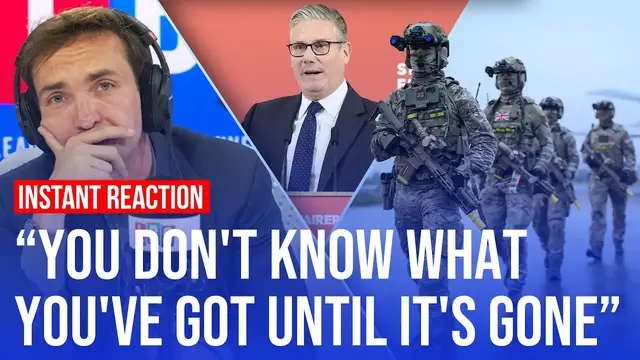
Russia, Ukraine, and the Middle East: Keir Starmer announces £15 billion for defence
Jul 1, 2026


Lewis Goodall and his callers react as Keir Starmer announces an extra £15 billion for defence. 0:00 | Lewis reacts to Starmer's (final) speech 2:23 | LBC listeners analyse Sir Keir's announcement 4:31 | Keir Starmer has failed to 'provide hope', says Roland 9:00 | War expert delivers his verdict 17:47 | Are Londoners are scared of having a working class PM? Sir Keir Starmer has said the amount of money in the defence investment plan is “the right choice for the country”, but warned it would mean some road and energy projects will be scrapped. Listen to the full show on the all-new LBC App: https://app.af.lbc.co.uk/btnc/thenewlbcapp #lewisgoodall #defence #starmer #ukpolitics #ukraine #russia #europe #nato #LBC LBC is the home of live debate around news and current affairs in the UK. Join in the conversation and listen at https://www.lbc.co.uk/ Sign up to LBC’s weekly newsletter here: https://l-bc.co/signup
Show More Show Less View Video Transcript
0:00
Keir Starmer making one of the most important announcements of his now numbered, in terms of days, Premiership
0:08
Announcing the long-awaited defence investment plan, as I said at the start, an almost valedictory feel from the Prime Minister
0:15
Again, trying to make his own judgement and own assessment on his own Premiership
0:20
and trying to bend, I think, the verdict of history ever so slightly in his direction
0:25
saying that he's made the tough choices that were needed to defend the country for the future
0:31
which, of course, is at variance with the verdict of his own Defence Secretary
0:34
or former Defence Secretary, John Healey. He's announced that the army will be 10 times, he says, more lethal
0:41
that the Defence Investment Plan will create 60,000 jobs, that £80 billion a year will be spent on defence by 2029
0:50
and, of course, we'll also have, he said, £64 billion separately on a nuclear deterrent
0:55
He said, strikingly, that he believes part of his legacy, or part of this effort
1:01
is about creating a more European NATO. Not at variance with the US, not excluding the US
1:08
but striking nonetheless to hear the Prime Minister, perhaps a bit freer than he might have been only a week or so ago
1:16
talking about the need to strengthen and deepen a more strategic European defence capability
1:23
a European NATO, talking about that in explicit terms. He said... I've also been clear since day one that we do this not because we want war
1:36
but because we want to avoid war. We lived through Iraq. We learned from those mistakes
1:45
And we don't want to repeat them. I showed that when I chose not to join the war in Iran
1:51
We want our people to be able to live in a world defined by peace, stability and the rule of law
2:02
But the paradox of peace is that when the world is arming and aggression is rising, the best way to avoid war is to prepare for it
2:13
Is your assessment that what the Prime Minister just outlined there is adequate for that effort
2:18
is the Prime Minister leaving Britain in a safer place and safer position than he found it
2:23
A couple of your texts here. Sue says, I'm going to miss Keir Starmer because I feel we had a truly clever man in charge
2:28
who comes from a normal background, so understands normal people. Sadly, normal people are fickle
2:33
and voters need likeable in their faces. I think people vote on mood, not knowledge of the people
2:39
They're imploring to work for them. I'm sorry we've lost him. It's the fault of the electorate we've made
2:43
The political landscape is fraught with rabbit holes. We're living in a post-truth era. You don't know what you've got till it's gone
2:48
Well, I will agree with one thing there, Sue, is that such is the fickle, capricious nature
2:52
of our politics and media culture that it will be no longer that he's departed
2:56
and shuffled off the political stage that the revisionism and the pay-offs for Keir Starmer
3:03
will start to be heard and people will say, oh, you know, he was all right, wasn't he
3:06
Let's bring him back because people are just so utterly fickle and the revisionism will start quickly
3:12
Beck says, Lewis, I don't disagree with you at all on the importance of being able to politic effectively
3:16
but arguably the most gifted in those terms in recent years was Boris Johnson
3:20
Look how that turned out. We need someone somehow to force a conversation
3:25
on why we as a nation focus more on the rapper than on the content. That's a good way of putting it, Bex
3:30
Joe, I think it's about both, personally, but anyway. Joe says Angela Rayner has been treated like dirt by NSM for exactly the same reason
3:36
Spot on, Joe. That's spot on. Look at the way Angela Rayner has been treated over the years. The snobbery
3:41
She goes to opera? Oh, she thinks she's working class. She goes to the opera. We saw it with Bridget Philipson this week as well
3:46
We saw it with Bridget Philipson. That's a good example. I hadn't thought about that. So you just prompted some little synapse to go off in my brain
3:52
Yes, Bridget Philipson, Daily Mail, accusing her of being some sort of class traitor or something
3:58
because what? Because her mum sold her council house for £99,000, a proprietor of that newspaper
4:03
Honestly, like, we barely get out of bed for £99,000 and having a go at a working-class family for selling their house
4:08
under right to buy for £99,000. Something that Labour governments ever since
4:12
right to buy the way, by the way, have continued to allow to happen. So this idea that somehow
4:17
you're a hypocrite, because you had a council house and you sold it just because you were
4:21
working class. My mom and dad, I grew up in a council house, they bought it under right to buy
4:25
Guess what? I believe in council houses. Those two things are not mutually exclusive
4:29
There's snobbery in the media, honestly. Let's talk to Roland, who is in Chelsea. Roland
4:34
what did you think about the Prime Minister's speech, perhaps his last speech? Well, I think that the word hope is a very, very important word. And I think
4:41
Starmer's an intelligent man, but he's missed that fact. If you go back to Churchill, he gave us hope in a terrible time
4:51
Attlee gave us hope at the end of the Second World War
4:55
Thatcher gave us hope when she basically reconfigured the country. Blair gave us hope
5:03
The Queen gave us hope in COVID. We'll meet again. You know, hope is very important
5:08
Even Johnson gave hope, although he then self imploded. But the point is that this country performs best in all aspects when there is hope Hope that I can build a business
5:24
Hope that my kids can get a house. So hope is important
5:30
Seriousness is important, but it has to be coupled together. And you think the Prime Minister, Keir Starmer, was unable to provide that
5:39
Yes, I do, because I think the first thing he should have done when he won that big majority was get all 400 MPs in the Queen Elizabeth Centre and said to them, look, this is what we're going to do
5:52
This is our agenda. But he got pushed around. I mean, they always thought Boris Johnson was a shopping trolley because he got pushed around
5:59
But I'm afraid to say Keir was a bit of a shopping trolley as well
6:03
And I'm surprised, really, because he's an intelligent man. But he didn't pick up what makes and inspires British people
6:12
And hope is part of it. And you think Burnham can? I don't know
6:17
I mean, he's mentioned hope, which is a tick in the right box. The question is, can he give hope to all those areas I just described
6:26
I mean, to be fair, Roland, I can't remember which year it was
6:31
because they rather sort of bleed into one. but I think I heard Keir Starmer, I think I was at every conference speech that he ever gave
6:38
And I remember one year, I think the entire theme of the speech was hope
6:42
I think he talked about ordinary hope and the power of ordinary hope, not grandiloquent hope, not the sort of hope that was unrealistic
6:49
but sort of ordinary acts of hope that politics could provide. But clearly that argument didn't sustain or certainly didn't sink in
6:57
Well, it was in his speech, maybe, I don't know. But the point is, you know, the British people are very sensible people
7:04
And if you come over as authentic, then people can believe you and believe what you're saying
7:12
You know, if it's written in a speech and he spits it out, we can understand very quickly whether that is in that man's heart or whether it's just he thinks the right thing to say
7:26
All right. Roland, grateful to you. We've got a text here from Christine in Lincolnshire
7:30
Lewis, you've won what you wanted. Keir Starmer out, so why do you need to continue to put the boot in
7:36
I thought you were better than this. But then almost all the podcasts and social media
7:40
have had a hand in bringing down Keir Starmer. Shame on you. Christine, I'm sorry, you are deluded about this
7:44
Honestly, I get this all the time on social media. It's absurd. I've always been the first to say that the media has given Starmer
7:51
in the main, a tough time. Although, to be fair, before he became Prime Minister
7:55
he had a pretty easy time, actually. Very little scrutiny, really. Everyone knew he was going to be prime minister
8:00
so he was treated to some extent with kid gloves, not least because, I mean, you know, compare how Jeremy Corbyn was treated by comparison, for example
8:07
But this idea, look, the prime minister is not the result of the media
8:12
alone at the very least, that the prime minister's own colleagues decided he wasn't good enough to do the job
8:18
And that's not to say that he doesn't have merits and that he hasn't done good things as prime minister
8:24
He has, and I would broadly agree with him that he's left the country in a better state than he found it in
8:29
But the point is, is that it could have been far better still if he had had more political skills
8:34
which he was able to exercise and use and capitalise on that extraordinary majority
8:40
that he achieved and that he was given. And unfortunately, for whatever reason
8:45
he wasn't able to do that. And simply blaming the media about that
8:49
even though I'm sure there is an element of truth to that, but exclusively saying that, I think, honestly, it's a delusional take
8:55
and it's one that might be comforting It might be comforting, but it just isn't true
9:00
Let's get the assessment now. Professor Anthony King, Professor of War Studies at the University of Exeter
9:04
as opposed to the old Professor Anthony King, who's a sophologist, of course, at the University of Essex
9:09
someone with whom I'm sure he gets confused all the time. Professor King, thanks so much for joining us this morning
9:14
What was your assessment of the plan? Is it adequate? In short, I don't think, unfortunately, it is
9:20
I mean, there is a £4 billion increase from when the previous Defence Minister, Sean Healy, resigned
9:27
two weeks ago um but that is only 1.4 billion each year which is obviously objectively a lot
9:33
of money but relatively in terms of the hole in defense that's been there for years and decades
9:38
and going forward with the new um equipment weaponry model uh going forward uh i i don't
9:47
think it's enough and almost all the commentaries have stated that including uh general richard
9:53
Barron's who wrote the Strategic Defence Review last year. So it's better than nothing for sure
9:59
And it's really important that it's been published and it's been articulated. But I think it falls a
10:05
long way short of what the UK needs and indeed what NATO allies, despite what Mark Rouser said
10:10
will be looking for from the UK. What do you think will be missed or we will not be able to do that
10:18
we really ought to be able to do as a result of the plan being less than what you think it ought
10:22
to be? Well, the point is that there's holes, there's existing legacy holes within the
10:28
equipment and inventory of each of the forces Very bad gaps in terms of weaponry in terms of communication systems in terms of logistical infrastructure stockpiles munitions All of these things have vast holes in
10:46
them. So even making up to get to a force that's capable of sustaining itself on a modern
10:51
21st century battlefield of high intensity, that's going to take billions to get there
10:56
And then on top of that, we obviously don't want to, the UK and neither does NATO
11:01
So we don't want to fight a 20th century war. We want to fight a war of the 21st century, which involves the famously stated digital targeting web
11:11
so a digital system of identifying targets and planning and supported human combatants, human soldiers, air personnel, sailors supported by remote systems
11:24
I mean, the autonomous system thing is a slight cannot, frankly, but remote systems
11:28
And that is a massive reinvestment, rearmament of covering the old holes and simultaneously generating a force structure that really is quite different than the UK and other nations have had
11:44
And, you know, the other net, Poland, Germany has gone for 5 percent by 2030 and neither of these are nuclear powers
11:52
And they might get close to what they need. So the UK, it is a lot of money, but objectively, in terms of what is required, in terms of shortfall, I think it's, I mean, I'm not disappointed in the sense that I wasn't expecting this, but I think most people, most commentators are disappointed by where the UK has landed
12:18
What would you say, those professors of the argument that, look, no one would doubt that our principal adversary appears to be Russia, and no one would doubt that Vladimir Putin is a very, very dangerous man and has, would in his ideal world, I'm sure, have designs to try and recreate, you know, at least the territorial extent of the Soviet Union, etc, etc. And that is dangerous. But how dangerous is he? Is he rather more toothless than he might appear, at least at the moment, in the sense that, you know, the Ukraine war has now been going on for longer than the First World War
12:48
he still cannot subjugate it in the way that he imagined he would at the start of the war
12:53
it now seems that ukraine is gaining at least to some extent something of an upper hand at least in
12:58
this stage it could reverse again and so on but is it very likely that after expending all of those
13:03
men and all of that money and all of that material that vladimir putin decides to open another front
13:08
against a nato state i mean this is the critical question and this is the one to focus on absolutely
13:14
So absolutely, Putin has effectively received a terrible defeat, a strategic defeat, I'd say
13:24
He might end up with some kind of political settlement down there. It looks like a peace will come probably next year
13:32
It's not going to be a satisfactory peace, but a sort of unsatisfactory peace. So the scenario is this, that the war ends in Ukraine in 2027
13:39
The current projections for the reconstitution of Russian forces are that period 2028. By 2028, 2029, he would be in an effective position to make some kind of intervention
13:53
That intervention doesn't have to be a massive land intervention. It's much more likely to be operations against fibre optic cables under the sea in the high north, etc
14:05
The other situation here is to remember is that it's I agree with you. It is unlikely in the next two, three, four years that there will be a secondary invasion of the type that happened in Ukraine in the Baltics
14:18
I think that's unlikely scenario. But here is a scenario that's much more likely that there is a conflict emerged in the Pacific or tensions increased in the Pacific
14:29
The US is distracted, has to withdraw massive support from Europe. We know with the Trump administration that is already happening
14:38
So US gets committed to the Pacific region much more strongly. Europe must have a collective defence plan
14:47
As an important, a medium-sized global power, but a major European power
14:52
it would be extraordinary and negligent of the UK not to be part of a NATO EU European, well
15:02
not EU, but European pillar within NATO. And that is what the SDR last year was articulating. And I
15:10
think it was one of the strongest passages in the SDR of the NATO first. That is the scenario. Now
15:17
the answer to you, one could say is, well, it's a risk we're going to take. Yes, it is a risk we
15:22
could take of not investing in defence. But it's also a risk that we can see the outfall of in the
15:27
case of Ukraine, where they were not able of deterring Russia. And the result is something
15:34
between 80 and 100,000 of their young people and older people have been killed on the front
15:38
and they've had tens of thousands of civilians killed and wounded. So deterrence against that
15:44
future scenario seems to me absolutely imperative in the light of geopolitical shifts both within the alliance and out with the alliance in terms of our adversaries and enemies And briefly just finally Professor what do you think that there will be much concern within the Ministry of Defence that when the Prime Minister was asked he could not give an assurance that his almost
16:06
certain successor, Andy Burnham, A, would adhere to the plan and stipulate it. He just said, well
16:11
I'm sure it's something he can build on and clearly wasn't able to say that Burnham had
16:14
been involved. Therefore, at the moment, we don't know that the incoming Prime Minister actually thinks that this plan is adequate? Oh, well, absolutely. I mean, even if Keir Starmer
16:24
was stayed as prime minister, we all know the gap between the statement of policy and its
16:30
implementation is always a massive gap. So, totally agreed. I think it's a great observation
16:35
I think it's not secure that even this restricted, denuded defence investment plan will be enacted
16:44
in the format that it's been said. I think it probably will
16:48
but I think there's events, dear boy. I think it's not at all certain
16:55
we will even get this level of investment. I hope that happens, but there needs to be a public debate
17:00
about the level of defence and the seriousness with which not just government and the MOD
17:06
citizens want to take their defence and security. Professor Anthony King there
17:11
Professor of War Studies at the University of Exeter, giving us his assessment. of the defence investment plan, which, well, he thinks is not adequate for the scale of the security threats
17:21
that we are likely to face. And as I've been saying as well, on a political level
17:25
potential real problem during this interregnum period, that the Prime Minister, of course
17:30
cannot guarantee he cannot bind his successor. And it is not clear from that Q&A that he did
17:36
with journalists after the speech, that his almost certain successor has accepted the plan
17:42
and will adhere to it. So we are in strange days, as ever, in British politics
17:47
I was born in Liverpool, and I spent most of my life in London since the age of two
17:56
And what I see here in London is that we're living in the most privileged city
18:02
in one of the most privileged countries in the world. and I think that Londoners are scared
18:10
of having an actual working class prime minister who's going to instil some old style English values
18:17
in the country and yeah, I don't consider any of London working class really
18:26
Well, I don't know about that, Arthur, to be fair. I mean, there's lots of... Some of the poorest wards in the country are in London
18:33
and it is true. I mean, I think this is an important corrective to get across. London streets are not paved with gold
18:37
Some have very, very affluent areas and pockets and so on. But then so does lots of the north of England or the Midlands where I'm from
18:44
There are lots of boroughs, literally, or wards, just a few miles from where I'm sitting right now that are very, very poor
18:50
Let me put it to you another way. I feel privileged for growing up in London
18:55
And I've grown up in Forest Gate, which is a multicultural, you know, lower sort of economic category of London
19:05
I feel very privileged for what I've been given in London. I think two things can be true at once, Arthur
19:10
And I don't think that's reflected amongst Londoners as a whole. I think two things can be true at once, Arthur
19:16
which is to say there's lots of deprivation in London, there's lots of poverty in London
19:21
and it's also true to say that there is access to economic opportunities in London on your doorstep
19:28
which is not always the case in lots of other parts of the country. So there's sort of opportunity and poverty coexisting
19:35
where in lots of parts of the country, frankly, it's just poverty. One man's poverty is another man's wealth, I'd say
19:43
Well, not if it's absolute poverty. I don't think there is absolute poverty in London
19:48
There absolutely will be absolute poverty in London. The only people who are actually impoverished in London is the homeless
19:55
and the homeless are filling up the prisons. Well, let's not forget as well, Arthur, that the cost of living in London is also much higher than other parts of the country
20:03
So again, if we're talking about relatively... If you look at people who are actually suffering in London, like the homeless, like people afflicted with drug addictions
20:14
like people from abusive childhood, you know, neglecting families, you know, the average Londoner, in my experience
20:24
doesn't actually give a toss about those types of people. Well, let's just bear in mind as well, I've just looked up the statistics, around 38% of children in relative poverty after housing costs in London, and about 20% are in absolute poverty, so that's one in five
20:37
Yeah. So there is absolute poverty in London. Sorry, what was your statistic
20:42
38% of children in London are in relative poverty after housing costs, the highest regional rate in England
20:47
What does the word relative mean? Is it relative to a child in India
20:51
No, no, relative to children in England, and 20%... It's only including England, isn't it
20:58
Arthur, Arthur, let me finish. 20% are in absolute poverty. Absolute poverty
21:03
Well, I don't believe it. Right, well, it doesn't matter whether you believe it or not because that's the Office for National Statistics
21:08
Arthur, grateful to you, although not so grateful on the introduction of relativism on absolutism
21:14
But never mind
news