Up next in 10



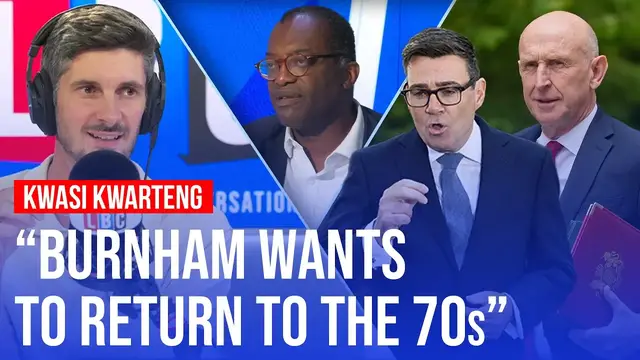
Former Chancellor Kwasi Kwarteng joins Tom Swarbrick to react to Burnham's pledge to cut VAT from household energy bills. The Government will tackle rising bills by removing VAT from household electricity bills from October 1, in time to impact the next Ofgem price cap. Chancellor John Healey said the cut would be funded by cancelling the £1.8 billion Digital ID programme. Listen to the full show on the all-new LBC App: https://app.af.lbc.co.uk/btnc/thenewlbcapp #tomswarbrick #kwasikwarteng #chancellor #ukpolitics #andyburnham #budget #LBC LBC is the home of live debate around news and current affairs in the UK. Join in the conversation and listen at https://www.lbc.co.uk/ Sign up to LBC’s weekly newsletter here: https://l-bc.co/signup
Show More Show Less View Video Transcript
0:00
The real quiz, ladies and gentlemen, is growth
0:03
Full-fat, lung-busting, revenue-increasing, job-unleashing growth. What is meant by a cost-of-living government
0:11
What can they actually do? Kwasi Kwarteng was, for a while, the Chancellor and also the Business Secretary
0:17
Thank you very much for coming in the studio. It's good to see you. I wonder what you make, first of all, of the government pledging to be a cost-of-living government
0:23
Well, I don't know what that means. I mean, if that suggestion is that they're going to intervene and keep prices down, that seems to me like a socialist measure
0:34
You're just going to try and suppress prices. You're giving away money
0:38
But then the question is, who's going to be taxed to pay for all of those giveaways
0:43
And that's something that's never addressed in this debate. I get Andy Burnham
0:50
He wants to be popular. Keir Starmer was very unpopular. and he feels that he's got to address people's concerns
0:57
But the answer can't be just taxing people and spending indefinitely. As you say, you've got to grow the economy
1:03
Taking taxes off things, 5% off energy bills, it's only 45 quid a year
1:07
but that's something that Kwasi Kwarteng as Chancellor would presumably approve of
1:12
I would. And the other thing that we didn't do, actually, and I sort of regret it
1:17
you've got to restrain spending growth. The welfare bill is out of control
1:22
You've got four million people in this country who claim welfare, and they don't even have a sanction
1:27
They don't even have to look for work. They just get those benefits. That's four million people
1:31
That's a lot of people in our country. And that number is increasing
1:36
And unless somebody tackles that, we're going to have to just keep putting up taxes
1:41
And I'm afraid the upshot of that is that a lot of wealth creators
1:46
I know they're not popular, rich people aren't popular, but a lot of people who set up businesses, who invest in the country
1:51
or just simply leave. And you're in a place where, you know
1:55
you've got very, very large numbers of people coming in. A lot of them are claiming benefits
2:00
And you're not growing the economy quickly enough to pay for it all
2:05
I'm just about old enough to remember, I think you were business secretary at the time, I think Rishi Sunet was chancellor
2:10
You wrote a letter after cutting fuel duty. You both wrote a letter to fuel companies, supermarkets
2:17
or what have you, to say, please, can you pass this fuel duty cut on? Yeah. And whilst you know cutting taxes on the cost of fuel is nice it showed didn it that the government doesn have any control of these things It doesn The businesses will have control And you know I read all sorts of things this weekend So was that a waste of time do you think No I mean I think that what we wanted to do was make sure that any cuts in tax were passed through to consumers
2:43
But, you know, I don't deny the fact that a lot of things we did in government were part of this sort of populist
2:49
let's just throw money at the problem. And, you know, people like that. People like being helped
2:54
But the bigger picture is if you don't get growth, you're simply in this doom loop where you're taxing people to pay for benefits and services
3:04
And in the end, you can't grow the economy quickly enough to pay for everything
3:09
So you're simply just taxing more and more people. And be under no illusion
3:14
The people who will be taxed in this new regime will be people in the southeast and in London
3:20
And there'll be redistribution across the country. If we were in agreement that Andy Burnham is going to put taxes up... 100%
3:27
I can't see any... You know, he's pledged in the last few days, obviously this electricity VAT cut
3:34
He says he's going to build more council houses. He said he's going to spend more to fund social care
3:42
He said he's looking at lifting the thresholds of tax, which means you get less tax revenue
3:48
So he's going to have to find the money somewhere. and the kinds of things that are being discussed
3:52
He hasn't ruled out wealth taxes. I know rich people are unpopular, but a lot of them will just leave and not create businesses
3:58
But what about the capital gains point? Yeah, the capital gains thing, I think, is crazy
4:02
Why? Very simply, capital gains is a tax on capital, on investment
4:08
And the thing about an investment is that it can go to zero. And if it goes to zero, you lose all your money
4:14
So taxing investment at the same level as income, Why would anyone invest money
4:20
If you can get a job in the civil service... Because the gains are there to be made. Because it's an area where growth has happened far quicker than it has in wages
4:29
It can do, but you can lose everything. So why risk that
4:33
Because the reward is greater. No, no, the reward isn't... If you're taxed, if you invest £100 and can lose everything
4:39
and you're taxed at 50%, your best case is, let's say, if you double your money, you get £100
4:46
And so why take the risk? Why not just get a job where you pay a good job
4:52
where you paid a certain amount of money and you get taxed to 50 Why take the risk of investing if you going to be taxed at the same level as someone in employment If part of what Burnham is doing is going to involve spending lots of money
5:05
he's talked about social care, my God... Defence? I didn't even mention defence. I mean, you've got a Chancellor..
5:09
But someone's got to do it. You've got a Chancellor who resigned from the government
5:13
because the Treasury, the department he now runs, wouldn't give him enough money for defence
5:18
But someone's going to have to do it. Someone's going to have to spend money on sorting out social care
5:21
I agree. Someone's going to have to increase... I agree, but if you're asking... It's a place they came to come from. Yeah, the answer actually is to try and get growth in the economy
5:27
so that, you know, until about 20 years ago, 25 years ago, all the Western countries, Western economies
5:33
were growing at about 2.5% a year. If you grow the economy, you grow the pie, you increase incomes across the board
5:40
your tax revenue is going to go up, even if you keep the same rate. But if you're not growing the economy
5:45
and more and more of your national wealth is going to spending, you're just going to have to increase rates
5:50
and you're going to kill growth. The area of spending increase which is becoming overwhelming is on benefits and welfare
6:00
Lots of talk about triple lock, for instance, one of the areas where there's going to be
6:04
15 billion extra by the end of this decade, state pension increasing dramatically as well
6:10
Would you think that that was an area as unpopular as it is? It's very unpopular, but we've got to look at everything
6:16
The problem the country faces, and it's not just unique to Britain, I know people aren't
6:21
that interested in other parts of the world, but a lot of other countries are in the same
6:25
situation, is that your spending on welfare, in terms of the triple lock on pensions, is
6:32
increasing at a much faster rate than your economy is growing. So that means that more
6:39
and more of your national wealth is going on benefits. And the ability of wealth creators
6:47
entrepreneurs to generate wealth is reduced and we're just going to get overwhelmed it's like a
6:54
raft is getting overwhelmed with these endless waves of of expenditure and the way that labor
7:00
left-wing politicians feel they can deal with this is by simply quote tax the rich and that's
7:05
easy because none of us like rich people well they all can they all can live uh on but but i'm saying
7:11
that if you destroy the incentives for people to create wealth, they will leave the country and you'll be in a worse position
7:18
I'll put it to you that you're saying this as a wealthy man, someone that presumably has various things It entirely self No because I have a view of how economies work not just from the UK but across history
7:34
And the ultimate socialist economies, which rely on redistribution, they all failed in the 20th century
7:40
I'm an old man, I'm 51. And they all failed in the 20th century. You look at Cuba, you look at North Korea
7:46
you look at... These are extreme examples. but they all essentially were built on this idea
7:52
Is it not Social Democrat? Is it not sort of... Whatever you want to call it
7:56
the idea that you can tax rich people in a kind of Robin Hood way
8:00
and then redistribute it infinitely, it doesn't work because in the end
8:05
the rich people just think, actually, why bother? If you're a rich person, you're being taxed 50% of your income
8:10
That's a massive disincentive. For every pound you earn, 50p goes to the government
8:14
and a lot of people just say, actually, do you know what? I'm going to leave the country. And that's what happened in the 70s
8:20
And as far as I can see, Andy Burnham wants to return to the 70s
8:25
Well, in the 70s, we were all kind of bailouts from the IMF. Yeah, but that was the situation
8:30
You know, in the 70s, you had 83% as a top rate of tax
8:35
You had 97% on so-called unearned income, dividend income. And now they're talking about wealth taxes
8:42
Even in the 70s, we didn't have wealth taxes, which is essentially a levy on your assets of between, I think Neil Kinnock suggested 2%
8:52
It's a high level, but you're essentially having to pay 2% a year
8:57
And a lot of people are asset rich. They might have inherited a farm or whatever it is
9:02
And if the farm is worth a certain amount, they have to come up with a levy every single year in cash
9:08
And what does that mean? That means they'll lay people off who work on the farm
9:12
That means they'll invest or they'll just sell it. and that will have a massive impact, I think, on the rural economy
9:18
and the culture of the country. People might not care about that, but I think it's important
9:23
You've rather dismissed the hopeful aura that was surrounding Andy Burnham with your suggestion..
9:28
Well, let's see what he does. I mean, I'm suspect... Well, he said... I didn't mention the 70s in this context
9:33
It was Andy who said he was going to rip up 40 years, he said, of neoliberalism
9:39
And that takes us back to the 70s. He blamed Thatcher for most of the problems that we face
9:45
And he wants to go back to some idyllic period where we were bailed out by the IMF
9:50
where unemployment was rising, where inflation was out of control, and the country simply wasn't working
#news