Up next in 10



As the trade war between the US and Canada ramps up, Matt Frei is joined by diplomatic editor Patrick Wintour and former Canadian politician Michael Ignatieff.
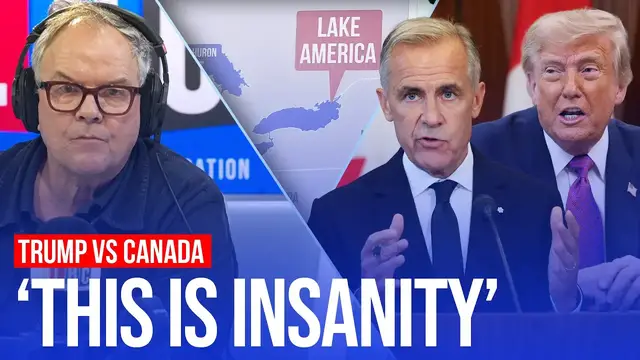
Trump imposed 50 per cent tariffs on $20 billion worth of Canadian goods, with Canada's Prime Minister retaliating in kind by imposing up to 50 per cent tariffs on US imports.
Donald Trump has also ordered Lake Ontario to be renamed 'Lake America' in yet another swipe at Canada.
Listen to the full show on the all-new LBC App: https://app.af.lbc.co.uk/btnc/thenewlbcapp
#mattfrei #donaldtrump #trump #markcarney #canada #tradewar #trade #tariffs #lakeontario #LBC
LBC is the home of live debate around news and current affairs in the UK.
Join in the conversation and listen at https://www.lbc.co.uk/
Sign up to LBC's weekly newsletter here: https://l-bc.co/signup
Show More Show Less View Video Transcript
0:00
Today I want to focus on Trump's ability to pick a fight with America's closest allies
0:04
He's had a go at us, of course. The Telegraph today, for instance, seems to think that he would let the Falklands go to Argentina
0:11
Trump seems to loathe the EU and he's never forgiven his allies for not joining him at
0:16
the very start in his disastrous war of choice in Iran. He's even falling out with the Israeli government that led him to that war in the first place
0:24
But this week he also renewed his fight with Canada after wrecking trade talks with last
0:29
last-minute demands that Canada simply couldn't meet if it wanted to stay a sovereign, independent
0:36
nation-state. Here's Prime Minister Mark Carney this week once again proving to his peers
0:40
that he is the patron saint of standing up to Trump. Well, we believed earlier this week
0:45
that we were moving towards a mutually beneficial agreement. In recent days
0:52
the United States proposed new terms that were uneconomic, unfair, and undermined the net benefits
0:58
for Canada and called into question the reliability of any deal. In short, they asked too much
1:07
and they offered too little. On that note, Doug Ford, the salty mouth premier of Ontario
1:14
told Trump to kiss my posterior. He didn't quite use that word. Anyway, Trump then responded
1:19
as he has done before, by drawing from his extraordinary semantic armoury
1:24
We're going to be changing the name of Lake Ontario, effective immediately to Lake America
1:31
And we filed all the necessary papers, documents, everything else. We notified all of the various people that we have to notify
1:40
So we've done everything that you have to do. And this is official, effective immediately
1:46
As you might have added, I thank you for your attention to this matter. Now, whatever the lake is called, the economic pain on both sides could be acute
1:53
but especially for Canada, the vast majority of whose exports head across the border to the US
1:59
And don't forget that Trump started his second term by declaring that he wanted Canada to become America's 51st state
2:05
Thanks, but no thanks was their response. So how far are both sides prepared to take this
2:10
And also, what lessons does this hold for the rest of us
2:14
Let's start with the rest of us by speaking to Patrick Winter. He's, of course, diplomatic editor of The Guardian
2:19
and we're going to speak to Michael Ignatieff, former leader of the Canadian Liberal Party
2:23
and leader of the opposition in a minute. He's also, of course, an author and a historian
2:27
Patrick, you first. I mean, is the problem here that America is lashing out
2:31
or that actually America doesn't have the power it used to have
2:35
and is therefore lashing out? I think in this case, there's both specifics about the trade deal
2:42
and arguments that probably a level of detail that you probably don't want to go into
2:47
as to why they weren't able to agree. But I think ultimately it came down to an assessment about national sovereignty and Canada's sense of itself
2:57
in that it wasn't going to be able to strike other trade deals without America's permission
3:01
There were going to be arguments about French language, and obviously there was going to be a huge hit to the Canadian steel and aluminium industries
3:11
So those were the sort of specifics. But beyond it is a bigger picture, which is that, as you said
3:16
And Mark Carney, through a very kind of rational, calm manner, has struck out as the individual leader in the West
3:26
who's willing to stand up to Donald Trump. And the classic example of that was a speech he gave at Davos
3:34
which was in January, where he made it absolutely clear that he felt there needed to be an alliance of middle nations
3:41
middle powers against America, because without that they were all going to be run over by this juggernaut And he I think has benefited from that electorally within Canada politically And there are more elections ahead in Canada in the near future
3:57
so he's got an eye on that. But I think the bigger picture is that he feels
4:02
there is a moment now where America's starting to appear weak. And although there are huge risks for the Canadian economy
4:12
if this trade war really develops, he still feels this is the moment to strike and to show that Trump is weak and can be defeated
4:22
even on the economy, which is obviously the natural strength of America
4:27
Indeed. Stay on the line, Patrick. I want to bring in Michael Ignatieff, who, as I said, was a former leader of the Canadian Liberal Party and also an author and a historian
4:34
Michael, it's good to have you on the programme. You heard what Patrick Winter there had to say
4:40
I mean, to many of us who don't know Canada well, they might be surprised that Canada, you know, you're known as a nation of polite
4:48
mild-mannered people, that you've taken this stance and that your Prime Minister
4:53
Mark Carney, who we remember as a very reasonable, you know, mild-mannered central banker in this
4:58
country, has now become really the strongest voice against the excesses of Donald Trump
5:05
Why has this fallen to Canada? It's a good question. We're a surprising
5:12
we're a surprising battler since our public image and our self-image is is moderation
5:20
i think we're fighting because for us it's existential if you have 75 percent of your
5:27
gdp or your economic profile heading to the united states you're un exceptionally vulnerable
5:35
to pressure so this is not a moment when you can this is a moment where your sovereignty is
5:43
as uh has been said is put into play so it's survival for us it's existential for us
5:51
we've been at this it's an old story for canada we've been at the business of survival next door
5:57
to the most powerful empire the world has ever known for 150 years and done a pretty bloody good
6:03
job at it. But we all know that that's what it's about. It's about survival. And as has been said
6:12
the critical issue was the attempt by the Americans to say, you are going to follow us
6:19
our trade policy, our tariff policy on everything. Your former freedom of maneuver is over. And that
6:28
was just a step that no responsible government could take. The larger issue here is that, you
6:37
know, I don't know about you, Matt, but I grew up in a place called the free world. It was a bit
6:43
hypocritical, the free world, because it included a lot of very dubious characters like Pinochet's
6:48
Chile. I mean, it wasn't it wasn't as free as it purported to be. But the premise of the free world
6:55
was that democracies that valued freedom had common traditions, common friendships, common linkages, common alliances. And that's over. We're in a world where it's who whom
7:09
as Lenin used to say, you know, it's all about force and power and intimidation
7:15
Carney's contribution has been to wake up to that reality earlier than most. But Canada's waking up
7:22
to it too. Friendship is over. We're deeply tied and linked emotionally to the United States
7:29
But between states, it is no longer an alliance between within the free world
7:36
And I guess what Donald Trump has never really taken into account is that you know there are such things as resilience and pride And if you trample on your best friend pride there will be a response And that some things are more important than deals and money
7:52
But to what extent do you think Canada can hold out if this continues
7:56
And I know there's a bit of wiggle room there. And some of the big bazookas haven't been deployed yet
8:01
like energy sanctions and so on. But what do you think Canada can hold out
8:04
if and when the economic pain really begins to bite? Nobody knows, Matt, and you mentioned the big bazooka of energy
8:14
And this morning, Trump announced a deal to get control of 65 billion, whatever, of Venezuelan oil
8:27
That has an immediate knock-on effect. Canada's biggest bazooka is oil and oil exports
8:33
many of its refineries depend for the very existence on the refining of our particular
8:39
form of heavy crude that bazooka may not now be deployable because trump has simply got another
8:48
decisive card to play but the two remaining bazookas or three remaining bazookas are
8:55
electricity supplies we keep the lights on in most of the east coast of the united states
9:01
potash which supplies most american farmers with their fertilizer and critical minerals
9:08
which are crucial to every modern industrial process the dilemma for canada is that if we
9:16
were to impose an export surcharge on those three items make it more costly in the united states
9:24
it immediately has huge ripple effects on our economy carne is very hesitant to use those
9:31
bazookas, I think he's actually hoping that they can get back around a table and do a deal that he
9:37
can sell to the Canadian people. But his margin of maneuver politically now is very, very sharply
9:44
reduced. Already in the summer, people were asking, why have you made so many of these compromises and
9:50
got so little back? So we may be in a situation where politically he's forced to refuse any
9:57
humiliating deal and then forced to put the Canadian economy through quite a lot of pain
10:04
And frankly, nobody knows how much pain this economy can take. And the diversification strategy
10:12
which he has, which is to build linkages with Europe, to bring linkages with Japan and China
10:18
all of that takes time to bear fruition. It's not as if this is an endgame. But the key dilemma he
10:25
has is that he hasn't got the time for his diversification strategy to compensate for what
10:33
he may lose in a battle with the united states and the final point to make is the whole thing
10:38
matt is nuts adam smith 250 years ago said the last thing you want is to be forced into a
10:47
mercantilist strategy against, you know, the world has been improved by free trade. Free trade has
10:56
its problems. I don't want to deny. But a world based on free trade is a better world than a
11:02
mercantilist dog-eat-dog world. This is the insanity that the whole world is now having to struggle
11:08
with. I want to bring in Patrick Winter again. Patrick, I mean, let's broaden this out to what
11:12
we were discussing in the first hour, which is defence. And I just wonder, you know, you as someone
11:17
who talks to a lot of, you know, foreign ministers and defence ministers around Europe, do you think
11:24
that if there was an attack on the Baltic states, which is, you know, what many experts fear might
11:29
be happening sooner rather than later by the Russians you know whether it an overt kind of incursion onto territory or something to do with cyber which is a constant in a way Do you think that Trump would actually intervene if Article 5 of the NATO treaty was
11:44
pulled? Would he intervene on the side of the Baltic Republics to defend them from Russia
11:50
Well, that's a huge question, which I think if you speak to most European defence ministers
11:56
you'll get different answers because according to where they're situated. But I think what's
12:01
striking is it's actually the Baltic ministers in particular who are most concerned by that and who
12:07
are most dubious about it. I think the kind of there's been briefings from British officials
12:14
over the last 48 hours to the effect that there could be a mistake and misunderstanding that might
12:21
lead to the Russians doing more than they intended and certainly that was part of this visit by the
12:27
CIA director to Russia, it seems increasingly clear that he was warning Russia that they had
12:34
intelligence, the Americans had intelligence that Russia was going to overstep the mark either in
12:39
the Baltics or indeed the British, because they felt that the weaponry that's now being deployed
12:45
in Ukraine against Russia is European sourced, and that makes them legitimate targets. And you
12:53
can see that starting to escalate as a problem. I think the bigger question in the short term
13:01
will be what the Americans do about the deployment of forces, its forces in Europe. And there
13:09
is going to be announcements on that in the next two months. And I think that will really
13:13
give a big signal as to how committed America is to Europe. But ever since I've been doing
13:20
this job. I've been listening to European officials saying we need to do step up about
13:25
our own defence and do more. And yet it seems to take so long for it to happen
13:31
Final one to you, Michael Ignatieff. I mean, I mentioned earlier that Trump started his second
13:35
term by saying we'd like Canada to be the 51st state and you Canadians turned around and said
13:40
thanks, but no thanks for that offer. We're not selling, even if your price is quite good
13:45
Do you think that he could actually, in his hemispheric Dunro doctrine kind of way
13:51
contemplate some military action against Canada, against your nation, in order to incorporate you
13:58
Or is that really dangerous, sort of outlandish thinking? I think it's outlandish and it's absolutely possible
14:06
I simply don't think anything can be excluded with this president. But the president is weakening politically
14:13
A military move against Iran that failed is hardly a setup for offensive action against the Canadians
14:23
The fact is the Canadians would fight. In our funny way, we would fight
14:28
We would resist. And so there would be costs. I think we all need to take this talk down and settle down
14:36
But I think there can't be any doubt that this is simply a new world or a world that returns us to a period that we've completely forgotten
14:48
The 19th century. You know, the 19th century was about national rivalries and we know how that ended
14:53
The War of 1812 was a war in which Canadians fought the Americans and didn't do too badly with the help of the British
15:00
So, look, I don't think we're going there, but it's a symbol of just how collapsed this old affinity that we used to have between democracies, between people with similar attachments to constitutional liberty
15:16
It's that that has disappeared in ways I find actually very frightening because it affects Europe as well
15:22
Of course it does. Well, I mean, there's always the Greenland issue. If it's not Canada, it's Greenland
15:27
And maybe now it's the Falkland Islands, which is something else altogether
news