Up next in 10



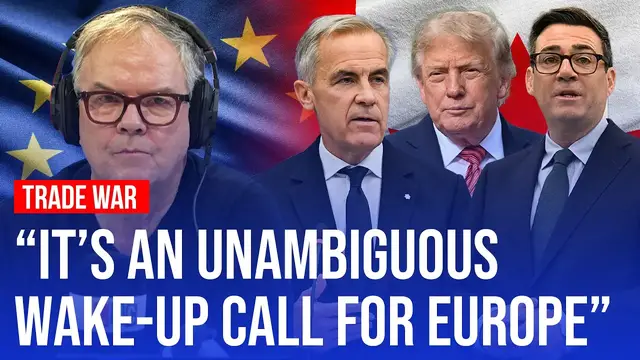
Matt Frei is joined by public policy expert Peter Foster and former civil servant Sir Philip Rycroft to react as Canada becomes an 'associate member' of the EU.
The European Commission President described the potential alliance as "not a partnership against anyone else, but for our common strength".
Trump has since threatened the EU with "serious tariffs" and a halt to trade over the tightening of relations.
Listen to the full show on the all-new LBC App: https://app.af.lbc.co.uk/btnc/thenewlbcapp
#mattfrei #canada #markcarney #trump #donaldtrump #europe #eu #brexit #andyburnham #politics #LBC
LBC is the home of live debate around news and current affairs in the UK.
Join in the conversation and listen at https://www.lbc.co.uk/
Sign up to LBC's weekly newsletter here: https://l-bc.co/signup
Show More Show Less View Video Transcript
0:00
That shifting sensation you can feel underfoot, yes, that one, that is the ground moving
0:05
It makes you queasy and a bit dizzy. It is not reassuring. It is the sensation that comes from
0:11
just about everything that we had taken for granted being cast in doubt. Is it a sentence
0:17
or is it an opportunity? We're not quite sure. All week we've been fretting about AI. Will it
0:23
kill cancer or will it kill us? But this morning I want to talk about other shifting plates
0:28
the diplomatic ones. We work up to news that the Trump administration has done a deal with Denmark
0:32
and Greenland, according to which the security of Greenland will be forever guaranteed by the US
0:39
with a heavily beefed up military presence. We have you to see the fine print, but let's remember
0:44
that 2026 kicked off with Trump sounding a bit like a mobster on the subject of Greenland
0:49
I'm not talking about money for Greenland yet. I might talk about that. But right now
0:54
We are going to do something on Greenland, whether they like it or not
0:59
Because if we don't do it, Russia or China will take over Greenland
1:04
And we're not going to have Russia or China as a neighbor. I would like to make a deal, you know, the easy way
1:15
But if we don't do it the easy way, we're going to do it the hard way. Love it. It was this language that threatened to tear NATO apart
1:21
frightened the horses and inspired the Canadian Prime Minister, Mark Carney, to give a rousing speech at the Davos summit that was essentially a battle cry for a new world order
1:30
in which the middle powers, the last chance saloon of liberal Western democracy
1:36
us in other words, would club together in polite defiance of an erratic, menacing America and an overbearing China
1:43
After trade talks collapsed between the US and Canada last month, and Trump continued to flirt with the idea of owning Canada or turning it into the 51st state
1:52
by hook or by crook, Carney refreshed his message at the European Parliament in Strasbourg this week
1:58
Canada and the European Union can anchor our ground to hold our values
2:03
while forming a protective canopy under which our citizens can thrive. This is about sovereignty
2:13
We must fight for every day. Sovereignty today goes beyond being able to feed, fuel and defend ourselves
2:22
It now requires secure access to AI, semiconductors, critical minerals, payment systems
2:28
clean energy technologies, vaccines, space-based communications. Canada and Europe are each strong
2:39
Europe and Canada are stronger together. And so was born the EU-Canada Association Agreement
2:46
In quieter times, you would have stifled a yawn. But not today. No more. Yawns are so yesterday
2:53
Andy Burnham may wonder if Canada has overtaken us on our island in the fast truck to nuzzle up to the EU
3:00
Let's not cribble, though. It's all a bit sketchy still. But is this the beginning of Carney's middle power alliance
3:06
And how do we fit in? Peter Foster of the Financial Times, he's their World Trade Editor
3:10
and Philip Rycroft, former Permanent Secretary at the Department of Exiting the European Union
3:15
Let start with you Peter Foster The language used by Mark Carney and indeed by Ursula von der Leyen was pretty remarkable I mean talking about sovereignty and freedom and so on Does the detail of what you know about this deal match the language the rhetoric Peter In short Matt no it doesn Listen these are nice warm words
3:34
They give you a nice, warm, cuddly feeling because everyone feels threatened by America
3:39
But the brutal reality is that, you know, 70 plus percent of Canada's trade goes with the United States
3:45
and 50 plus percent of our trade goes with the EU. Geography matters
3:50
And so you can talk about associate membership of Canada with the EU
3:54
By the way, there's no legal structure for that. It doesn't exist. We're talking about things that literally legally don't exist
4:01
But, you know, the truth is that, you know, Canada is attached physically to the United States
4:07
It trades massively with the United States. And so, you know, Carney is signaling that the middle powers can do stuff together, can create an alternative reality
4:17
But the truth is, and I think we've seen this, haven't we, since Trump came to power, that actually in a world of great power competition of China v. the US, the challenge that the middle powers have is that they're endlessly able to be picked off by the big ones
4:33
And so, you know, we all thought we're going to club together. But then China comes along and says to Spain, we're going to invest lots in your car factories
4:39
We're all going to club together. And then when Trump comes along, what do the Brits do
4:43
They run off to Washington and say, can we have the first trade deal, get one for 10 percent
4:47
the EU gets 15%. You see what's happening? There's an endless opportunity for the big powers
4:53
to pick off the little ones, and that's why the little ones ultimately will always struggle to be more than the sum of their parts
5:00
Philip Rycroft, is geography more important than shared values? It depends what aspects of the world you're looking at
5:09
in terms of trade and defence. Clearly, absolutely right in what Peter says is correct
5:16
I think that was one of the big reasons that people thought that Brexit was not such a great idea because of the predominance of our trading interests with our near abroad
5:27
We're never going to replace that with trade deals with Australia and New Zealand and so on
5:33
However good those trade deals are, they cannot compensate for the lost trade with the EU
5:42
But values matter as well. I, Peter's right to be hesitant about how far a Canadian EU deal might go
5:55
It isn't. There is such a thing as an association agreement in the treaties
5:59
This isn't that. It is an unknown thing. Canada's trade with the EU is pretty small at the moment
6:08
It's only about 1.3% of EU imports. So there's lots of scope for that to grow
6:14
So the Carney vision of the world, I'd like to be a little bit more optimistic about it
6:21
If we don't try and go down that track, we sort of are left there waiting, as Peter says, to be picked off, which is a slightly depressing thought
6:30
Peter, I mean, history is full of, you know, stirring rhetoric, language used in the face of adversity
6:36
I mean, Churchill offers one of his examples. There are plenty of others. I mean the fact that Carney is speaking in those terms the fact that he the EU president
6:44
Ursula von der Leyen is reciprocating those terms in her own way does show you that there's a real
6:49
crisis of values of alliances of partnership afoot doesn it no no absolutely it does I mean it signals very strongly about the crisis of communism You mentioned at the start this deal
7:02
we haven't seen the details that the US has finally done over Greenland. But, you know, Trump's attitude to Greenland
7:09
has completely rocked Europe's kind of assumptions, post-war assumptions that the US underwrites European security
7:18
But more importantly, that the U.S. believes that underwriting the global commons, the global goods, which it did from the Marshall Plan onwards, you remember the rebuilding of Europe, is in the U.S.'s interests
7:33
But I think, you know, it's pretty clear that certainly in Trump world, that is no longer a given
7:38
And I think that's what's really, you know, rocked the middle powers, because we know we're vulnerable
7:45
I mean, in some ways, you know, they do protest too much. They know how difficult it is actually to kind of turn that rhetoric into reality because, you know, you go back to Churchill
7:56
Why did we win the Second World War? It wasn't plucky Britain. It was because the U.S., with its massive economic power, came in on our side
8:04
And I think the most disturbing thing about Trump is that, frankly, you know, he's treated the U.S.'s strategic rivals and direct enemies, Russia and China, often better than his own allies
8:17
you know Japan, South Korea, the European Union, you know European you know US economic diplomacy
8:25
has been directed as much against them as it has with them which is really destabilizing in terms
8:31
of you know the way we assume that the world is going to be. There's a very good book about
8:37
the diplomacy during the second world war called Allies at War by my friend historian Tim Boover
8:42
who's been on this program. And he makes the point very convincingly that in that period
8:47
what we see as a foregone conclusion with hindsight that Roosevelt will come in on the side of Churchill
8:52
wasn't at all a foregone conclusion. Churchill really had to use all the powers
8:56
of whiskey and persuasion to get Roosevelt on side because the Americans at the time thought
9:01
that this was a dastardly plot by the British to extend their empire
9:05
Of course, the exact opposite happened eventually. But it's interesting just looking at this particular moment
9:11
whether history is being rewritten here. And I just wonder, you know, Philip
9:16
what are the alternatives to what Carney is saying when our Western values, whatever is left of them
9:21
have been so clearly trampled on by Trump? What are the alternatives? And how can we make this thing, you know
9:26
how can we put some flesh to the bone? We are, I think, at a pivot moment
9:32
As you allude to, the US has not always been working hard to sustain a world order
9:40
it was very isolationist between the wars. I think with the coming of China, the rise of China
9:49
and the rivalry between the US and China, I think US attention was always going to be drawn away
9:55
from the structure of alliances that had been put in place after the Second World War
10:01
So I think Trump has had a huge impact here, clearly, because of the way he's approached it
10:07
But I suspect whoever replaces Trump, We're not going to go back to the status quo ante
10:12
I think the world has changed and changed for good. And in a way, the silver lining of the way that Trump has done it
10:20
is an unambiguous wake call to European powers to get their act together on defence And when you see what going on with Russia Ravanchise Russia pushing the boundaries
10:33
now we are in a sort of hybrid warfare already with Russia. It is absolutely clear that European powers have to get their act together and look to their own defence
10:44
And let's not forget, you talk about middling powers, these still are amongst the largest economies in the world. So we have the economic wherewithal
10:53
to do this. What's required now is the political will. And talking of that, Peter Foster, you've written a lot about this in the Financial Times
11:01
Just us, you know, the Burnham government nuzzling up to the EU is coming up against all sorts of
11:06
obstacles. We know with the Canada trade deal that was negotiated nine years ago, that's not
11:10
even been ratified by 10 parliaments in the EU. So where does Britain fit into this new
11:18
middle power arrangement, if at all? You know what, Britain is a really good example of a
11:24
middle power that is really struggling to play piggy in the middle. So, you know, we want to
11:29
have our reset with Europe. Burnham says we want to be closer to Europe. That makes sense economically
11:34
because half of our imports come from Europe. At the same time, we want to have a good relationship
11:40
with China. Lots of EVs come from China. Lots of investment comes from China. But the European
11:47
Union is currently confronting China. It's putting tariffs on Chinese EVs because it's threatened
11:51
by Chinese de-industrialisation because of Chinese exports. So what does the UK do? Does the UK
11:57
get its reset with the EU? If it does, it then has to almost certainly put up tariffs on Chinese
12:04
electric vehicles because it can't really pretend to be a great friend of the EU and then not join
12:08
the EU in trying to, you know, fight against Chinese unfair subsidies. And so those kind of
12:15
invidious choices come up all the time. And when it makes those choices, what does it do about the
12:20
US? Because, you know, its security relationship, its security is still underpinned. You know, F-35s
12:25
don't fly properly unless we get software upgrades from Washington. And so we're in a really
12:31
invidious triangle. You know, if you're a member of the EU, at least you're part of a large block
12:36
albeit one that's very divided. But actually, the UK, you know, it's been trying to spin plates ever since Brexit
12:43
It's trying to have its cake and eat it with Washington, with Beijing and Brussels. But as, you know, those three entities become more and more, you know, divided
12:54
Fortress Europe grows, it puts up its barriers to trade, and Beijing and Washington continue to kind of decouple
13:02
the UK is going to find it harder and harder to keep those plates spinning
13:06
and keep everybody happy. And I suspect there's some pretty tough choices coming down the tracks
13:11
In 20 seconds, Philip Wycroft, where do you see Britain's future in these shifting tectonic plates
13:16
It comes back to where you started, geography. We are a European country
13:21
We can't get away from that. Our defence and security is hooked to the continent
13:28
Our economy is hooked to the continent. There are really, really difficult choices ahead
13:33
but geography ultimately will tell. ours is a european future we can't get away from that do you remember that old joke fog in the
13:40
channel europe isolated that used to you know make us laugh continents isolated yes exactly indeed
13:47
yeah no indeed and that's uh as i say geography geography determines an awful lot
news