Up next in 10



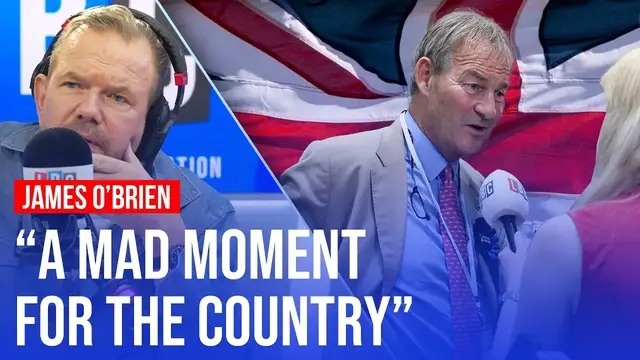
James O'Brien reacts as Equalities Minister Bridget Phillipson claims sexism and racism have become 'normalised' in Britain.
The Labour MP said she was 'increasingly worried' about how commonplace misogyny and racism had become, fuelled by online interactions and statements by politicians she said would not have been acceptable a few years ago.
James reflects on the 'significant sea change' of British politics and argues that 'nothing is off limits' when it comes to weaponised nostalgia.
Listen to the full show on the all-new LBC App: https://app.af.lbc.co.uk/btnc/thenewlbcapp
#jamesobrien #ukpolitics #reform #debate #rupertlowe #nigelfarage #LBC
LBC is the home of live debate around news and current affairs in the UK.
Join in the conversation and listen at https://www.lbc.co.uk/
Sign up to LBC's weekly newsletter here: https://l-bc.co/signup
Show More Show Less View Video Transcript
0:00
But let's just talk about the word deportation, all right
0:04
And where it appears in your conscience, or consciousness, actually. And I remember talking to Nick Lowell, who founded Hope Not Hate
0:17
and he was talking about his mother, who was... I forget precisely where she was from, forgive me
0:24
I didn't know I was going to be mentioning him today, it just popped into my head. But his mother was from overseas
0:29
And when the National Front were on the march in the 1970s, Nick developed, I mean, a deep fear of his mother being deported
0:41
I mean, it's going to be partly to do with whether or not you catch a little bit of the news when you're a kid
0:46
while you're trying to find the programmes that you want to watch or, depending on where you live
0:52
leaflets might be put through your letterbox. But that language of deportation in the 1970s, when the country was measurably much more racist, was rare
1:03
You know, it would be associated with neo-Nazis and the far right. I don't mean the deportation of foreign criminals, which is, I mean, a tricky business if you actually stop to think about it
1:15
because it means that you're creating a society in which you get punished differently according to where you were born or some other immutable characteristic
1:23
and that's probably not an easy road to go down but it's not hard to get your head around
1:27
why somebody born overseas does something awful and perfectly decent people conclude
1:32
well they shouldn't be here anymore so that's a very different proposition but being deported just for being too foreign
1:39
used to be a preserve of the most toxic politics the most toxic people
1:46
the most toxic politicians they tried to sort of rephrase it or reframe it didn't it
1:51
by calling it re-migration. But sometimes, in the spirit of the boiled frog
1:56
you don't notice how bad things have got until you do. And what you're noticing is a significant sea change
2:03
She was from... Nick's mum was from Mauritius. So, you know, he is not what you would call observably mixed race
2:10
but he became terrified that his own mother would be deported because she was born in Mauritius
2:15
He heard the language of the far right. You can listen to him talking about it on an old episode of Full Disclosure
2:21
And even on a personal level, because he's obviously inherited half of his genes are from his mum's side of the family
2:27
if they went on holiday together, he'd sit in a tent rather than expose himself to sunlight
2:32
because he was so frightened of his skin going sufficiently dark for himself to become a target
2:37
of the people that we're talking about deporting people like his mum. Actually, just pause for a minute and think about that
2:44
Because that feels, or that once felt, in fact, even perhaps two, three years ago when I sat down with the guy
2:50
that felt a little bit bonkers you know, sweetly bonkers don't be sad, I mean come up
2:55
and now how prevalent is the word deportation in public discourse in Britain today
3:01
I meet Rupert Lowe a fellow who's struggling to understand weather at the moment but he uses it
3:08
more often than most of us use toilets I mean he is always, every time I see him
3:13
popping up somewhere he's talking about deporting millions of people who've done absolutely
3:17
nothing wrong except being a bit a bit too foreign um and and he is making inroads of course both electorally and
3:26
most powerfully on elon musk platform where he is obviously boosted and put in front of people on a on a on a nuclear scale but that an that a really mad moment for a country and i i a white bloke i mean i got irish heritage eventually if this uh if the temperature
3:46
continues to be turned up then people like rupert lay will probably be calling for second generation
3:50
irish people to be or first generation actually uh irish people to be adopted to be um to be
3:56
deported i think i'm technically first generation because i was adopted but um it was it was it
4:03
was really abnormal not long ago right or it was out of the ordinary not that long ago to hear
4:10
people talking about deportation it was the british national party and the national front
4:13
if to be completely innocent but guilty of being a bit foreign or too foreign or the wrong kind of
4:22
foreign then you would be forcibly removed to this country and of course these people don't
4:27
care about where you go it's just a sort of rhetorical flourish so that's what you might
4:31
call a big ticket boiled frog moment that perhaps we haven't properly noticed because it's happened
4:37
relatively slowly i presume it begins with farage banging on about deportation without as is his
4:44
um as is his want without being particularly specific or having any details he just lights
4:49
blue touch paper and runs away and then you've got um supposedly intellectual people who started
4:56
talking about the great replacement, this idea that there is a secret plan underway
5:02
to replace white people with people of colour because people of colour are more likely to..
5:07
I don't actually know what they're more likely to do, vote for something that I'm not going to vote for
5:12
or that you're not going to... I don't know. But that was poisonous, racist nonsense
5:16
which sadly was published in this country, I think mostly in the pages of the Spectator magazine
5:21
And that leads, that bleeds in, It seeps in to the temperature of public discourse
5:29
So we live in a country now where talking about deporting people just for being people who are here legally, legally has become commonplace
5:40
We're going to deport people who've got who've currently got every right to be here. We're going to take their right to be here away and we're going to deport them
5:47
And I have no way of knowing how frightening that would be for somebody like the 10-year-old Nick Lowles, 40-odd years ago when the National Front were on the march
5:58
I mean, what on earth would that be like for a child today? If they were to stumble across the wrong or the right headline, if they were to find themselves witnessing a conversation, overhearing a conversation in the kitchen between family members about whether or not we're on this list, whether or not we're likely to be
6:15
if someone who is being treated with a relative degree certainly being treated
6:22
like a proper politician on Twitter and sits in the House of Commons
6:27
he's talking about deporting millions of people millions of people and you are of foreign extraction
6:36
how do you know he doesn't mean you? how do you process that
6:43
if you're a child? So that's what I would call a sort of big ticket moment, that you probably need to have some ethnic minority heritage to fully understand
6:55
And I obviously don't. But I'm interested today also in the small ticket moments
7:01
Racism and sexism have become normalized in Britain, the Equalities Minister has said
7:06
warning in particular that young men were being sucked into violent misogyny by a social media cesspit as Bridget Philipson word I worry she said in a podcast that we are at a kind of ground zero in terms of attitudes around violence against women and girls
7:24
Things that not very long ago felt totally unacceptable are becoming normal
7:30
I think we're seeing that in terms of attitudes towards women, and I think we see that in terms of attitudes around racism
7:37
And she's just correct, isn't she? because you can't argue with the fact that not that long ago
7:44
talking about deporting people who had every right to be here would have been absolutely beyond the pale
7:49
And now it's in the House of Commons, let alone the pages of some newspapers
7:55
and, crucially, I suppose, the profoundly racist platform or the very racist promoting platform
8:02
that Elon Musk has managed to create in an extraordinarily short amount of time
8:09
So the thing about boiling frogs is that the frog isn't supposed to notice
8:15
Technically, apparently, it doesn't actually work like this, but it's a figure of speech for a reason
8:19
The boiled frog dies because the frog doesn't notice the heat increasing
8:25
because the heat is being increased so incrementally. You turn it up so slowly, you miss the moments, right
8:32
You miss the milestones. you go from the beginning of the journey to the end of the journey without pausing or noting
8:40
any of the stopping off points i think the phrase i want you to focus on there is that you miss
8:46
the moments the moments of change the moments of decline one of the political uh comments i think
8:54
about most often and i won't get the words right but it's the sense of what he said that matters
8:59
most was Tony Benn talking about victory being impossible. You never win anything if you are
9:06
I'm going to, for the purposes of this conversation, repulsed by racism. You never win anything. All
9:12
you ever do is win temporary battles and then the other side start pushing back. It's the sort of
9:18
to-ing and fro-ing of human history. There was a documentary on the television this week, we may
9:24
talk about it later that was attacking adhd it's been it criticized by almost everybody qualified
9:29
to comment on the subject um but it was deeply irresponsible the great adhd myth or something
9:35
like that and um a chap i who i follow on blue sky roland smith described it as that weaponized
9:43
nostalgia this idea that something must be false because it wasn't around when i was a kid and i
9:51
said to him do you think they'll go for dyslexia surely we can derive some optimism from the fact
9:55
that dyslexia was once dismissed and poo-pooed and uh and and prompting great amounts of skepticism
10:03
and he said no they'll go for that if they can because it's weaponized nostalgia nothing is off
10:08
limits with weaponized nostalgia and so it is with social progress they reversed roe versus wade in
10:14
the united states of america when i was studying that for my politics a level in the late 1980s
10:19
that was one of those things that you thought as a kid oh wow
10:23
that's permanent abortion's legal now bodily autonomy for women is legal now
10:29
and now it's not not legal, permanent and of course it wasn't
10:36
you can repeal that as well it was a whole sector of my A-level politics
10:41
because it was such a seminal moment Roe versus Wade allowing a woman to have an abortion
10:47
it happened years later in Ireland but of course it not permanent Nothing is permanent There a far nationalist on the march in Germany at the moment who is pro and is set perhaps to become
11:00
the first far-right politician to run a state in Germany since, well, you don't need me to tell you who was in charge
11:07
last time far-right politicians were governing entire states in Germany. Nothing is ever permanent
11:14
These things, that's the word that I want, flow. they ebb and they flow and that's why today i just want to notice some moments and it's not
11:27
confined i hope this doesn't sound a bit um tin-eared it's not going to be confined to victims
11:33
a friend of mine messaged me the other day in in quite a state actually i don't even know why they
11:41
messaged me but obviously this is what i do for a living because they've been sitting in a pub
11:45
and there were some lads there. I don't think it matters where they come from, but they weren't from the part of London that the pub was in
11:52
And there were some lads there, and they'd started a conversation. They were down here to work
11:56
They were construction workers, not from London, white guys. And they were getting on famously, and they were having a bit of a laugh
12:04
I think the guys were probably, or thought at least, they were chatting up my friend
12:08
and that's what has kept pubs, kept beer flowing in pubs for years
12:12
and one of them, only one of them, just started dropping the N-word into the conversation
12:18
as if it were the most natural thing in the world. And she didn't know what to do
12:23
I mean, you know, you say you can't do that or you say, I'm really sorry
12:26
I'm deeply uncomfortable with that word, but the utter incomprehension about why a young white woman
12:31
in a pub in London in 2026 would balk at, be repulsed by, horrified by the use of the N-word
12:37
would not have happened ten years ago. You would not need to explain ten years ago
12:41
why you just don't use the N-word in polite conversation. If you use it at all, as Nigel Farage reportedly did for most of his life
12:49
according among others to the bloke that actually founded UKIP, then you do it behind closed doors
12:55
You don't do it in public with strangers. Well, you do now. You do now
13:02
And so the reason I say that, and the reason why I say I hope I'm not being tin-eared
13:07
is that we might all have noticed you don't have to be on the receiving end
13:11
or you don't have to be the target for the normalisation of racism and or sexism to have noticed it
13:21
And in some ways, I think, and I reserve the right to be wrong, as always
13:26
but I think it's important for those of us who are not going to be the target of it
13:30
to point out when we've noted it as well, the moments that are missed as the frog gets boiled
13:43
So, the Equalities Minister says that racism and sexism have been normalised in the UK
13:49
I want you to tell me the single thing that you have witnessed
13:54
or experienced, equally valuable for me this morning, but obviously not equally traumatic or equally powerful for you
14:03
but the single thing you have witnessed or experienced that speaks to a significant change
14:11
in how these two issues affect our country and how normalised, to use Bridget Phillipson's words
14:20
racism and sexism has become. So it will be the thing that's happened to you relatively recently
14:24
that either you couldn't quite believe or you thought had been consigned to the history books. Right
news