Up next in 10

Code of Hammurabi: History of development of Babylonian Laws #law #history #babylon #education
Dec 19, 2025

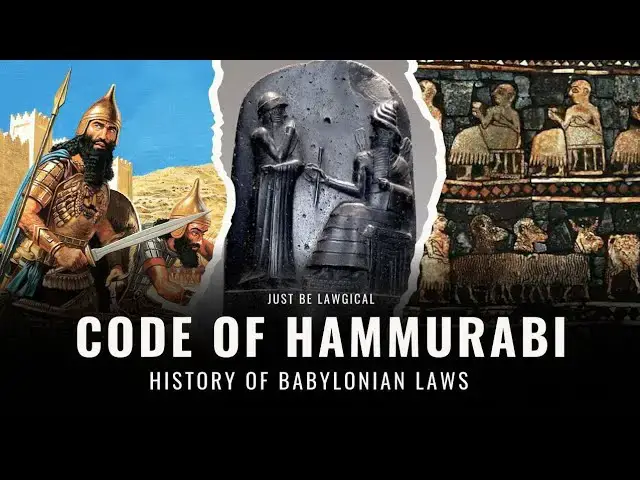
The Code of Hammurabi as one of the oldest deciphered writings of significant length, a Babylonian legal text from around 1754 BCE, containing 282 laws covering family, property, criminal, and civil matters, famously known for the principle of "an eye for an eye" (lex talionis), but with punishments varying by social class, inscribed on a large stone stele discovered in ancient Mesopotamia.
Origin: Created by King Hammurabi, the sixth king of the First Babylonian Dynasty, for the Babylonian Empire.
Content: 282 laws addressing slander, trade, slavery, labor, theft, divorce, contracts, and family relationships.
Lex Talionis: Famous for "an eye for an eye," where punishments often mirrored the crime, but scaled for social status (e.g., nobleman vs. slave).
Social Structure: Established three classes (upper, middle, enslaved), influencing rights and responsibilities.
Discovery: Found in 1901 by French archaeologists in Susa (modern-day Iran) and now housed in the Louvre Museum.
Significance: Provided deep insight into ancient Babylonian life, justice, and legal development, influencing later legal traditions, including those in the Hebrew Bible.
Examples of Laws:
If a builder's house collapses and kills the owner, the builder shall be put to death.
A father had significant control over his children, even the right to sell them.
Show More Show Less View Video Transcript
0:01
Hey there and welcome to just be logical and today we are going to discuss a very very interesting
0:07
tale a very interesting historic piece or rather I should say something that
0:13
somewhere in the annals of uh the history of law
0:20
you know as one of the most important subjects
0:28
see I'll be very honest enough. You know what happens is as lawyers we fail to
0:35
understand that it's not just important you know
0:43
it's all right but if I ask you a simple question why are you wearing a band or if I ask you please tell me why do you
0:49
wear a black and white attire why do you have a coat why do you have a band from
0:55
where did the word law come from So you may be extremely good at practice
1:03
but it may not make you a complete intellectual and lawyers
1:08
if they aren't intellectuals
1:24
because as they say and I quote it's a two-way street.
1:30
It's a two-way street and
1:45
but see to be very honest jokes aside it's very very important that we
1:51
understand these you know concepts we understand these topics
1:57
title subject code of Hamurabi one of the closest to
2:04
my heart sorry huh so I'm discuss code of Hamurabi
2:17
what is code of Hamurabi if you are into the legal profession you
2:23
may be in the teaching profession you may be in uh you know practicing as a lawyer. You may be practicing as an
2:28
advocate. You may be practicing in litigation. In non-litigation, does not matter. But code of Amurabi does matter
2:36
in wherever whatever niche you are in or whatever
2:41
is your cherrypick in law. See code of Hamurabi to be very honest
2:50
it is one of the most complete and I would say rather perfect extent
2:57
Now what is perfect extant? Extant something that still exists. So it's the
3:03
most one of the most complete and perfect extant collection of the Babylonian laws.
3:11
All right.
3:25
So now this code of Hamurabi it developed during the re of king
3:31
Hamurabi. King Hamurabi
3:41
when he was the crown king. This is somewhere we are talking uh 1792 to 1750
3:48
BC and he was of the first dynasty of Babylon. Let me tell you
3:55
Hamurabi himself was the sixth Amorite king of Babylon and he was why was he so
4:01
famous? Was he famous just for giving the code of Hammurabi? Not just that but he was also famous for uniting
4:09
Mesopotamia and creating the code of Amurabi. And why Hamurabi code of Hamurabi is so
4:15
famous? Simply because it is one of the earliest and the most complete written law codes. Written law codes in a way in
4:23
a way you can say codified. You might have heard something like you
4:29
know a principle like an eye for an eye. Just complete an eye for an eye makes
4:35
the whole world blind. Principle an eye for an eye.
4:42
This code of Amurabi has featured it. Why? Obviously for establishing order or
4:48
consistent rules or justice across his vast empire naturally.
4:54
See there is no doubt that he was a very very ex I would say exponentially and
5:00
I'm flabbergasted to say that he was one of the most profound and skilled diplomats and a military leader you know
5:08
who expanded Babylon into dominant power and obviously his laws were no less than
5:15
himself because it covered an entire plethora of
5:20
subjects like what criminal offenses trade loss,
5:26
family laws and the later systems even I could say
5:32
some of these modern legal systems were influenced by it because it was cons these laws consisted
5:39
his legal decisions. So let's say you know we can just take
5:45
it in this way that during the end of his re they all were collected and they all after collection what
5:51
happened they were inscribed on a diorite stella you know it looks more like a thumb.
6:00
So this was set up in you know Marduk temple. Marduk temple is you know Marduk
6:06
as we can understand is the national god of Babylon. And these laws what what did it had the
6:14
code of Amurabi if you know uh sorry I have a bit of
6:20
amnesia but around 282 case laws which
6:25
was revolving around you know that that included these these economic provisions let it be trade let it be prices let it
6:32
be commerce let it be tariffs let it be civil law let it be criminal law let it be family law,
6:39
family law. Maybe it had marriage, it had divorce, it spoke about it. It spoke
6:45
about debt and slavery also when it comes to civil laws. It spoke about theft when it came to criminal also
6:51
assault I should say. And it also had the systems for
6:56
penalties. So understand what we are talking about
7:03
the code of Hamurabi we are talking about you know ancient times my dear
7:09
friends and why what's the need see the background of the code is pretty simple
7:15
now it is you know uh if you might have heard something known as Sumerian laws so it is a body of Sumerian laws
7:24
because for many many centuries civilized communities have lived under
7:30
It have been umbrella under it
7:36
and the existing text if you talk about it. So the existing text in Kadinian
7:44
someone also pronounced it as accordian that is cemitic language.
7:50
See but we we do we do understand that when you talk about
7:59
no We do acknowledge see even though there is no Sumerian version which probably
8:05
you know was able to survive the tides of time but the code was absolutely
8:10
meant to be applied to you know a realm which was much much more wider you know
8:16
than just a single country and it also integrated the Sumerian
8:22
traditions and the cemetic traditions and also the
8:30
So despite you know a few few primitive survivals which are relating to this
8:36
district responsibility or you know we if you would have heard this lex talonian uh lex text uh talionist that
8:44
is an eye for an eye a tooth for a tooth you know things like that family solidary
8:51
family solidarity sorry things like these okay so the quote was advanced,
8:59
you know, an advanced as in because see we are talking about ancient times. So it was far far advanced beyond those
9:04
tribal customs and let me tell you
9:11
it recognized things like no blood feud, marriage by capture, private
9:17
retribution. So the principal source of the code of
9:23
Hamurabi when we talk is the Stella itself. that you might have seen now
9:30
and it was discovered you know in the 1901 at Souza and I think it was you know by
9:37
the uh the French uh some some I think Jean Vincent you know uh he was a French
9:44
orientalist okay and it is now in Lu it's preserved in Lou
9:52
now that was about king Hamurabi that was about the kod of Hamurabi but when I talk about Babelonia itself.
9:59
What about that? See when we speak of Babylonia you know itself it was an
10:07
ancient cultural region and it was occupying the entire
10:12
southeastern Mesopotamia okay between you know the Euphrates and the Tigris rivers you know if we talk about today's
10:20
time you know uh modern southern Iraq let's say from
10:26
you know to the Persian Gulf somewhere from Baghdad to the Persian Gulf so because of the city of Babylon since it
10:34
was you know the capital of this particular like I mentioned the area you know and not just for a couple of years
10:40
but you know immemorial centuries what happens is see the term Babylonia
10:46
has basically come to refer to entire culture you know that was per say
10:52
developed in that area and you know with time it was first settled about we are talking about some 4,000 BC
10:59
this is before uh and when you know before the babyona's uh rise to the political prominence
11:07
the area was divided into two countries card or someone uh you know some call it
11:14
as Akar and Sumeir Sumeir was in the southeast and you know Akad was in the
11:19
northwest so brief treatment of Babylonia follows
11:28
brief treatment what we discussing And when we talk about these two these two particular nations these two
11:35
particular countries back then that is Akad and Sumeir. Okay. So the history of
11:40
these guys is one of is one of the constant warfare. See Sumerian city the
11:45
Sumerian city states they fought one another for what? Obviously having that
11:50
control having that uh you know crown over the region and then rendered it
11:56
vulnerable to the invasion from what obviously a card and from its neighbor to the east that
12:03
is allow but what you guys should understand
12:09
despite these entire the the entire you know chain of I would call it political
12:15
crisis you know which were inscribing their
12:21
history. Please understand God and Sumeir were
12:28
developed rich cultures despite all of this
12:33
developed rich cultures just like India and this is no uh not on any face of uh
12:41
you know analogies per se just for some relevance
12:48
when we talk about the first system of uniform first systems of writing Now what is
12:54
uniform? We'll do it ahead.
13:00
So when you're talking about the first systems of uniform of writing, Sumerianss were responsible for it. And
13:08
these are the earliest known codes of law. Please understand the development of the city states you know and the uh
13:16
have you seen
13:25
because of these people the invention of the potter's wheel sailboat seed plow
13:31
you know or even when we talk about the uh you know the creation of architectural forms literacy literary
13:39
musical And these forms also you know these all have now influenced
13:45
all of the western civilizations later on. So this was the cultural heritage.
13:52
Please people of
13:57
why are we so so much pressing on this code of Amurabi?
14:03
Because when we talk about such a cultural heritage, you know, this was adopted by the Kadian Kadians and the
14:09
Sumerians, their successes. Okay? And who are the successes? The Amorites,
14:15
which is itself a western cemitic tribe. And they had conquered the entirety of
14:22
Mosesia by about let's say some 1900 BC if I'm not incorrect.
14:28
There came the rule of Amorites. I think it went till some 1600 BC and
14:33
Babylon became a political uh commercial and political center of the you know Euphrates Tigris era the area sorry
14:43
and then Babylonia became a great empire because why obviously the entire of southern Mesopotamia and you know I
14:51
would say part of some some part of Assyria to the north all of this was
14:56
there. Now there comes when when when you have
15:02
these rule of Amorites when the Amorites as the successors they came now you have your king Hamurabi
15:10
he was the sixth of the first dynasty of Babylon as we mentioned it earlier as well and what happened after Hamurabi's
15:16
death you know the Babylonian Empire it declined and it was declining until say
15:21
some 1595 BC uh there was this one invader if I'm not
15:28
incorrect. Uh some Morul one if I'm pronouncing it right Mul one of the you
15:35
know the Hitite invader he was a Hittite invader and unseated the he had unseated
15:42
the Babylonian king that that time it was uh some suditana
15:47
so the casits from the mountains of east of Babylonia now they were allowed by
15:56
Musul one to assume power and establish a dynasty. And that dynasty, let me tell you, it lasted nearly for 500 years.
16:03
Nearly for 500 years. And during the few centuries of the
16:09
Casside rule, okay, literature and religion had exponentially flourished in
16:14
Babylonia as the record says. Many of these records are they they
16:20
tested they they testify this. Now when we talk about literary work all
16:26
right the most important literary work of that period was the Anuma Elish which
16:32
was the Babylonian epic of creation and during the same time let me tell you the
16:37
Assyria they broke away from Babylonian control and what happened they became an independent empire and they developed as
16:44
an independent empire per se this created an entire threat to the Casad
16:49
dynasty in Babylonia and on a few occasions temporarily
16:54
they were gaining the control.
17:00
So also grew powerful and ultimately it conquered most of the Babylonia.
17:06
This impacted the Kasai dynasty as simple as this. So the these these in
17:12
series of wars you know the Babylonian kings had an absolute new line and the
17:20
second dynasty of the city of you know it was Isen or is some people call it
17:25
that was established. There was this one person, one very very
17:32
I would say you know uh as again the records in the open sources they call
17:38
him the most outstanding member Nebu Chadzar one.
17:46
Now he reigned from around uh you know 1,119 to 1,098 BC he defeated Alam and he's
17:56
also fought off the Assyrian successfully for for some years we can say
18:03
now several for several centuries following this gentleman's this
18:08
outstanding member's rule you know a three-way struggle had developed among the Assyrians and the Aramian and
18:15
Charaldian tribesmen Obviously for what having a good control over Babylonia.
18:26
Now from the 9th century to the fall of the Assyan Empire till the late 7th
18:32
century BC please this is to be noted Assyrian kings they were the ones who
18:39
ruled Babylonia most frequently and they used to appoint subkings to
18:46
administer the
18:52
Maharaj know
19:06
the last king to Assyan Assarian re
19:11
last ruling Assyan king I'm mentioning that is Ashur Banipal to Ashur Banipal
19:17
He was the one who had fought a civil war against his brothers. Basically they were the subkings in
19:22
Babylon. You and he had devastated the entire population and the entire city as well. And when this guy Ashur Banipal
19:31
when he this this gentleman when he died okay he was a childian leader. Okay. So
19:38
sorry uh there came a child leader after his death. The name is Nabu Polasar.
19:45
Okay. He made Babylon his capital and he instituted the last and the greatest
19:50
period of Babylonian supremacy. All right. His son he had conquered
19:56
Syria and Palestine as well. And he is best remembered for now you will be able
20:02
to relate now best remembered for the destruction of Jerusalem and Judah in 15
20:09
in 587 B.CE. And also not to mention but for you know
20:16
the ensuring Babylonian captivity of the Jews. Now this is all as per the records in
20:23
the open sources. Please don't put it to me.
20:29
Now this now he also had revitalized Babylon.
20:34
He had constructed the wondrous hanging gardens and also he you know uh rebuilt
20:41
the temple of Mahaduk and it's you know I would say accompanying uh Sigura all
20:48
of these things were there. Now the Persians under the under you
20:53
know Cyrus the great as they call him they then captured Babylonia from
20:59
Nebuchadzar's last successor that was uh Nabonidas in the 539 BC and after
21:07
thereafter you know Babylonia it ceased to be independent you know eventually in 331 BC it was uh going to Alexander the
21:16
great and he had planned then subsequently to make Babylon as uh you the capital of his ren empire and he as
21:26
well as we don't know died in Nebucha Drazar's palace itself and when
21:32
Alexander passed away you know uh the Seucids they eventually you know then we
21:38
also know the abandoning of Babylon so they eventually abandoned Babylon and
21:44
there came one of the ends of the greatest empires in history now if you remember we had discussed something we
21:50
had mentioned a word that is ununiform law. Now what is ununiform?
21:55
Ununiform law is basically you know it is a body of these laws which is revealed by documents that is written in
22:03
uniform.
22:15
millennia BC last millennia BC
22:23
and like loss of the majority of the inhabitants
22:30
of the ancient Middle East
22:37
harrians the tasides the uh the Hetites
22:46
who despite many ethnic differences were in contact with each other or similar
22:52
civilizations. So in certain periods what happened? See this cultural community was also
22:57
reinforced by the diffusion of accadian. Okay. So that was as we know you know
23:05
diffusion of it was a diplomatic and scholastic language written in uniform.
23:12
And therefore let me tell you it is not arbitrary to classify the laws of these civilization as uniform. Indeed it is a
23:20
scientific necessity. See because you know that is covering all and only
23:26
these laws
23:36
that is only capturing a part of the range of laws that are involved. Also when we talk about this you know
23:43
the notion of ancient Middle Eastern laws that is extremely vast people extremely vast and for it also that is
23:51
including both the uh the Egyptian laws and the Judaic laws as well which were I
23:56
should tell you separate developments but many of these scholars you know they
24:02
have seen the relationship between the uniform law and the bibl the biblical law some scholars they do see
24:11
So the various collection of these uniform laws they had developed by these several nations and kingdoms. You know
24:17
obviously
24:31
But it was there in which let me tell you the prince emphasizes the importance of the actions
24:37
actions the work that he has been doing what is the object of it
24:43
and also commanding the observance by blessings or threats. See and secondly it is also imperative to understand that
24:50
although these were written as if inspired by the gods the legislation is still secular
24:58
because composed of it has been composed of dispositions fixed and codified by
25:03
the temporal law and although the laws may derive from different sources
25:09
example deliberate legislation judicial decisions customs the fact that they are
25:15
introduced by the prince gives them all the characters of legislation or let me
25:20
also tell you enactment.
25:25
If I compare it with the modern codes genuinely see these ancient codes they do not
25:33
systematically threat you know treat all the rules applicable to a given area of law. That is what you know they treat a
25:41
variety of matters but often they are ignoring many highly important
25:47
rules simply because
26:00
And also because legal customs generally you know legal they were known
26:07
they were very wellnown in the collection that was focusing on what explaining individual cases the
26:14
presidents used as examples and they did not even attempt to present
26:20
the abstract formulas or the general formulas and because of such kind of absence of
26:27
doctrinal intent you know The arrangement of these cases it seems erratic and often it defies the modern
26:35
interpretation. So here if I say see it is possible only
26:42
to illustrate some of the major extant laws or codes.
26:53
It was I think uh Uramu or Uramu.
26:59
Now he was the founder of one of the Sumerian dynasties at the city of Ur
27:06
that has been dating from the middle of the 21st century BC dealt with witchcraft.
27:14
21st century BCU that dealt with witchcraft that dealt
27:21
with the flight of uh that dealt with bodily injuries that dealt with the flight of slaves as well
27:28
or if I talk about a more ample vestage of Sumerian law is the so-called code of
27:34
lipidar that 1930s
27:40
1930s BC to some 24 25 BC if I'm that was containing the typical
27:46
prologue, epilogue, articles, you know, that deals with such matter as the right
27:51
of succession, penalty, property, contract, marriage, sa these things were there and see although earlier
27:59
Babylonian codes are known you know see unquestionably the most perfect monument of Babylonian law code law is the code
28:05
of Amurabi as we discussed and the main record code of Amurabi it
28:12
was on a St. Yeah. It's a stone monument. All right. As you
28:19
can see, like a thumb or steel top the top of that still you know there was a
28:25
relief as you can see there's a relief that represents the king in prayer before the god of justice.
28:33
So the laws are engraved beneath in no less than 282 paragraphs. This is
28:40
apart from the epilogue and the prologue. See the fact that the copies of these
28:45
part of the code they have been discovered in other you know nations uh scattered over a millennium of time uh
28:52
you know that that confirms that the code had a lasting importance in the at least in the ancient Middle East. Okay.
29:00
Huh. It is to be agreed that you know these countries were no longer in force but still we cannot stand in denial that
29:08
these things didn't exist and that it is not one of the most perfect extents.
29:14
So this is what the code of Hamurabi is because it's see 282
29:21
laws when we talk about it that is talking about your price list you know
29:26
uh law of persons family laws penal laws see it it differs from the earlier codes
29:32
as well as from the earliest laws of Greece and Rome let me tell you this
29:38
with regards to the relative importance of laws concerning property and you know the other economic matters. So naturally
29:47
and in brief if we discuss if we talk about the laws of Assyria see they were
29:52
created later than the Babylonian laws and they summon up the image of the less developed society but the existing
29:59
tablets from the 13th or 15th century that is before the rise of the Assyan Empire itself. They dealt they also
30:05
dealt with the land prop the land property women families personal property and the laws reflect a society
30:11
that was patriarchal rather strict as true as I say it
30:18
and when you're talking about the hite laws or the hitit law code as some people call it that is again going
30:26
dating from some 14th century BC even that reflects the hit you know the uh that also reflects the hit closed the
30:33
rural economy and the feudal aristocracy
30:40
penal they were not as severe
30:47
and they note worthy for the very heavy pecunary compensations that imposed
30:52
and it is very very important for you people to understand the code of Amurabi theian laws and theite laws so important
31:01
so you might information
31:08
please understand one thing and I would like to on a personal note say this to you
31:13
it's not always necessary that you know how much you know or what you know there
31:19
are two kinds of people which I have personally observed
31:31
Are you understanding? Example 1 + 1 is equal to 2.
31:49
This is what law is. See, law is a noble profession.
31:55
I don't give a damn to it. All I'm telling is you are professionals
32:02
and naturally.
32:17
You guys bloody flex your monthly anniversaries. Oh god.
32:38
So study, read all of this. Why? Because this is a profession you have chosen or
32:48
either you be the best, might as well don't do it then. Simple.
32:57
Simple as that. All right.
33:12
with those who are interested into legal history or who want to know what is the
33:17
code of Hamurabi. Be the trends setter. Okay. Be the trend
33:24
set. Curiosity. As lawyers, you should always be curious. Stay curious types.
33:31
And please be logical. Take care. Have a good day. Bye-bye.
#Government
#Legal
#Legal Education