Up next in 10

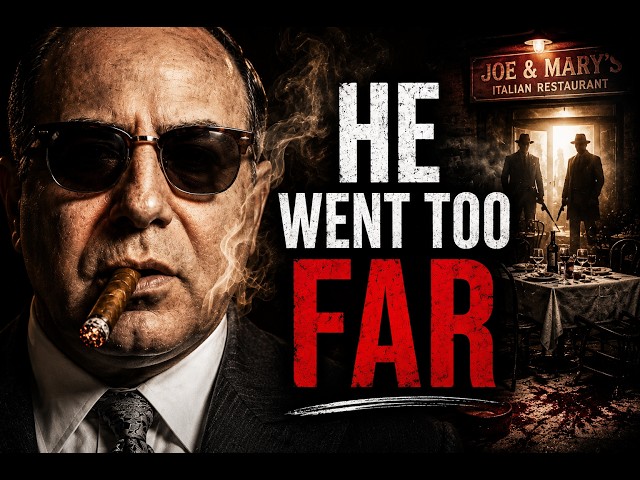
Carmine Galante was one of the most feared Mafia bosses in American history.
He controlled massive heroin networks, challenged the Mafia Commission, and believed he could become the ultimate boss of organized crime in America.
But on July 12, 1979, everything ended in a small Italian restaurant in Brooklyn.
Shot multiple times while eating lunch… with a cigar still burning in his mouth.
This is the complete story of Carmine “Lilo” Galante — from the streets of East Harlem to the bloody assassination that shocked the American underworld forever.
━━━━━━━━━━━━━━
⏱ TIMESTAMPS
00:00 The Assassination Begins
00:53 The Most Iconic Mafia Crime Scene
02:11 Carmine Galante’s Childhood
03:34 First Arrests & Violence
04:45 Enter The Bonanno Family
05:30 Mafia Enforcer Years
06:05 The Carlo Tresca Murder
07:45 Rise Inside The Bonanno Family
09:29 The Heroin Empire
10:49 Prison Changes Nothing
12:14 Released From Prison
13:55 Galante’s Power Grab
15:27 The Commission Gets Nervous
Show More Show Less View Video Transcript
0:00
The date is July twelfth, nineteen seventy-nine.
0:04
It is just after noon on a summer day in Bushwick, Brooklyn.
0:09
At a small Italian restaurant called Joe and Mary's — on a block called Knickerbocker Avenue
0:17
— three men are eating lunch on a rear garden patio.
0:21
One of them is Carmine Galante. Known to almost everyone who feared him as Lilo.
0:28
He is sixty-nine years old.
0:30
He is, at this moment, the most dangerous man in the American underworld.
0:37
He controls the heroin pipeline from Sicily.
0:40
He has openly defied the ruling body of organized crime in America.
0:46
And right now, he is eating grilled fish and drinking wine in the July sun.
0:53
Three gunmen enter through the restaurant kitchen. They move fast. Professionally.
1:00
There is no shouting. No warning.
1:02
In seconds — according to police investigators and court testimony — the patio erupts in
1:10
gunfire.
1:11
Two of the men with Galante are killed instantly.
1:15
Galante himself takes multiple shotgun blasts.
1:18
He is found slumped in his chair, his sunglasses still on his face.
1:24
His cigar — still lit — clenched between his teeth.
1:28
The image of Carmine Galante dead in that chair — cigar in his mouth, eyeglasses intact —
1:35
became one of the most iconic crime scene photographs in American history.
1:41
But photographs tell you where a story ends. They rarely tell you how it began.
1:47
And the story of Carmine Galante begins not in a Brooklyn restaurant garden — but in the
1:54
streets of East Harlem, sixty years earlier, in a world that produced men like him the way a
2:01
furnace produces heat.
2:02
Inevitable. Consuming. Impossible to ignore.
2:11
Carmine Galante — pronounced Car-MEEN Gah-LAHN-tay — was born on February twenty-first,
2:18
nineteen ten, in East Harlem, New York.
2:21
His parents were Sicilian immigrants. His father, Vincenzo, worked the docks.
2:27
His mother kept the family anchored to a neighborhood that was itself barely holding
2:33
together — a maze of tenement buildings, pushcart markets, and the slow, grinding arithmetic
2:40
of poverty.
2:41
East Harlem in the nineteen-tens and twenties was not simply a place. It was a curriculum.
2:47
And young Carmine was an attentive student.
2:51
By the time he was ten years old, Carmine Galante had already been arrested.
2:57
The charge was minor by the standards of what would follow.
3:02
But the pattern it announced was not.
3:05
According to F-B-I records and multiple organized crime historians, Galante was described
3:12
even as a child as having an unusual quality — a stillness.
3:16
A coldness. A capacity for violence that seemed less like anger and more like weather.
3:23
Something that simply arrived. And did what it came to do.
3:28
By his mid-teens, Galante was running with street gangs in East Harlem.
3:33
By seventeen, he was arrested for assault.
3:36
By nineteen, he was serving time in a reformatory. Each arrest was followed by release.
3:42
Each release was followed by escalation. He stole. He fought. He threatened.
3:48
He moved through the criminal ecosystem of Depression-era New York with the quiet efficiency
3:54
of someone who had already decided what he was going to be — and was simply waiting for the
4:00
world to confirm it.
4:02
In nineteen thirty, Galante — now twenty years old — was involved in a shooting in which a
4:09
police officer was wounded.
4:11
He was arrested. He was tried. And for the first of many times in his life, Galante walked.
4:18
The charges were dropped or could not be proven to the jury's satisfaction, depending on
4:25
which account you read.
4:27
What is not in dispute is the effect the acquittal had on his reputation among the men who
4:34
were watching him from above.
4:36
A young man who could kill, stay silent, and walk free — was exactly the kind of man the
4:43
Mafia needed.
4:45
The family that took notice of Carmine Galante was the Bonanno crime family — then led by
4:52
Joseph Bonanno, known in the underworld as Joe Bananas.
4:57
But the man who first put Galante to serious use was Vito Genovese — pronounced VEE-toh
5:04
Jeh-NO-veh-say — one of the most calculating and ruthless figures in organized crime
5:12
history.
5:13
Genovese recognized something in Galante. Not loyalty, exactly.
5:18
Something more useful than loyalty.
5:21
He recognized a man who had no ceiling on what he was willing to do.
5:30
Through the nineteen thirties and into the forties, Galante worked as an enforcer — a
5:36
professional instrument of violence deployed wherever the families required a result that
5:42
could not be achieved through negotiation.
5:45
He developed a reputation not for flamboyance, but for efficiency.
5:50
He was not the kind of man who enjoyed the theater of intimidation.
5:54
He was the kind of man who simply completed assignments.
5:58
And in nineteen forty-three, he was reportedly assigned one that would shadow him for the
6:05
rest of his life.
6:06
On the evening of January eleventh, nineteen forty-three, Carlo Tresca — a prominent
6:15
Italian-American anti-fascist journalist and labor activist — was shot dead on Fifth Avenue
6:24
in Manhattan.
6:25
He was killed in broad street view. One bullet. Clean. Professional.
6:32
Tresca had made powerful enemies on multiple fronts — from Mussolini's agents to American
6:41
communists to the American Mafia, which he had publicly criticized.
6:48
According to multiple investigators, historians, and later F-B-I testimony, the gunman was
6:57
Carmine Galante.
6:59
Galante was questioned. Galante denied everything. No charges were ever filed that stuck.
7:06
But the Tresca killing — if indeed Galante was responsible — was significant for a reason
7:14
beyond the act itself.
7:16
Tresca was not a rival gangster. He was a public intellectual. A voice.
7:22
Eliminating him required either personal conviction or orders from someone with political
7:29
reach well beyond the usual underworld.
7:32
Either way, it confirmed what people already suspected about Carmine Galante.
7:39
He was not simply dangerous. He was useful at the highest level.
7:45
By the late forties, Galante had cemented his position within the Bonanno family.
7:51
He was a capo — a captain — overseeing a crew and building the connections that would
7:57
eventually define his legacy.
7:59
Those connections were not primarily with other American crime families.
8:05
They were with Sicily.
8:06
Galante made multiple trips to Italy during this period, according to law enforcement
8:12
intelligence documents.
8:14
He was cultivating relationships with Sicilian Mafia figures — the Zips, as American
8:20
mobsters would come to call them — who controlled the heroin supply chain moving from the
8:27
poppy fields of Southeast Asia through European laboratories and across the Atlantic.
8:33
He saw what the others, cautiously, were avoiding. He saw the future.
8:39
Joseph Bonanno — JOH-zef Boh-NAN-oh — recognized Galante's organizational intelligence, even
8:46
as he kept him at a measured distance.
8:49
Galante became Bonanno's driver, his bodyguard, his instrument of enforcement.
8:55
Close enough to be trusted. Dangerous enough to be watched.
8:59
In the memoir that Bonanno would later publish — A Man of Honor, released in nineteen
9:06
eighty-three — he described Galante in notably careful terms.
9:10
Capable. Loyal when it served him.
9:13
And possessed of an ambition that had no natural stopping point.
9:18
Bonanno, it seems, understood exactly what he had built. And could not quite contain it.
9:29
The operation that brought Galante down — temporarily — was one of the most significant
9:36
federal narcotics investigations of the nineteen fifties.
9:40
By nineteen fifty-eight, federal authorities had assembled enough evidence to arrest Galante
9:47
on narcotics conspiracy charges.
9:49
The case centered on a heroin pipeline that prosecutors alleged had moved tens of millions
9:56
of dollars worth of product through a network spanning New York, Canada, and Europe.
10:02
The man at the center of it all, investigators said, was Carmine Galante.
10:08
The trial was complex. The evidence was, by the standards of the era, substantial.
10:15
Galante was convicted in nineteen sixty-two on narcotics conspiracy charges and sentenced to
10:22
twenty years in federal prison.
10:24
He was fifty-two years old.
10:26
The sentence seemed, to many observers, like the end of Carmine Galante's story.
10:33
Men who went into federal custody for two decades rarely emerged to reclaim their position.
10:40
The underworld moved on. The alliances shifted. The power redistributed.
10:46
But Carmine Galante was not most men.
10:49
What prison did to Galante is worth pausing on. It did not humble him.
10:55
There is no evidence — from court documents, from law enforcement surveillance, from the
11:01
accounts of former associates — that Galante ever softened during his twelve years of actual
11:09
incarceration.
11:10
He maintained his connections. He issued instructions.
11:14
He kept his eye — with extraordinary patience — fixed on what he intended to do when the
11:21
gates opened again.
11:23
According to multiple law enforcement accounts, Galante ran portions of the Bonanno family's
11:30
operations from inside the walls of the federal penitentiary.
11:35
Prison was not an interruption to Carmine Galante's career. It was a delay.
11:41
It is worth pausing on something else, too. Heroin is not an abstract crime.
11:48
The narcotics pipeline that Galante built and presided over did not exist in a vacuum.
11:55
It fed addiction through working-class neighborhoods of New York and beyond.
12:01
It destroyed families.
12:03
It killed people — slowly and invisibly, in ways that never produced the dramatic crime
12:10
scene photographs of a restaurant patio in Brooklyn.
12:14
The Commission — the ruling council of American organized crime — had officially banned drug
12:22
trafficking for many of its member families, in part due to the severe federal penalties it
12:30
attracted.
12:31
Galante ignored the ban. Quietly, persistently, and with growing confidence.
12:37
Galante was released on parole in nineteen seventy-four.
12:42
He had served twelve years of his twenty-year sentence.
12:46
He walked out of prison into a changed world.
12:49
The Bonanno family had been weakened — by internal betrayals, by the defection of Joe
12:55
Valachi, by federal pressure that had reshaped the landscape of organized crime in New York.
13:02
But the heroin networks Galante had built — and nurtured from inside prison walls — were
13:09
still there.
13:10
Still profitable. And now — available.
13:13
When Carmine Galante emerged from federal custody in nineteen seventy-four, he did not
13:20
return as a cautious man seeking to rebuild quietly.
13:25
He returned as a man who believed — with absolute conviction — that he had earned the right
13:32
to take everything.
13:34
The Bonanno family was his to command. The heroin trade was his to control.
13:40
And the Commission — the combined leadership of New York's five crime families — was an
13:47
obstacle to be managed, circumvented, or simply ignored.
13:52
He began the campaign to seize power almost immediately.
13:57
The Bonanno family that Galante returned to was fractured and vulnerable.
14:03
Its leadership had cycled through turmoil since Joe Bonanno's own forced retirement in the
14:10
mid-nineteen sixties.
14:11
Philip Rastelli — FIL-ip Ras-TEL-ee — technically held the boss position, but his authority
14:19
was contested and his control was weak.
14:22
Galante moved through the family's structure with deliberate force. He elevated loyalists.
14:29
He sidelined rivals.
14:30
He installed Sicilian-born members — the Zips — into key positions, bypassing the existing
14:37
American-born capos who had traditional claim to rank.
14:42
It was not coalition building. It was a coup.
14:46
Galante's ambitions in narcotics were on a scale that alarmed even his own allies.
14:52
The pipeline from Sicily that he had begun cultivating in the late forties was now a mature,
14:58
sophisticated operation.
15:00
Heroin moved through Montreal, through New York, and into distribution networks across the
15:07
eastern seaboard.
15:08
The profits were staggering.
15:10
According to law enforcement estimates cited in congressional testimony, the operation was
15:16
generating tens of millions of dollars annually.
15:20
Galante controlled a significant portion of it. And he intended to control all of it.
15:27
The other four New York families watched Galante's expansion with growing alarm.
15:33
He was not simply getting rich. He was getting powerful.
15:38
And power, in the organized crime world, has a specific grammar.
15:43
When one boss accumulates too much of it, the others face a choice. Submit. Or act.
15:49
The Commission — which included the leadership of the Gambino, Genovese, Lucchese, and
15:56
Colombo families — began to discuss Carmine Galante in the way that commissions discuss
16:03
problems that have grown too large to resolve with a conversation.
16:09
Law enforcement officials who worked organized crime cases in New York during this period
16:16
have spoken about what Galante represented.
16:20
One former F-B-I agent, speaking in a documentary interview recorded in the late nineteen
16:27
nineties, described Galante's position in terms that were almost clinical in their clarity.
16:34
The agent offered this assessment.
16:38
Galante wasn't just running drugs. He was building a parallel power structure.
16:42
He had the Zips loyal to him personally — not to the Commission, not to any family.
16:47
Just to him. The other bosses saw exactly what that meant.
16:51
One man with that kind of supply chain and that kind of private army — he doesn't need the
16:57
Commission.
16:58
And a boss who doesn't need the Commission is a boss who can ignore the Commission.
17:03
Which is exactly what Galante was doing.
17:05
What made Galante uniquely threatening to the established order was not merely his power.
17:12
It was his manner. He made no effort to conceal his contempt for the other bosses.
17:19
He did not attend Commission meetings when summoned.
17:23
He reportedly dismissed their concerns with a directness that, in the world of organized
17:30
crime, was not bluntness.
17:32
It was a declaration.
17:34
According to investigators and mob historians, Galante was known to say — with varying
17:41
degrees of formality — that when he was done, he would be the boss of all bosses.
17:47
Not a position. A throne.
17:49
The Zips — Sicilian-born members brought in by Galante and loyal exclusively to him — were a
17:56
source of particular concern for the Commission.
18:00
They were disciplined, insular, and operated outside the traditional American Mafia chain of
18:07
command.
18:08
They answered to Galante. Not to the family. Not to the Commission. To him.
18:13
This was, in the structural logic of the American Mob, an existential threat.
18:19
The Commission's authority depended on the basic premise that no single man could accumulate
18:26
power independent of the collective.
18:29
Galante was proving that premise wrong. Deliberately. Openly.
18:33
With his cigar clenched between his teeth.
18:39
The decision to kill Carmine Galante was not made in anger. It was made in arithmetic.
18:47
The Commission — or the relevant faction of it, according to law enforcement accounts and
18:55
the testimony of cooperating witnesses — assessed Galante's continued existence as a net
19:03
liability.
19:04
He was too powerful to contain, too arrogant to negotiate with, and too dangerous to leave
19:12
in place.
19:13
The order — reportedly sanctioned by the leadership of multiple families — was issued
19:21
sometime in the spring or early summer of nineteen seventy-nine.
19:27
The location chosen for the hit was Joe and Mary's Italian restaurant on Knickerbocker
19:34
Avenue in Bushwick, Brooklyn.
19:37
The restaurant was owned by a relative of a Bonanno family member.
19:42
It was a place Galante visited regularly — comfortable, familiar, Italian.
19:48
Exactly the kind of environment where a man who believed himself untouchable would lower his
19:56
guard by one crucial degree.
19:58
According to federal prosecutors and testimony from cooperating witnesses in subsequent
20:05
trials, three gunmen entered through the restaurant kitchen.
20:10
They wore ski masks. They were professionals.
20:14
July twelfth, nineteen seventy-nine, was a Thursday.
20:18
The temperature in Brooklyn that afternoon was in the mid-eighties. A summer day.
20:24
Galante had arrived at the restaurant with his two companions — Leonardo Coppola and
20:31
Giuseppe Turano — as well as two armed bodyguards who, according to investigators, may have
20:38
been complicit in the setup.
20:40
The lunch had been going on for some time. The wine was open. The food was mostly eaten.
20:46
The cigar was lit. And then the kitchen door opened.
20:51
What happened next was over in seconds.
20:55
Galante — according to the crime scene reconstruction and witness testimony — did not have
21:03
time to react.
21:05
The shotgun blasts struck him multiple times.
21:09
He died in the chair where he had been sitting. Coppola and Turano were also killed.
21:17
The two bodyguards survived.
21:19
Their survival, investigators later concluded, was not an accident.
21:26
When the police arrived on Knickerbocker Avenue that afternoon, they found Carmine Galante
21:34
exactly as the photographers would record him.
21:38
Slumped in his chair. Sunglasses on. Plate still in front of him.
21:44
And in his mouth — still lit, still burning, still producing its thin column of smoke — the
21:52
cigar.
21:56
The killing made front page news across the country.
22:00
The New York tabloids ran the crime scene photograph — Galante dead in his chair with the
22:07
cigar in his teeth — with the kind of coverage reserved for events that feel like historical
22:14
punctuation marks.
22:15
The New York Times described Galante as one of the most feared figures in organized crime.
22:22
Within the organized crime world itself, the reaction was more muted. More knowing.
22:28
The Commission had spoken. As it always did. In the end.
22:33
Federal investigators would spend years untangling the threads of Galante's murder.
22:39
Three men were eventually identified and charged in connection with the killing.
22:45
Convictions followed — though the exact chain of authorization, as is typical with
22:51
Commission-level decisions, remained difficult to prosecute fully.
22:56
The cooperating witnesses who provided the most detailed accounts came largely through the
23:03
government's use of the RICO — Racketeer Influenced and Corrupt Organizations — statute,
23:09
which by the nineteen eighties was reshaping the federal government's capacity to prosecute
23:16
organized crime from the top down.
23:19
Galante's murder, in a grim irony, became evidence in the prosecutions that would eventually
23:26
cripple the Commission itself.
23:28
Mob historians and criminologists who have studied Galante's career in depth tend to share a
23:36
particular observation about the manner of his death.
23:40
Author and organized crime historian Selwyn Raab — SEL-win Rab — has written about the
23:48
Bonanno family extensively.
23:50
His analysis of Galante, drawn from court records and law enforcement interviews, captures
23:57
the essential paradox of the man.
24:00
Galante understood power. He accumulated it brilliantly.
24:05
What he never understood — or chose not to understand — was that power in the Mafia is never
24:13
entirely personal.
24:14
It exists within a system.
24:16
And when you challenge the system without having fully replaced it, the system finds a way
24:24
to answer you.
24:25
The cigar in his mouth when he died — it became a symbol of defiance.
24:30
But it was also a symbol of miscalculation.
24:34
One of the most troubling — and revealing — details of the Galante assassination is the
24:41
survival of his two bodyguards.
24:44
Both men, who had been positioned to protect Galante, emerged from the shooting unharmed.
24:51
Federal investigators and prosecutors concluded — and subsequent cooperating witness
24:57
testimony suggested — that the bodyguards had been part of the setup.
25:03
They had either stood down or actively facilitated the gunmen's access.
25:09
In the language of the underworld, this had a specific meaning.
25:13
Galante had not simply been killed by the Commission. He had been betrayed by his own.
25:21
A retired organized crime investigator who worked the Bonanno family file during the
25:27
nineteen seventies and eighties offered a perspective that cuts to the center of what
25:34
Galante's death meant institutionally.
25:37
He described the Commission's logic in terms that are worth hearing directly.
25:43
Every organization has a mechanism for dealing with a member who goes rogue.
25:49
Corporations fire people. Governments prosecute. The Mafia kills. It's brutal.
25:54
It's also, in a strange way, functional. Galante was useful to them for a long time.
26:00
And then he became a threat.
26:02
The moment he became a threat — and the moment they concluded he couldn't be reasoned with —
26:08
the outcome was predetermined.
26:10
The only real question was the timing.
26:20
Carmine Galante is buried in Saint John's Cemetery in Queens, New York — the same cemetery
26:27
that holds the remains of several other figures from the American underworld's history.
26:33
His grave is modest by the standards of the neighborhood. But his legacy is not.
26:40
The heroin networks that Galante built — the connections between the Sicilian Mafia and
26:46
American distribution channels — did not die with him in that garden in Bushwick.
26:52
They continued. They evolved.
26:55
They contributed, investigators would later conclude, to what became known as the Pizza
27:01
Connection — a massive heroin smuggling operation run through pizza parlors across the
27:08
northeastern United States that federal prosecutors dismantled through a landmark trial in
27:14
the mid-nineteen eighties.
27:16
Galante had laid the foundation. Others built on it after he was gone.
27:22
The Commission Trial of nineteen eighty-five to nineteen eighty-six — prosecuted by a young
27:29
federal attorney named Rudolph Giuliani — brought down the leadership of all five New York
27:36
crime families simultaneously.
27:38
It was the most successful organized crime prosecution in American history.
27:44
The evidence used in that trial included the mechanisms by which the Commission had
27:50
authorized, and carried out, the killing of figures like Carmine Galante.
27:55
In attempting to silence a man who defied them, the Commission had created a paper trail.
28:02
And paper trails, eventually, lead somewhere.
28:06
Here is the moral inversion at the center of Carmine Galante's story.
28:12
He was, by almost any measure, a violent and destructive man. He killed.
28:19
He trafficked poison.
28:21
He enriched himself at the expense of communities that could not protect themselves from
28:29
what he built.
28:30
And yet — in the specific institutional logic of the American Mafia — he was right.
28:38
The Commission's authority was not moral. It was structural.
28:44
A cartel of power that existed to divide profit and suppress internal warfare.
28:51
Galante understood that structure well enough to see its weaknesses.
28:57
He was simply unwilling — or unable — to survive long enough to exploit them.
29:05
The photograph of Galante dead in his chair — cigar in his mouth, glasses on, body still
29:12
seated as if in conversation — has never quite left the cultural memory of the era.
29:19
It has appeared in books, in documentaries, in exhibitions of crime photography.
29:26
It is one of those images that carries a surplus of meaning beyond what any single reading
29:33
can fully contain.
29:35
Is it a portrait of defiance? Of hubris?
29:38
Of the inevitable consequence of a life built entirely on violence and the refusal to
29:45
recognize limits?
29:47
Perhaps it is all three. Perhaps that is the point.
29:52
Carmine Galante spent his adult life refusing to put down the cigar.
29:58
Not literally — though he was famous for never being seen without one. But metaphorically.
30:06
The cigar was the signal. The performance of a man who could not be told to stop.
30:13
Who would not show deference, would not lower his eyes, would not sit quietly in the lesser
30:22
seat assigned to him by men he considered his inferiors.
30:27
He built real power. He accumulated real wealth.
30:31
He ran a real criminal empire with genuine organizational sophistication.
30:38
And in the end — because he could not complete the transition from powerful captain to
30:46
supreme authority — he was removed.
30:49
With the cigar still lit.
30:52
The story of Carmine Galante is not, at its core, a story about organized crime.
30:59
It is a story about the limits of individual will inside institutional power.
31:05
It is a story about a man who looked at a system designed to contain men exactly like him —
31:13
and believed, with genuine conviction, that he was the exception.
31:18
He was not. No one is.
31:20
But for a brief, dangerous, and consequential period in the history of American organized
31:27
crime — Carmine Galante made the Commission nervous.
31:32
And in that world, in that era, that was its own kind of testament.
31:38
The cigar went out eventually. On a Thursday afternoon in July, in a garden in Brooklyn.
31:46
The smoke rose. Dispersed. And was gone.
#Arts & Entertainment