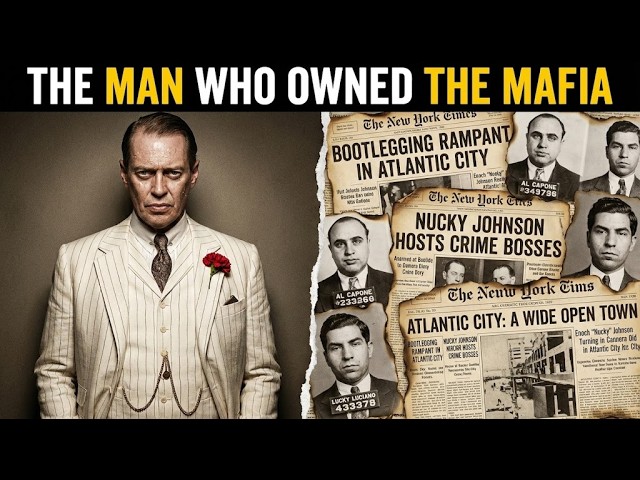
Up next in 10

The year is nineteen twenty-nine. In a smoke-filled suite at the President Hotel, the most powerful criminals in America are gathering. And the man hosting them isn't a gangster. He's a politician.
Enoch "Nucky" Johnson controlled Atlantic City for three decades. Not through violence. Through something far more powerful: the law itself.
While Al Capone hid in Chicago and Lucky Luciano operated from shadows, Nucky walked openly through the Boardwalk in custom suits, greeting voters and criminals with the same warm handshake. Because in Atlantic City, there was no difference.
This is the true story behind HBO's Boardwalk Empire. But the reality was darker, smarter, and far more dangerous than fiction ever showed.
Historical Note: Dialogue and scenes are reconstructed from court records, witness testimony, and documented historical accounts. Some conversations are dramatized for narrative flow.
🏛️ Documentary Includes:
→ The Atlantic City Conference of nineteen twenty-nine
→ How Prohibition created a nine million dollar empire
→ The political machine that made crime legal
→ The economics of vice in America's playground
→ Why the most powerful criminals wore suits, not guns
📚 Sources & Further Reading:
→ Boardwalk Empire: The Birth, High Times, and Corruption of Atlantic City (Nelson Johnson)
Show More Show Less View Video Transcript
0:00
They called it the world's playground. He called it his own. Welcome to the
0:05
empire of Nucky Johnson. His name was Enoch Lewis Johnson, but
0:10
everyone called him Nucky. And for 30 years, he didn't just run Atlantic City.
0:16
He was Atlantic City. While Al Capone killed to stay in power, Nucky signed
0:22
paperwork. While Lucky Luchano hid from federal agents, Nucky posed for
0:27
photographs with them. While Mayor Lansky buried bodies, Naki buried them
0:33
in bureaucracy. By 1929, his empire generated $9 million a year.
0:40
That's 150 million in today's money. And the entire operation was legal because
0:47
Nucky Johnson didn't break the law. He wrote it. This is a documentary about
0:52
power. Real power. the kind that doesn't need a gun because it already owns the
0:58
badge. Some dialogue and specific scenes have been reconstructed from court
1:04
testimony, witness accounts, and historical records to bring this story
1:09
to life. But the pattern is undeniable. A politician became the most successful
1:15
criminal in America, and he did it without committing a single crime that mattered until the day someone finally
1:23
noticed. The year is 1883. Atlantic City is 7 miles of sand dunes
1:30
and broken dreams. The railroad just arrived. A few hotels dot the shoreline.
1:37
Fishermen pull nets through freezing October surf. Enoch Lewis Johnson is
1:43
born into this nothing town to parents who bet everything on the wrong coast.
1:48
His father is a minor political operative. His mother dies when Nucky is
1:53
young. The Atlantic Ocean is loud through thin walls. The boy learns
1:59
early. Politics is family business. Favors are currency. Loyalty is
2:05
survival. At 16, Nucky drops out of school, not because he's stupid, because
2:11
school teaches the wrong lessons. He starts working for his father's political machine, running messages,
2:19
remembering names, learning who owes what to whom. Atlantic City in 1900 is
2:25
transforming. The boardwalk opens. Hotels rise like monuments to American
2:31
excess. New York's wealthy arrive by train to escape summer heat. And with
2:37
them comes money. Real money. Nucky is 17 when he understands the game. The
2:44
hotels need liquor licenses. The politicians grant liquor licenses. The
2:50
politicians need votes. The hotel owners employ voters. It's a circle. And
2:56
whoever controls that circle controls everything. By 1911, Nucky Johnson is
3:02
Atlantic County Sheriff. He's 28 years old, tall, handsome, always in expensive
3:09
suits, even though the salary is $3,000 a year. People notice, they don't ask
3:15
questions because asking questions in Atlantic City is bad for business. The
3:21
sheriff's office in 1912 is on Atlantic Avenue, small, dark wood. Nucky's desk
3:28
faces the door always. He likes to see who's coming. On his desk are three
3:33
items. A telephone, a ledger, and a list of every business owner in Atlantic
3:39
County who needs something. The ledger is the key. It's not evidence of crimes.
3:45
It's evidence of services rendered. A liquor license approved. A building
3:50
inspection delayed. A competitor's permit mysteriously lost. Next to each
3:56
entry is a number. The price of access. Nucky doesn't take bribes. That's
4:02
illegal. He accepts donations to the Republican party. That's politics. By
4:08
1913, the ledger fills faster than Nucky can turn pages. The office door opens on
4:15
a March morning. A hotel owner walks in sweating, nervous. There's been a
4:21
problem. A girl was found dead in one of his rooms. Overdose, probably. Bad for
4:26
business. Very bad. Nucky doesn't stand. He leans back in his chair, asks two
4:32
questions. Is she local? Does she have family with lawyers? The answers are no
4:37
and no. The coroner's report filed 3 days later lists cause of death as heart
4:44
failure. Natural causes. The hotel's name never appears. The owner's donation
4:50
to the Republican party that month is unusually generous. This is the moment
4:55
Nucky Johnson learns the most important lesson. Control the paperwork and you
5:01
control reality. 1914. War begins in Europe. America claims
5:08
neutrality, but money doesn't care about politics. Atlantic City becomes a
5:13
clearing house, not for weapons, for everything else. Luxury goods flowing to
5:19
British buyers. building contracts for coastal fortifications and liquor. So
5:25
much liquor because there's a movement growing. A temperance movement. Women
5:31
marching with signs about demon rum and family values. Churches organizing.
5:37
Politicians in Washington listening. Nucky sees it coming before anyone else.
5:43
Prohibition isn't a moral crusade. It's a business opportunity. He starts making
5:49
calls. quiet calls to Canadian distillers, to shipping companies, to
5:55
warehouse owners along the coast. He's not buying anything. Not yet. Just
6:01
asking questions, learning roots, understanding supply chains. When
6:06
someone asks what he's doing, Nucky smiles, that easy smile, just preparing
6:11
for the worst, he says, hoping for the best. The ledger gets a new section
6:16
written in pencil, easy to erase. 1919. The 18th amendment passes. Prohibition
6:24
becomes law. The manufacture, sale, and transportation of alcohol in America is
6:31
now illegal. Churches celebrate. Temperance leaders declare victory. And
6:36
in a small office on Atlantic Avenue, Nucky Johnson erases the pencil marks
6:42
and writes in ink. The Ritz Carlton Hotel on the boardwalk is 11 stories of
6:47
marble and gold. Nucky takes the entire 9inth floor, not as a residence, as a
6:54
headquarters, five suites connected by interior doors, one for meetings, one
7:00
for entertaining, one for storage, two for guests who need to disappear for a
7:06
while. The rent is $1,200 a month. Nucky pays it personally from the sheriff's
7:12
salary. That's still officially 3,000 a year. Nobody asks about the math. It's
7:19
May of 1920. Prohibition is 6 months old. Every speak easy in America is
7:26
desperate for supply. And Atlantic City has a 9-mile coastline with 300 boats
7:33
and 4,000 hotel rooms where federal agents are quietly discouraged from
7:38
checking too carefully. The system works like this. Canadian whiskey arrives on
7:44
ships that anchor 12 mi offshore just beyond federal jurisdiction. Small boats
7:51
motor out at night, their fishing boats officially. The cargo manifests list
7:57
mackerel and cod. The crates loaded below deck contain something more
8:02
valuable. Those boats dock at marina's nucky controls, not directly, through
8:08
shell companies, through friends who owe favors, through family members with
8:13
clean names. The crates move to warehouses. The warehouses are owned by
8:18
the Republican party of Atlantic County. Nucky is the treasurer of that party.
8:24
The warehouses are inspected regularly by the sheriff's office. Nucky is the
8:29
sheriff. From warehouses, trucks carry crates to hotels to private clubs to
8:36
restaurants with back rooms. Every establishment has a liquor license from the city. Those licenses are approved by
8:44
the city commission. The city commission is appointed by the Republican party.
8:49
The circle is perfect, self-contained, self-protecting.
8:54
And at the center of that circle is a man in a white suit who never touches a bottle but controls every drop. By 1921,
9:04
Nucky Johnson's operation moves $15,000 cases a month. At $50 a case, that's
9:11
$750,000 monthly. And Nucky doesn't keep it all.
9:16
That would be greedy. He pays everyone. Police captains get 200 a month to look
9:22
the wrong direction. Federal agents get 500 to file reports without checking too
9:28
carefully. Judges get a thousand to remember that the Fourth Amendment requires probable cause. And Atlantic
9:36
City somehow never has any. Politicians get campaign contributions.
9:42
Voters get jobs. And hotel owners get the one thing that matters. Customers
9:48
who keep coming back. The boardwalk on a Saturday night in 1922 is America's ID
9:54
made visible. Women in short dresses and pearls. Men in tuxedos stumbling between
10:01
clubs. Jazz music pouring from every doorway. The ocean roaring like
10:06
applause. A federal agent stands at the corner of Atlantic and South Carolina
10:12
Avenue. Watching, taking notes. He's new, transferred from Philadelphia. He
10:19
doesn't understand the rules yet. Nucky walks past him, tips his hat, smiles,
10:25
keeps walking. The agent follows for three blocks, watching Nucky stop and
10:30
shake hands, watching hotel doormen nod with respect. Watching police officers
10:36
step aside, the agent approaches a local cop, asks who that man in white is. The
10:42
cop looks at the agent like he just asked who George Washington was. That's Nucky Johnson. The cop says he runs
10:50
things here. Runs what things? The agent asks. The cop doesn't answer, just walks
10:55
away. By Monday, the federal agent is transferred to Montana. His replacement
11:02
knows better than to ask questions. Now, here's where the story takes a turn no
11:07
one expected. Because Ny's empire isn't built on secrecy. It's built on
11:13
visibility. He wants to be seen. Needs to be seen. Every photograph, every
11:20
handshake, every public appearance is a message. This is my city. I am
11:25
untouchable because power isn't what you hide. It's what everyone knows and can't
11:31
do anything about. And in 1929, Nucky decides to prove it. The Atlantic
11:38
City Conference begins on May 13th, 1929. Historians will call it the most
11:45
significant crime summit in American history. At the time, it's just called a
11:50
convention. The President Hotel on the boardwalk. Three floors booked solid. No
11:57
other guests. Security at every entrance. Not hired muscle. Atlantic
12:02
City police officers in uniform being paid overtime by the Republican party.
12:09
The men arriving that week are the most wanted criminals in America. Al Capone
12:15
from Chicago, Lucky Luchano from New York, Mayor Lanski, Frank Costello,
12:21
Johnny Torio, Longilman, Joe Adenis. They don't sneak in through back doors.
12:28
They walk through the lobby. They pose for photographs on the boardwalk because
12:33
in Atlantic City, being a criminal isn't illegal if the sheriff says it isn't.
12:39
And the sheriff is hosting. Nucky Johnson stands at the head of the conference table on the first night.
12:46
White linen suit, gold watch chain, glass of champagne. He's not the most
12:52
violent man in the room, not the richest, not the most feared, but he's
12:57
the only one who can gather these men in one place without someone getting killed
13:02
because he offers something none of them possess. Legitimacy. The conference
13:08
lasts 4 days. The discussions are never recorded. No minutes, no notes, but the
13:14
outcomes become clear within months. National distribution territories are
13:19
established. Chicago gets the Midwest. New York gets the East Coast. Miami gets
13:26
the South. And disputes will be settled through arbitration, not assassination.
13:32
The American Mafia doesn't begin at the Atlantic City Conference, but it gets
13:37
organized there, structured, professionalized, and Nucky Johnson
13:42
becomes the closest thing organized crime has to a founding father. There's
13:48
a photograph from that week, May 16th, 1929.
13:53
Nucky and Al Capone standing on the boardwalk, both in light colored suits,
13:58
both smiling. Capone's bodyguard visible over his shoulder. The photograph runs
14:04
in newspapers across the country. Federal agents in Washington see it. Jay
14:10
Edgar Hoover sees it. Treasury Department officials see it. They all see the same thing. Proof. But proof of
14:18
what? Two men standing on a public street. No crime, no transaction, just a
14:24
photograph. And that's the genius of Knucky's system. Everything is visible.
14:30
Nothing is prosecutable until someone realizes the one thing Nucky can't make
14:35
disappear. Numbers. The year is 1935. Prohibition is over. The 18th Amendment
14:43
repealed. The speak easys are legal now. The bootlegging routes are obsolete.
14:49
Atlantic City should collapse. The entire economy was built on illegal liquor. Now liquor is legal everywhere.
14:57
New York, Philadelphia, Chicago. Why travel to Atlantic City? But the city
15:03
doesn't collapse because Nucky Johnson already pivoted. Gambling, prostitution,
15:09
entertainment, the things that are still illegal everywhere else but tolerated in Atlantic City. The hotels stay full. The
15:18
political machine keeps running. The donations keep flowing. Nucky is 52
15:24
years old, still wearing white suits, still walking the boardwalk like a king,
15:29
greeting subjects, still untouchable, except the federal government is
15:34
evolving, too. A young Treasury agent named Frank Miles arrives in Atlantic
15:40
City in 1936. He's not here for bootlegging. He's here for something simpler, taxes, because
15:48
Nucky Johnson files tax returns every year, like every American. And according
15:54
to those returns, his income is roughly $10,000 annually. Sheriff's salary plus
16:01
small investments. But Nucky lives in a suite that costs $1,200 a month. Wears
16:07
custom suits that cost $300 each. Drives a Cadillac. Owns a yacht. Employs a
16:14
staff of 12. The math doesn't work. Miles doesn't raid warehouses. Doesn't
16:20
chase bootleggers. He sits in a small rented office and reads ledgers, bank
16:26
statements, property deeds, purchase records. This is the same strategy that
16:32
took down Al Capone, not violence, accounting, and Nucky Johnson is about
16:37
to learn that you can control police and judges and politicians, but you can't
16:43
control arithmetic. The investigation takes 3 years. Miles works quietly,
16:50
building a case one receipt at a time. Every hotel bill, every car purchase,
16:56
every campaign contribution that went through Ny's hands. By 1939,
17:02
Miles has proof not of bootlegging, not of bribery, of tax evasion. Nucky
17:09
Johnson declared 10,000 in income. He spent 300,000.
17:14
The difference is a federal crime. On August 7th, 1941,
17:20
Enoch Lewis Johnson is indicted on federal tax evasion charges. The same
17:26
charges that destroyed Capone. The news runs on front pages across America.
17:33
Atlantic City's political boss, the man who controlled the city for 30 years,
17:39
the man who hosted America's most powerful criminals and walked away untouched. Finally charged. Not for what
17:47
everyone knew, for what he tried to hide. The trial begins in September of
17:52
1941. Federal courthouse in Trenton, New Jersey. Nucky sits at the defense table
18:00
in a dark suit. Not white. For the first time in decades, not white. The
18:05
prosecution presents 300 exhibits. Bank statements showing deposits that dwarf
18:11
declared income. property records listing assets never mentioned on tax
18:17
forms. Witnesses testifying to cash payments for services rendered. Nucky's
18:23
defense is simple. The money wasn't his. It was political contributions.
18:29
Funds that passed through his hands to the Republican party. He was a conduit,
18:35
not a beneficiary. The prosecution responds with one question. If the money
18:40
wasn't yours, why did you spend it? No answer. The jury deliberates for 6
18:46
hours. They return on October 3rd, 1941. Guilty on all counts. Nucky Johnson is
18:54
sentenced to 10 years in federal prison. He's 58 years old. The empire that took
19:00
three decades to build collapses in 3 weeks. The hotels find new management.
19:07
The political machine fragments. The police commissioners retire. The city
19:13
commission reorganizes. And Atlantic City becomes what it was always supposed to be, just another
19:19
beach town. Nucky serves 4 years. Released in 1945 for good behavior. He
19:27
returns to Atlantic City. Not to power, to obscurity. A small apartment three
19:33
blocks from the boardwalk. A modest pension. no white suits. He lives another 23 years walking the same
19:41
streets where he once ruled. Watching the city change, watching new generations who don't know his name.
19:48
Enoch Lewis Johnson dies on December 9th, 1968. Age 85. The obituary in the
19:56
local paper is six paragraphs. It mentions his time as sheriff, his
20:01
conviction, his sentence. It doesn't mention the empire, the conference, the
20:07
power. Because Atlantic City has a short memory. And Nucky Johnson's greatest
20:12
achievement was also his fatal flaw. He made it all looks so easy that people
20:18
forgot it was a crime. Take a breath. Because from here on, the story only
20:23
gets darker. Not because of what Nucky did, but because of what his model
20:28
created. The Atlantic City system didn't die with Nucky. It evolved the same
20:34
basic structure. Political protection for organized vice. Legitimate
20:40
businesses hiding illegal operations. Power concentrated in one person who
20:46
controls the paperwork. Las Vegas in the 1950s used NIS template, the casino
20:53
licenses, the political donations, the controlled corruption. Miami in the
20:59
1960s, same system. Atlantic City itself in the
21:05
1970s when casino gambling became legal. The buildings changed, the names
21:12
changed. But the structure Nucky built survived because Nucky Johnson didn't
21:17
invent corruption. He industrialized it, made it scalable, repeatable, and proved
21:24
that the most dangerous criminal isn't the one who hides, it's the one who governs. His ledger from 1913 still
21:32
exists, kept in the Atlantic County Historical Society. 40 pages of names
21:39
and numbers, evidence of crimes that can't be prosecuted because everyone
21:44
involved is dead, and the statute of limitations expired 70 years ago.
21:50
Researchers can request to see it. The archivist brings it out in a protective
21:55
sleeve. You can't touch the pages, just look. Every entry is the same format. a
22:02
name, a service, a number, no moral judgments, no justifications,
22:08
just transactions. And at the bottom of the final page, in Ni's handwriting, a
22:14
single sentence, balanced and closed, December 1941,
22:20
the month he went to prison, the month the empire ended. He balanced the books
22:25
before he left. Like any good accountant, the President Hotel where the Atlantic City Conference happened
22:33
was demolished in 1967, one year before Nucky died. A casino
22:39
stands there now. The guests gambling inside have no idea they are standing
22:45
where American organized crime became a business. The Ritz Carlton where Nucky
22:50
kept his suite is gone too. Condominiums now expensive ones. Ocean views. The
22:58
9inth floor where he ran the city for 20 years is divided into luxury apartments.
23:04
If you stand on the boardwalk at Atlantic and South Carolina Avenue, you can still see the view Naki saw the
23:11
ocean, the hotels, the crowds. What you can't see is the infrastructure
23:17
underneath, the political connections, the financial networks, the systems of
23:23
power that turn vice into profit. Because that infrastructure is invisible. It always was. Nucky Johnson
23:31
understood something most criminals don't. Power isn't about force. It's
23:36
about permission. And the fastest way to get permission is to be the one granting it. He didn't break into the system. He
23:44
became the system. And for 30 years, that made him untouchable. Right up
23:50
until the moment it didn't. There's a question historians still debate. Was
23:55
Nucky Johnson a political boss who became a criminal or a criminal who
24:00
became a political boss? The answer matters less than the method because
24:05
Nucky proved that the line between legitimate power and criminal power isn't a line at all. It's a circle. And
24:13
whoever controls that circle writes the rules. Atlantic City in 1920 was wide
24:20
open. A frontier town where law was negotiable and power was for sale. Nucky
24:27
didn't create that environment. He just monetized it better than anyone else.
24:32
But the model he built outlived him. It's visible today in every city where
24:38
political power and criminal enterprise share a handshake, where licenses are
24:44
granted to the right contributors, where enforcement is selective, where the law
24:49
applies to some but not to others. Nucky Johnson died in obscurity, but his
24:56
system is immortal. Atlantic City didn't fall because Nucky Johnson was a
25:01
criminal. It fell because he finally looked like one. The white suits, the
25:07
public conferences, the photographs with gangsters. For years that visibility was
25:13
armor, proof of untouchability. Then overnight it became evidence. Same
25:18
actions, same man, different context. And that's the real lesson of Nucky
25:24
Johnson's empire. Power doesn't corrupt. It just stops pretending. And the moment
25:29
you stop pretending is the moment someone finally sees you clearly. Was
25:34
Nucky Johnson a villain who destroyed Atlantic City's soul or a pragmatist who
25:40
gave the city exactly what it wanted? Comment one word, villain or pragmatist.
25:46
His model is still out there in different cities, different names, same
25:51
structure. We're investigating them all. Subscribe, hit the bell, we go deeper
25:57
every week. Atlantic City didn't fall because Nucky Johnson was a criminal. It
26:03
fell because he finally looked like one. The photograph of Nucky and Al Capone on
26:09
the boardwalk creates a problem Nucky doesn't see coming. Not in Atlantic
26:14
City. There, the photo is proof of power. Local newspapers run it with
26:19
pride. Atlantic City's sheriff entertaining America's most famous
26:24
criminal. Business as usual. But in Washington, that photograph lands on the
26:31
desk of J. Edgar Hoover, director of the Bureau of Investigation. The agency that
26:38
will become the FBI. Hoover circles Knucky's face in red pen. Writes a
26:44
single word in the margin. Interested. Not enough for an investigation. Not
26:49
yet. just a name to remember, a face to watch. Because Hoover is building
26:55
something new, a federal law enforcement apparatus that doesn't respect local
27:00
political protection, and men like Nucky Johnson are exactly the kind of target
27:06
that could prove the bureau's value. The file labeled Johnson Enoch L is opened
27:12
on June 4th, 1929, 3 weeks after the Atlantic City
27:18
Conference ends. It's thin at first, just the newspaper clipping. A few
27:23
reports from agents who happened to be in Atlantic City that week. Nothing actionable, but files have a way of
27:30
growing. May of 1930, the stock market crashed 7 months ago. The depression is
27:37
crushing America. Banks failing, unemployment rising, breadlines forming
27:43
in every major city. Atlantic City is packed. Because when the world falls
27:49
apart, people want to forget, and Atlantic City sells for getting better than anywhere else. The hotels are full,
27:57
the clubs are packed, money flows through Knucky's system like nothing changed. Except something did change.
28:06
The federal government is desperate for revenue. Income tax becomes the primary
28:11
source of federal funding. And that means the Treasury Department starts looking very carefully at people whose
28:19
spending doesn't match their declared income. People like Nucky Johnson. A
28:24
Treasury agent named William Frank is assigned to the Newark field office in
28:29
1931. He's 32 years old. Accounting degree
28:34
from Rutgers. No sense of humor. The kind of man who balances his personal
28:40
checkbook to the penny. Frank's supervisor hands him a stack of files.
28:46
Routine audits, small businesses suspected of under reporting. Nothing
28:51
glamorous. At the bottom of the stack is a file on Atlantic County's Republican
28:57
Party finances, just a standard review. The party reported 50,000 in donations
29:04
last year. The Treasury wants to verify. Frank opens the file on a Tuesday
29:10
morning in March. By Wednesday afternoon, he knows something is wrong.
29:16
The Republican Party of Atlantic County lists its treasurer as Enoch L. Johnson.
29:22
The same Enoch Johnson, who is Atlantic County Sheriff. Salary $3,000 per year.
29:30
The party's expenses last year included 12,000 for office space. That office
29:36
space is nine suites at the Ritz Colton Hotel. Monthly rent listed as 1,000 per
29:42
month. Frank does the math. 12 months, 1,000 per month, 12,000 total. But the
29:50
Ritz Scolton's published rates show those suites cost 1,400 per month.
29:56
16,800 per year. Someone is paying the difference. $4,800.
30:02
that money isn't in the party's ledger. Frank writes a note, requests Johnson's
30:08
personal tax returns, starts building a timeline. This is minute 17. Pay
30:14
attention to what happens next. It's easy to miss because William Frank
30:20
doesn't raid anything, doesn't arrest anyone, doesn't even interview Naki. He
30:25
just reads and takes notes and requests more documents. This is how empires
30:30
fall, not with explosions, with addition. Nucky Johnson in 1932
30:37
is at absolute peak power. The city council is entirely his appointments.
30:43
The police chief reports directly to him. The mayor is a figurehead who signs
30:49
what Nucky puts in front of him. There are 43 hotels on the boardwalk. 38 of
30:56
them have liquor licenses approved through Knucky's office. The other five are owned by people who refused to
31:03
contribute to the Republican party. They struggle. Permits delayed. Inspections
31:09
frequent. Mysterious problems with electrical and plumbing. Eventually,
31:15
they sell to buyers recommended by Nucky who suddenly find permits approved
31:20
immediately. The system is perfect, self-regulating, self-protecting, and
31:27
completely dependent on one man staying in power. Summer of 1933,
31:33
prohibition ends. The 21st amendment is ratified. Alcohol is legal again. Every
31:40
bootleggger in America faces the same crisis. Their entire business model just
31:46
evaporated. The Canadian whiskey roots are obsolete. The offshore operations
31:52
are worthless. The speak easys can operate openly now as legal bars.
31:58
Atlantic City should collapse. The whole economy was built on illegal liquor. But
32:04
Nucky pivoted months before repeal. He saw it coming. Started shifting
32:09
operations. Gambling becomes the new liquor. Still illegal everywhere else.
32:15
Tolerated in Atlantic City. The back rooms of clubs that served bootleg
32:20
whiskey now house roulette tables. Craps poker. The same protection system
32:27
applies. The same political machinery, just a different product. And
32:32
prostitution, always prostitution. The hotels that once bribed inspectors to
32:38
ignore liquor now bribe inspectors to ignore the women working the lobbies and hallways. High-end operations.
32:46
discreet, expensive. Nucky doesn't run the brothel. That would be crude. He
32:52
just makes sure the owners have proper business licenses. That the police don't
32:57
raid during busy weekends. That the girls who get arrested are released quickly with charges dropped for a fee,
33:05
not to Nucky personally, to the Republican Party of Atlantic County. Tax
33:11
deductible campaign contributions. By 1934, the post-prohibition empire
33:18
generates more revenue than the Prohibition Empire ever did. Because
33:23
gambling and prostitution have higher margins than bootlegging, no supply
33:28
chain, no shipping costs, just service and access. Ny's personal spending that
33:35
year reaches $280,000. Custom suits, the yacht, the Cadillac,
33:41
the staff, the suite. His declared income on his 1934 tax return is $9,500.
33:50
The math is becoming impossible to ignore. William Frank now has six file
33:55
boxes of documents, bank statements, property records, purchase receipts,
34:02
hotel bills. Every piece of paper creates a clearer picture. Enoch Johnson
34:07
spends 30 times what he earns every single year. Frank brings the
34:13
discrepancy to his supervisor in January of 1935, requests authorization to open a formal
34:20
investigation. The supervisor looks at the name, looks at Frank, asks if he understands who
34:27
Enoch Johnson is. Frank says yes, a county sheriff. The supervisor says no.
34:34
The political boss of Atlantic City, connected to every Republican in New
34:39
Jersey, friends with senators, contributors to gubanatorial campaigns.
34:45
This isn't an audit anymore. It's a political bomb. Frank asks if that
34:50
matters. The supervisor stares at him. Finally says it doesn't. Not if the
34:55
evidence is solid. Authorizes the investigation with one condition.
35:01
Absolute discretion. No leaks. No field interviews, paper only until the case is
35:07
airtight. Frank goes back to his boxes, keeps reading, keeps adding. Nucky has
35:14
no idea the boxes exist. Atlantic City in 1936 is booming. The depression is
35:21
everywhere else. Here, the hotels are full, the clubs are packed, the
35:26
boardwalk is crowded every weekend. Nucky walks it every Sunday afternoon.
35:31
Same routine for 20 years. White suit, gold handled cane he doesn't need but
35:38
carries anyway. Stopping every 50 ft to shake hands. Pose for photographs. Ask
35:44
about families. Voters love him. Business owners respect him. Criminals
35:49
fear him. He's 53 years old, healthy, powerful, untouchable. On a Sunday in
35:56
April, Nucky stops at the corner of Atlantic and Pennsylvania. There's a new
36:01
building going up. 16 stories. Another hotel. The construction foreman
36:08
approaches. Nervous. There's a problem with the permits. The city inspector is
36:14
requiring additional fire safety measures. It'll delay opening by 3
36:19
months. Nucky asks who the inspector is. The foreman gives the name. Nucky nods.
36:26
Tells the foreman the inspection will be resolved by Tuesday. opening stays on
36:31
schedule. The foreman asks how Nucky doesn't answer, just smiles, keeps
36:37
walking. Monday morning, the inspector receives a call from the city safety
36:42
commission. The additional fire safety measures are waved. Approved as
36:48
submitted, the inspector asks why. The commission says new guidance from the
36:54
Republican party's building standards committee. The inspector is free to approve immediately. The inspector knows
37:02
there is no building standards committee approves anyway. Tuesday morning,
37:07
construction resumes. This is how Nucky governs. No threats, no violence, just
37:14
phone calls. Just systems that exist because he built them and run because he
37:19
maintains them. But every phone call is a transaction. Every waved inspection is
37:26
a favor and favors create records. William Frank is collecting those
37:31
records. By 1937, Frank has testimony from 12 witnesses,
37:38
not criminals, accountants, bank managers, hotel clerks, people who
37:44
handled money and kept receipts and can testify about transactions.
37:49
None of them implicate Nucky in bootlegging or gambling or prostitution.
37:54
They just show money flowing in directions that don't make sense unless Enoch Johnson is spending party funds as
38:02
personal income, which is embezzlement and tax evasion. Frank writes a 200page
38:09
report, submits it to the Treasury Department in October of 1937,
38:15
recommends criminal prosecution. The report sits for 8 months because
38:21
prosecuting Nucky Johnson isn't like prosecuting a bootleger. It's prosecuting a sitting county sheriff, a
38:29
political boss, a man with connections to every level of New Jersey government.
38:34
The Treasury Department needs approval from Washington, from the Attorney General's office, from people who
38:41
understand the political consequences. While the report waits, Nucky keeps walking the boardwalk. keeps shaking
38:48
hands, keeps running the city, still untouchable, still invisible until May
38:55
of 1938 when J. Edgar Hoover's office receives a
39:00
copy of William Frank's report. Hoover remembers the photograph from 1929.
39:07
Remembers the notation. Interested. Now he's very interested because Hoover is
39:14
building the FBI into America's premier law enforcement agency and taking down
39:20
political bosses is exactly the kind of high-profile victory that builds
39:26
institutional power. Hoover writes a memo to the Treasury Department. The
39:32
Bureau of Investigation offers full support for the Johnson prosecution.
39:37
agents, resources, whatever is needed. The message is clear. This isn't just
39:43
the Treasury Department anymore. This is federal. Authorization for prosecution
39:49
is granted on June 15th, 1938. William Frank is assigned to FBI agents,
39:57
given access to bureau resources, told to build an indictment Trey case. The
40:03
investigation that was quiet becomes operational. And in Atlantic City, Nucky
40:09
Johnson still has no idea the boxes exist. No idea Frank exists. No idea
40:16
that every receipt and bank statement and hotel bill from the last decade is
40:21
being assembled into evidence. He's still walking the boardwalk in white suits. Still hosting politicians at the
40:28
Ritz Carlton, still running the machine, still untouchable for exactly three more
40:34
years. Summer of 1939, Europe goes to war again. America
40:41
declares neutrality again and Atlantic City becomes profitable again. War means
40:47
soldiers on leave. War means government contracts. War means money flowing
40:53
through coastal cities. Naki's system absorbs it all. The hotels fill with
40:59
military officers. The clubs fill with defense contractors. The money keeps
41:04
flowing. His declared income in 1939 is $11,000.
41:10
His spending is $320,000. William Frank adds it to the boxes.
41:17
There are now nine boxes organized by year, cross-referenced by transaction,
41:23
every deposit, every withdrawal, every unexplained expenditure. Frank has
41:29
testimony from 18 witnesses. He has bank records from four institutions. He has
41:36
property deeds showing purchases made in cash that Ny's tax returns don't
41:41
explain. The case is ready, airtight, overwhelming. On November 2nd, 1939,
41:49
Frank delivers the completed investigation to the US Attorney for New
41:54
Jersey. Recommended charges: Willful tax evasion. 1933 through 1939.
42:02
Seven counts. Potential sentence 50 years. The US attorney reads the
42:08
summary, asks Frank one question. Are you certain? Frank is certain. The
42:13
indictment is drafted, reviewed, approved, and then it waits. Because indicting a sitting county sheriff
42:20
requires timing, coordination, preparation for the political earthquake
42:25
that will follow, the indictment is sealed. The date is chosen. August 7th,
42:32
1941. Nucky Johnson walks the boardwalk that morning. Same routine, white suit, gold
42:40
cane, shaking hands, smiling. At 2:30 p.m., two federal marshals enter the
42:47
sheriff's office on Atlantic Avenue. They carry a warrant. Nucky is at his desk, the same desk he sat behind for 30
42:55
years. The marshals read the charges. Seven counts of willful income tax
43:01
evasion. Total amount $265,000 in unpaid taxes. Nucky doesn't stand,
43:09
doesn't react, just asks if he can make a phone call. The marshals say yes.
43:14
Nucky calls his attorney, says seven words. They finally found something that
43:19
matters. Hangs up, stands, puts on his jacket, straightens his tie, walks out
43:26
of the office he's occupied for three decades into a federal vehicle to a
43:31
courthouse in Trenton. The machine he built keeps running for exactly six more
43:36
hours. Then it starts collapsing. By 8:00 p.m., three city commissioners
43:42
resign. By midnight, five police captains request transfers. By morning,
43:48
the mayor announces he won't seek re-election because the machine wasn't a system. It was one man, and that man
43:56
just got indicted. Atlantic City in August of 1941 is a city holding its
44:03
breath. The hotels are still full. The clubs are still open. The gambling still
44:09
happens. The prostitution continues, but the protection is gone. The political
44:15
cover is evaporating. And every business owner who paid into Nucky's system is
44:21
suddenly exposed. Federal agents who couldn't get search warrants for 20 years suddenly find judges very
44:28
cooperative. Raids happen. Arrests follow. The same operations that ran
44:35
openly for decades are now criminal enterprises because they always were
44:40
criminal. The only thing that changed is who's protecting them. And Nucky Johnson
44:46
is in a federal holding cell in Trenton reading the indictment that just destroyed everything he built. Nine
44:54
pages, seven counts. $265,000. Not a word about bootlegging or gambling
45:02
or prostitution or political corruption. Just numbers, just math. Just the one
45:08
thing Nucky couldn't control. Arithmetic. The trial date is set for
45:13
September 15th, 1941. Niy's attorney asks for a postponement.
45:20
Denied. Asks to move the trial to Atlantic City. Denied. Asks to suppress
45:26
the financial evidence. denied. Every motion fails because the case isn't
45:31
about politics. It's about taxes. And tax evasion is the one crime where
45:37
political connections don't matter. You either paid or you didn't. The math
45:42
doesn't care who you know. Nucky sits in the holding cell and realizes something he should have understood years ago.
45:50
Visibility was never armor. It was evidence. every photograph, every public
45:56
appearance, every expensive suit and luxury car and Ritz Sculton's suite,
46:02
every piece of the image he built to project power. All of it is now a prosecutor's exhibit, proof he spent
46:09
money he didn't declare, proof he lived beyond his means, proof he lied on his
46:15
tax returns for a decade. The very thing that made him untouchable made him
46:20
prosecutable. And there's no political fix for this. No favor to call in, no
46:26
inspector to bribe, no permit to wave, just nine boxes of receipts and a
46:32
treasury agent who can add. September 14th, 1941,
46:37
the night before trial begins. Knucky's attorney visits the holding cell. Brings
46:43
a final plea offer from the prosecution. Plead guilty to three counts. Sentencing
46:49
recommendation. 6 years. Eligible for parole in three. Naki asks, "What
46:56
happens if he goes to trial? The attorney is honest. You'll lose. The
47:01
evidence is overwhelming and the sentence could be 30 years." Naki asks
47:06
if there's any chance of winning. The attorney says, "No, not unless the jury
47:12
decides to ignore mathematics." Nucky sits silent for a long time, then asks
47:18
what the attorney recommends. The attorney recommends taking the deal. Nucky refuses because taking the deal
47:26
means admitting guilt. Means accepting that everything he built was criminal.
47:31
Means the story ends with surrender. And Nucky Johnson has never surrendered in
47:36
his life. The trial will happen. Let them prove it. The trial begins at 9:00
47:42
a.m. on September 15th, 1941. Federal courthouse packed gallery.
47:49
Reporters from New York, Philadelphia, Washington. Nucky sits at the defense
47:55
table wearing a dark suit, not white. The white suits are gone now. Evidence
48:00
locker. Exhibit G through exhibit M. Six white suits. Combined cost $1,800.
48:09
One year of declared income. The prosecution's opening statement takes 40
48:14
minutes. We will prove that Enoch Johnson declared $11,000
48:20
average annual income from 1933 to 1939. We will prove he spent an average of
48:27
$270,000 those same years. We will prove the difference is unexplained, unreported,
48:35
and constitutes willful tax evasion. Simple, mathematical, devastating. The
48:42
defense's opening statement takes 12 minutes. Enoch Johnson is a public
48:47
servant who devoted his life to Atlantic City. The money in question was
48:52
political funds, campaign contributions, party expenses, not personal income. The
49:00
prosecutor stands for rebuttal. Asks one question. If the money wasn't personal,
49:05
why was it spent on personal suits, personal cars, personal yacht memberships, and personal hotels suites?
49:13
No answer. The trial lasts 3 weeks. The prosecution calls 42 witnesses. Bank
49:20
managers testifying about deposits. Hotel clerks testifying about bills paid
49:26
in cash. Taylor's testifying about custom suit orders. William Frank
49:32
testifies for 6 hours walking the jury through the boxes year by year, receipt
49:39
by receipt. Showing the pattern, income declared, spending documented, the gap
49:46
between them. The defense calls eight witnesses, character witnesses, Atlantic
49:52
City residents testifying that Nucky was a good sheriff, a helpful neighbor, a
49:58
generous man. The prosecution doesn't object, doesn't cross-examine aggressively because none of it matters.
50:05
Character doesn't change mathematics. On October 2nd, 1941, closing arguments
50:12
begin. The prosecution goes first. 60 minutes summarizing the evidence,
50:18
showing the jury in large charts, income versus spending year after year after
50:25
year. The conclusion is inescapable. Enoch Johnson lied on his tax returns
50:32
willfully repeatedly for 7 years. The defense closes with 30 minutes arguing
50:39
reasonable doubt, arguing that political funds are complicated, arguing that
50:44
Nucky believed he was acting legally. The jury deliberates for 6 hours. They
50:50
return at 4:47 p.m. guilty. All seven counts. Nucky doesn't react, just sits,
50:58
staring straight ahead. Sentencing is scheduled for October 10th. That week is
51:03
the longest of Ni's life. Sitting in a cell waiting to learn how much of his remaining years will be spent in federal
51:10
prison. He's 58 years old, healthy, but 58. 6 years means 64 when released. 10
51:19
years means 68. 30 years means he dies inside. October 10th, sentencing
51:25
hearing. The judge asks if Nucky has anything to say. Nucky stands speaks for
51:32
90 seconds. I served Atlantic City for 30 years. I helped build it from a
51:37
resort town into a city. I employed thousands. I brought prosperity. If I
51:43
made mistakes in my accounting, they were honest mistakes. I never stole. I never killed. I just helped people. The
51:51
judge listens, thanks him, delivers the sentence. 10 years in federal prison,
51:58
eligible for parole after serving one-third of sentence. Nucky sits, the
52:03
marshals approach, and the man who ran Atlantic City for three decades is led
52:09
out of the courtroom in handcuffs. The empire doesn't gradually decline. It
52:14
implodes. Within a month, 15 city officials resign or are indicted. Within
52:21
6 months, the entire Republican political structure of Atlantic County collapses. The machine Knuck built over
52:29
30 years disassembles in under a year because it was never a machine. It was a
52:36
monarchy. And monarchies don't survive the king's arrest. The hotels keep
52:41
running. The clubs stay open. Atlantic City continues, but the protection is
52:47
gone. Federal agents raid gambling operations that ran openly for decades.
52:54
Prostitution arrests increase. The same businesses that paid Nucky for
52:59
protection are now prosecuted without mercy. And every business owner who
53:05
contributed to the Republican Party of Atlantic County suddenly can't remember
53:10
making those contributions. Records are lost. Ledgers disappear. Memories fade.
53:17
Within 18 months, Atlantic City is just another coastal town with gambling
53:23
problems and struggling tourism. The golden age is over, and Enoch Johnson is
53:29
in a federal prison in Lewisburg, Pennsylvania, wearing a number instead of a white suit, learning that power has
53:36
an expiration date. But there was someone else watching. Someone whose name you'll hear again. Because what
53:43
Nucky built didn't die, it evolved. The model survived. Political protection for
53:50
organized vice. Legitimate businesses hiding illegal operations. The structure
53:56
was too profitable to abandon. It just needed a new location. And 500 m west in
54:03
a desert town called Las Vegas. People were taking notes. Lewisburg Federal
54:09
Penitentiary, Eastern Pennsylvania, November of 1941.
54:15
Inmate number 12,417 walks through intake processing.
54:21
Fingerprinted, photographed, issued prison uniform, gray cotton, no white linen, no gold
54:29
watch chain. Enoch Johnson is 58 years old. For the first time in 30 years,
54:35
nobody calls him Nucky. Nobody asks for favors. Nobody needs his signature on
54:41
anything. He's assigned to the laundry 8 hours a day folding sheets. The same
54:47
hands that signed liquor licenses and approved building permits now fold prison linens. Other inmates recognize
54:55
him. The guards recognize him. Everyone knows who he was. Past tense. The first
55:02
six months are the hardest. Not because of violence. Lewisburg is a white collar
55:07
facility. Tax evaders, embezzlers, corrupt officials, men who stole with
55:13
pens, not guns. The hardest part is the silence. For 30 years, Ny's world was
55:19
phones ringing, people waiting outside his office, meetings, handshakes,
55:25
constant motion, constant power. In Lewisburg, there's just time and
55:30
laundry. And the knowledge that everything he built is collapsing without him. Newspapers arrive three
55:37
days late. Nucky reads them in the prison library, watching Atlantic City
55:43
disintegrate in black and white. December 1941,
55:48
Pearl Harbor. America enters the war. Atlantic City becomes a training ground.
55:55
The hotels are converted to military hospitals. The boardwalk fills with
56:00
soldiers. The clubs close. The gambling stops. The city Naki ruled becomes a
56:07
military base almost overnight. And the empire that generated 9 million a year
56:13
evaporates like it never existed because it was always temporary, built on
56:18
prohibition, sustained by protection, dependent on one man's ability to
56:25
control the machinery of government. Take that man away and the whole structure collapses. Nucky reads about
56:32
the transformation from a prison library in Pennsylvania, watching his life's
56:37
work erased by history. But 500 m west, someone else is reading the same
56:44
newspapers and seeing something different. Las Vegas, Nevada, 1942.
56:51
The city is barely a city. 30,000 people, a few casinos, dusty streets,
56:58
desert heat. But Nevada legalized gambling in 1931,
57:03
and Las Vegas has something Atlantic City never had. Legal protection from
57:09
the start. A man named Benjamin Sieel arrives in Las Vegas in 1942.
57:15
Everyone calls him Bugsy, though never to his face. He's a gangster. New York
57:21
organized crime. Associates of Lucky Luchano, Mayor Lansky's partner. Bugsy
57:28
walks the Las Vegas strip and sees potential not for illegal gambling.
57:33
Legal gambling. Casinos operating in daylight with state licenses and police
57:39
protection. Everything Nucky had to build in shadows. Las Vegas can build
57:45
openly. Bugsy makes phone calls back east. Talks to Lansky. Talks to crime
57:51
families in New York and Chicago. Describes the opportunity. Atlantic
57:57
City's model without Atlantic City's problem, all the profit, none of the prosecution. Because Ny's mistake wasn't
58:05
running gambling and vice, it was pretending he wasn't. Hiding income,
58:10
filing false tax returns, creating the paper trail that destroyed him. Las
58:16
Vegas can operate legally. The casinos pay taxes. The owners declare income.
58:23
Everything visible. Everything documented. And the real money happens in the skim. The cash that never makes
58:31
it to the books. The percentages taken before counting. The profits hidden not
58:36
through lying on tax forms, but through creative accounting that's harder to prove. Bugsy starts planning the
58:43
Flamingo Hotel, a luxury casino that will bring Atlantic City's glamour to
58:49
the Nevada desert. But smarter, cleaner, legal enough to survive federal
58:55
scrutiny. He's building Ny's empire with Ny's model, learning from Knucky's
59:01
mistakes, and Nucky is folding laundry in Pennsylvania with no idea his
59:07
blueprint is being perfected somewhere else. 1943,
59:12
Naki's second year in Lewisburg. He receives visitors monthly, his attorney,
59:18
a few old friends from Atlantic City. They bring news, most of it bad. The
59:23
city has changed. The political machine is gone. The new sheriff is a reformer
59:29
from Philadelphia. The new mayor is independent. The city commission has
59:34
four Democrats. Everything Nucky built reversed. His attorney brings up parole
59:41
eligibility. Nucky can apply after serving 3 years and 4 months. Good
59:46
behavior, no incidents, strong chance of approval. Nucky asks what he'd be
59:52
parrolled to. The attorney doesn't have a good answer because there's no position waiting, no office to return
1:00:00
to, no machine to rebuild. Atlantic City doesn't want him back. The Republican
1:00:05
party doesn't want him back. Parole means freedom, but freedom to do what?
1:00:11
Nucky tells the attorney not to file yet. He'll serve more time. Think about what comes next. The attorney thinks
1:00:18
he's crazy, choosing prison over freedom. But Nucky understands something the attorney doesn't. Prison is honest.
1:00:26
Everyone here knows what they are. Criminals, failures, men who got caught
1:00:31
outside. He'd be a ghost walking through a city that used to be his. past
1:00:37
buildings he used to control among people who used to fear him. Better to
1:00:42
stay in Lewisburg where at least the diminishment is official. Stop. Rewind
1:00:47
that in your mind. Because it matters. Nucky Johnson chose prison. Not because
1:00:53
he had to. Because the alternative was worse than captivity. That's what total
1:00:58
loss of power looks like when freedom feels like punishment. Meanwhile, in Las
1:01:04
Vegas, the Flamingo Hotel breaks ground in December 1945.
1:01:10
Bugsy Sieel pours $6 million into construction. Mob money from New York
1:01:16
and Chicago. The building rises in the desert. Pink Stuckco, luxury suites, a
1:01:23
casino floor bigger than anything Atlantic City ever had. It opens on
1:01:29
December 26th, 1946. The grand opening is a disaster. Half
1:01:35
finished construction, plumbing problems, electrical failures. Guests
1:01:41
leave early. Bugsy loses money immediately. The mob investors are
1:01:46
furious. By June of 1947, Bugsy is dead. Shot in his girlfriend's
1:01:53
Beverly Hills mansion. Mob execution for wasting their investment. But the
1:01:59
flamingo survives. New management takes over, fixes the problems. Within a year,
1:02:05
it's profitable, and more importantly, it proves the model works. Legal casinos
1:02:12
in Nevada can generate massive profits with proper management, proper
1:02:17
accounting, proper political protection at the state level instead of the local level. The model Nucky built in Atlantic
1:02:25
City becomes the blueprint for Las Vegas, but evolved, improved, legalized
1:02:32
just enough to survive. By 1950, five major casinos operate on the Las Vegas
1:02:38
strip, all using variations of Knucky's structure. political donations to Nevada
1:02:45
state officials, licensed operations that look legitimate, skim operations
1:02:50
that hide profits, and Nucky Johnson is in his fourth year of folding laundry
1:02:56
with no idea he's the founding father of an empire bigger than his ever was. 1945
1:03:04
spring attorney visits with news. The parole board is willing to consider early
1:03:11
release. The war is ending. Prison populations need to decrease. Nonviolent
1:03:17
offenders are being prioritized. Nucky can apply for parole hearing in
1:03:23
June. Likely approval if he shows remorse and has a plan for reintegration.
1:03:29
Nucky asks what showing remorse means. The attorney says, admitting wrongdoing,
1:03:35
accepting responsibility, expressing intention to live as a law-abiding citizen. Nucky sits quiet
1:03:43
for a long time, then says he'll think about it. The attorney leaves frustrated
1:03:50
because Nucky still doesn't see himself as a criminal. He ran a city. He
1:03:55
employed thousands. He built prosperity. The tax evasion was a technicality, a
1:04:01
mistake in accounting, not a moral failure. Showing remorse means admitting
1:04:07
the whole empire was wrong. And Nucky isn't ready to admit that. But three
1:04:12
more years in Lewisburg is becoming unbearable. The laundry, the routine,
1:04:18
the slow realization that he's aging in a cage while the world moves on without
1:04:23
him. In August of 1945, Nucky files for parole. The hearing is
1:04:30
scheduled for October. October 17th, 1945.
1:04:35
Parole hearing. Three board members. Nucky sits across from them in prison
1:04:40
uniform. No lawyer present. Just him and the board. They ask standard questions.
1:04:46
Has he been rehabilitated? Does he accept responsibility? What are his
1:04:51
plans upon release? Nucky answers carefully. Yes, he's learned from his
1:04:57
mistakes. Yes, he takes responsibility for failing to properly account for income. His plans are to return to
1:05:04
Atlantic City and live quietly as a private citizen. The board asks if he
1:05:10
intends to reenter politics. Nucky says no. That part of his life is over. The
1:05:16
board deliberates for 20 minutes. Returns with a decision. Parole granted.
1:05:22
Release date November 15th, 1945. Nucky served 4 years, eligible for six
1:05:30
more. Released early for good behavior and the postwar prison population
1:05:35
crisis. November 15th, 1945. Release day. Nucky walks out of
1:05:42
Lewisburg wearing a donated suit. Gray wool, cheap, nothing like the white
1:05:48
linen from before. His attorney picks him up, drives him to Atlantic City.
1:05:53
3-hour drive. Neither man speaks much. They arrive at dusk. The boardwalk is
1:05:59
quiet. November is off season. A few locals walking. No tourists, no crowds.
1:06:06
The attorney drops Nucky at a boarding house on Pacific Avenue, three blocks from the ocean. Small room, shared
1:06:13
bathroom down the hall, $12 a week. The attorney hands Nucky $200. Donations
1:06:21
from old friends. It's all they could collect. Nucky takes the money, nods,
1:06:26
thanks him. The attorney leaves, and Enoch Johnson is alone in a city he used
1:06:31
to own with $200 and no plan. The first 6 months of freedom are harder than
1:06:37
prison. Because in prison, everyone is diminished. Outside, only Nucky is
1:06:43
diminished. He walks the boardwalk in cheap suits. Sees people who used to fear him now ignoring him. Sees
1:06:51
buildings he used to control operated by strangers. Sees the Ritz Carlton under
1:06:56
new management that doesn't know his name. He tries to find work. Applies to
1:07:02
hotels as a desk cler. They don't hire him. Applies to the city as a building
1:07:08
inspector. Application rejected. Convicted felon. By spring of 1946,
1:07:15
Nucky is living on a small pension from his sheriff years. $120 a month, enough
1:07:22
for rent and food. Nothing else. The white suits are gone. The Cadillac is
1:07:28
gone. The yacht membership is gone. The power is gone. Everything that made him
1:07:33
Knuck Johnson is gone. What's left is just Enoch, a 62year-old man walking
1:07:39
past his former empire every day. Some people recognize him. They nod. Don't
1:07:45
speak. What is there to say? Others don't recognize him at all. He's just
1:07:50
another old man on the boardwalk. And that might be the crulest part. Not hostility. Irrelevance. 1950. Nucky is
1:08:00
67 years old. Atlantic City is changing again. The wartime boom is over. The
1:08:07
military hospitals close. The hotels struggle. Tourism declines. The city
1:08:13
that thrived during Prohibition and survived the depression is losing to a
1:08:18
new competitor. Las Vegas. Wealthy gamblers who used to travel to Atlantic
1:08:24
City now fly to Nevada. Legal casinos. Desert Sun. Hollywood celebrities.
1:08:31
Everything Atlantic City offered but newer, flashier, legal. The boardwalk
1:08:36
hotels try to compete. They can't. One by one they decline. Occupancy drops.
1:08:42
Maintenance decreases. The glamour fades. Nucky watches it happen from a
1:08:47
bench on the boardwalk. The same bench he used to walk past greeting voters.
1:08:52
Now he sits on it anonymous, forgotten. And in Las Vegas, the model he created
1:08:59
generates hundreds of millions. The casinos boom. The mob perfects the skim.
1:09:06
The political protection operates at state level. Everything Nucky invented,
1:09:11
refined and legalized in Nevada. And he gets nothing. No credit, no percentage,
1:09:17
no acknowledgement. Because empires don't belong to the men who build them.
1:09:22
They belong to whoever runs them when they are profitable. 1960.
1:09:27
Nucky is 77 years old. He still lives in the boarding house on Pacific Avenue.
1:09:34
still walks the boardwalk daily. Still collects his pension. The city barely
1:09:39
remembers him. New generations don't know the name. Oldtimers who remember
1:09:44
don't talk about it. Atlantic City is dying slowly. The hotels close one by
1:09:50
one. The boardwalk decays. The famous attractions shut down. What Nucky built
1:09:57
with vice and political protection. The city can't sustain with legitimacy and
1:10:03
reform. Turns out the corruption was the economic engine. Remove it and Atlantic
1:10:09
City is just an aging beach town with cold water and fading paint. Nucky sees
1:10:15
the irony. The reformers who destroyed his empire also destroyed the city's
1:10:21
prosperity. The very thing they claim to save. But there's no satisfaction in
1:10:27
being right. Just the quiet knowledge that power was temporary and cities are
1:10:32
ungrateful. 1968 December Nucky is 85 years old. Healthy
1:10:39
for his age. Still walking, still alert, but he's been alone for 50 years. Never
1:10:45
remarried after his first wife died. No children, no family. The boarding house
1:10:52
where he lives is scheduled for demolition. Urban renewal. The city is
1:10:57
tearing down old buildings, trying to modernize, compete with new beach destinations. Nucky receives notice on
1:11:04
December 1st, 30 days to relocate. He's searching for new housing when he
1:11:10
collapses on December 9th. Heart attack on the boardwalk. Three blocks from
1:11:16
where the Ritzkolton used to be. An ambulance arrives. Paramedics don't
1:11:21
recognize him, just another old man. They transport him to Atlantic City
1:11:26
Hospital. He dies in the emergency room at 7:43 p.m. No family present, no
1:11:34
friends, just hospital staff who don't know they're watching the man who built Atlantic City die alone. The death
1:11:41
certificate lists his occupation as retired. No mention of sheriff. No
1:11:47
mention of political boss. Just retired. The obituary in the Atlantic City Press
1:11:53
runs six paragraphs, page 8. It mentions his time as sheriff, his conviction, his
1:12:00
prison sentence, his quiet retirement. It doesn't mention the empire, the
1:12:06
millions, the political machine, the Atlantic City conference, the blueprint
1:12:11
that became Las Vegas, just a sheriff who went to prison and lived quietly
1:12:16
after. The funeral is attended by 23 people. Most are old. Former associates
1:12:23
who remember the glory days. A few journalists covering it as historical
1:12:28
footnote. No politicians attend. No current city officials. Atlantic City
1:12:35
wants to forget Enoch Johnson existed. He's buried in Pleasantville, New Jersey. Small cemetery, modest
1:12:42
headstone, no epitap, just his name and dates. Enoch Lewis Johnson, 1883 to
1:12:50
1968. The man who owned Atlantic City reduced to two dates, but the model survived.
1:12:58
Las Vegas in 1968 is booming. 10 major casinos on the strip. Millions in
1:13:05
revenue. Mob controlled but operating with state licenses and federal
1:13:10
tolerance. The same structure. Political donations ensuring protection. Legal
1:13:16
operations hiding illegal ski. Visibility as cover. Nucky's blueprint.
1:13:23
Perfected. Miami in the 1970s adopts the same model. Political bosses controlling
1:13:30
vice through legitimate business fronts. gambling, drugs instead of alcohol, same
1:13:36
structure, different products, and Atlantic City itself. 1976,
1:13:43
casino gambling legalized in New Jersey, the Boardwalk Casino's return. Resorts
1:13:49
International opens in 1978. The city that rejected Knucky's empire
1:13:55
embraces it 8 years after his death, makes it legal, regulates it, taxes it.
1:14:02
Everything he built in the shadows now operating in daylight and the model
1:14:07
keeps spreading. Every city where political power and criminal enterprise
1:14:12
find symbiosis. Where legitimate business fronts hide illegal operations. Where donations
1:14:20
ensure protection. The structure is immortal because it works. Nucky Johnson
1:14:26
didn't invent corruption. He industrialized it. made it scalable,
1:14:31
proved it could generate wealth at levels that traditional crime never could. And that blueprint is still in
1:14:38
use today. Different cities, different names, different products, same circle,
1:14:44
same system. Political power protecting criminal enterprise. Criminal enterprise
1:14:50
funding political power. Both sides prospering. Both sides protected until
1:14:57
someone does the math. until someone adds up the spending and the declared income and notices the gap. That's the
1:15:05
vulnerability, not the crime itself, the accounting. Nucky understood that too
1:15:11
late. The Las Vegas operators understood it early. The modern inheritors of the
1:15:17
model understand it perfectly. Don't lie on tax returns. Declare enough income to
1:15:23
match lifestyle. Pay taxes on the visible money. Hide only what can't be
1:15:28
traced. The math has to work because arithmetic is the one investigator that
1:15:34
never sleeps, never gets bribed, never looks away. Nucky Johnson died alone in
1:15:40
a hospital, but his ghost runs casinos in Nevada. Night clubs in Miami,
1:15:47
political machines in cities that don't even know his name because what he proved is immortal. The most profitable
1:15:54
crime is the one that looks like government. The year is 2024. Atlantic
1:16:00
City still struggles. The casinos didn't save it. Tourism is down. The boardwalk
1:16:07
is half empty. The city is broke. Turns out legalized gambling wasn't the
1:16:12
solution. It was just another industry subject to competition and economics and
1:16:18
the reality that people can gamble anywhere. Now, what made Atlantic City special wasn't gambling. It was Knucky's
1:16:26
protection. The guarantee that the law didn't apply. That excess was
1:16:31
encouraged. That sin was safe. Legalize the sin and the thrill disappears. The
1:16:38
tourists go elsewhere. The city that destroyed Nucky Johnson is now desperate
1:16:43
for what he provided. That edge, that danger, that promise of protected vice,
1:16:50
but it's too late. The moment passed, the empire ended, and Knucky's grave in
1:16:55
Pleasantville is visited by maybe five people a year. Historians researching,
1:17:01
true crime enthusiasts, HBO fans who watched Boardwalk Empire and wanted to
1:17:07
see the real man's resting place. The headstone is simple, weathered. Nothing
1:17:14
indicates the man buried there controlled a $9 million empire. Just a
1:17:19
name and dates and grass that needs cutting. But 500 m west, the casinos
1:17:26
still light up the Vegas strip. The model still works. The circle still
1:17:31
turns. Political power, criminal enterprise, legitimate fronts, protected
1:17:38
operations. All of it traceable back to a man in a white suit who walked a boardwalk in New Jersey and proved that
1:17:45
the best way to run crime is to run the government first. And that lesson is
1:17:51
being taught right now in cities across America, in countries around the world.
1:17:57
Wherever power and profit discover they need each other. Nucky Johnson's empire
1:18:03
died in 1941. His blueprint is immortal. There's a photograph that doesn't exist in any
1:18:10
archive. May of 1929. Inside the President Hotel suite, the
1:18:16
Atlantic City Conference round table. Eight of America's most powerful
1:18:22
criminals. No photographer was allowed in that room. No records kept. But
1:18:28
everyone who was there remembered the same moment. Nucky Johnson standing at the head of the table. White suit,
1:18:36
champagne glass raised, and one sentence that became legend among the men who
1:18:41
heard it. Gentlemen, the future belongs to whoever controls the paperwork. Al
1:18:47
Capone supposedly laughed. Lucky Luchano nodded. Mayor Lansky took notes because
1:18:54
in that moment, Nucky wasn't teaching them how to run crime. He was teaching
1:18:59
them how to run government. And the distinction matters. Every criminal organization since has faced the same
1:19:07
fundamental problem. Violence creates attention. Attention creates
1:19:12
investigation. Investigation creates prosecution. The cycle is predictable, inevitable. Every
1:19:20
mob boss who relied on force eventually ended up dead or imprisoned. But Nucky
1:19:26
proved there was another way. Don't fight the government. Become the government. Don't hide from the law.
1:19:33
Write the law. Don't fear investigation. Control the investigators. This wasn't
1:19:39
crime. It was colonization. Taking over the machinery of the state
1:19:44
and running it for profit. And once you control that machinery, the violence
1:19:50
becomes unnecessary because you don't need to kill competitors when you can just deny their
1:19:56
business licenses. You don't need to threaten witnesses when the prosecutors
1:20:01
work for you. You don't need to hide when the people looking for you are on your payroll. Nucky understood this at a
1:20:09
level most criminals never reach. Power isn't about what you can take. It's
1:20:14
about what you can grant. And for 30 years, he granted everything. Licenses,
1:20:20
permits, protection, access. The entire economy of Atlantic City flowed through
1:20:26
his signature until the day someone asked a simple question. Where did the
1:20:31
money come from? Not the city's money, Ny's money, the suits, the cars, the
1:20:38
yacht, the suite. And the answer destroyed everything. Because arithmetic
1:20:43
doesn't negotiate. Math doesn't accept bribes. 2 + 2 equals 4. Even when a
1:20:49
political boss says it equals 5. That's the vulnerability in every corrupt
1:20:55
system, not the corruption itself, the accounting. Nucky could control police,
1:21:01
could control judges, could control politicians, but he couldn't control the
1:21:07
gap between what he declared and what he spent. And that gap became a chasm that
1:21:13
swallowed an empire. Now, here's where the story takes its final turn. Because
1:21:18
Ny's fall didn't stop the model, it perfected it. Las Vegas learned from his
1:21:24
mistake. Declare enough income to match lifestyle. Pay taxes on visible money.
1:21:30
Build legitimate businesses that generate legal profits. Then skim from
1:21:35
the ski. Hide only the excess. Keep the math close enough that investigation
1:21:41
becomes complicated. And it worked for decades. Las Vegas casinos operated with
1:21:48
mob control while maintaining enough legitimacy to avoid prosecution. The
1:21:54
same structure Nucky built, just better accounting. Miami's cocaine trade in the
1:22:00
1980s used the same blueprint, legitimate businesses, real estate, car
1:22:07
dealerships, restaurants, all generating legal income that explained expensive
1:22:13
lifestyles. The drug money hid behind the legitimate money. Modern political
1:22:18
machines in American cities still use variations of NIS structure. Campaign
1:22:24
contributions buying access granting contracts. Contracts generating
1:22:31
kickbacks. Kickbacks funding campaigns. The circle never stops. Because Nucky
1:22:37
didn't invent corruption. He industrialized it. Proved it could scale. demonstrated it could survive for
1:22:45
decades if the math was managed correctly. His mistake wasn't being corrupt. It was being lazy about hiding
1:22:52
it. And every system that inherited his model learned that lesson. The corruption is sustainable. The
1:23:00
visibility is deadly. Manage the gap and the empire survives. Fail to manage the
1:23:06
gap and you end up like Nucky folding laundry in Lewisburg. There's a question
1:23:11
that haunts Ni's legacy. What was he? The easy answer is criminal, tax evader,
1:23:18
corrupt politician. The charges were real. The conviction was legitimate. He
1:23:24
stole from the public trust and lied about his income. But that answer is incomplete because Nucky also employed
1:23:33
thousands, built infrastructure, turned a failing beach town into America's most
1:23:39
profitable resort, created an economy that fed families for three decades. The
1:23:45
hotels that thrived under his protection, they existed because he made Atlantic City safe for Vice. The workers
1:23:53
who had jobs, they worked because Ny's machine kept the money flowing. When he
1:23:59
fell, they fell, too. The reformers who prosecuted him didn't build anything to
1:24:05
replace his system. They just destroyed it and watched Atlantic City collapse
1:24:10
into decades of decline. So, was Nucky a villain who corrupted a city? Or was he
1:24:16
the engine that powered a city's only viable economy? The answer depends on
1:24:22
what you value. Legitimacy or prosperity, clean government or full
1:24:28
employment. The law as written or the city as lived. And that's the uncomfortable truth about Nucky Johnson.
1:24:36
He proved that sometimes the most effective government is the most corrupt one. Atlantic City under Nucky was
1:24:43
crooked, completely undeniably. The whole system was a crime, but it worked.
1:24:50
Hotels full, restaurants profitable, construction booming, unemployment low,
1:24:56
money flowing. Atlantic City under reformers was clean, legitimate, law
1:25:01
abiding and dying, hotels closing, businesses failing, population
1:25:07
declining, money leaving. The question isn't whether Nucky was corrupt. He was.
1:25:13
The question is whether corruption that creates prosperity is worse than legitimacy that creates poverty. And
1:25:20
there's no easy answer because both options are failures. One fails
1:25:26
ethically, the other fails practically. Naki's empire was built on lies, but it
1:25:32
fed families. The reformers told the truth, and the families starved, which
1:25:38
failure matters more. Let that sink in because we're just getting started
1:25:43
because Ny's model didn't die with him. It evolved. And the evolution reveals
1:25:48
something darker than one corrupt sheriff. It reveals that corruption isn't an aberration. It's a feature, a
1:25:57
tool that governments and criminals discover they both need when legal systems become obstacles to profit.
1:26:04
Nucky didn't corrupt Atlantic City's government. Atlantic City's government
1:26:10
invited corruption because corruption was more profitable than legitimacy. The
1:26:16
hotels wanted protection from competition. Nucky provided it. The
1:26:21
voters wanted jobs. Nucky created them. The criminals wanted access. Nucky sold
1:26:28
it. Everyone got what they wanted. The only cost was the law. And everyone
1:26:34
agreed the law was negotiable. This pattern repeats everywhere power and
1:26:39
profit intersect. Developing nations where bribes move faster than permits.
1:26:46
American cities where contracts go to campaign donors. Corporations where
1:26:51
lobbying shapes legislation. Different scale. Different vocabulary. Same
1:26:57
structure. Legal power protecting profitable vice. Profitable vice
1:27:02
funding. Legal power. The circle sustaining itself, Nucky just did it openly. Walked the boardwalk in white
1:27:10
suits, hosted gangsters in public hotels, made no effort to hide. And that
1:27:16
visibility was both his power and his destruction. Because when everyone knows
1:27:21
you're corrupt, you're either untouchable or you're evidence. There's no middle ground. For 30 years, Nucky
1:27:29
was untouchable. Then overnight, he became evidence. Same man, same actions,
1:27:36
different context. And that's the real lesson. Power isn't permanent. It's
1:27:41
contextual. What makes you untouchable today makes you prosecutable tomorrow.
1:27:47
The white suits that projected authority became exhibits in a trial. The public
1:27:53
appearances that demonstrated power became proof of unexplained wealth. The
1:27:58
machine that sustained him for decades collapsed in weeks. Because machines
1:28:04
don't survive the loss of their engineers, and empires don't outlive the men who understand how they work. Nucky
1:28:12
built a system so dependent on his personal control that removing him destroyed the entire structure. The same
1:28:20
floor that doomed monarchies for centuries. Las Vegas learned that lesson, too. The casinos that survived
1:28:28
weren't controlled by single bosses. They were controlled by boards,
1:28:33
syndicates, distributed power that survived individual arrests. The model
1:28:39
evolved from monarchy to corporation, from Ni's personal empire to
1:28:44
institutional corruption, and institutional corruption is harder to prosecute. Because who do you arrest
1:28:51
when the crime is the system itself? 1968, the year Nucky died. Atlantic City is
1:29:00
dying with him. The boardwalk is decaying. The hotels are closing. The
1:29:05
population is declining. 8 years later, casino gambling is legalized. The city
1:29:12
bets its future on becoming Las Vegas East, and it fails because legalized
1:29:18
gambling isn't special. It's just gambling. The thrill was never the cards
1:29:24
or the dice. It was the illegality, the protection, the sense that normal rules
1:29:30
didn't apply, make it legal and it's just another casino competing with
1:29:35
tribal casinos and online gambling and Vegas itself. Atlantic City today has
1:29:41
nine casinos. Five closed in the last decade. The remaining one struggle. The
1:29:48
city is billions in debt. Unemployment is double the national average. Turns
1:29:54
out Naki's empire wasn't sustainable through legitimacy. It required
1:29:59
corruption to function. Remove the corruption and the economic engine
1:30:04
stops. So the city that destroyed Nucky for being corrupt now suffers because it
1:30:10
can't be corrupt anymore. The reformers won and the city lost. There's a cruelty
1:30:17
to that. The man who built Atlantic City's prosperity was prosecuted for it,
1:30:23
and the city that prosecuted him has been failing ever since. Nucky's grave
1:30:28
is 10 mi from the boardwalk. Pleasantville Cemetery. Section D, plot
1:30:34
47. The headstone is granite. Simple, just his name and dates. No mention of
1:30:40
sheriff. No mention of political boss. No epitap. Nothing to indicate the man
1:30:46
buried there controlled millions and employed thousands and built an empire.
1:30:51
Just a name being slowly eroded by 80 years of weather. Five people visit per
1:30:58
year. Maybe historians, true crime researchers, tourists who watched
1:31:04
Boardwalk Empire and wanted to see the real grave. They take photographs, post
1:31:09
them online, write captions about the rise and fall of Atlantic City's political boss. Then they leave and
1:31:17
Nucky goes back to being forgotten. But his model is alive, thriving, evolving.
1:31:24
Every city where political power and criminal enterprise find mutual benefit.
1:31:30
Every system where legitimate businesses hide illegal operations. Every
1:31:35
government where donations ensure access and access ensures profit. The structure
1:31:41
is immortal because it works and things that work survive. Naki proved
1:31:47
corruption could be industrialized. His successors proved it could be sustained. His modern inheritors prove
1:31:54
it can be institutionalized. The evolution is complete. From one man
1:32:00
in a white suit to systems that span continents. from Atlantic City's
1:32:05
boardwalk to global networks of power and profit. And the vulnerability
1:32:11
remains the same. Not the corruption itself, the accounting, the gap between
1:32:17
declared income and actual spending. the math that doesn't lie. Every corrupt
1:32:23
system eventually faces William Frank, some treasury agent or federal
1:32:28
investigator or forensic accountant who can add, who notices the gap, who builds
1:32:34
the case receipt by receipt. That's the weakness, not moral, mathematical, and
1:32:41
as long as humans keep records and governments require tax returns, the
1:32:46
weakness persists. The most sophisticated corruption in the world can be destroyed by a calculator and
1:32:54
patience. Nucky understood that too late. Spent his final years
1:32:59
understanding it completely. The power he built was real. The empire he
1:33:05
controlled was massive. But it was all temporary because he couldn't control
1:33:10
arithmetic. And arithmetic is the only authority that never gets corrupted.
1:33:16
There's one final detail. A story that may or may not be true. No way to
1:33:21
verify, but it's repeated by enough old-timers that it deserves mention.
1:33:27
December 9th, 1968, the day Nucky died. He was walking the
1:33:33
boardwalk three blocks from the old Ritz Carlton site when he collapsed. The
1:33:38
ambulance took 11 minutes to arrive. While Nucky lay on the wooden boards,
1:33:44
conscious, struggling to breathe, a small crowd gathered, maybe 20 people
1:33:49
watching. No one recognized him. One person asked if anyone knew his name for
1:33:55
the ambulance report. An old man in the crowd spoke up, said, "That's Enoch
1:34:01
Johnson. Used to be sheriff a long time ago. Someone else asked if he had family
1:34:06
to call. The old man said, "No, he's been alone for years." And supposedly
1:34:12
Nucky heard that heard himself described as alone. As a former sheriff from a
1:34:18
long time ago, heard his entire empire reduced to those two facts, alone and
1:34:24
former, the story goes that he smiled just before the ambulance arrived, a
1:34:30
small smile, because maybe in that moment he understood the final joke. He
1:34:36
spent 30 years building power that made him essential. And he died as a stranger
1:34:42
on the boardwalk where everyone once knew his name. The ultimate diminishment. Not prison, not poverty,
1:34:50
anonymity. The man who demanded to be seen died invisible. Whether that story
1:34:56
is true doesn't matter as much as whether it should be true because it captures the ark perfectly from
1:35:02
untouchable to unknown. from the man who owned Atlantic City to the man nobody
1:35:08
recognized on its boardwalk. That's what total loss of power looks like. And that
1:35:15
silence said everything. Atlantic City didn't fall because Nucky Johnson was a
1:35:21
criminal. It fell because he finally looked like one. The white suits, the
1:35:26
public power, the visible empire. For decades, that visibility was armor.
1:35:32
Proof he was untouchable. Then overnight it became evidence. Proof he was guilty.
1:35:37
Same visibility. Same man, different eyes watching. And that's the final
1:35:42
lesson Knucky Johnson teaches. Power doesn't corrupt. It just stops pretending. The moment you stop
1:35:50
pretending is the moment someone finally sees you clearly. And once they see you
1:35:55
clearly, the math becomes obvious. The gap becomes evidence. The empire becomes
1:36:02
a criminal enterprise and you become inmate 12,417
1:36:07
folding laundry forgotten until you die alone on the boardwalk you once owned.
1:36:14
Was Nucky Johnson a criminal who corrupted Atlantic City or a pragmatist
1:36:19
who built the only economy the city could sustain? The evidence is there.
1:36:24
The convictions are real. The empire is documented. The corruption is
1:36:30
undeniable, but so is the prosperity, the employment, the infrastructure, the
1:36:36
three decades when Atlantic City thrived. Both things are true. He was a
1:36:41
criminal and he built a city. He was corrupt and he created prosperity. He
1:36:47
lied on his tax returns and he employed thousands. The question isn't which fact
1:36:52
matters. It's which failure we accept. ethical failure that creates prosperity
1:36:59
or moral legitimacy that creates poverty. There's no easy answer, just
1:37:04
the evidence. And the city that thrived under corruption and died under reform,
1:37:10
what you conclude is yours to decide. Comment one word, villain or pragmatist.
1:37:16
His blueprint didn't die, it evolved. Las Vegas, Miami. Modern political
1:37:22
machines. The same structure, different cities, different names. We're investigating them all. The pattern
1:37:29
continues. The model survives. Subscribe. Hit the bell. We go deeper
1:37:34
every week. Atlantic City didn't fall because Nucky Johnson was a criminal. It
1:37:40
fell because he finally looked like
#Arts & Entertainment
#Government
#Legal
#Politics