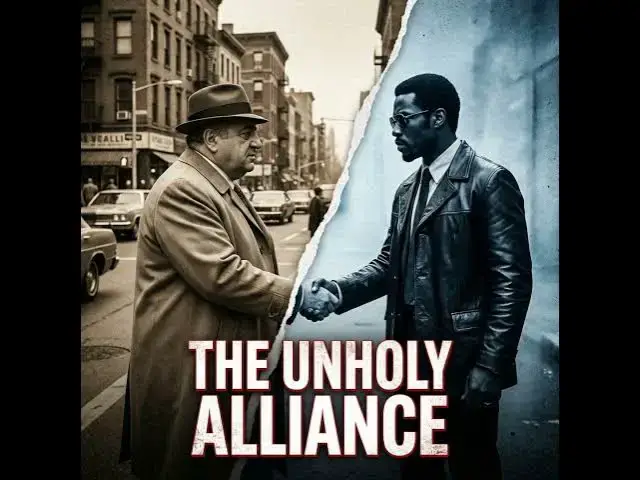
Up next in 10

HOOK LINE:In the late 1960s, the Italian American Mafia realized they were sitting on a volcano of heroin profits they couldn't control alone—this is the story of the deadly alliance they formed with rising Black criminal empires.
CONTENT OVERVIEW:We are cracking open the classified files on the uneasy, violent partnership between traditional Italian organized crime and the Black syndicates of Harlem, Philadelphia, and Chicago. This episode tracks the blood trail from Bumpy Johnson's numbers rackets to Frank Lucas's heroin pipeline, revealing how these two distinct underworlds collided and cooperated to move hundreds of millions of dollars in narcotics.
TEASE:You’ll hear the truth about the "Blue Magic" connection that bypassed the Italian middlemen, the brutal tactics the Philadelphia Black Mafia used to extort Italian numbers runners, and the ultimate vanishing act of the billionaire kingpin, Frank Matthews.
CREDIBILITY:Based on declassified FBI wiretaps from the 1970s, sealed grand jury testimony, and historical accounts of the era's biggest players.
CTA:If you want the full, cinematic story of the groups behind these secrets, check out our 100-episode master series on our main channel, Global Mafia Universe. The link is in the description. Go deep.
ENGAGEMENT:Was Frank Lucas smarter for bypassing the Italians, or was Nicky Barnes smarter for copying their structure? Let us know your take in the comments.
HASHTAGS:#MafiaHistory #BlackMafia #LaCosaNostra #FrankLucas #NickyBarnes #HarlemCrime #Underworld #TrueCrimeDocumentary #Gangland #OrganizedCrime
Show More Show Less View Video Transcript
0:00
Welcome true crime afficionados and
0:02
history buffs to Global Mafia. Today
0:05
we're kicking off our first season and
0:08
we're diving deep into a truly shocking
0:10
chapter that reshaped the underworld the
0:13
moment the Black Mafia met the Italian
0:15
families. This isn't just history. It's
0:17
the genesis of so much of what we see on
0:19
our streets even today. It's a story
0:22
steeped in violence but also in a
0:24
strange uneasy business arrangement.
0:26
Imagine this summer of ' 68. Philly. The
0:30
air thick with the smell of stale
0:32
aniset, cheap cigars, and honestly
0:35
nervous sweat. Outside, the world's on
0:38
fire. Civil rights riots, anti-war
0:40
protests. But inside this dark social
0:44
club in South Philly, a different kind
0:46
of war was actually ending.
0:49
And a much deadlier one was beginning.
0:51
You had four made guys from the Angelo
0:54
Bruno crime family, the old guard,
0:56
sitting across a formica table from
0:59
three leaders of what the papers were
1:01
just starting to call the black mafia.
1:04
No lawyers, no contracts, just men with
1:07
guns deciding the fate of millions in
1:09
narcotics.
1:10
Exactly. This wasn't about racial
1:13
integration. Not at all. This was about
1:15
cold, hard leverage. The Italians, they
1:18
had the supply. They controlled the
1:20
docks. those heroin lines snaking in
1:22
from Marseilles. But the black
1:24
organizations, they controlled the
1:26
street corners, the actual distribution.
1:29
North Philly, Harlem, Detroit, that's
1:31
where the product turned into cash. For
1:34
years, the five families in New York,
1:36
they'd viewed black criminals as just
1:38
tools, right? Low-level runners,
1:40
customers. But by the late 60s, early
1:43
70s, that cash flow became too massive
1:46
to ignore. We're not talking pocket
1:48
change here. Experts estimate a hundred
1:51
million dollars annually in Harlem
1:53
alone. That's a volcano. And the
1:55
Italians realized they couldn't control
1:57
it with just threats anymore.
1:59
So they had to negotiate. It's a huge
2:02
pivot from their traditional playbook.
2:04
And what's wild is how much of this was
2:06
allowed to fester because of sheer
2:09
almost unbelievable ignorance from law
2:11
enforcement. The FBI was obsessed with
2:13
the Italians, surveilling every social
2:16
club in Little Italy. But black
2:18
neighborhoods, they were entirely
2:20
ignored.
2:21
That's the crucial point, Lily. They
2:23
didn't believe black criminals were
2:25
capable of organizing on a large scale.
2:28
That racist ignorance, ironically, was
2:30
the greatest asset the black syndicates
2:32
had. It allowed them to build massive
2:34
infrastructures right under the nose of
2:37
the federal government. And that's why
2:38
this story is so vital to uncover. We're
2:41
not just pulling this out of thin air.
2:43
We're tracking the blood trail from the
2:45
numbers rackets of the 1950s to the
2:47
heroin pipelines that flooded American
2:49
cities in the 1970s. We're ripping open
2:52
files, declassified wiretaps, buried
2:55
grand jury testimony from witnesses who
2:58
frankly didn't vanish, and financial
3:00
forensics that finally connect the dots.
3:03
It was never a friendly merger. This was
3:05
a hostile environment where trust was
3:08
non-existent. Violence was the only
3:10
currency that held value. The Italians
3:13
had the political connections. They paid
3:15
off judges, police captains, but the
3:18
black organization leaders. They had the
3:20
soldiers on the ground who knew the
3:22
terrain, who knew the streets.
3:25
When these two forces connected, it
3:27
created a perfect storm of narcotics
3:29
trafficking that frankly overwhelmed law
3:32
enforcement for two decades. Today we're
3:34
going to look at seven critical friction
3:36
points where these two worlds collided,
3:39
cooperated, and ultimately crumbled. And
3:42
first up, we have to talk about the
3:44
foundation laid in Harlem.
3:47
Ah, Harlem. And the legend Ellsworth
3:50
Bumpy Johnson. He wasn't just a
3:52
gangster. He was an institution. From
3:55
the 1930s all the way through the 60s,
3:57
he ran the numbers game. This was the
4:00
poor man's lottery, a nickel and dime
4:02
business. But it generated millions in
4:05
untaxed cash every single week. A real
4:08
cash mountain.
4:09
And the Italian syndicates, specifically
4:12
Dutch Schultz, saw that mountain. And
4:14
they tried to take it by force in the
4:16
30s. It was a bloodbath. Bumpy Johnson
4:19
didn't roll over. He fought back with a
4:22
level of strategic violence that
4:24
genuinely stunned the Italian
4:25
leadership.
4:26
Bodies piled up in the East River,
4:28
Jesse. It got so bad that Lucky Luciano,
4:31
the architect of modern organized crime
4:33
as we know it, had to step in. Luciano
4:36
realized Bumpy couldn't just be
4:37
eliminated without destroying the entire
4:39
golden goose that was Harlem. So they
4:42
cut a deal, a sitdown. Bumpy Johnson ran
4:45
Harlem. He controlled the numbers, the
4:47
street level vice. The Genevese family,
4:50
they provided political cover, police
4:52
protection, and took a percentage off
4:54
the top. It was an arrangement born of
4:57
mutual respect, not for each other, but
5:00
for their capacity for violence.
5:03
Bumpy was the bridge, you know. He was
5:05
the only man the Italian Dons trusted to
5:08
keep order uptown. He proved that a
5:10
black criminal enterprise could operate
5:12
independently while still maintaining a
5:15
business relationship with the
5:16
commission. That was a gamecher, but it
5:19
was nothing compared to what came next.
5:21
Precisely. Number two on our list is the
5:24
man who decided he didn't need the
5:25
Italians at all, Frank Lucas. By the
5:28
late 1960s, the Vietnam War was raging
5:31
and heroin use among GIs was rampant.
5:34
The traditional Italian supply lines,
5:36
primarily the French Connection, were
5:38
getting squeezed by law enforcement.
5:40
Lucas, a former driver for Bumpy
5:43
Johnson, saw an opening nobody else
5:45
caught. The official story, the one you
5:48
hear in movies, is he smuggled heroin in
5:50
the coffins of dead American soldiers.
5:52
The cadaavver connection. Whether it was
5:55
coffins or false bottom furniture, the
5:58
reality is he bypassed the French
6:00
connection entirely.
6:01
He went straight to the Golden Triangle
6:03
in Southeast Asia. He bought high purity
6:06
heroin for something like $4,200 a kilo
6:09
in Bangkok that was selling for 50,000
6:12
in New York. I mean, think about that
6:14
profit margin. He cut out the Italian
6:16
middlemen completely.
6:18
For the first time, a black kingpin
6:20
controlled the product from source to
6:22
street. This absolutely terrified the
6:24
five families. Lucas was selling a purer
6:27
product, blue magic, for a lower price
6:29
on their territory. The Gambinos and
6:32
Geneovves were suddenly losing market
6:34
share in their own backyard. And they
6:36
couldn't kill him because he was too
6:37
big. They couldn't squeeze his supply
6:40
because they didn't control it. Lucas
6:42
proved that the Italian monopoly on
6:44
international trafficking was in fact a
6:46
myth. The deeper you go, the darker it
6:49
gets truly.
6:50
Which leads us to number three, the rise
6:52
of the council in Harlem and Leroy Nikki
6:56
Barnes. While Lucas was the lone wolf
6:58
international player, Barnes was
7:00
studying the Italian playbook. He
7:03
realized that organization was power. He
7:06
didn't want to fight the five families.
7:08
He wanted to emulate them.
7:09
Barnes formed the council. It was a
7:12
seven-man governing body that ruled the
7:14
Harlem drug trade, modeled directly
7:16
after the mafia commission. They pulled
7:18
resources, shared intelligence, and
7:20
resolved disputes without immediate
7:22
bloodshed. They divided Harlem into
7:24
territories and assigned distribution
7:26
rights. This was sophisticated. And the
7:28
Italians respected this structure. They
7:31
understood it. The Lucesi and Columbbo
7:33
families began supplying Barnes with
7:35
massive quantities of heroin because
7:38
they knew his organization could move it
7:40
efficiently and crucially quietly.
7:42
Barnes became the king of New York,
7:44
flashing stacks of cash, driving
7:46
Bentleys.
7:48
He was the face of the new black
7:50
organized crime power structure,
7:52
operating in this lucrative, if
7:54
temporary, partnership with the old
7:56
guard. He was moving tens of millions of
7:58
dollars a month, much of it supplied by
8:00
Italian wholesalers who were actually
8:03
happy to let Barnes take the spotlight
8:05
and all the heat that came with it.
8:08
And this is where things get truly
8:10
dangerous. Our fourth point takes us
8:12
back to Philadelphia. The city of
8:15
brotherly love was in fact a war zone.
8:17
The Philadelphia Black Mafia or PBM
8:20
wasn't interested in partnerships. They
8:22
were interested in immediate
8:24
acquisitions.
8:26
In the late60s and early '7s, the PBM
8:28
launched a campaign of terror. They went
8:31
after independent numbers runners and
8:33
small-time lone sharks, many of whom
8:35
were paying tribute to the Angelo Bruno
8:37
family. The PBM didn't negotiate.
8:40
Daniel.
8:40
They walked into a numbers bank, put a
8:43
gun to the head of the manager, and
8:44
demanded a 50% cut of the daily take. If
8:48
the manager refused, they were executed
8:50
right there. They bombed businesses.
8:53
They kidnapped family members. It was
8:55
brutal and swift.
8:58
Angelo Bruno, the docile dawn, was
9:00
facing a revolt from within his own
9:02
ranks. His soldiers were demanding
9:04
action against these upstarts who were
9:06
eating into their profits. But Bruno,
9:08
the strategic mind, knew an all-out war
9:11
in South Philly would bring too much
9:12
heat. He made a difficult choice,
9:14
appeasement.
9:16
He allowed the PBM to take over certain
9:19
territories in North and West Philly in
9:21
exchange for peace in South Philly. It
9:24
was a clear sign of weakness, one that
9:26
many historians believe eventually
9:27
contributed to Bruno's own assassination
9:30
in 1980. The PBM proved that raw,
9:33
unbridled violence could force the
9:35
traditional mob to retreat.
9:37
And that's just the surface, honestly.
9:39
Next up, we head to Chicago, the home of
9:42
the outfit, Al Capone's heritage. The
9:45
south side of Chicago operated
9:47
completely differently. Here you had
9:49
massive street organizations like the
9:51
Blackstone Rangers, later known as the
9:53
El Rukans, led by Jeff Fort.
9:56
These weren't just gangs, Lily. They
9:58
were governments in the projects. They
10:00
had thousands of soldiers, a literal
10:02
army on the ground, and the Chicago
10:04
outfit, much like the New York families,
10:06
realized they couldn't operate in these
10:08
neighborhoods directly. They needed
10:10
distribution networks. So, it became a
10:12
business pact. The outfit controlled the
10:14
high-level incoming shipments of
10:16
narcotics. They needed the Elukans to
10:19
move it into the veins of the southside.
10:21
The outfit provided the product and
10:23
crucially kept the highle police brass
10:26
off their backs. and Jeff Fort in turn
10:28
maintained absolute discipline in the
10:30
projects, ensuring the money flowed
10:33
upward. This alliance allowed the outfit
10:35
to profit immensely from areas where an
10:37
Italian face would have stopped traffic
10:40
cold. It was a segregated business model
10:42
that generated hundreds of millions
10:44
during the heroin epidemic of the 70s.
10:47
It's almost clinical in its efficiency.
10:50
Clinical and dark. And if you think
10:53
that's dark, our sixth point delves into
10:55
the ultimate phantom, Frank Matthews,
10:58
the Black Caesar. If Frank Lucas and
11:00
Nikki Barnes were millionaires, Frank
11:02
Matthews was on his way to being a
11:04
billionaire. By 1972, this guy was
11:07
operating in 20 plus states. He was the
11:10
only black trafficker who managed to
11:12
establish direct connections with both
11:14
the French Corsican suppliers and the
11:16
Venezuelan sources. He operated on a
11:18
scale that dwarfed most Italian
11:20
families. At his peak, he was moving
11:23
millions of dollars of heroin a week.
11:25
The five families in New York were
11:27
actually buying from him when their own
11:29
supplies ran dry. He flipped the script
11:31
completely.
11:32
And then in 1973, the DEA finally caught
11:36
up to him. They set his bail at
11:38
$325,000,
11:40
the highest in US history at the time. A
11:42
week later, Matthews walked out of the
11:44
federal courthouse in Brooklyn carrying
11:46
a bag containing an estimated $20
11:48
million in cash. He got into a car and
11:52
was never seen again. Poof.
11:54
The Italians were stunned. They usually
11:56
killed guys who got that big or they
11:58
made them pay. But Matthews outsmarted
12:01
the feds, outgrew the mob, and vanished
12:03
into the ether. A truly legendary
12:06
escape. But as incredible as that is,
12:08
this next final point is perhaps the
12:11
most brutal and certainly the most
12:12
impactful. You're talking about the
12:14
inevitable betrayal, aren't you? The
12:16
collapse. By the late 1970s and early
12:19
80s, the heat was just too intense. The
12:22
RICO Act had been passed in 1970, giving
12:25
the feds a nuclear weapon against
12:27
organized crime structures. And finally,
12:30
law enforcement woke up to the scale of
12:32
the black criminal organizations they'd
12:34
ignored for so long.
12:35
The fragile alliances began to shatter.
12:38
When the cuffs went on, the code of
12:40
silence evaporated. Nikki Barnes, facing
12:43
life in prison without parole, turned
12:45
states evidence. He testified against
12:47
his own council. He testified against
12:50
his Italian suppliers. He gave up the
12:52
entire infrastructure.
12:54
The Italians realized these partnerships
12:56
were now major liabilities. The black
12:59
syndicates were considered too flashy,
13:01
too violent, and ultimately unreliable
13:03
under pressure. The Italians pulled
13:05
back, insulating themselves. The golden
13:08
age of the cross-cultural heroin pact
13:10
ended in a flurry of indictments and
13:12
assassinations. The business didn't
13:14
stop, of course. Heroin continued to
13:16
flow, but those handshake deals in back
13:19
rooms, the uneasy truses, they were
13:21
over. The trust was completely gone, if
13:24
it ever really existed beyond pure
13:26
profit.
13:27
When you connect the dots on all these
13:29
files, you really see the truth. It was
13:32
never about brotherhood. It was always
13:34
about leverage and logistics. The
13:36
Italian families needed distribution
13:38
into territories they couldn't
13:40
physically control. The black syndicates
13:43
needed high volume product and political
13:45
insulation that only decades of
13:48
established corruption could provide.
13:51
It was a truly symbiotic relationship
13:53
built on nothing but greed. And it
13:55
accelerated the decay of American inner
13:57
cities in ways we're still grappling
14:00
with. They flooded the streets with
14:02
poison because the profit margins were
14:04
astronomical. Color didn't matter when
14:06
the money was stacked to the ceiling.
14:08
But loyalty, loyalty was always thin on
14:10
the ground.
14:11
It's chilling to think about how the
14:13
streets we see today, the territories,
14:15
the drug corners, the ingrained violence
14:17
were shaped by these deals made 50 years
14:20
ago by men in silk suits and leather
14:22
jackets who decided to carve up the
14:24
country between them.
14:25
Absolutely. It's a sobering look at how
14:28
crime evolves, adapts, and sometimes
14:31
unfortunately thrives through unexpected
14:33
alliances. And this is just the tip of
14:36
the iceberg really. Indeed, if you want
14:38
the full cinematic story of the groups
14:41
behind these secrets, we've got a 100
14:43
episode master series on our main
14:45
channel, Global Mafia Universe, diving
14:48
even deeper into these untold stories.
14:50
The link is in the description. Go deep.
14:53
We'll see you next time.