0:00
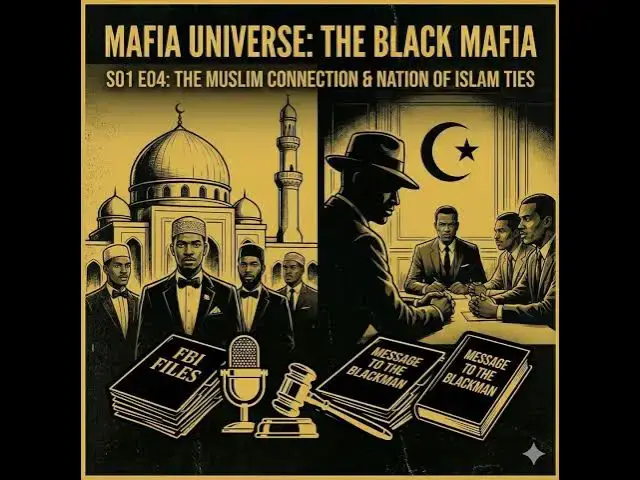
Welcome back to Roots Information, our
0:03
deep dive into the historical origins of
0:06
what's been termed the Black Mafia.
0:08
Today, we're tackling a fascinating and
0:10
honestly pretty complex chapter, the
0:13
Muslim Connection, specifically the ties
0:16
between these organized crime elements
0:18
and the Nation of Islam. Jesse Lily,
0:21
thanks for joining me.
0:22
Thanks, Daniel. This topic is ripe for
0:24
discussion, especially because it's so
0:26
often misunderstood or sensationalized.
0:29
It's not as simple as NOI was the black
0:31
mafia, which is a common misconception.
0:33
Absolutely, Jesse. We're talking about a
0:35
period from the 60s onward where the
0:37
lines could get really blurry. But it's
0:39
crucial to distinguish between an
0:41
organization's stated goals and the
0:43
actions of individuals or even how
0:45
criminal elements might try to leverage
0:47
or mimic aspects of a legitimate
0:50
Exactly. Let's set the stage, though.
0:52
The 1960s and 70s were a time of immense
0:55
social upheaval in black communities
0:57
across America. There was a desperate
0:59
need for protection, for economic
1:01
uplift, for a sense of identity and
1:03
pride. And into this vacuum, you have
1:06
the rise of the Nation of Islam offering
1:08
a very disciplined, self-sufficient, and
1:11
often defiant message. Right? The NOI
1:14
was presenting an alternative, a stark
1:16
contrast to the existing power
1:18
structures. They preached black
1:20
self-reliance, discipline, and a strong
1:22
moral code, at least on the surface. For
1:24
many, it was a lifeline. But for some,
1:27
particularly those already involved in
1:29
illicit activities, it also presented,
1:31
let's call it, opportunities.
1:33
And that's where the connections start
1:35
to emerge. Historically, in places like
1:37
Philadelphia, Chicago, or Detroit, where
1:40
the Nation of Islam had a strong
1:42
presence, some individuals involved in
1:44
what would become known as the Black
1:46
Mafia were either former members of the
1:48
NOI, or they used the organization's
1:51
reputation and discipline as a front for
1:54
their own operations.
1:56
It's like a dual identity in a way. You
1:59
could be seen as a legitimate
2:00
businessman, part of a respected
2:02
religious group, while simultaneously
2:04
running numbers, dealing drugs, or
2:07
engaging in protection rackets under
2:09
that guise. The strict dress codes, the
2:11
abstension from alcohol and pork, it all
2:14
projected an image of moral rectitude.
2:16
And that image was powerful. In
2:19
communities deeply distrustful of
2:20
mainstream institutions, including law
2:23
enforcement, an organization that
2:25
promoted black empowerment and
2:26
self-defense, could gain a certain level
2:28
of respect, even fear. Criminal elements
2:31
could exploit that respect to operate
2:33
with less scrutiny or even offer
2:35
protection under the banner of a strong
2:38
One of the key aspects here is the
2:40
economic component. The Nation of Islam
2:43
had legitimate businesses, bakeries,
2:45
restaurants, clothing stores. These
2:47
provided employment and revenue for the
2:49
community, but also in some instances
2:52
offered a way to launder illicit funds
2:54
or expand influence into legitimate
2:56
sectors. It gave a veneer of
3:01
You know, one of the more infamous
3:02
examples that often comes up is the
3:04
Black Mafia in Philadelphia and their
3:07
alleged ties to some Nation of Islam
3:09
mosques or individuals associated with
3:11
them. This was a group known for extreme
3:14
violence, drug trafficking, and control
3:16
over various rackets.
3:18
Indeed, the Black Mafia, which was
3:20
really an umbrella term for several
3:22
distinct but often interconnected black
3:24
crime syndicates, sometimes used the
3:26
NOI's philosophy of black nationalism
3:29
and self-defense to justify their
3:31
violent actions to themselves and to
3:33
some in the community. They might claim
3:35
they were protecting the community while
3:37
really just extracting resources through
3:39
fear. And it's important to stress that
3:41
the official stance of the Nation of
3:43
Islam under leaders like Elijah Muhammad
3:46
and later Lewis Farrakhan was always
3:48
against criminal activity. They publicly
3:51
denounced drug use, violence, and
3:53
promiscuity. But charismatic figures
3:55
within the organization or individuals
3:58
leveraging its symbols could certainly
4:02
So, we're talking about a kind of
4:04
parasitic relationship perhaps where
4:06
criminal elements either infiltrated or
4:08
simply mimicked and exploited the
4:10
legitimate social and religious movement
4:12
for their own ends or were there
4:14
instances of direct collaboration where
4:16
NOI members or even specific mosques
4:19
were actively involved in illicit
4:21
activities is more the former. I'd say
4:23
the research points to individuals who
4:25
were members or had strong affiliations
4:28
using their position or the NOI's
4:30
reputation to facilitate criminal
4:32
enterprises. There were instances where
4:34
mosques were used as meeting places or
4:36
where security details for NOI leaders
4:39
might have had other less legitimate
4:41
responsibilities on the side, but
4:43
pinning it on the organization as a
4:45
whole is usually an oversimplification.
4:48
Think about it from a sociological
4:49
perspective. In a highly racialized
4:52
society with limited opportunities and
4:54
systemic oppression, these
4:56
organizations, whether legitimate like
4:58
the NOI or criminal like the Black
5:01
Mafia, emerged as alternative power
5:03
structures. They both offered a sense of
5:06
belonging, purpose, and a way to exert
5:08
control, even if through vastly
5:12
That's a really good point, Jesse. They
5:14
filled a void. And the discipline
5:16
inherent in the Nation of Islam, the
5:18
very strict codes of conduct, could also
5:21
be appealing to someone coming out of a
5:22
chaotic street life, even if they didn't
5:25
fully adhere to it. It offered a kind of
5:27
structure and a sense of belonging, a
5:30
brotherhood, which is a core component
5:32
of any successful organized crime group,
5:34
isn't it? Loyalty, discipline, a shared
5:37
identity. they could find that framework
5:39
within the NOI or at least a corrupted
5:41
version of it that mirrored what they
5:43
needed for their criminal ventures.
5:45
Let's not forget the protection aspect.
5:48
In the early days, black communities
5:50
often lacked effective police protection
5:52
and sometimes faced hostility from law
5:54
enforcement. The NOI with its
5:56
paramilitary wing, the fruit of Islam,
5:59
was seen by some as a protective force.
6:02
Criminals seeing this might have sought
6:04
affiliation or leveraged that perception
6:06
for their own protection from rivals or
6:11
So, it's almost like a form of street
6:13
cred. If you were down with the Nation
6:15
of Islam, or at least appeared to be,
6:17
you carried a certain weight that could
6:19
deter rivals or give you leverage in
6:21
your own criminal operations. And this
6:23
wasn't just in the big cities, right? It
6:25
was a phenomenon seen in varying degrees
6:29
Absolutely. Wherever the NOI established
6:31
a strong presence, especially in the 60s
6:34
and 70s, you'd see these dynamics play
6:36
out. From Newark to Oakland, the pattern
6:39
repeated. The local black mafia outfits
6:42
might not have been a monolithic entity,
6:44
but they often shared this common thread
6:46
of trying to intertwine with or exploit
6:48
the respect and structure offered by the
6:50
Nation of Islam. And the fact that the
6:53
NOI emphasized economic independence,
6:56
starting their own businesses, that was
6:58
a huge draw for someone looking to
7:00
legitimize their illicit gains or to
7:02
find a pathway out of pure street crime.
7:05
An NOI affiliated business could be an
7:07
appealing front. It provided a veneer of
7:09
legitimacy that traditional rackets
7:12
But what about when law enforcement
7:14
started to catch on? How did these ties
7:17
or the perception of these ties impact
7:19
investigations into the black mafia? And
7:21
conversely, how did it affect the Nation
7:23
of Islam as a legitimate religious
7:25
organization? That's a critical point
7:28
for law enforcement. It created a
7:30
massive challenge. Distinguishing
7:32
between a legitimate religious leader
7:33
and someone using their position as a
7:35
cover was incredibly difficult. It also
7:38
led to a lot of surveillance and
7:40
potentially mischaracterizations of the
7:43
NOI as a whole, which then fed into its
7:46
own narrative of being persecuted.
7:48
And for the NOI, it was a double-edged
7:50
sword. While some individuals might have
7:52
benefited from the fear factor
7:54
associated with crime, the organization
7:56
itself had to constantly distance itself
7:59
from illicit activities to maintain its
8:01
religious and social credibility. It's a
8:03
delicate balance when elements
8:05
purporting to be part of your movement
8:07
are engaging in things you officially
8:10
So, as we move into the 80s and '9s, did
8:13
these connections evolve? Did they
8:15
become more overt? Or did the NOI
8:18
successfully manage to sever these links
8:20
as it tried to consolidate its image as
8:22
a more mainstream, albeit still
8:24
controversial, religious and social
8:26
movement? They largely dissipated in the
8:29
overt sense. As the NOI evolved and as
8:32
law enforcement tactics became more
8:33
sophisticated in targeting organized
8:35
crime specifically, the utility of such
8:38
a front diminished. While individual
8:40
members might still have had their own
8:42
side hustles, the institutionalized
8:44
direct ties became much rarer.
8:46
Also, the nature of organized crime
8:48
itself shifted. The crack epidemic in
8:51
the 80s decentralized a lot of power.
8:54
gangs became more numerous, less
8:56
centralized, and often less interested
8:58
in the ideological or protective aspects
9:00
that the NOI might have once offered. It
9:03
became more about pure profit and
9:07
So, the Black Mafia itself changed,
9:09
which in turn changed its relationship,
9:11
or lack thereof, with the Nation of
9:13
Islam from a complex intertwining in the
9:16
60s and 70s to a more fragmented and
9:19
less direct influence in later decades.
9:21
Precisely. By the 90s and 2000s, while
9:24
you might still find individuals who
9:26
were ex-cons who found solace or
9:28
structure in the NOI, the idea of the
9:30
black mafia using the NOI as an
9:32
institutionalized cover or partner had
9:35
largely faded from prevalence. The focus
9:38
of the NOI itself was also changing,
9:40
engaging more in political activism and
9:42
community outreach rather than
9:44
maintaining a street presence in the
9:46
same way. And the term black mafia
9:48
itself started to become less a
9:50
description of a singular organized
9:52
entity and more a historical label for
9:55
various independent black crime
9:56
syndicates that rose and fell over time.
9:59
The unifying thread of Muslim connection
10:03
It's a testament to the fluidity of
10:05
these movements, both legitimate and
10:07
illegitimate, how they adapt to changing
10:09
social, political, and economic
10:11
landscapes. The 60s and 70s really
10:14
offered a unique window for this
10:16
particular intersection to thrive. It
10:18
really highlights the idea that crime at
10:20
its root is often a response to systemic
10:22
issues. When legitimate pathways are
10:25
blocked, people will find other avenues.
10:27
And sometimes those avenues intersect
10:29
with or exploit existing community
10:31
structures, even religious ones.
10:34
And it reminds us that history is rarely
10:36
black and white. There's so much nuance
10:38
and complexity in these interactions.
10:40
You can't just slap a label on it and
10:42
call it a day. You have to look at the
10:44
individual players, the motivations, and
10:47
the broader context.
10:48
Absolutely. This has been a really
10:50
enlightening discussion. Understanding
10:52
these historical Muslim connections
10:54
helps us grasp the full spectrum of
10:56
challenges and choices faced by black
10:59
communities during those tumultuous
11:00
decades. Jesse Lily, thank you both for
11:03
this fantastic conversation.
11:05
My pleasure, Daniel. Always great to
11:07
explore these deeper layers.
11:09
Thanks for having me. It's a crucial
11:10
part of the narrative to get right.
11:13
And to our listeners, thank you for
11:15
tuning in to Roots Information. Join us
11:17
next time as we continue to peel back
11:20
the layers of history. Until then, take