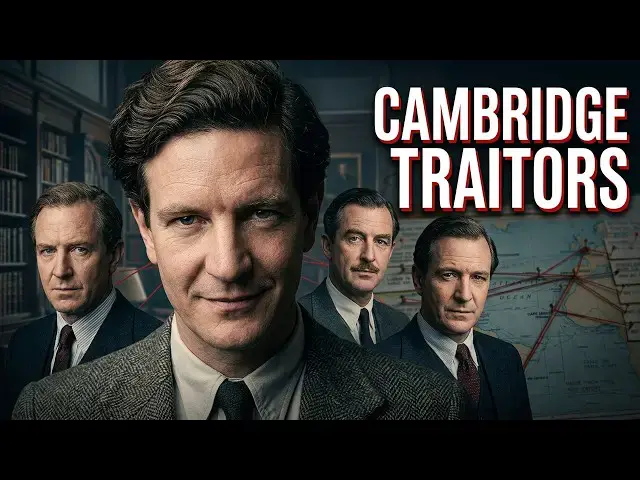

How did five young aristocrats from Cambridge University become the KGB's most productive and destructive spy ring inside British intelligence?
In 1949, American codebreakers working on the secret VENONA project decrypted an old Soviet teletype cable that pointed to an ongoing, catastrophic breach inside the British diplomatic establishment. The codename was HOMER. What investigators uncovered over the next three decades would shake the foundations of Western intelligence to its core—and reveal a fatal flaw not in Britain's security ciphers, but in its class structure.
Why did Kim Philby, Donald Maclean, Guy Burgess, Anthony Blunt, and John Cairncross betray the country that raised, educated, and trusted them? And why did MI5 and Whitehall protect them for decades under the assumption that "gentlemen do not spy"?
🎬 Based on declassified national archives, released SVR records, and authentic memoirs, this comprehensive documentary reconstructs the architecture of the Cambridge Five—from the drawing rooms of the Cambridge Apostles in the 1930s, through the high-stakes codebreaking of Bletchley Park and Washington in WWII, to the midnight flight from Southampton and Kim Philby's dramatic confrontation in Beirut.
---
📚 KEY HISTORICAL FIGURES:
• H.A.R. "Kim" Philby (MI6 Section IX / KGB Codename: SÖHNCHEN)
• Donald Maclean (Foreign Office / KGB Codename: HOMER)
• Guy Burgess (BBC / MI5 / Foreign Office / KGB Codename: MÄDCHEN)
• Sir Anthony Blunt (MI5 B Division / Royal Surveyor / KGB Codename: TONY)
• John Cairncross (Bletchley Park Ultra / Treasury / KGB Codename: MOLIÈRE)
• Dr. Arnold Deutsch (Soviet Illegal Recruiter)
• Nicholas Elliott (MI6 Senior Officer & Philby's Friend)
• Peter Wright (MI5 Counterintelligence Officer & Author of Spycatcher)
• Yuri Modin (KGB Controller in London)
Show More Show Less View Video Transcript
0:00
In the autumn of nineteen forty-nine, inside a converted girls' school in Arlington,
0:08
Virginia, an American cryptanalyst sat before a partially decoded Soviet intelligence cable.
0:16
The message was years old — sent from New York to Moscow in nineteen forty-four.
0:24
But what it revealed was not historical. It was ongoing.
0:29
Somewhere inside the British diplomatic establishment, a Soviet agent was still operating.
0:37
The cable carried a codename. HOMER. And the Americans had no idea how deep the problem ran.
0:47
The VENONA project — the secret American effort to break Soviet wartime communications — had
0:54
been grinding through intercepted cables for years.
0:58
Most yielded fragments. Partial names. Operational patterns. But HOMER was different.
1:05
The traffic suggested an agent with access to the highest levels of Anglo-American
1:11
diplomatic correspondence.
1:14
Someone inside the British Foreign Office. Someone trusted.
1:24
When the Americans shared their findings with MI5 , the reaction was not alarm.
1:30
It was discomfort.
1:32
The suggestion that a Soviet mole had penetrated the Foreign Office was not simply an
1:39
intelligence problem.
1:41
It was a social problem.
1:43
Because in Britain, in nineteen forty-nine, the Foreign Office was not staffed by
1:50
professionals drawn from open competition.
1:53
It was staffed, overwhelmingly, by the sons of the aristocracy, the alumni of public schools
2:01
and ancient universities.
2:03
To investigate the Foreign Office was to investigate a class.
2:08
This documentary is based on declassified files, published memoirs, and verified historical
2:15
accounts.
2:16
Some dialogue is reconstructed from documented testimony.
2:21
To understand how Soviet intelligence built its most productive spy ring inside British
2:28
power, you have to begin not in Moscow, and not in Whitehall — but in Cambridge.
2:34
Specifically, in the drawing rooms and dining halls where a certain kind of young Englishman
2:41
was formed.
2:42
Cambridge in the early nineteen-thirties was not simply a university.
2:47
It was a finishing school for the governing class.
2:51
The young men who arrived there — from Eton , from Westminster, from families whose names
2:58
appeared in Debrett's — understood, without anyone saying it aloud, that they were being
3:05
prepared to run the country.
3:07
The diplomatic service. The intelligence agencies. The Treasury. The judiciary.
3:13
These were not careers to be competed for. They were inheritances to be assumed.
3:20
But something had shifted. The Great Depression had reached Britain.
3:26
Unemployment was savage. The hunger marches had crossed the country.
3:32
And among the brightest students at Cambridge, a question was forming that their parents had
3:40
never been forced to ask.
3:42
Whether the system they had been born to administer deserved to survive at all.
3:49
Marxism, in this atmosphere, was not fringe. It was fashionable.
3:55
It was intellectually credible.
3:58
And for a particular kind of privileged young man — guilty about his inheritance, repelled
4:06
by fascism, searching for moral seriousness — it offered something seductive.
4:13
Purpose.
4:14
At the centre of this world sat a secret society called the Cambridge Apostles .
4:20
Founded in eighteen twenty, the Apostles were an invitation-only intellectual club whose
4:28
members included some of the most influential minds in British academic life.
4:34
Membership was for life. Meetings were private.
4:37
And the culture of the group prized one quality above all others — the rejection of
4:44
conventional morality in favour of personal conviction.
4:49
What made the Apostles dangerous — though no one recognized it at the time — was not their
4:56
politics.
4:57
It was their social architecture. The Apostles operated on absolute trust.
5:03
Members vouched for one another.
5:05
And that trust, once established, followed them out of Cambridge and into the corridors of
5:13
British government.
5:14
Soviet intelligence did not stumble upon Cambridge. It was guided there.
5:20
And the hand that pointed the way belonged not to a Russian, but to an Austrian — a man
5:27
whose role in this story has only become clear decades after the fact.
5:33
His name would surface much later.
5:36
But by nineteen thirty-three, he was already in London, watching, assessing, and building a
5:43
list.
5:44
The question was never whether these young men could be recruited.
5:49
The question was whether anyone would ever think to suspect them.
6:00
His name was Arnold Deutsch .
6:02
Born in Vienna in nineteen-oh-four, he held a doctorate in chemistry, spoke multiple
6:09
languages, and had been a committed Communist since his student days.
6:14
By the early nineteen-thirties, he had been trained by Soviet military intelligence and
6:21
dispatched to London with a specific brief — recruit agents from the British establishment
6:28
who could be positioned for long-term penetration.
6:31
Deutsch was not a crude operator.
6:34
He understood that the young men he was targeting did not need to be bribed or blackmailed.
6:41
They needed to be believed.
6:43
They needed someone to tell them that their idealism was not naive — that it could be turned
6:50
into action.
6:52
The first to be approached was Kim Philby .
6:55
Harold Adrian Russell Philby — known to everyone as Kim — was the son of Harry St John
7:02
Philby , a distinguished Arabist and sometime adviser to the Saudi royal family.
7:08
Kim had been educated at Westminster School and Trinity College, Cambridge.
7:14
He was charming, well-connected, and politically restless.
7:18
Deutsch met Philby in London in June of nineteen thirty-four.
7:23
According to Soviet records declassified after the Cold War, Philby agreed to work for
7:30
Soviet intelligence almost immediately.
7:33
He was given the codename SÖHNCHEN — German for little son.
7:38
Decades later, in Moscow, Philby would describe the moment in terms that revealed the
7:45
psychology of the recruitment.
7:48
I was given the opportunity to do something real. Not to talk about changing the world.
7:55
To actually do it. In secret. That was the attraction. The secrecy made it feel serious.
8:03
What Philby did not say — what the record suggests but cannot prove — is how much his
8:10
father's own rebellious streak shaped his willingness to betray.
8:15
Harry St John Philby had himself been a maverick inside the British establishment, courting
8:23
controversy, converting to Islam, defying Whitehall.
8:27
The son, it seems, found a more dangerous form of defiance.
8:33
Within months, Deutsch had a second recruit.
8:37
Donald Maclean — the son of Sir Donald Maclean, a former Liberal cabinet minister.
8:43
Educated at Gresham's School and Trinity Hall, Cambridge.
8:48
Tall, handsome, brilliant, and already marked out for a career in the Foreign Office.
8:55
Then came Guy Burgess — an Etonian, a member of the Apostles, a man of enormous personal
9:02
charm and equally enormous personal chaos.
9:05
Burgess drank heavily, talked recklessly, and seemed, on the surface, the last person any
9:13
intelligence service would trust with secrets.
9:16
And yet Moscow Centre trusted him.
9:19
Because Burgess had something more valuable than discretion. He had access.
9:25
He knew everyone.
9:27
He moved through London's political and social elite as though he had been born in their
9:34
drawing rooms — which, in a sense, he had.
9:38
This was the hidden mechanism.
9:41
The feature of British society that Soviet intelligence exploited more effectively than any
9:49
cipher or dead drop.
9:51
Class.
9:52
In the Britain of the nineteen-thirties and forties, social trust was not earned through
10:00
background checks.
10:02
It was inherited.
10:03
A man who had attended the right school, who belonged to the right club, who spoke with the
10:11
right accent and knew the right people — that man was trusted by default.
10:18
The vetting procedures that existed within MI5, MI6 , and the Foreign Office were, by later
10:26
standards, almost comically inadequate.
10:30
But they were not inadequate by accident.
10:34
They were inadequate because the system assumed that gentlemen did not betray their country.
10:42
The Cambridge spies did not exploit a flaw in British intelligence.
10:48
They exploited a feature.
10:51
Peter Wright , a former MI5 officer who spent years investigating Soviet penetration,
10:57
described the problem with a clarity that bordered on fury.
11:02
The trouble was not that we didn't look.
11:05
The trouble was that we didn't know what we were looking at. These men were us.
11:12
They dressed like us. They talked like us. They went to the same schools.
11:17
Suspecting them felt like suspecting yourself.
11:22
Two more names would eventually be added to the ring, though their identification took
11:29
decades longer.
11:30
Anthony Blunt — art historian, Apostle, and future Surveyor of the King's Pictures — was
11:37
recruited in nineteen thirty-seven.
11:39
John Cairncross — a Scottish-born linguist who had won a scholarship to Trinity College —
11:46
was recruited around the same period.
11:49
Blunt and Cairncross came from different social backgrounds — Blunt from the minor
11:56
aristocracy, Cairncross from a working-class family — but both shared the same channel into
12:03
Soviet service.
12:04
Cambridge. The Apostles.
12:06
The quiet trust network that Deutsch and his successors learned to navigate with
12:13
extraordinary precision.
12:15
What is easily overlooked, from this distance, is what the recruitment cost these men
12:21
psychologically — even before they passed a single document.
12:26
To agree to work for Soviet intelligence was to accept a permanent double life.
12:32
Every friendship became a performance.
12:35
Every professional success was shadowed by the knowledge that it existed, in part, to serve
12:42
a foreign power.
12:43
Maclean, in particular, appears to have struggled with this almost from the beginning.
12:49
He drank. He suffered episodes of violent instability.
12:53
According to colleagues who knew him in the Foreign Office, there were moments when the
13:00
pressure seemed to radiate from him physically.
13:03
But no one asked the obvious question. Because gentlemen did not spy.
13:09
By the late nineteen-thirties, the architecture was complete.
13:14
Five agents, recruited through a single social network, positioned inside — or moving toward
13:21
— the most sensitive institutions in British government.
13:25
Soviet intelligence had not cracked a code or stolen a key.
13:30
It had walked through the front door.
13:33
And the doorman had nodded them in, because they looked like they belonged.
13:38
The question that would haunt British intelligence for the next forty years was not how the
13:45
ring was built.
13:46
It was how long it took anyone to notice.
13:56
The Second World War did not interrupt the Cambridge spy ring. It accelerated it.
14:03
As Britain mobilized, the intelligence services expanded rapidly — and they recruited from
14:11
the same narrow social pool they had always drawn upon.
14:16
Kim Philby entered the Secret Intelligence Service, MI6, in nineteen forty.
14:23
Within a year, he was working in Section Five — the counterintelligence branch responsible
14:30
for monitoring enemy espionage in the Iberian Peninsula.
14:35
By nineteen forty-four, he had been appointed head of Section Nine — the new anti-Soviet
14:43
section.
14:44
The irony was structural.
14:46
The man tasked with identifying Soviet intelligence operations inside Britain was himself a
14:54
Soviet agent.
14:56
Donald Maclean, meanwhile, had entered the Foreign Office in nineteen thirty-five and risen
15:03
steadily.
15:04
By the early years of the war, he was handling classified communications between London and
15:12
Washington.
15:13
In nineteen forty-four, he was posted to the British Embassy in Washington, D.C., where he
15:20
served as First Secretary.
15:22
His access was extraordinary.
15:25
Maclean saw cables relating to Anglo-American nuclear cooperation, post-war planning for
15:32
Europe, and the emerging structure of what would become NATO .
15:37
According to documents released by the SVR — the successor to the K-G-B — Maclean provided
15:44
Moscow with thousands of classified documents during this period.
15:50
Some historians have estimated the volume at forty-five volumes of material.
15:56
Yuri Modin , a Soviet intelligence officer who handled several members of the ring in the
16:02
late nineteen-forties, later described Maclean's output in his memoir.
16:07
Maclean was our most productive source in the West. The quantity was remarkable.
16:13
But it was the quality that mattered.
16:15
He gave us the thinking behind the decisions — not just what the British and Americans
16:21
decided, but why.
16:22
That was invaluable.
16:24
Guy Burgess had taken a more chaotic path.
16:28
He had worked for MI5, then the B-B-C, then the Foreign Office — always moving laterally,
16:35
always at the edges of serious policy discussion, always somehow present when sensitive
16:43
matters were discussed.
16:45
His personal behaviour was increasingly erratic. He drank prodigiously.
16:51
His sexual relationships with men — at a time when homosexuality was a criminal offence in
16:58
Britain — created additional vulnerability.
17:02
And yet he was tolerated. Protected, even.
17:05
Because the system that should have flagged him as a security risk was the same system that
17:13
had produced him.
17:14
Old school ties. Old friendships.
17:17
The quiet assumption that a man of his background could be trusted, no matter how badly he
17:25
behaved.
17:26
John Cairncross occupied a position that, in retrospect, may have been the most
17:32
consequential of all.
17:33
In nineteen forty-two, he was assigned to Bletchley Park — the Government Code and Cypher
17:40
School — where he worked on decrypted German signals intelligence.
17:45
Cairncross passed Ultra material — the product of Britain's breaking of the German Enigma
17:52
cipher — directly to Soviet intelligence.
17:55
According to some accounts, the intelligence he provided contributed to Soviet preparations
18:02
for the Battle of Kursk in nineteen forty-three, one of the decisive engagements of the
18:08
Eastern Front.
18:09
The documents that survive do not settle the question of how much Cairncross's material
18:16
actually influenced Soviet military planning.
18:19
But the fact that Ultra-level intelligence was reaching Moscow through a single agent at
18:26
Bletchley is itself a measure of how catastrophically British security had failed.
18:33
Anthony Blunt served in MI5 during the war, working in B Division — responsible for
18:40
counterespionage.
18:41
His role gave him access to a range of sensitive material, including details of MI5's own
18:49
operations against suspected Soviet agents.
18:52
Blunt was, in many ways, the most enigmatic of the five.
18:57
He was a distinguished art historian, an authority on Poussin and French Baroque painting.
19:04
He moved with ease through the highest levels of British cultural and social life.
19:11
His recruitment by Soviet intelligence appears to have been driven less by ideological
19:18
passion than by a kind of intellectual arrogance — the belief that he could see further than
19:26
the system he served, and that history would vindicate his choice.
19:31
What makes Blunt's position especially corrosive is that he was inside the organization that
19:39
should have been hunting people like him.
19:42
He was not merely passing secrets. He was monitoring the hunters.
19:48
The scale of what the Cambridge Five transmitted to Moscow during the war years remains
19:56
difficult to comprehend.
19:58
Collectively, according to post-Cold War assessments, they provided tens of thousands of
20:06
documents — diplomatic cables, military assessments, intelligence reports, signals
20:13
intercepts, policy papers.
20:15
But the volume itself created a paradox.
20:18
Soviet intelligence, receiving this flood of high-grade material from multiple sources
20:26
inside British power, occasionally struggled to believe it was genuine.
20:32
The K-G-B's own institutional paranoia — sharpened by Stalin's purges — led handlers in
20:40
Moscow to suspect, at various points, that some or all of the Cambridge agents might be
20:47
British double agents feeding disinformation.
20:51
The irony is almost architectural.
20:54
The spies were too successful to be fully trusted by the very service they served.
21:02
In a rare interview given in Moscow years later, Philby addressed this paradox with
21:09
characteristic dryness.
21:11
There were times when Moscow didn't believe what I was sending them.
21:16
They thought it was too good. Too easy. I found that rather amusing.
21:22
I had risked everything, and they suspected me of being exactly what I was pretending to be.
21:30
When the war ended, the Cambridge Five emerged with their reputations not only intact but
21:37
enhanced.
21:38
Philby was spoken of as a future chief of MI6.
21:42
Maclean was a rising star in the Foreign Office.
21:45
Blunt was being considered for a prestigious appointment in the Royal Household.
21:52
Burgess, despite everything, still had friends in high places.
21:56
Cairncross had moved quietly into the Treasury. The war had been their cover story.
22:03
They had served Britain and the Soviet Union simultaneously — and Britain had rewarded them
22:10
for the visible half of their service.
22:13
But the Cold War was about to begin.
22:16
And the intelligence the Cambridge Five were now positioned to deliver was no longer about a
22:23
shared enemy.
22:24
It was about the West's most closely guarded secrets — nuclear weapons, alliance strategy,
22:31
and the emerging architecture of containment.
22:34
The alliance that had protected them was over. The exposure had only been delayed.
22:46
The first crack came not from British investigation, but from American cryptanalysis.
22:53
The VENONA project, by nineteen forty-nine, had decrypted enough Soviet wartime traffic to
23:01
identify patterns.
23:02
One codename in particular — HOMER — pointed unmistakably toward a source inside the British
23:10
Embassy in Washington during the mid-nineteen-forties.
23:15
The biographical details in the intercepts narrowed the field.
23:20
HOMER had access to atomic energy policy discussions. He had been posted to Washington.
23:27
He had a pregnant wife who travelled to New York. MI5 compiled a short list.
23:34
By the spring of nineteen fifty-one, that shortlist had been reduced to one name.
23:41
Donald Maclean.
23:43
What happened next remains one of the most damaging episodes in the history of British
23:50
intelligence.
23:51
Philby, still inside MI6 and now serving as liaison to the C-I-A and F-B-I in Washington,
23:59
learned of the investigation into Maclean.
24:03
He understood immediately that Maclean's interrogation could unravel the entire network.
24:10
Philby sent a warning — through Burgess, who was at that time also posted to Washington and
24:18
behaving so erratically that the Embassy was on the verge of sending him home.
24:26
The precise words exchanged between Philby and Burgess have never been fully documented.
24:33
But according to Yuri Modin's account, Philby conveyed the urgency with cold precision.
24:40
Donald is about to be questioned. He has to leave. And it has to happen now.
24:47
Burgess was meant to arrange Maclean's escape and then return to his own life, maintaining
24:54
his cover.
24:55
Instead — in a decision that would mystify intelligence historians for decades — Burgess
25:03
fled with him.
25:04
On the night of May twenty-fifth, nineteen fifty-one, Burgess and Maclean boarded a
25:11
cross-Channel ferry from Southampton to Saint-Malo .
25:15
They left behind their families, their careers, and any remaining pretence of loyalty to the
25:23
country that had raised, educated, and trusted them.
25:27
By the time MI5 realized they were gone, the two men were already moving east — through
25:34
France, through Switzerland, and eventually to Moscow, where they would spend the rest of
25:41
their lives.
25:45
The flight of Burgess and Maclean was not merely an intelligence failure.
25:51
It was a class scandal.
25:53
Two men from the most privileged tier of British society had defected to the Soviet Union.
26:00
The implications were not limited to security.
26:04
They touched the foundations of institutional trust.
26:08
And here the aristocratic shield — the same mechanism that had protected the ring for nearly
26:16
two decades — reasserted itself.
26:19
Not as cover for espionage, but as cover for embarrassment.
26:23
Senior figures in the Foreign Office and MI5 resisted the full implications of the
26:30
defection.
26:31
The investigation into Philby, who was immediately suspected, was conducted with what Peter
26:39
Wright later described as institutional reluctance.
26:43
Philby was summoned before a board of inquiry.
26:47
He performed brilliantly — calm, articulate, wounded by the accusation but forgiving of
26:54
those who felt obliged to ask.
26:56
In nineteen fifty-five, after years of suspicion but no formal charge, Philby held a press
27:04
conference in his mother's London flat.
27:07
His composure was extraordinary. I have never been a Communist.
27:12
The last time I spoke to a Communist, knowing him to be a Communist, was in nineteen
27:19
thirty-four.
27:20
It was a masterpiece of deception — technically constructed to avoid a direct lie about
27:27
espionage while denying the ideological commitment that had driven it.
27:33
The British press largely accepted his performance.
27:37
Harold Macmillan , then Foreign Secretary, cleared Philby in Parliament.
27:43
The system protected its own.
27:46
Not because it was corrupt in the conventional sense — but because the alternative was to
27:53
admit that the system itself had failed.
27:56
That the trust it had placed in breeding, education, and social familiarity was not merely
28:04
insufficient but fundamentally exploitable.
28:08
Inside MI5, a small group of officers — including Arthur Martin and Peter Wright — continued
28:17
to believe that Philby was guilty, that Blunt was involved, and that the ring was larger
28:25
than anyone in Whitehall wanted to acknowledge.
28:29
But they operated against institutional resistance.
28:34
Every thread they pulled led back to the establishment they served.
28:40
Wright later wrote, in his controversial memoir Spycatcher, that the investigation felt less
28:49
like counterespionage and more like archaeology — digging through layers of social
28:57
protection to reach evidence that the system preferred to leave buried.
29:04
For twelve years after the flight of Burgess and Maclean, Kim Philby remained free.
29:12
Officially cleared. Privately suspected. Quietly moved out of MI6 but never prosecuted.
29:19
He worked as a journalist in Beirut , ostensibly retired from intelligence.
29:26
Anthony Blunt continued to serve as Surveyor of the Queen's Pictures — a position of
29:34
extraordinary cultural prestige, placing him inside Buckingham Palace itself.
29:40
His name had surfaced in the investigation. But no action was taken.
29:47
The Cambridge Five had not merely penetrated British intelligence.
29:52
They had revealed something about the society that produced them — that in a system built on
30:01
class trust, betrayal was not just possible.
30:05
It was, in a structural sense, invisible.
30:08
And then, in January of nineteen sixty-three, everything changed.
30:20
On the evening of January twenty-third, nineteen sixty-three, Kim Philby vanished from
30:27
Beirut.
30:28
He had been confronted — finally, after a decade of institutional hesitation — by Nicholas
30:36
Elliott , a senior MI6 officer and, crucially, a personal friend.
30:42
Elliott had been sent to offer Philby a deal — a confession in exchange for immunity.
30:49
According to Elliott's later account, Philby appeared to consider the offer.
30:56
He asked for time.
30:58
And then he disappeared — boarding a Soviet freighter and arriving in Moscow, where he would
31:06
live under K-G-B protection for the remaining twenty-five years of his life.
31:12
Nicholas Elliott, who had defended Philby for years and regarded the accusation as a
31:19
personal insult, later described the encounter with a devastation that went beyond
31:26
professional failure.
31:27
I trusted him absolutely. I would have staked my career on his innocence.
31:33
And in a sense, I did.
31:35
What Elliott did not say publicly — but what colleagues understood — was that his trust in
31:42
Philby had never been purely evidential.
31:45
It was social. Philby was the right kind of man. He came from the right world.
31:52
And that, in the end, was the intelligence failure that mattered most.
31:58
The following year, in nineteen sixty-four, Anthony Blunt was confronted by MI5.
32:05
The evidence against him had been building slowly — fragments of testimony, Soviet defector
32:13
reports, and the patient work of Arthur Martin.
32:17
Blunt was offered immunity from prosecution in exchange for a full confession. He confessed.
32:25
He confirmed his role in the ring. He identified contacts.
32:30
He described his recruitment, his wartime espionage, and his post-war assistance in
32:38
facilitating the escape of Burgess and Maclean.
32:42
And then something extraordinary happened. Nothing. Blunt's confession was classified.
32:49
He retained his position as Surveyor of the Queen's Pictures. He continued to lecture.
32:57
He continued to attend official functions.
33:01
He continued to live as Sir Anthony Blunt, distinguished art historian and public servant.
33:09
The secret was held for fifteen years.
33:12
The decision to grant Blunt immunity and suppress his confession was not, according to the
33:20
available evidence, made on intelligence grounds alone.
33:25
It was made because exposing Blunt would have exposed the system that had produced and
33:33
protected him.
33:34
The connections ran too deep — to the Royal Household, to the upper reaches of British
33:42
academia, to the social networks that bound the intelligence services to the governing
33:49
class.
33:50
What the files do not show — and what historians continue to debate — is whether the
33:58
immunity deal was designed to protect Blunt or to protect the institutions that had failed
34:06
to detect him.
34:10
On November fifteenth, nineteen seventy-nine, Prime Minister Margaret Thatcher stood before
34:17
the House of Commons and confirmed what the journalist Andrew Boyle had publicly alleged in
34:24
his book The Climate of Treason.
34:27
Anthony Blunt had been a Soviet agent. Blunt was stripped of his knighthood.
34:33
He held a press conference at The Times.
34:36
He appeared frail, precise, and entirely unapologetic.
34:41
When asked whether he felt remorse, Blunt offered a response that seemed designed to provoke
34:48
and deflect in equal measure.
34:50
I could say that I was so convinced by Marxism that I was prepared to do almost anything for
34:58
it.
34:59
I did what I did because I believed it was the right thing to do at the time.
35:05
There was something almost aristocratic about the answer.
35:10
Not its content, but its structure.
35:13
The assumption that personal conviction was its own justification.
35:18
That moral seriousness, regardless of outcome, was a defence.
35:23
It was the voice of a man shaped by the Apostles — by a culture that prized intellectual
35:30
audacity over conventional loyalty.
35:33
And it enraged a country that had expected, at the very least, an apology.
35:39
John Cairncross was the last of the five to be publicly identified.
35:45
He had left government service in the early nineteen-fifties after falling under suspicion,
35:54
and had spent decades living abroad — in Italy, in France — working as a translator and
36:03
academic.
36:04
Cairncross admitted passing secrets to Soviet intelligence during the war, but maintained
36:12
until his death in nineteen ninety-five that he had acted alone and that his espionage had
36:21
been directed only against Nazi Germany — a claim that was not fully supported by the
36:29
declassified Soviet records that later emerged.
36:34
His case illustrated a tension that ran through the entire Cambridge Five story.
36:41
The line between anti-fascist conviction and Soviet allegiance was, for these men, more
36:50
blurred than any of them were prepared to admit publicly.
36:56
In Moscow, the lives of the defectors were not what Soviet propaganda suggested.
37:04
Burgess, who had loved London with a passion that his politics never extinguished, drank
37:12
himself into decline and died in nineteen sixty-three — the same year Philby arrived.
37:21
Maclean adapted more successfully, working at a policy institute and publishing a book on
37:30
British foreign policy, but remained emotionally isolated until his death in nineteen
37:38
eighty-three.
37:40
Philby received a K-G-B pension, a Moscow apartment, and the Order of Lenin .
37:47
He gave occasional lectures to K-G-B trainees. He drank heavily. He married a Russian woman.
37:56
And by the accounts of those who visited him, he spent his final years in a state of
38:05
carefully maintained composure that looked, from certain angles, very much like regret.
38:14
He died in Moscow in nineteen eighty-eight.
38:18
What the Cambridge Five left behind was not merely a list of compromised secrets — though
38:26
the list was staggering.
38:28
It was a structural wound in the relationship between British intelligence and the society
38:35
it served.
38:36
The reforms that followed — tighter vetting procedures, positive vetting with financial and
38:43
personal background checks, the gradual professionalization of MI5 and MI6 recruitment —
38:50
were necessary.
38:52
But they were also an acknowledgement that the old system had not simply failed.
38:58
It had failed because of its most cherished assumption — that class was a proxy for loyalty.
39:06
The aristocratic networks that had built the British intelligence establishment had also,
39:13
inadvertently, provided the infrastructure for its most catastrophic penetration.
39:19
The trust that flowed through public school dining halls and Cambridge common rooms had been
39:27
weaponized — not by an external enemy breaking in, but by insiders who had been welcomed at
39:34
the door.
39:40
The files, even now, do not tell the complete story. Soviet archives remain largely closed.
39:48
MI5 and MI6 have released selected documents, but the full internal record of the
39:56
investigation — its delays, its compromises, its institutional silences — has never been
40:05
made public.
40:06
What can be said is this.
40:08
Five men, educated at one of the world's great universities, shaped by a class system that
40:17
assumed their loyalty as a birthright, chose to serve a foreign power for decades.
40:24
They were not coerced. They were not poor. They were not desperate.
40:31
They acted from conviction — and from the knowledge, conscious or not, that the system they
40:39
betrayed would be the last to suspect them.
40:43
The Cambridge Five did not expose a flaw in British intelligence.
40:50
They exposed a flaw in British society — the belief that privilege and patriotism were the
40:58
same thing.
40:59
The institutions survived. The assumption did not.
41:04
And in the silence where the full truth should be — in the files still sealed, the
41:12
testimonies never given, the conversations that were never recorded — the case remains, in
41:20
its deepest sense, unfinished.
#Arts & Entertainment