live_tv
Livestream Starting Soon
00
Hours
:
00
Minutes
:
00
Seconds
Up next in 10

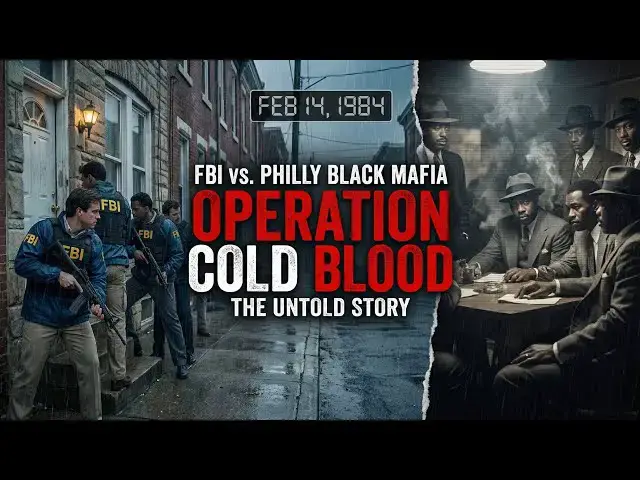
February 14th, 1984. Valentine's Day. Before most of Philadelphia woke up, two hundred FBI agents were already smashing through doors across the city. By sunrise, thirty-one men were in handcuffs. And the Black Mafia—the most powerful African American criminal organization of its era—was finished.
This documentary reveals the untold story of Operation Cold Blood, the massive federal investigation that took five years to build and one morning to execute. We go inside the FBI war room where agents mapped an invisible empire. We follow the informants who wore wires into rooms where one wrong word meant death. And we expose the deals that were made—and the prices that were paid—to bring down an organization that thought it was untouchable.
You'll hear about CJ Washington, the mid-level operator who became the government's most valuable asset. About Raymond Delaney, the FBI legend who orchestrated the takedown. About Terrence Giles, who refused witness protection and paid with his life. And about the defendants who faced trial, knowing their own people had betrayed them.
But this story doesn't end with the convictions. What Operation Cold Blood destroyed, the streets quickly replaced. The vacuum filled within months. The drug trade adapted, evolved, and continued. The real question isn't whether the FBI won—it's whether anything actually changed.
This video connects to our ongoing Black Mafia series, showing how the crisis of the 1984 crackdown transformed the organization's remnants into something new. The seeds planted here would grow into the next generation of Philadelphia's underworld.
Subscribe to Global Mafia Universe to see how deep the conspiracy goes.
📌 CHAPTERS:
0:00 — Valentine's Day, 5:47 AM
6:15 — Finding a Way In
14:30 — The Man Who Wore the Wire
23:45 — The Raids
33:20 — Justice and Its Costs
42:00 — The Legacy
Show More Show Less View Video Transcript
0:00
February 14th, 1984, Valentine's Day. The temperature in
0:06
Philadelphia hovers at 19°. Ice clings to the fire escapes. Steam rises from
0:12
manhole covers into the pre-dawn darkness.
0:18
At exactly 5:47 a.m., over 200 federal agents fanned out across the city in 60
0:24
unmarked vehicles. They carry battering rams, automatic weapons, and sealed arrest warrants bearing 31 names. These
0:32
men have trained for this moment for months. Some have waited years. By 6:15
0:38
a.m., the first doors start coming down. Wood splinters, glass shatters, women
0:45
scream, children cry, and the black mafian organization that has held
0:50
Philadelphia in its grip for over a decade begins its final collapse into history. This is the story of Operation
0:56
Cold Blood, the largest federal takedown of an African-American criminal organization in United States history.
1:03
Up to that point, it was the culmination of a 5-year investigation that costs millions of dollars, destroyed careers,
1:10
shattered families, and left bodies on both sides. The FBI called it a triumph
1:16
of American justice. The streets of North Philadelphia called it something else entirely. They called it a
1:22
betrayal. They called it an invasion. They called it the morning the devil came to
1:29
breakfast. But the real story of Operation Cold Blood isn't about the raids themselves. It isn't about the
1:35
headlines that dominated every newspaper in the city for weeks afterward. It isn't about the politicians who rushed
1:41
to microphones to claim credit. The real story is about what happened in the shadows during the 5 years before those
1:47
doors came down. It's about the informants who sold out their own brothers for promises that may or may
1:52
not have been kept. It's about the federal agents who crossed lines that were never meant to be crossed. It's
1:58
about the deals made in rooms that officially don't exist, documented in files that remain sealed to this day.
2:05
This was a war fought in whispers, a battle waged with tape recorders and
2:10
betrayal. And the truth about who really won and what it cost has never been fully told until now. This is Operation
2:19
Cold Blood. This is how an empire fell. And this is the price that everyone paid
2:24
to understand how Operation Cold Blood came together. You first have to understand what the FBI was facing in
2:30
the early 1980s. The Black Mafia that existed in 1979 was a fundamentally
2:36
different organization than the one that had emerged from the streets of North Philadelphia in the late 1960s.
2:42
It had evolved. It had professionalized. It had learned from the mistakes that brought down its first generation of
2:48
leaders. And it had become something far more dangerous than the federal government initially realized. The
2:55
original black mafia had been built on a foundation of ideology and muscle. Some Christian Ronald Arbay and the other
3:02
founders had emerged from the Nation of Islam, blending religious discipline with criminal enterprise. They ran
3:07
numbers, rackets, they extorted local businesses. They enforced their will through spectacular violence. And for a
3:14
few years in the early 1970s, they held a grip on black Philadelphia that the Italian mob could only observe and envy.
3:21
But that first generation made critical mistakes. They kept written records.
3:27
They talked on phones that could be tapped. They trusted people who shouldn't have been trusted. And by
3:33
1974, federal indictments had scattered the original leadership, Sume Topre.
3:39
Some to unmarked graves, some to exile in cities where their names carried no weight. The empire that Sam Christian
3:46
built didn't collapse overnight. It bled out slowly, block by block, corner by
3:52
corner, body by body. By 1976, most law enforcement officials
3:58
considered the Black Mafia finished. A historical footnote, a cautionary tale.
4:04
They were wrong. What rose from the ashes of the original organization was something more sophisticated. The new
4:10
leadership had learned from watching their predecessors fall. They understood that the future of organized crime
4:16
wasn't about muscle. It was about systems, about money, about insulating
4:21
the people at the top from the violence at the bottom, about creating structures that could survive the loss of any
4:27
individual member. By 1979, the reorganized black mafia operated through a web of legitimate business fronts, car
4:34
washes that laundered cash, check and stores that moved money without banking scrutiny, real estate holdings that
4:41
provided both investment and territorial control. They had lawyers on retainer who knew which judges could be
4:47
approached. They had police officers on payroll who provided warning when raids were planned. They had political
4:53
connections that reached into city council offices and ward leader organizations. The drug operation itself
5:00
had become a model of efficiency. Heroin came in through connections in New York. Italian suppliers who had been doing
5:06
business with the black mafia since the early days. It was cut and packaged in safe houses scattered across the city.
5:13
locations that changed every few weeks. Distribution flowed through a hierarchical structure that mimicked
5:19
legitimate corporations, territory managers, shift supervisors, street
5:24
level representatives. Every level was insulated from the levels above and below. No single arrest could compromise
5:30
the entire organization, and the enforcement armed the men who maintained discipline and eliminated threat become
5:36
surgical in their precision. Bodies still dropped, but they dropped quietly.
5:42
Witnesses didn't just disappear. They were never allowed to become witnesses in the first place. Potential informants
5:48
were identified and neutralized before they could ever reach a federal agent. The organization had learned the most
5:54
important lesson of all. In the drug trade, silence isn't just golden. It's
6:01
survival. Every time the Philadelphia Police Department got close to a major case, something went wrong. Witnesses
6:08
recanted on the stand, their memories suddenly uncertain. Evidence disappeared from property rooms, replaced by bags of
6:15
flour or baking soda. Search warrants were executed an hour after the drugs had been moved. It was as if the
6:22
organization could see the future, or as if someone was telling them exactly what was coming. The FBI's Philadelphia field
6:29
office had been trying to build a case since 1978. made arrests here and their low-level dealers, corner boys who
6:36
didn't know enough to hurt anyone important. But every time they climbed higher up the ladder, the rungs
6:41
disappeared beneath them. The leadership remained untouchable, invisible,
6:47
protected by layers of insulation that traditional investigative methods couldn't penetrate. Washington was
6:53
getting impatient. The Reagan administration had declared war on drugs, and victories were expected. The
7:00
Black Mafia was becoming an embarrassment symbol of federal impotence in the face of organized
7:05
crime. Pressure came down through channels that weren't supposed to exist. Results were demanded. Careers were
7:12
threatened. And in the spring of 1979, a decision was made that would change everything. They were going to bring in
7:18
someone who knew how to win. His name was Raymond Patrick Delaney, 53 years
7:24
old, a legend in the FBI's organized crime division. He'd spent 15 years
7:30
working Italian mob cases in New York, building the kind of RICO prosecutions
7:35
that sent bosses away for life. He'd helped bring down members of the Gambino family, the Colbo family, the Lucesy
7:42
family. He understood how criminal organizations actually functioned. Not the Hollywood version, but the real
7:49
thing, the boring parts, the paperwork, the hierarchy, the pressure points, the
7:56
weaknesses that could be exploited. Delaney was different from the agents who'd worked the Black Mafia case before
8:02
him. He didn't care about quick wins or press conferences. He didn't care about arrest statistics or budget
8:08
justifications. He cared about one thing, building cases that couldn't be beaten. Cases so solid that the best
8:15
defense lawyers in the country would take one look and tell their clients to plead guilty. He arrived in Philadelphia
8:22
in March 1979 with a small team of agents he'd personally selected, men and women he'd worked with before, people he
8:29
trusted completely. They set up shop in a windowless office on the third floor of the field office building. They
8:35
covered the windows with black paper so no one could see in.
8:40
They swept four bugs every morning and they began the slow, tedious,
8:46
unglamorous work of taking apart an empire. Delaney's approach was different from anything the bureau had tried
8:52
before against this organization. He didn't focus on drug buys. He didn't put undercovers on street corners. He didn't
8:59
kick down doors looking for product. He focused on something far more boring and far more deadly. Money. Every criminal
9:07
organization, Delaney understood, ultimately exists for one purpose do
9:13
generate profit. And profit, unlike violence, leaves traces.
9:18
It has to go somewhere. It has to be stored. It has to be moved. It has to be
9:24
converted from street cash into something that can be spent in the legitimate world. and every step of that
9:29
process creates documentation. His team started mapping the black mafia's
9:35
financial infrastructure. They pulled in corporation records for every business they suspected of being connected. They
9:41
subpoenaed bank statements. They traced property ownership through layers of shell corporations. They interviewed
9:47
accountants and lawyers and real estate agents. Anyone who might have touched the organization's money without fully
9:54
understanding what they were touching. It was tedious work. mind-numbing work. Most of the agents
10:00
spent their days in front of microfilm readers, their eyes burning from hours of scanning tax filings and corporate
10:06
documents. They built spreadsheets by hand. This was before computers were standard investigative tools. They cross
10:13
referenced names and addresses and dates, looking for patterns that would reveal the organization's structure. The
10:19
other agents in the field office didn't understand what Delane's team was doing. They were out there making arrests,
10:25
putting bad guys in handcuffs, getting their names in the newspaper. Delaney's people were buried in paperwork,
10:32
invisible and apparently unproductive. There were complaints. There were budget
10:37
reviews. There were pointed questions from supervisors who didn't see results. Delaney ignored all of it. He knew what
10:44
he was building. And slowly, over months of grinding work, a picture began to
10:49
emerge. The Black Mafia wasn't just a drug operation. It was a corporona,
10:55
sophisticated financial enterprise with revenue streams, expense structures, and a clear chain of command. The legitimate
11:02
businesses weren't just fronts. They were profit centers in their own right, generating income that was mixed with
11:08
drug money to create an untraceable slush fund. The real estate holdings weren't just investments. They were the
11:15
physical infrastructure of the drug trade stash houses. distribution points,
11:20
meeting locations, all owned by entities that couldn't be easily connected to anyone in the organization. Delaney
11:26
could see the outlines of something massive. An empire built on money as much as drugs, a criminal enterprise
11:32
that was integrated into the legitimate economy of Philadelphia in ways that would make prosecution extraordinarily
11:39
difficult. The organization's leaders weren't just drug dealers. They were businessmen who happened to sell heroin
11:45
on the side. The problem was proving it. Reichtha rakateeer influenced and
11:50
corrupt organizations act required demonstrating a pattern of criminal activity connected to an enterprise. The
11:58
financial records could prove the enterprise existed. But to prove the pattern of criminal activity, Delaney
12:04
needed something more. He needed witnesses who could testify to the organization's structure. He needed
12:10
people who'd been inside and were willing to tell a jury what they'd seen. He needed informance. Finding someone
12:17
willing to inform on the Black Mafia was not like finding someone willing to testify against a street gang. The
12:24
organization's reputation for dealing with snitches was legendary. Everyone in North Philadelphia knew what happened to
12:31
people who talked. The bodies might never be found, but the message was always received. Silence was enforced
12:38
not just through fear of death, but through fear of what would happen before death arrived. Delaney understood this.
12:45
He knew that approaching potential informants directly would likely get them killed and get nothing useful in
12:51
return. He needed to find someone who was already vulnerable, someone with pressure on them that the organization
12:57
couldn't relieve, someone whose loyalty could be redirected through careful manipulation. He spent months studying
13:04
the organization's personnel, looking for the right candidate. too high in the hierarchy and they'd be too protected,
13:12
too committed, too dangerous to approach, too low, and they wouldn't
13:17
know enough to be useful. He needed someone in the middle, someone with access, but not power, someone with
13:24
something to lose that the organization couldn't protect. In the summer of 1981,
13:30
he found exactly what he was looking for. His name was Curtis Leavon Washington, 34 years old. Everyone on
13:37
the streets called him CJ. He was a mid-level operator who ran a small but
13:42
profitable territory in West Philadelphia. He'd been with the organization for 8 years, long enough to
13:48
understand how things worked. Not senior enough to be truly protected by the leadership. He was good at his job,
13:54
reliable, trusted, a company man who showed up every day and did what he was told. And
14:02
he had a problem. A problem named Marcus. Marcus Washington was CJ's younger brother, 27 years old, a
14:10
hot-headed kid who'd grown up worshiping his older brother and wanting to follow in his footsteps. CJ had tried to keep
14:16
Marcus out of the life had sent him money, tried to get him interested in legitimate work, even paid for a
14:22
semester of community college, but the streets have a gravity that's hard to escape. By 1980, Marcus was running his
14:29
own small operation independent of CJ's organization, trying to make a name for himself. In November of that year,
14:36
Marcus' ambition caught up with him. A drug deal went wrong. Words were
14:43
exchanged. Guns came out. When the smoke cleared, two men lay dead on the floor
14:48
of a warehouse in Kensington. And Marcus Washington was standing over them with a still warm pistol in his hand. The
14:54
evidence was overwhelming. Three witnesses, forensics that matched Marcus
15:00
to the weapon and the scene. a prosecutor who saw an easy conviction and a chance to look tough on drug
15:05
violence. Marcus was charged with two counts of first-degree murder. If convicted, he was facing death or life
15:12
without parole. There was no deal to be made. No angle to work. The case was
15:18
airtight. CJ tried everything. He hired the best lawyers he could afford. He
15:25
tried to reach the witnesses. He even approached the organization's leadership, hoping their connections
15:30
might be able to help. But Marcus wasn't a member. He'd been operating independently. And the leadership made
15:37
it clear this wasn't their problem. CJ was on his own. Raymond Delaney was
15:44
watching all of this unfold. His team had been monitoring CJ for months, waiting for exactly this kind of
15:50
opportunity. When Marcus was arrested, Delaney knew his moment had come. But he
15:56
didn't rush. He didn't approach CJ directly. He waited. He watched. He let
16:02
the desperation build. The trial came in March 1981. It lasted 2 weeks. The defense did
16:09
everything they could, but the evidence was too strong. The jury deliberated for
16:15
less than a day. Marcus Washington was convicted on both counts of first-degree murder. The judge scheduled sentencing
16:21
for the following month. Delaney made his approach 3 days after the conviction. Not to CJ directly, that
16:28
would have spooked him. He sent an intermediary, a retired Philadelphia cop who'd done occasional work for the
16:34
bureau. The message was simple. There might be a way to help your brother. If
16:40
you're interested in talking, CJ refused. Of course, he refused. He knew
16:45
what the FBI wanted. He knew what cooperation meant. He'd seen what happened to in he told the intermediary
16:52
to never contact him again and for a month he heard nothing. Then the sentencing came down. The judge had no
17:00
mercy. Marcus Washington received 35 years to life. He would be an old man before he was allegible for peril. He
17:07
survived that long. The prison system wasn't kind to convicted murderers who couldn't afford protection. That night,
17:14
CJ Washington sat in his car outside his mother's house for 3 hours. He watched
17:19
her through the window, watched her crying at the kitchen table, watched her world falling apart. His mother was 61
17:27
years old. She'd raised five children alone after their father left. She'd worked her entire life, and now she was
17:34
going to watch her youngest son die in prison. At midnight, CJ drove to a pay phone on Baltimore Avenue. He dialed the
17:41
number the intermediary had given him. And when Raymond Delaney answered on the second ring, CJ Washington said seven
17:48
words that would change everything. Tell me what you want from me. The terms of
17:53
CJ's cooperation were negotiated over the following weeks. Delaney was careful, methodical. He understood that
18:00
any mistake could get CJ killed and destroy years of investigative work in the process. The arrangement was clear.
18:08
CJ would continue his normal activities within the organization. He would give no one any reason to suspect his loyalty
18:14
had shifted. He would attend meetings, run his territory, collect money, move
18:20
product. From the outside, nothing would change, but he would wear a wire when instructed. He would report back
18:26
regularly on operations, personnel, structures, and plans. He would provide
18:32
documentation, anything he could copy or photograph without being noticed. He would identify other potential
18:38
informants, people who might be vulnerable to similar pressure. And when the time came when the case was ready,
18:43
he would testify in open court about everything he'd seen. In exchange, the
18:48
bureau would work to get Marcus' sentence reduced or overturned. Delini was honest. He couldn't promise
18:56
anything. The conviction was solid. The appeals process was unpredictable, but
19:01
he had relationships with prosecutors and judges. Strings could be pulled.
19:07
Favors could be called in if CJ delivered what the bureau needed. His brother would not die in prison. And
19:13
when the operation was over, when the arrests came down and the trials began, CJ and his entire family would enter the
19:20
witness security program, new names, new identities, new lives in a city far from
19:28
Philadelphia. The Black Mafia's reach was long, but it wasn't infinite. in the right place with the right precautions,
19:35
they could survive. CJ agreed. He had no choice. And on a warm June evening in
19:41
1981, in the basement of a federal building in downtown Philadelphia, he put on his first wire. For the next 2
19:48
and 1/2 years, Curtis Washington lived a double life of extraordinary danger and
19:54
psychological torment. He went to work every day in an organization that would have killed him slowly if they knew what
20:00
he was doing. He laughed with men he was betraying. He ate dinners with people he
20:05
was sending to prison. He played with the children of colleagues whose fathers would be taken from them because of the
20:10
words he recorded. The technical side was challenging enough. The recording equipment of the early 1980s was bulky
20:17
by later standards. Transmitters could be detected by the increasingly sophisticated counter surveillance
20:22
measures the organization employed. CJ learned to position himself carefully to angle his body so the microphone picked
20:29
up conversations clearly to avoid situations where he might be searched or scanned. But the psychological toll was
20:36
worse. CJ developed insomnia. He started drinking heavily. A lost
20:41
weight nearly 30 lb in the first year. His wife noticed the change but attributed it to stress from Marcus'
20:48
situation. She didn't know the truth. She couldn't know. The fewer people who knew, the safer everyone would be.
20:55
Delaney had his team monitor CJ carefully. They watched for signs that
21:01
he might be breaking down, that his cover might be compromised. They provided what support they could regular
21:07
meetings where CJ could unburden himself. Reassurances that the end was coming. Progress reports on Marcus'
21:15
appeal. The recordings CJ gathered were extraordinary. He captured conversations about drug shipments, quantities,
21:22
sources, distribution routes, pricing structures. He recorded discussions of
21:27
murders, some that had already happened, some that were being planned, some that were being debated. He got tape of the
21:34
organization's leadership laying out strategies, expressing concerns, boasting about their power, naming names
21:41
that law enforcement had never connected to the enterprise. Over the course of his cooperation, CJ Washington recorded
21:48
more than 300 hours of audio, thousands of individual conversations,
21:53
hundreds of identifiable voices, evidence that would take prosecutors months to catalog and analyze. Every
22:00
minute of it potentially admissible in court. But CJ wasn't working alone. Delaney had been cultivating other
22:07
informants throughout the organization. Some were recruited through pressure, similar to CJ's men with family members
22:13
in legal jeopardy. Debts that the organization couldn't satisfy, vulnerabilities that the bureau could
22:19
exploit. Others were simply opportunistic people who saw which way the wind was blowing and wanted to be on
22:25
the winning side when the storm hit. By the end of 1983, Delaney had five active
22:31
sources inside the organization, each providing pieces of a puzzle that was finally coming together. The bureau
22:37
didn't trust any single informant completely. They cross-referenced everything, verified every claim against
22:44
multiple sources, looked for inconsistencies that might indicate deception or disinformation. What
22:50
emerged from this synthesis was a comprehensive portrait of the black mafia's operations at its height. The
22:56
drug supply chains connected to Italian distributors in New York and Baltimore. Heroin that flowed down the Interstate
23:02
95 corridor into Philadelphia's streets. The moneyaundering networks moved cash
23:07
through a dozen legitimate businesses, converting drug profits into real estate, vehicles, and untraceable bank
23:14
accounts. The enforcement arm maintained discipline through carefully planned violence that rarely attracted law
23:19
enforcement attention. The picture was complete. The case was ready. Now came
23:26
the hardest part. Deciding when to strike. Raymond Delaney presented his findings to the US Attorney's Office in
23:32
October 1,983. The RICO case was solid one of the
23:37
strongest he'd ever built. They had evidence for over 40 indictments, multiple charges for each defendant,
23:43
predicates that crossed a dozen different federal statutes. If the trials went well, the organization's
23:50
leadership could face life sentences across the board. But the decision of when to move wasn't purely legal. It was
23:57
political. It was tactical. It was a calculation of risk and reward that had to account for
24:02
dozens of variables. Move too early and some targets might escape. The organization had resources to flee the
24:09
country. Several of its leaders had connections abroad houses in the Caribbean, bank accounts in the Caymans,
24:15
contacts in countries without extradition treaties. If they caught wind of what was coming, the most
24:21
important defendants might simply disappear. wait too long and the informants would be exposed. Every day
24:28
the investigation continued was a day that CJ Washington and the others were at risk. The organization had its own
24:34
intelligence capabilities. They were always watching. Always suspicious. One
24:40
wrong word. One suspicious phone call. One piece of bad luck and the informants
24:45
would be dead end. Years of investigative work would die with them. The prosecutors wanted to move
24:50
immediately. They saw careermaking cases. They saw headlines and promotions. They saw the political
24:56
advantages of a major RICO takedown during an election year. Delaney counseledled patients. He wanted the net
25:02
to be complete. He wanted to be certain that no one would escape. He wanted to tie up every loose end so the defense
25:09
couldn't exploit gaps in the evidence. The debate went back and forth for weeks. Memos were written. Meetings were
25:17
held. Washington got involved. Finally, a decision was made. They would move in
25:22
February 1984. The exact date was chosen with symbolic weight. February 14th, Valentine's Day.
25:32
A message to the organization and the city that would be impossible to miss. The two weeks before the operation were
25:38
a blur of preparation and paranoia. 60 target locations had to be 200 agents
25:45
had to be briefed and assigned. Coordination with local police had to be arranged carefully because some of those
25:51
local officers were suspected of being on the organization's payroll. Search warrants had to be prepared. Arrest
25:58
warrants had to be sealed. Evidence processing procedures had to be established and the informants had to be
26:05
extracted. The night before the raids, CJ Washington was pulled from the field. A routine looking traffic stop pulled
26:12
him over at 11 p.m. on a quiet street in West Philadelphia. He was placed in the back of an unmarked van and driven to a
26:18
safe house in southern New Jersey. His wife and children had been quietly moved earlier that day, told only that CJ had
26:25
called and asked them to pack for an emergency trip. By midnight, Curtis Washington had ceased to exist. The man
26:31
who would eventually testify at trial would have a new name, a new face reconstructive surgery was already
26:38
scheduled, and a new life waiting in a city he had never visited. He would never return to Philadelphia. He would
26:45
never see his mother again. He would never attend his brother's parole hearings or watch his nieces and nephews
26:50
grow up. The price of his survival was the eraser of everything he had ever been. The other informants received
26:56
similar treatment. Some were extracted, cleanly picked up at predetermined locations, vanished into the federal
27:03
witness protection machine. One, a man named Terrence Giles, who had provided crucial testimony about the enforcement
27:09
arm, refused to leave. He said he had unfinished business, personal matters
27:14
that couldn't wait. He promised to go into protection after the arrests when the chaos would provide cover for his
27:20
disappearance. Delaney argued with him for an hour. He explained the risks. He
27:26
described in detail what the organization did to informants. He begged Giles to reconsider.
27:33
Giles refused. He had his reasons. Reasons he never explained and that died
27:38
with him. Two weeks after the raids, Terren Giles's body was found in a wooded area of Fairmont Park. He had
27:45
been shot 11 times. His tongue had been removed. The message was clear to everyone who needed to receive it. The
27:52
organization might be falling, but it hadn't forgotten how to send a message. February 14th, 1984.
28:00
Valentine's Day. Philadelphia woke to a cold that seemed to reach into bones.
28:06
Frost clung to car windows. Steam rose from manhole covers. Most of
28:11
the city was still asleep when the first wave of agents left the staging area at 5:30 a.m. At 5:47, the operation began.
28:20
60 teams hit 60 locations simultaneously. Rowouses in North Philadelphia,
28:26
apartments in West Philly, businesses in Center City, stash houses that the
28:31
bureau had been watching for months, homes of men who thought they were beyond the reach of any law. The targets
28:38
were caught in every state of vulnerability. Some were in bed, pulled from their sleep by flashbang grenades,
28:44
and shouted commands. Some were in the shower, dragged out, naked, and handcuffed while water still ran. Some
28:52
were eating breakfast with their families, their children screaming as agents flooded through doors that had
28:57
been standing seconds before. There was no time to run, no time to hide, no time
29:04
to destroy evidence. The coordination was military in its precision before most of the city knew anything was
29:10
happening. 31 men were in federal custody and three tractor trailers were being loaded with evidence. The scale of
29:16
what the bureau recovered exceeded even Delane's expectations. Cash over $2
29:22
million found in a single hidden basement vault in North Philadelphia, bundled in stacks that filled an entire
29:28
room. Weapons, handguns, rifles, shotguns, enough to equip a small army.
29:33
drugs, enough heroin to supply the city's demand for months, packaged and ready for distribution, and records.
29:41
Despite all the organization's precautions, despite the lessons learned from the first generation's mistakes,
29:47
some members had kept documentation, ledgers that named names, account books
29:52
that traced money flows, photographs that showed connections between people who were supposed to have no connection,
29:59
the kind of evidence that defense lawyers have nightmares about. By noon, the media had arrived in force. Every
30:07
local television station, every newspaper, satellite trucks lined up outside the federal building where
30:13
Delane's supervisors were preparing a press conference. The story led every newscast, dominated every front page.
30:21
Politicians rushed to claim credit. Community leaders rushed to express outrage. The city was electric with the
30:28
news. But in the streets of North Philadelphia, the reaction was more complicated. There was fear. Certainly
30:35
fear of what might come next. Fear of who might have been talking. Fear of the chaos that always follows the removal of
30:42
established order. But there was also anger. Deep historical anger that had
30:48
nothing to do with the specific men who'd been arrested. The FBI, after all,
30:53
had a complicated relationship with black America. Co-intelpro was not
30:58
ancient history. The surveillance of Martin Luther King Jr. was within living memory. The bureau was not seen as a
31:05
protector in these communities. It was seen as an occupying force. And the spectacle of 200 armed agents almost,
31:12
all of them white storming through black neighborhoods at dawn stirred memories that would not fade. The trials began in
31:18
September 1984 and would continue for nearly 2 years. 29 defendants faced
31:23
Reiko charges carrying potential life sentences. The government's case rested heavily on the testimony of cooperating
31:30
witnesses, primarily CJ Washington, though he was never identified by his real name in open court. CJ's testimony
31:37
took 9 days. He was transformed from the man he'd been reconstructive surgery had altered his face. Voice training had
31:44
changed how he spoke. Weight gain had changed his body. Even people who had known him for years might not have
31:51
recognized him, but his words were unmistakable. He walked the jury through every level of the organization. He
31:58
identified defendants by name and described their roles. He played recordings that captured them in their
32:04
own words, discussing crimes that could put them away forever. The defense strategies varied. Some defendants
32:10
claimed ignorance, insisting they were legitimate businessmen caught up in a case of mistaken identity. Some attacked
32:16
the credibility of the informants, portraying them as criminals who would say anything to save themselves. Some
32:22
challenged the legality of the recordings, arguing that the wiretaps had exceeded their authorized scope.
32:27
Some simply remained silent, trusting that the code of the streets would protect them, that witnesses would
32:33
recant, that jurors would be intimidated. None of it worked. The evidence was overwhelming. The
32:40
recordings spoke for themselves. The financial documents traced money with damning clarity. Witness after witness
32:46
took the stand to describe what they had seen, what they had done, what they had been ordered to do. The verdicts came
32:52
down over a period of months. 24 convictions on major RICO charges. Five
32:58
acquitt, mostly defendants who had managed to stay on the periphery of the evidence. Sentences ranged from 10 years
33:05
to life without parole. The leadership of the black mafia was effectively decapitated in a single judicial stroke.
33:11
Raymond Delaney watched the final verdicts from the back of the courtroom. He'd been promoted and transferred to
33:17
Washington before the trials concluded. His career would continue to rise. He eventually became an assistant director
33:23
of the FBI before retiring in 1997. He never spoke publicly about Operation
33:29
Cold Blood after the trials were over. He never wrote a memoir. He never gave
33:35
interviews. He took his methods and his memories to a quiet retirement in Virginia where he
33:41
died in 2011. Largely forgotten by a bureau that had moved on to other wars.
33:47
CJ Washington lived in witness protection for the rest of his life. The bureau relocated him to a small town in
33:53
the Pacific Northwest about as far from Philadelphia as you can get without leaving the country. He worked
33:59
unremarkable jobs. He married again. He raised his new children with stories
34:05
about a past that was entirely fictional, a history that had never happened. His brother Marcus was
34:11
released from prison in 1995. His sentence had been quietly reduced, part
34:16
of a deal that was never officially acknowledged. The brothers never saw each other again. They communicated
34:22
occasionally through intermediaries, letters routed through the US Marshall Service, phone calls that were monitored
34:28
and recorded. But a visit was too dangerous. Too much risk that someone might make a connection, might recognize
34:35
a face, might wonder why a man in Washington state had a brother who'd done time in Pennsylvania. CJ died in
34:43
2003. Heart attack. He was 56 years old. There
34:49
was no obituary in any Philadelphia newspaper. No one from his old life knew
34:54
he was gone. The man who'd been Curtis Washington, who'd grown up in North Philly, who'd run corners and worn wires
35:01
and destroyed an empire, that man had already been dead for 20 years. What remained was buried under a name that
35:08
appears nowhere in this story. But the story of Operation Cold Blood doesn't end with the convictions. What the FBI
35:14
dismantled wasn't destroyed. It evolved. The vacuum left by the arrests was filled almost immediately. New
35:21
organizations rose to take the black mafia's place. Some were led by men who had avoided indictment's second tier
35:27
figures who suddenly found themselves in positions of power. Others were entirely
35:33
new, built by a generation that had learned from the old guard's mistakes. The drug trade in Philadelphia didn't
35:39
stop. It couldn't stop. The demand was too high. The money was too good. The
35:46
street's nature uphores a vacuum. And this vacuum was filled within months. By
35:51
summer of 1984, the heroine trade was back to pre-rade levels. New suppliers
35:57
had been found. New distribution networks had been established. New enforcers had emerged to maintain the
36:03
peace. But the game had changed. Everyone was more paranoid now, more
36:08
suspicious, more violent. The lesson the criminal underworld took from Operation Cold
36:14
Blood wasn't that crime didn't path survivors were proof that it still did.
36:19
The lesson was that you couldn't trust anyone. The lesson was that brothers would sell out brothers. That the man
36:25
you'd known for 10 years might be recording every word you said. That the FBI could reach anyone anywhere at any
36:33
time. The crack era was coming. Cocaine would transform the drug trade in ways
36:38
that heroin never had. The money would multiply. The violence would intensify.
36:43
The organizations that rose from the ashes of the black mafia would be more fragmented, more
36:50
dangerous than anything that came before. Within 5 years of Operation Cold Blood, the streets of North Philadelphia
36:57
were more deadly than they'd ever been. Not because the operation had failed, but because in some ways it had
37:03
succeeded too well. It had destroyed the old order without creating anything to replace it. It had removed the men who
37:10
for all their crimes had maintained a kind of brutal peace. What came after was chaos. The FBI meanwhile declared
37:19
victory and moved on. The techniques developed during the investigation a long-term informant cultivation.
37:25
Financial forensics coordinated multi-target strikes became templates
37:30
for future operations. They would be applied to organizations across the country from Italian mob families to
37:36
drug cartels to street gangs. In Tatsensei Operation Cold Blood changed
37:42
law enforcement forever. It proved that patience in paperwork could accomplish what raids and arrests could not. It
37:48
proved that even the most sophisticated criminal organization could be destroyed from within. But for the people who
37:54
lived through it families of those arrested, the communities that were raided, the witnesses who were relocated
38:01
or killed, the legacy was more complicated. Justice, they learned, wasn't the same thing as healing. Taking
38:07
down an organization wasn't the same as solving the problems that created it. The Black Mafia rose because certain
38:13
communities had no other path to power. Because the legitimate economy had locked them out, because the systems
38:20
that were supposed to protect them had failed, or worse, had been designed to fail. Operation Cold Blood addressed the
38:28
symptom. The disease remained and new symptoms would emerge again and again. In the
38:35
decades that followed, 40 years have passed since that Valentine's Day morning. The city has changed. The
38:42
Richard Allen homes, where so many of the defendants grew up, have been demolished. New housing stands, where
38:48
the old towers once loomed. Different crews control the corners now, selling
38:53
different products to different customers under different rules, but the files from Operation Cold Blood remain
38:59
partially sealed. Certain informants have never been publicly identified. Certain deals have never been
39:05
acknowledged. There are names on those arrest warrants that don't appear in any public record. People who were indicted
39:12
but never tried, whose cases were dismissed for reasons that have never been explained. Raymond Delaney took
39:18
some secrets to his grave. So did CJ Washington. So did Terren Giles. Shot 11
39:24
times in a park because he wouldn't run when he had the chance. So did dozens of other zagans and informants, prosecutors
39:31
and witnesses who knew pieces of the truth that have never been assembled into a complete picture. The official
39:37
story of Operation Cold Blood is a story of law enforcement triumph. The bureau's
39:42
files tell a tale of careful investigation, patient cultivation, and surgical execution. The press releases
39:49
speak of justice served and communities protected. The real story is messier.
39:54
The real story involves compromises that would never survive public scrutiny, deals made with murderers, evidence that
40:02
was obtained in ways that courts would question, promises that were made and broken, lives that were destroyed not
40:08
because of guilt, but because they were in the wrong place at the wrong time.
40:13
Some of that story may never be told. The witnesses are dead or scattered.
40:20
The files remain sealed. The institutions involved have no interest in revisiting decisions that were made
40:26
decades ago by people who are no longer alive to answer for them. What we know for certain is this. On a freezing
40:34
February morning in 1984, the FBI struck a devastating blow against organized
40:39
crime in Philadelphia. They arrested the guilty. They put away the dangerous. They disrupted networks
40:45
that had caused immeasurable harm. And the next day, the sun rose on the same streets. New bosses emerged. New
40:53
territories were carved. New bodies started falling. The faces changed. The
40:59
game remained the same. The documents are still out there in federal archives
41:05
and sealed court files and evidence lockers where magnetic tape slowly degrades in climate control darkness.
41:13
The truth is written somewhere in testimony that was never made public. In photographs that were never released, in
41:19
recordings that captured voices that are now silent forever, the streets, remember, even when the records are
41:25
sealed, old men in barber shops still talk about that morning, about the sounds of doors coming down, about the
41:32
fear and the chaos and the aftermath. They remember the names, some of them
41:38
anyway, the names that were never printed, the names that were whispered but never written down. and they
41:44
remember the lesson that Operation Cold Blood taught everyone who was paying attention. In the end, it's not the law
41:52
that destroys empires. It's not police or prosecutors or federal agents. It's
41:57
betrayal. It's the brother who wears a wire, the friend who makes a deal, the
42:03
soldier who decides that survival matters more than loyalty. That's what cold blood proved. That's
42:10
what the streets learned. And that's why in the decades since, the underworld has
42:16
become a place where trust is even rarer than mercy. This was operation cold
42:22
blood. This was how an empire fell. This was what it cost to bring down the black
42:27
mafia. And this was why despite all the resources expended and all the lives
42:33
destroyed, another empire rose to take its place before the paperwork was even filed. The underworld never dies. It
42:41
just changes faces. The streets remember what the files forget. And somewhere in cities across
42:48
America, the same story is unfolding again. Different names, different drugs,
42:54
different techniques, but the same fundamental drama of power, money, betrayal, and blood. Subscribe now
43:02
because what comes next is darker still. The Black Mafia's story didn't end with
43:07
Operation Cold Blood. the men who survived, the lessons that were learned.
43:12
The new organizations that emerged, those threads connect to something larger, something that's still unfolding
43:18
in the streets of America's cities today. The shadows are always watching, the wires are always recording, and the
43:25
betrayals never stop. Stay with us. The next chapter is