live_tv
Livestream Starting Soon
00
Hours
:
00
Minutes
:
00
Seconds
Up next in 10

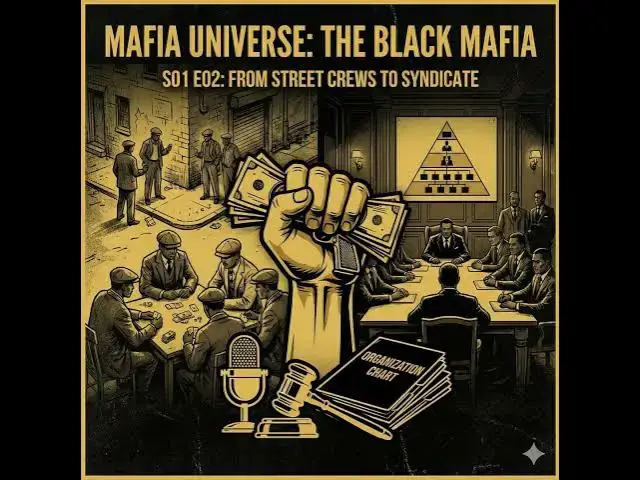
Ridge Avenue, North Philadelphia. October 14, 1968. Six men meet in a closed barbershop to discuss something that will change urban organized crime forever: Operation Philly—the systematic transformation of competing street crews into a unified criminal syndicate.This is the untold origin story of the Black Mafia, one of the most sophisticated organized crime groups in American history. Between 1968 and 1973, Samuel Christian and his associates built a criminal empire that generated over twenty million dollars while remaining virtually invisible to media obsessed with Italian mobsters. They studied their oppressors, copied their organizational methods, and created something law enforcement didn't see coming: a hierarchical Black criminal syndicate with divisions, territories, and discipline rivaling any Mafia family.Through FBI surveillance reports, sealed court documents, and testimony from federal RICO prosecutions, this documentary reveals how Operation Philly converted street-level chaos into criminal enterprise. We explore the barbershop meetings where strategy was planned, the territorial consolidation that built their empire, the corruption networks that protected them, and the federal investigation that finally brought them down.This isn't a story of simple criminality. It's a complex examination of how systemic oppression, limited legitimate opportunity, and sophisticated organizational thinking converged to create an empire built on numbers rackets and narcotics distribution—all while leaders claimed they were practicing Black economic empowerment.Was Operation Philly criminal entrepreneurship adapting to systemic racism, or exploitation disguised as liberation? The answer is more complicated than either narrative allows.Subscribe for more untold stories from the Mafia Universe—the hidden empires, forgotten architects, and operations that changed organized crime forever.
Show More Show Less View Video Transcript
0:00
Welcome back to Concrete Jungle Crimes,
0:02
where we peel back the layers of urban
0:04
underworlds. Today, we're kicking off a
0:07
brand new season, Roots and Formation,
0:09
diving deep into one of America's most
0:11
misunderstood and feared criminal
0:14
organizations, the Black Mafia of
0:16
Philadelphia. Specifically, we're going
0:18
to explore how what we're calling
0:20
Operation Philly, the formation and rise
0:22
of this powerful syndicate, truly began.
0:26
It's a story rooted in the tumultuous
0:28
1960s, a time of immense social change
0:31
and paradoxically growing despair in
0:33
many urban centers. Jesse Lily, thanks
0:36
for being here.
0:37
Thanks for having us, Daniel. You know,
0:39
when we talk about Operation Philly in
0:41
this context, it's really about
0:43
understanding the perfect storm that
0:45
brewed in Philadelphia, particularly in
0:47
North Philly during that era. The 60s
0:49
were explosive, right? civil rights,
0:51
Vietnam, but also massive urban decay,
0:54
de-industrialization, and a serious lack
0:57
of opportunities for young black men.
0:59
These weren't just idle hands. These
1:01
were people facing systemic barriers.
1:03
And for some, the streets offered the
1:05
only path to power or prosperity,
1:07
however fleeting.
1:09
Absolutely, Jesse. And it's crucial to
1:11
acknowledge that context. You had
1:13
traditional organized crime, the Italian
1:15
mafia, already established, but they
1:18
often weren't operating in these
1:19
specific black neighborhoods. There was
1:22
a vacuum, a sort of wild west scenario
1:24
where petty criminals, strong men, and
1:27
ambitious young men saw an opportunity
1:29
to carve out their own territories. They
1:32
started small with street crews,
1:34
protection rackets, numbers games, but
1:36
they quickly realized the power in
1:38
consolidation. That's exactly it, the
1:42
vacuum. It wasn't just about a lack of
1:44
opportunity. It was also about a lack of
1:46
legitimate governance or protection
1:48
within these communities. So, these
1:50
crews stepped in, often providing a
1:52
twisted form of order. Who were some of
1:55
those early pivotal figures, Lily, that
1:57
started to coalesce these disperate
1:59
groups into something more formidable?
2:02
Well, you can't talk about the early
2:03
days without mentioning names like
2:05
Raymond Long John Boon and James Blackat
2:07
Irving. These weren't just street thugs.
2:10
They were charismatic, often incredibly
2:12
intelligent and ruthless. Boon, for
2:14
example, was known for his street smarts
2:16
and his ability to organize. He saw
2:18
beyond just controlling a block. He
2:20
envisioned a larger network. Black Cat
2:23
Irving, on the other hand, was perhaps
2:24
more overtly violent, but his fear
2:27
factor was instrumental in establishing
2:29
dominance.
2:30
And it wasn't just brute force. There
2:32
was an element of shrewd business
2:34
acumen, however illicit. They weren't
2:36
just mugging people. They were
2:38
developing sophisticated protection
2:39
schemes for small businesses, running
2:42
highly profitable numbers operations.
2:44
And then crucially, they started tapping
2:47
into the burgeoning drug trade. Heroin
2:49
especially became a massive revenue
2:52
stream that allowed these crews to grow
2:54
exponentially and attract more talent,
2:57
if you can call it that.
2:58
The drug trade really changed the game,
3:00
didn't it? Before that, they were
3:02
operating on smaller scales. But heroin,
3:05
that's where the real money and the real
3:06
violence escalated. It transformed them
3:09
from street gangs into something
3:10
resembling a true syndicate. Operation
3:13
Philly moving into high gear. What was
3:15
the catalyst for that transition? Was it
3:18
an intentional strategy or more organic?
3:21
It was probably a bit of both, Daniel. I
3:23
mean, they saw the success of the
3:24
Italian mob, right? They had structures,
3:26
territories, a code, even if a twisted
3:29
one. These early black leaders
3:30
recognized that if they wanted to
3:32
compete, if they wanted to survive and
3:34
thrive, they couldn't just be a
3:36
collection of waring factions. They
3:38
needed to consolidate, establish
3:40
hierarchies, and control the flow of
3:42
their illicit goods. The money from
3:44
drugs provided the capital to do that,
3:46
to arm themselves, to pay off people,
3:48
and to project power.
3:50
And let's not forget the social aspect.
3:52
In some ways, they presented themselves
3:54
as an alternative power structure. The
3:57
police were often seen as outsiders or
3:59
oppressive forces in these
4:00
neighborhoods, and the traditional
4:02
political system wasn't delivering. So,
4:05
some people out of desperation or a
4:07
desire for local control might have
4:09
tolerated or even grudgingly respected
4:12
these figures who brought a certain kind
4:14
of order, even if it was violent. They
4:17
might have even helped with community
4:18
problems, creating a bizarre social
4:21
contract.
4:22
That's a fascinating point, Jesse. They
4:24
filled a void left by systemic neglect.
4:26
So they weren't just criminals. They
4:28
were, in a twisted sense, community
4:30
organizers. How did they manage to exert
4:33
such control? Was it pure intimidation,
4:35
or were there more subtle methods at
4:37
play? It was definitely a mix.
4:39
Intimidation was a huge part of it,
4:41
especially with figures like Black Cat
4:43
Irving. His reputation for brutality
4:45
preceded him. But there was also a
4:47
shrewdness. They were known to have
4:49
connections, to know who to lean on, who
4:51
to pay off, whether it was low-level
4:53
politicians, police officers, or even
4:55
influential community figures who might
4:57
look the other way. They understood the
4:59
mechanics of power, both overt and
5:02
covert.
5:02
And they were masters of propaganda in a
5:05
sense. They cultivated this image of
5:07
being untouchable, of being the true
5:09
power brokers in their domains. When you
5:12
have a whole community, especially the
5:14
younger generation, looking up to these
5:16
guys because they're driving fancy cars
5:18
and flashing cash, it creates a powerful
5:21
allure. It's a distorted version of the
5:24
American dream, but it's effective in
5:26
recruitment and maintaining a certain
5:28
level of silence from the populace.
5:30
So, as Operation Philly consolidates, we
5:33
see a shift from just street crime to
5:35
more systematic organized criminal
5:37
enterprises. And part of that expansion
5:39
involved clashes, right? They weren't
5:42
just operating in a vacuum. There were
5:43
other players and they had to assert
5:45
their dominance. What were some of the
5:47
early power struggles or rivalries that
5:49
defined their rise? Oh, absolutely. The
5:52
early days were incredibly bloody. There
5:54
were constant turf wars, both among the
5:56
emerging black gangs and with existing
5:58
criminal elements. You had the Johnson
6:00
brothers, another significant crew,
6:02
often clashing with Boon's faction.
6:04
There were internal power struggles,
6:06
too. The sheer amount of violence was
6:08
staggering. All aimed at solidifying
6:10
control over drug routes, gambling
6:12
operations, and protection rackets. It
6:15
was a clear demonstration. If you didn't
6:17
fall in line, you were eliminated.
6:19
And the methods were brutal. It wasn't
6:21
just a punchup. They weren't afraid to
6:24
use extreme violence, beatings,
6:26
shootings, even assassinations to send a
6:29
message. This level of brutality
6:31
instilled a deep fear not just in rivals
6:34
but in anyone who might consider
6:35
crossing them. It was a key component of
6:38
Operation Philly establishing its grip
6:40
on the city's underworld.
6:42
It sounds like a Darwinian struggle for
6:44
survival and dominance where only the
6:46
strongest and most ruthless could
6:48
ascend. And it culminated in some truly
6:50
notorious figures taking the helm. We've
6:53
mentioned Long John Boon and Blackcat
6:54
Irving, but then there's also Major
6:56
Coxin, who becomes a prominent figure.
6:59
How did these different personalities
7:01
and leaders contribute to the
7:02
syndicate's overall structure and
7:04
reputation? Well, Coxin represents an
7:06
interesting evolution. He had a bit more
7:08
of a legitimate front, you could say. He
7:10
owned businesses, was involved in
7:12
community initiatives, or at least
7:13
presented himself that way. This allowed
7:15
the black mafia to gain a different kind
7:17
of influence, extending beyond just
7:19
intimidation and into the fabric of the
7:22
community itself. He projected an image
7:24
of a successful black businessman, which
7:26
was powerful in itself, masking the
7:28
illicit underpinnings.
7:30
Exactly. While Irving was all about
7:32
fear, Coxin understood the power of
7:35
perception and political maneuvering. He
7:38
allowed the organization to move into
7:40
different spheres to network and to
7:42
create a more sophisticated enterprise.
7:45
It wasn't just about street corners
7:46
anymore. It was about leveraging
7:48
influence and capital, whether
7:50
legitimate or not, to expand their
7:53
reach. This showed a maturation of
7:55
Operation Philly from pure street crime
7:58
to a more complex criminal entity.
8:01
So, we're talking about an organization
8:03
that by the early to mid70s has truly
8:05
solidified. They've established
8:07
territories, revenue streams, and a
8:09
reputation that casts a long shadow over
8:12
large parts of Philadelphia. What was
8:14
the reaction from law enforcement and
8:16
the broader community as Operation
8:18
Philly fully emerged? Initially, I think
8:21
law enforcement struggled to understand
8:22
the scope and nature of what was
8:24
happening. They were used to dealing
8:25
with individual gangs or specific
8:27
crimes. This was different. This was a
8:30
cohesive, rapidly expanding syndicate.
8:32
It took them a while to even acknowledge
8:34
it as a singular entity, often referring
8:36
to them as separate crews or gangs for
8:38
far too long. This delayed an effective
8:41
response,
8:42
and the community's reaction was really
8:44
complex, as we touched on earlier. For
8:46
many, it was sheer terror. People were
8:49
caught in the crossfire of turf wars,
8:51
victims of extortion, or just lived in
8:54
fear. But for others, there was a
8:56
strange sense of pride or defiance. Here
8:58
was a black organization that had
9:00
achieved power and wealth, even if
9:02
through illicit means in a system that
9:05
often denied them both. It's a very
9:07
uncomfortable truth, but it was part of
9:10
their early strength.
9:11
That's a nuanced perspective often
9:13
missed. It wasn't black and white, pun
9:15
intended. So, by the time we hit the
9:17
late 70s, early 80s, Operation Philly
9:20
isn't just a collection of street crews
9:22
anymore. It's a full-fledged criminal
9:24
enterprise with a significant footprint.
9:27
What kind of legacy did these early
9:28
formations leave? How did the groundwork
9:31
laid in the 60s and 70s shape the future
9:33
of organized crime in Philadelphia? The
9:36
legacy is profound. They essentially
9:38
created a blueprint for urban
9:39
syndicates. They showed how to take
9:41
desperate street elements and forged
9:43
them into a disciplined or at least
9:45
violently controlled organization. They
9:47
established drug pipelines, perfected
9:49
extortion rackets, and demonstrated how
9:52
to leverage community ties and political
9:54
corruption. this model would be
9:55
replicated and its impacts are still
9:57
felt in the city's criminal landscape
9:59
today.
10:00
And it also set a precedent for the
10:02
level of violence and ruthlessness that
10:04
would become characteristic of
10:06
Philadelphia's underworld for decades.
10:08
The early turf wars and power struggles
10:11
were not just isolated incidents. They
10:13
ingrained a culture of extreme
10:15
aggression as a means to an end. It
10:17
created a ripple effect shaping future
10:20
generations of criminals and how law
10:22
enforcement had to adapt or often fail
10:25
to adapt. It's a chilling thought. From
10:28
those desperate origins in the 1960s, a
10:31
powerful organized force emerged,
10:33
reshaping Philadelphia's criminal
10:35
landscape for generations. The story of
10:38
Operation Philly is not just about
10:39
crime. It's about power, poverty,
10:42
community, and the complex choices made
10:44
when legitimate paths are closed. We've
10:47
just scratched the surface of how it
10:48
began, the very roots of this formidable
10:51
syndicate. Jesse, Lily, thank you both
10:54
for this insightful discussion. It's
10:56
truly a gripping start to our new
10:57
season.
10:58
Thanks, Daniel. It's a history that
10:59
definitely needs to be understood.
11:01
My pleasure. There's so much more to
11:03
unpack here,
11:04
and there will be. Join us next time on
11:06
Concrete Jungle Crimes as we continue
11:08
our journey into the heart of the Black
11:10
Mafia, exploring their expansion and the
11:12
infamous figures who would further
11:14
define their reign. Until then, stay
11:16
safe and stay curious.
#Discrimination & Identity Relations
#Drug Laws & Policy