Up next in 10



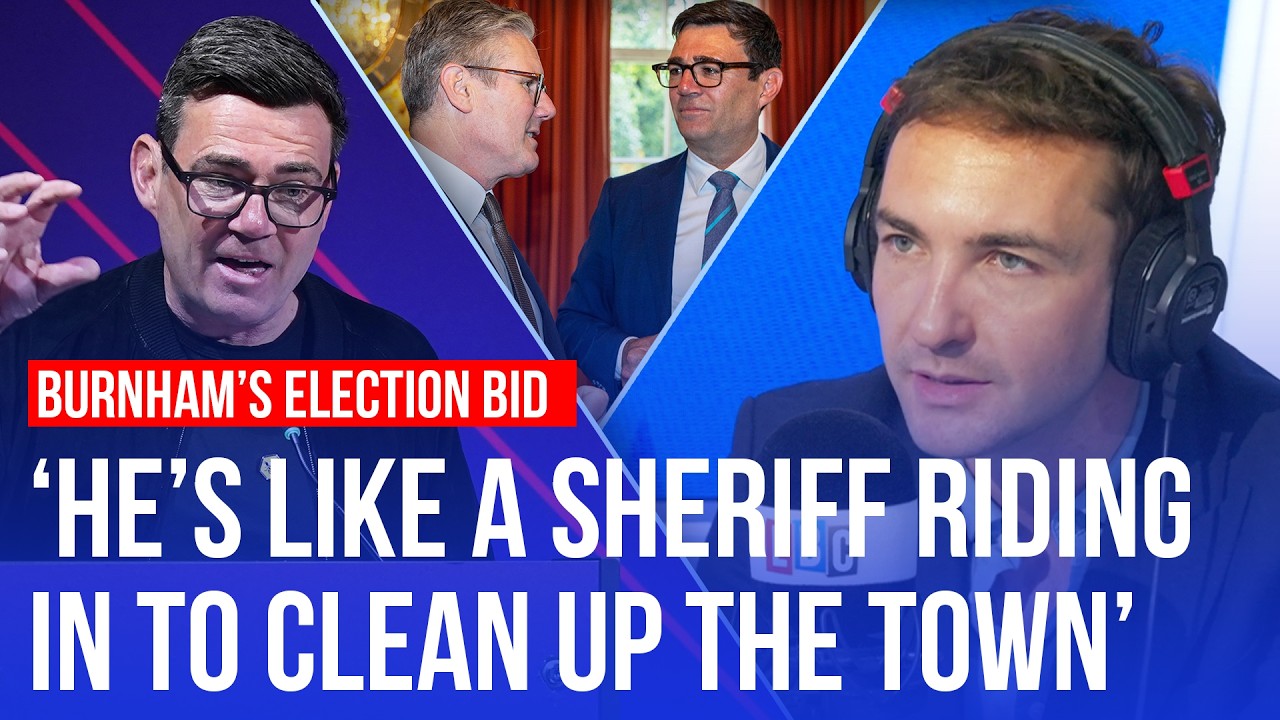
Shelagh Fogarty and Lewis Goodall try to get to grips with one key question: Why is Andy Burnham so popular in Labour right now? The Greater Manchester mayor hopes to be Labour’s candidate in the Makerfield by-election, which could provide him with a route back to Parliament to challenge for the party leadership and potentially the keys to No 10. During a speech at a summit in Leeds today, he promised a “new path which brings the country back together”. Lewis Goodall says part of his 'appeal' as a candidate for PM is his 'anti-Westminster' agenda, through his experience as Manchester Mayor. His reputation as 'Mr Manchester', Lewis argues, is his 'greatest asset'. But if Burnham does replace Starmer on the back of this 'anti-Westminster agenda', how does he translate this into a 'successful political agenda?' Lewis Goodall proposes his theory. Listen to the full show on the all-new LBC App: https://app.af.lbc.co.uk/btnc/thenewlbcapp #lewisgoodall #shelaghfogarty #politicsuk #starmer #andyburnham #LBC LBC is the home of live debate around news and current affairs in the UK. Join in the conversation and listen at https://www.lbc.co.uk/ Sign up to LBC’s weekly newsletter here: https://l-bc.co/signup
Show More Show Less View Video Transcript
0:00
So listen, Lewis, that speech by Andy Burnham
0:02
it wasn't a barnstormer, but it was interesting, wasn't it? It was interesting. I'll tell you a bit about most interesting, Sheila
0:07
People listening to it on LBC and elsewhere may have noticed that at one point Andy Burnham
0:13
deviated from his normal, informal, conversational style to suddenly sound as if he was reading something off a page
0:21
and that's because he was reading something off a page, which were the lines about Brexit, which clearly had been formulated with his team over the weekend
0:27
So concerned have they been, I think, that the opening days of this campaign
0:32
have been dominated by an argument at West Streeting's instigation, let's be honest
0:37
who might not necessarily have Andy Burnham's best interest, long-term interest at heart
0:41
Surely not. Not Wes, not Wesley. And the fact that he's been dominated by that
0:46
something that they would clearly like to move on from, trying to shut down all of this feverish speculation
0:52
and conversation about Brexit by saying, look, I'm not looking to reverse Brexit
0:56
Yes, I've said, you know, I'd like to see it reversed at some point. But that's not on the ballot in this by-election
1:01
Of course, the question is whether reform will allow that to be the case. And B, whether voters in Makerfield want this by-election to be about that issue
1:08
as we head to the, of course, 10 years now, this June, since the Brexit vote
1:13
And the voting indications of that electorate would suggest they don't. Well, I mean, look, I suppose the point is that for the Labour Party
1:22
there's a question here about politics and about policy, right? Is it the right politics? Is it the right policy
1:28
Let's be clear. Why is West Streeting doing this? Well, let's be generous in one breath and say, you know
1:33
many of us, many people have had an argument, particularly within the Labour Party, that Keir Starmer doesn't make enough arguments
1:38
Well, here's West Streeting making an argument. And he's right. You know, in order to win an argument, you've got to make it in the first place
1:43
If that's what he believes, that's what he believes. Fine. But on the other hand, we all know that it's not just about
1:48
of course, the long-term success of a potential rejoin campaign that West Streeting is being motivated by
1:54
West Streeting has got an eye. Everything that he doing now is about his eye on a Labour Party membership that might be voting on a Labour leader in the circumstances in which Andy Burnham is not in the contest because he lost that contest right West Streeting is preparing the way preparing his prospectus knowing cognizant of that that membership is highly London and highly pro
2:18
which is, by the way, one of the reasons that Keir Starmer won the leadership back in 2020. So he's doing that
2:23
The question, of course, is, is there a wider politics in which this would be advantageous to the Labour Party
2:28
Well, it's true that it's been a long time since the referendum. It's true that the electorate has changed
2:33
A lot of Leave voters are no longer with us who were in 2016
2:37
And it is true to say that a lot of the polls do suggest that there is now a Remain majority in the country
2:43
But of course, Remain wouldn't be on the ballot. There is a difference between being a Remainer and being a rejoiner
2:47
And how you vote too. And being a rejoiner and how much you care about that issue and the extent to which even Remain voters
2:55
might not want to reopen the Pandora's box of Brexit because we know that once that box is open
3:02
And we know from bitter experience that it sucks up all of the political oxygen
3:07
and it inevitably would if the Labour Party were to go down that route. Which is the point that Burnham made in the speech, isn't it, as well
3:13
From what he said about re-industrialising, and he talked about the last 40 years, privatisation, deregulation
3:20
all of that, the focus on university education to the detriment of tech and vocation
3:26
all of those things. He's not the first Labour politician to speak like that
3:30
But let's imagine for a second that we've just seen the beginnings of the process that puts him into number 10
3:36
How does Labour government change if that happens? Well, what's Andy Burnham's secret sauce right now, Sheila
3:42
Why is he more popular than anybody else in the Labour Party? Anyone in Westminster
3:48
Well, the answer is it's because he's not in Westminster, right? The mayoral system, and Boris Johnson pulled this off to some extent as well
3:53
The mayoral system has done something in English politics, and I use that term advisedly
3:58
in English politics, which was not possible for really for politicians to do before, at
4:02
least not throughout most of the 20th century, which is build up, it's the thing that you
4:06
see a lot more in America, build up a political base, which is not in Parliament, and is not
4:12
in Westminster where you can do the thing that often American politicians do particularly American governors like Bill Clinton or George W Bush or Ronald Reagan and be the kind of sheriff over the hill on the horizon who says come in I coming in to clean up this town
4:25
You know, Westminster, it stinks, drain the swamp, whatever. And they have a budget, and they have power, and they have, you know, the infrastructure of governance around them
4:31
Exactly. Andy Burnham's great asset is basically that he can run against Westminster, right, and be Mr. Manchester
4:39
The question is, can that and does that translate into a successful political agenda when you are Westminster, when you are the Prime Minister
4:47
Well, I think the answer, and I think you can see the sort of glimmers of this agenda coming in
4:52
the answer is that the best thing for him to do, probably, particularly given that he is running against other insurgents
4:57
other anti-Westminster figures like Farage, is to continue to run against Westminster
5:02
or at least to continue to run against the status quo. And that is why he is talking about the idea of breaking up, of dispersing, of spreading power around, of talking about, going back to Brexit, a lot of the themes that were present in that campaign as well, about control, about the feeling that people don't have enough political control over their lives and the things that affect their lives
5:25
Hence why he's talking about things like water and power and energy
5:29
and the idea that we gave control of these things away, often to private companies in the 1980s and 1990s
5:34
And pay more for it as a result. And pay more for it as a result. Now, does that continue to translate into the agenda
5:39
Well, possibly. It depends how well thought through this stuff is. And, of course, there's another element to this as well, Sheena
5:45
And I think, forget Brexit for a moment, the most revealing bit, I think, of Burnham's interview he did with ITV over the weekend
5:51
was when he was being asked about the fiscal rules. And to be honest, he was a little bit all over the place on that stuff
5:57
And the truth is, is that Burnham, he's been out, because he's been out of Westminster for a long time
6:01
because he's been king over the water, he's been dealing with local transport issues
6:05
he's been dealing with local economic development issues, he's been dealing with devolution matters
6:09
He hasn't had to have a prospectus on the big fiscal economic questions
6:15
Macro questions, which he would have to do as prime minister. So right now, the challenge for Burnham really is
6:21
he's got three audiences and everything he's saying. He got one eye on the maker field electorate he got one eye on the Labour Party and the potential maybe he would have to fight the contest And he kind of got one eye on the bond markets and how they might be responding to different things
6:35
and the idea of an incoming government. Because the most disastrous thing of all would be he becomes Prime Minister
6:39
and there's a run on the pound. So those three things, it takes some political skill to triangulate between them
6:45
because depending on who your audience is, it's going to pull you in different directions. Can I ask you, if he loses in Makerfield
6:51
then there could and is likely to be still a Labour leadership election
6:56
just without him, right? So there's that. If he wins big, there's the possibility of a kind of a coronation
7:03
Yes. If he wins small, what then? I think if he wins almost by any margin
7:09
maybe it's like one vote or ten or something, it's a bit different, but I think almost by any margin
7:14
I think that the prospect of a coronation is there. Because I think, as we were talking about last week
7:18
he will say, look, this is a hard scene. And I was talking to people who know Makerfield well over the weekend
7:23
They're saying, you know, this is going to be really tough. You know, people in Westminster..
7:27
Here's one thing to bear in mind, I don't think it's been factored in to some of the local election ysis nearly enough
7:33
is that it wasn't just the case in many of these places like Makerfield
7:38
that the Labour vote collapsed and reform were kind of the net beneficiary
7:43
or the Greens went up a bit and it sort of, you know, reformed with the beneficiary. That did happen
7:47
It's also true to say turnout in a lot of these places, while it's quite substantially higher. I spoke to people who know Maker Fiat
7:52
but also constituencies like it, or local authorities like it, who say, look, in some of these most reformed wards
7:58
turnout was really high, 10 points, 15 points higher. People were actively going out to vote for Farage
8:03
They were excited about voting for Farage and reform. Can Burnham quell that
8:08
Can he lessen that? Can he soften that? Can he generate his own enthusiasm
8:12
on the countervailing side? Maybe, but it's a big unknown. So no one should believe for a second
8:17
that this is going to be easy, that just because you've got Bram Burnham
8:21
that it unlocks it. This is a tough seat. And if he does win it, as a result, I think
8:25
of almost, with any margin, I think it will increase the possibility of a coronation
8:31
Because as I say, he will take it as proof of concept that a Labour Party, led by him, can defeat these guys
8:36
and almost anybody else can't. In those kinds of areas
news