Up next in 10



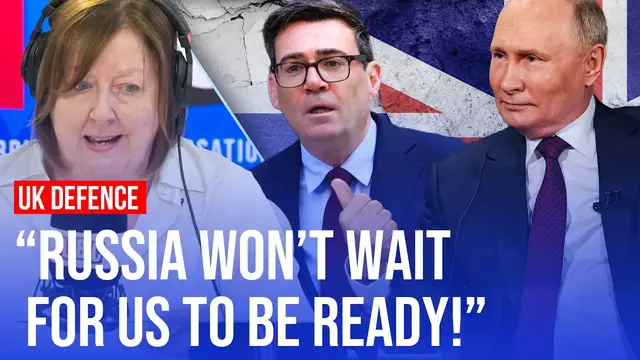
Andy Burnham said in Prime Minister's Questions that 'national security cannot come at the expense of social security.'
00:49 | Kemi Badenoch accuses the Labour Party of becoming 'addicted to welfare.'
01:37 | Security expert Edward Lucas says there is already a 'constant barrage' of Russian attacks on UK soil.
Mr Burnham added that the Government was "absolutely" committed to raising defence spending to 3.5% by 2035.
But the statement followed confirmation from the Treasury that the Chancellor will not commit to spending 3% of GDP on defence by 2030 when he unveils his October budget.
Listen to the full show on the all-new LBC App: https://app.af.lbc.co.uk/btnc/thenewlbcapp
#ShelaghFogarty #AndyBurnham #KemiBadenoch #security #defence #benefits #ukpolitics #uknews #LBC
LBC is the home of live debate around news and current affairs in the UK.
Join in the conversation and listen at https://www.lbc.co.uk/
Sign up to LBC's weekly newsletter here: https://l-bc.co/signup
Show More Show Less View Video Transcript
0:00
Yes, we do everything to support our national security
0:03
but it can't come at the expense of social security. Unbelievable, Mr Speaker, that the Prime Minister would say that
0:13
He is clearly unwilling. We need to fund our defence, not spend all of our money on welfare
0:19
I cannot believe that he would actually say that. The whole row yesterday at Prime Minister's questions
0:25
about social security versus national security kicked off, didn't it? And it certainly kicked off on breakfast this morning with Nick Ferrari
0:35
He spoke to the Conservative leader, Kemi Bejanovic, saying that Andy Burnham is putting benefits ahead of the defence of the country
0:42
It comes after the Prime Minister declared yesterday national security cannot come at the expense of social security
0:48
Take a listen. I couldn't believe he'd said it. In fact, I think for a split second, I thought, no, I must have misheard that
0:53
He must have said something else. But no, he actually said national security should not come at the expense of social security
1:02
And I believe that sometimes it does need to. Defense of the country is more important than paying benefits
1:09
He's basically saying benefits are more important. And this is why I say they're not the Labour Party anymore
1:15
They're the welfare party. They have become addicted to welfare. We need to wean the country off welfare, not feed this addiction
1:22
And now the intelligence assessment says that Russia could attack a NATO country by 2030
1:28
We have to be ready for that. So I'm saying let's get to the amount we need, which is 3% of GDP by 2030
1:35
And Labour won't do it. Well, Edward Lucas joins me, international security expert and author of The New Cold War
1:42
On that PMQ's ding-dong first, Edward, is it fair to say that Andy Burnham yesterday was saying it's either this or it's that
1:53
It's a bit more complex than that, isn't it? It's a bit more complicated in that there's lots of things that we could spend money on, lots of things we could spend less money on, and benefits is just one of them
2:06
But I'm speaking to you from Latvia, which is a country considerably poorer than
2:10
Britain, which spends 5% on defence as to their Baltic neighbours, Estonia and Lithuania
2:16
So, in the end, it's a matter of political will. And all Latvian public servants are paid a bit less in order to meet that target Pensions are squeezed the roads are a little bit bumpier there all sorts of things signs that they had to make some sacrifices But in the end they really care about their
2:33
freedom. And they're defending not only themselves, but us. And what's so humiliating here at this
2:39
conference is hearing people from the region, both the Baltics, the Nordics and elsewhere
2:44
who've always looked up to Britain as a real security lodestar. One of them said he used to
2:49
been magnetic north for us and they say what's happened you don't take defence seriously anymore
2:55
and why is this then it's really embarrassing and i was very cross with the mascot about this
3:01
under keir starmer and i had some hopes that andy burnham would be better but he's not and in the
3:07
end there are very tough choices we have to make we just have to go ahead and make them and stop talking about it we have to wait till july don't we to find out what the plan is next july to find
3:15
what the plan is. Perhaps the plan will please you. It's a long way off, I admit
3:20
but we don't really know, do we, whether he's the same as Starla or not
3:25
This isn't like a football match where we say the kickoff's going to be in 2030
3:30
so we've got to get the right team, get them fit, get the pitch mode and so on. Russia's not going to wait until we're ready
3:36
Russia's attacking us right now. The Norwegians have just said that they found a Russian secret weapon
3:43
on their seabed near their islands of Svalbard. And these are the same secret weapons that Russia is deploying
3:49
around our waters to attack our data cables and our electricity interconnectors and other undersea infrastructure
3:56
So this is happening right now. We've had a really serious explosive drone attack in Leipzig, in Germany
4:03
which just failed not to kill anyone, but only by chance. So this is already happening
4:09
It's not a question of being ready for 2030. and we don't seem to have either the willingness to spend money
4:16
or the willingness to take risks that we need to do if we're going to deter this stuff
4:21
Have we, you know, setting aside which government is in at which time
4:25
have we just for the last few decades and still ongoing despite the change in the backdrop
4:31
just become too used to the post-war, post-Cold War ease or apparent ease
4:37
I know it never fully went away but compared to now, have we just not woken up I should say to this new reality
4:46
You're absolutely right, I wish you were Foreign Secretary. You might not like it but you know it a bit like insurance National security is a a form of insurance You accept a degree of inconvenience and you spend a bit of money
5:00
And in the end, you sleep safer at night because you're insured. And we all insure our cars, we insure our houses, we may insure our lives
5:07
We're used to the idea of insurance. And this is basically the same idea. Now, we've got used to the idea that you don't need insurance
5:13
And so we spent the money on other stuff. And now we're realising, actually, we're not insured
5:17
we're dependent on other countries the americans are getting very fed up with it our european
5:22
allies are increasingly despairing and we've got to start buying insurance and that means not just
5:28
spending the money which is very important but also the change changing the way we live and work
5:33
we've got to get much more vigilant we've got to get much better at spotting threats we've got to
5:37
get much better in terms of preparing ourselves for things going wrong whether it's a hostile
5:42
state attacking us like russia or it could be a climate catastrophe there's all sorts of
5:46
reasons why we might have the power going off or the internet going down or the water stopping or
5:51
something else with our railways and I suspect our rowers are in such a mess we wouldn't even
5:55
notice if they were attacked you might say the same for the air traffic control system some of
5:58
them but this this stuff is happening all the time and we we've got to wait and our words and
6:04
deeds have got to change and you know we've seen Russia you talk about Russian attacks and the
6:09
nature of them but we've seen some very blatant Russian attacks in recent years haven't we on
6:14
airliners on planes that enemies of Putin are on and yesterday it looks as though President
6:21
Zelensky's plane was almost attacked by a Russian drone on the way to King Harold's
6:24
funeral in Norway. And that was in not Ukrainian airspace but in Moldova which is a candidate
6:31
country to join the EU very friendly pro-western democracy the poorest country in Europe on that
6:37
Britain's done a lot to try and help which is you know and actually has part of its territory
6:41
since the early 90s occupied by Russian soldiers. So yes, we are, but we're all at risk
6:48
It's happening all the time in Britain today. Don't think that this is, just because you don't see it in the headlines
6:52
doesn't mean it's not happening. For a lot of the attacks that happen, things being burnt down or blown up
6:57
or fires at our defence plants and so on, it's written off as a one-off
7:02
It was a cyber attack. It was hooliganism. Maybe it was just kids, whatever
7:06
But actually, there's a constant barrage of these attacks going on. And I think the first thing our government needs to do is to tell us the truth
7:13
And if they tell us the truth about what's going on, then I think people will be much more ready whether they worried about benefits or any other bit of government expenditure much more ready to say yes let make some sacrifices You not the first person to say that to me that actually the government any government that in needs to be much more blunt about
7:28
where we're up to. Just a final question to you, if I may, on the CIA chief, John Ratcliffe. He's
7:33
rumoured to be taking a leading role in Washington in its efforts to end the Russia-Ukraine war. But
7:38
he was, of course, the man who elicited from Vladimir Putin, that's a state secret, when
7:44
referring to potential attacks on Britain. How confident are you that he's the man
7:50
Well, John Radcliffe flew to Moscow via Riga, the Latvian capital, which is where I am now
7:56
And that was a very powerful signal that this is not some deal that's being done
8:00
behind the backs of America's allies. We still don't really know what he talked about
8:06
I think what's certainly true is the sort of tragicomic duo of Jared Kushner and Steve Whitcoff
8:13
are so disastrous that even the Trump administration has noticed they're not really up to it
8:17
So it may well be that Trump's losing a bit of confidence in them. He's certainly, I think, looking for some kind of diplomatic win
8:23
because he's not finding any in the Gulf, so maybe try something on Ukraine
8:28
But there is no peace plan. The Wyckoff-Kushner plan doesn't even have Russian support
8:34
let alone Ukrainian. It's only involves Ukrainian compromises. I don't believe, actually, that Ratcliffe is going to take the lead on this
8:41
And although that was a report in the FTN, which is a very reputable news outlet, it was categorically denied from the CIA and from the White House
8:52
But you would expect to see more traditional diplomats, intelligence individuals at the forefront in the future, would you
9:00
I think that there's plenty of room to do more to put pressure on Putin
9:06
And that's the only path to peace. past a piece doesn't involve arm twisting the ukrainians because they say even if you twist our
9:12
arms off we'll still keep fighting it's like the black knight in multibiton it's absolutely
9:16
existential for them um so i think the the only way forward is for the europeans to do their job
9:23
and to take those frozen russian central bank reserves and give them to the ukrainians the
9:27
ukrainians got money and the americans should join in hard on sanctions and we should join in hard on
9:33
actions and then we might get some movement but until that i'm afraid we're reliant on the
9:37
ukrainians spectacular achievements on the battlefield but i don't think those are enough
9:41
on their own at least right now to bring an end to the war thank you very much indeed edward
9:45
always good to talk to you edward lucas international security expert and author of the new cold war
#news