live_tv
Livestream Starting Soon
00
Hours
:
00
Minutes
:
00
Seconds
Up next in 10


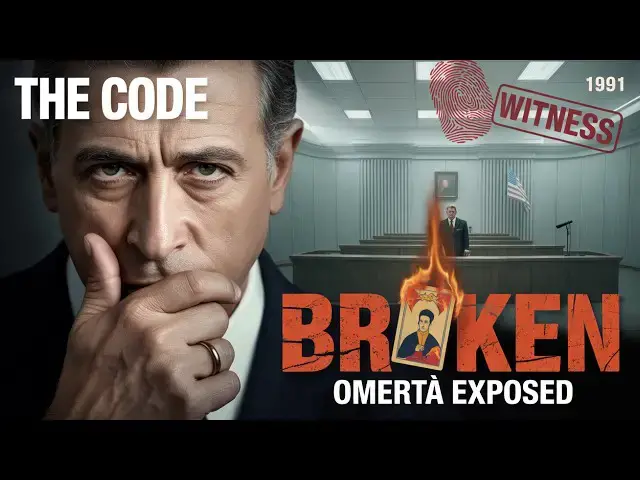
For four hundred years, Omertà—the Mafia's code of silence—was considered unbreakable. Members swore oaths binding their souls to eternal damnation if they cooperated with authorities. The penalty for breaking the code was death, not just for you but potentially for your family. Yet in 1991, something unprecedented happened: the underboss of America's most powerful crime family walked into a federal courtroom and destroyed the code forever.
This is the story of Omertà's rise and fall. From Joseph Valachi's groundbreaking 1963 testimony to Sammy "The Bull" Gravano's devastating cooperation that brought down John Gotti, we explore why the supposedly sacred code of silence collapsed under pressure. We examine the psychological toll on those who broke it, the justifications they created for their cooperation, and the question that still haunts organized crime: Was Omertà ever real, or was it always a beautiful lie?
Through the lens of how Hollywood portrayed the code in films like "The Godfather," "Goodfellas," and "The Sopranos," versus how ex-mobsters like Gravano now expose its mythology, we reveal the gap between romantic fiction and brutal reality. The truth is far more complex than simple betrayal—it's about structural changes that made cooperation rational, about organizations that demanded absolute loyalty while providing none, and about the moment when survival instinct overpowers sacred oaths.
Was breaking Omertà an act of cowardice, or was maintaining it a form of suicide? Do men like Sammy Gravano deserve condemnation for betrayal or recognition for exposing a hypocritical system? Drop your thoughts in the comments below.
If you want more investigations into the hidden truths behind organized crime, the codes that govern criminal worlds, and the mythology Hollywood creates versus reality, hit subscribe and turn on notifications.
Playlist: Mafia Myths vs Reality 👉 [Link]
Keywords: omerta code of silence, mafia informants, sammy gravano testimony, john gotti trial, goodfellas true story, witness protection, breaking omerta, mafia turncoats, organized crime cooperation, joseph valachi, henry hill, cosa nostra secrets
-~-~~-~~~-~~-~--~-~~-~~~-~~-~--~-~~-~~~-~~-~-
⚠️ Content Disclaimer:
This video is created for educational and informational purposes only. We do NOT glorify, promote, or encourage any form of criminal activity.
All visuals, audio, and materials used in this video are either:
✔ Created using AI tools, or
✔ Sourced from royalty-free platforms with valid licenses.
Some images and characters have been generated using AI and do not represent real people or events.
Show More Show Less View Video Transcript
0:00
Brooklyn, New York. 1,991.
0:05
A federal courtroom falls silent as
0:08
Salvatore Gravano raises his right hand
0:10
and swears to tell the truth. In the
0:12
gallery, John Gotti, the most powerful
0:14
mob boss in America, stares at his
0:16
underboss with eyes that could burn
0:18
holes through steel. For 400 years, the
0:21
mafia's code of America had held silence
0:24
unto death. Never cooperate with
0:28
authorities. Never testify against your
0:30
brothers. In the next 9 days, Sammy the
0:33
Bull Graano will speak 187,000 words,
0:37
confess to 19 murders, and dismantle the
0:40
entire structure of the American mafia
0:42
with his testimony. How does someone
0:44
swear an oath of eternal silence and
0:46
then destroy everything he vowed to
0:48
protect? Between 1963 and 2024,
0:52
approximately 1,200 made members of
0:55
organized crime families became
0:57
cooperating witnesses. According to FBI
0:59
records, each one violated the most
1:02
sacred principle in the underworld. Ome
1:04
the Sicilian word translates roughly to
1:06
manliness or humility, but in practice,
1:09
it meant something far more absolute.
1:11
Complete silence about organizational
1:14
activities, even under torture, even
1:17
facing death, even when your own family
1:19
was threatened. The penalty for breaking
1:21
a morta was always the same. Death. Not
1:25
a quick death, either. A message death.
1:28
The kind that made every other member
1:30
remember why silence was survival. Yet
1:33
something changed in the late 20th
1:34
century. The unbreakable code began
1:37
breaking. First in a trickle, then a
1:40
flood. Soldiers became informants. Capos
1:44
became witnesses. Bosses themselves
1:46
flipped and testified. The mythology
1:49
that Hollywood had spent decades
1:51
romanticizing in films like The
1:52
Godfather and Goodfella's The Sacred
1:55
Bond of Loyalty. The Honorable Silence
1:58
collapsed under the weight of RICO
2:00
prosecutions and life sentences. But the
2:02
truth is far more complex than simple
2:04
betrayal. So get ready to dive into the
2:06
story of Omemerita. The code that built
2:09
an empire, the men who broke it, and the
2:11
question that still haunts organized
2:13
crime today. Was the code everill, or
2:15
was it always just a beautiful lie? The
2:18
truth is, we don't know exactly when or
2:21
where omemer originated. Most historians
2:24
trace it to rural Sicily in the 19th
2:26
century, where peasants developed codes
2:29
of silence to protect themselves from
2:30
corrupt authorities and foreign
2:32
occupiers. If the police couldn't be
2:35
trusted, you handled problems yourself.
2:38
If the government was your enemy, you
2:40
told them nothing. This cultural
2:41
practice transformed into criminal
2:43
doctrine when Sicilian immigrants
2:45
brought it to America in the late 1800s.
2:48
In cities like New York, Chicago, and
2:51
New Orleans, Italian organized crime
2:54
groups formalized a concept. Ometha
2:56
became more than cultural tradition. It
2:59
became organizational policy. The first
3:02
recorded mafia initiation ceremony in
3:04
America took place sometime in the early
3:06
1900s. According to later testimony from
3:09
in the ritual was theatrical and
3:11
binding. A new member would sit in a
3:14
room surrounded by maidmen. They would
3:16
prick his trigger finger until it bled,
3:18
then burn a picture of a saint in his
3:20
palm while he recited the oath. I enter
3:23
alive into this organization and will
3:25
have to get out dead. May my soul burn
3:28
in hell like this, saint, if I betray my
3:30
brothers. The psychological power of
3:32
this ritual cannot be overstated. You
3:34
weren't just promising silence. You were
3:37
binding your soul to damnation if you
3:40
broke the code. But there was a problem
3:42
with basing an entire criminal
3:44
organization on supernatural
3:46
enforcement. Eventually, someone would
3:48
decide that earthly prison was
3:50
preferable to heavenly damnation. Or
3:53
more accurately, that earthly prison for
3:55
the rest of your life was worse than
3:57
whatever hell the mafia could devise for
3:59
breaking a that realization first
4:02
manifested publicly in 1963 when a
4:05
soldier in the Genevese crime family
4:07
named Joseph Velasi did something
4:09
unprecedented. He testified before the
4:11
US Senate about the internal structure
4:13
of the American mafia. Joseph Velasi was
4:16
born in 1904 in Aastle. He grew up in
4:19
the same environment that produced
4:21
hundreds of mobsters, poverty, limited
4:24
legitimate opportunities, and the
4:26
visible example of criminals living
4:28
better than honest workers. By his 20s,
4:31
Balachi was running with organized crime
4:33
crews, participating in bootlegging
4:35
during prohibition, and building a
4:37
reputation as a reliable earner. In 1930
4:41
at Array 26, Velasi was inducted into
4:44
what he called Kanastra a thing. He took
4:48
the oath of a meta and spent the next 33
4:51
years as a loyal soldier, never rising
4:53
particularly high in the organization,
4:55
but also never causing problems. Yet,
4:58
something was missing in Velasi's
5:00
criminal career. Protection from his own
5:02
paranoia, by 1962, Velasi was serving
5:06
time in federal prison on narcotics
5:08
charges. His boss, Veto Genovves, was
5:12
serving time in the same facility.
5:14
According to Velas's later testimony,
5:16
Genevies became convinced incinerate.
5:19
Velasi was an informant. The evidence
5:21
was thin. Some comments Velasi had made,
5:25
some associations he'd maintained. But
5:27
in the paranoid world of organized
5:29
crime, suspicion was often enough.
5:31
Therefore, in the prisonard economy of
5:34
violence, Genevies ordered Velasi
5:36
killed. Velasi knew he was marked. He
5:39
could see it in how other inmates
5:41
avoided him. He could feel it in the
5:43
sudden isolation. In the mafia's code,
5:46
once a boss orders your death, you have
5:48
three options. Accept it, run from it,
5:51
or fight back in a way that makes your
5:53
execution impossible. Velasi chose the
5:56
third option in the most dramatic way
5:58
possible. In June 1962, Velasi spotted
6:02
another inmate he believed was the
6:04
designated hit. In the prison yard in
6:06
front of guards and other prisoners,
6:08
Velasi beat the man to death with a
6:10
pipe. He was wrong. The man he killed
6:12
was not the assassin. Nevertheless, the
6:15
murder gave federal authorities leverage
6:17
they'd never had before. Facing
6:19
additional murder charges that would
6:20
keep him in prison for the rest of his
6:22
life. With a boss who wanted him dead
6:24
anyway, Velashi made a calculation,
6:27
Umemerita protected the organization.
6:30
But the organization was no longer
6:32
protecting him. Therefore, on September
6:34
27th, 1963, Joseph Velasi became the
6:38
first made member of the American Mafia
6:41
to publicly break Omera and testify
6:44
about the organization s internal
6:46
structure. His testimony before the
6:48
Senate Permanent Subcommittee on
6:50
Investigations was broadcast on national
6:52
television. Millions of Americans
6:54
watched as Velasi described how the
6:56
mafia was organized into families, how
6:58
bosses and underbosses and capos and
7:01
soldiers formed a hierarchical
7:03
structure, how initiation ceremonies
7:05
worked, and how the code of Amera was
7:08
enforced. However, Velociius revelations
7:11
had a significant limitation. He was a
7:13
low-level soldier with limited knowledge
7:16
of high-level operations. He could
7:18
describe the organizational structure,
7:20
but he didn't know about specific major
7:22
crimes that could lead to additional
7:24
prosecutions. He could explain how the
7:27
system worked in theory, but he didn't
7:29
have access to the financial records or
7:31
strategic planning that happened at boss
7:33
level. Nebert lees his testimony
7:36
achieved something critically important.
7:39
It destroyed the mafia's greatest
7:41
protection, which was public denial of
7:43
its existence. For decades, organized
7:46
crime families had successfully
7:48
convinced many Americans that the mafia
7:50
was either a myth or a wildly
7:52
exaggerated ethnic stereotype. Prominent
7:55
Italian-American organizations protested
7:57
whenever the media suggested there was
7:59
such a thing as organized Italian crime.
8:02
Law enforcement struggled to investigate
8:04
what officially didn't exist. Velashi
8:07
made denial impossible. Here was a maid
8:09
member under oath describing the
8:12
organization in detail. The FBI could no
8:15
longer be accused of ethnic profiling
8:17
for investigating Kosan Nostra. Maid
8:20
member had confirmed it existed. Yet
8:22
Velasi paid a price for breaking a
8:25
extended beyond mere physical danger. He
8:27
spent the rest of his life in protective
8:29
custody. Isolated from society, living
8:32
under constant guard, he was rejected by
8:34
the culture he'd grown up in.
8:37
Italian-American community leaders
8:39
denounced him. Former friends and family
8:41
members refused to speak to him. He died
8:43
in 1971 alone in protective custody,
8:47
having spent 8 years as the most famous
8:50
informant in mafia history. Think you
8:53
know what happens next? Keep watching
8:56
because Velasi's testimony, while
8:58
groundbreaking, didn't actually break
9:00
the code of Amerita for other mobsters.
9:03
Most members of organized crime families
9:06
looked at his fate despised, living in
9:09
fear and decided silence was still the
9:12
better option. For the next decade,
9:15
cooperation remained rare. However,
9:17
Congress had been watching Velasi's
9:19
testimony carefully. If one informant
9:21
could provide this much information,
9:23
what could prosecutors accomplish if
9:25
they had better tools to pressure
9:27
cooperation? The answer came in 1970
9:30
with the passage of Rico the Rakatia
9:32
influenced and corrupt organizations
9:34
act. RICO changed everything about
9:37
prosecuting organized crime. Previously
9:40
prosecutors had to prove specific crimes
9:42
committed by specific individuals. Under
9:44
RICO, they could prosecute entire
9:46
criminal enterprises, holding bosses
9:49
responsible for crimes they ordered,
9:51
even if they didn't personally commit
9:52
them. More importantly, Rico carried
9:55
sentences of up to 20 years per count
9:57
with multiple counts, often charged
10:00
simultaneously. Therefore, by the late
10:02
1970s, mobsters faced a new calculation.
10:05
Maintain meth and potentially spend the
10:07
rest of your life in prison or cooperate
10:10
and receive reduced sentences through
10:12
witness protection. The mathematics of
10:14
loyalty suddenly changed. In 1980, a
10:18
Banano family soldier named Joseph
10:20
Keystone was revealed to be an
10:22
undercover FAB agent Ward infiltrated
10:26
the organization for 6 years using the
10:28
alias Donnie. His testimony led to over
10:31
100 convictions. More importantly, it
10:34
demonstrated that the mafia's vetting
10:36
procedures who considered foolproof
10:38
could be defeated. Nevertheless, these
10:40
were still outsiders and low-level
10:42
soldiers breaking. The real earthquake
10:45
came when high-ranking members began
10:47
flipping. In 1986, a capo in the Luces
10:51
crime family named Henry Hill entered
10:53
witness protection after cooperating
10:55
with authorities. His testimony helped
10:57
convict dozens of mobsters. More
10:59
significantly, his life story became the
11:02
basis for Nicholas Pelgi's book Wise
11:04
Guy, which Martin Scorsesei adapted into
11:07
the film Good. But there was a problem
11:09
with Hill's credibility. He was a drug
11:12
addict who deviolated multiple mafia
11:15
rules before cooperating. Prosecutors
11:18
and defense attorneys alike could argue
11:20
that Hill was already a disgrace to
11:22
organized crime before he became an
11:24
informant. His testimony, while
11:26
valuable, did untend fundamentally
11:28
challenge the mythology of Omera because
11:31
he never been a true believer in the
11:33
code anyway. Yet on November 8th, 1990,
11:36
that argument became impossible to
11:38
maintain. That was the day Salvatore
11:41
Sammy the Bull Graanboss of the Gambino
11:44
crime family, one of the highest ranking
11:46
mobsters in America, a man who deilled
11:49
19 people to prove his loyalty, was
11:51
arrested alongside his boss, John Gotti,
11:53
on federal racketeering and murder
11:55
charges. The FBI had tapes, surveillance
11:59
recordings from a bug planted in the
12:01
Ravenite Social Club in Little Italy. On
12:03
those tapes, John Gotti discussed
12:05
murders, ordered hits, and ran the
12:08
family's operations. The evidence was
12:10
overwhelming. Both men faced life
12:13
sentences. However, the FBI had captured
12:16
something else on those tapes. John
12:18
Gotti, criticizing Sammy Gravano behind
12:21
his back. In recorded conversations,
12:24
Gotti complained that Sammy was too
12:25
ambitious, made too much money, took too
12:28
much credit. Gotti suggested that maybe
12:31
Sammy should take the fall for certain
12:32
murders to protect the boss. The words
12:34
were vague, coded in the language of the
12:37
underworld, but the implication was
12:39
clear. When convenient, Gotti would
12:42
sacrifice his most loyal soldier.
12:45
According to court documents, when
12:46
federal prosecutors played those tapes
12:48
for Sammy Gravano, something inside him
12:51
broke. 20 years. Sammy reportedly said
12:54
to his lawyers, "I gave him 20 years of
12:56
loyalty. I killed for him. I made him
13:00
millions. And this is how he talks about
13:02
me. The prosecutors made an offer.
13:05
Testify against Gotti and receive a
13:07
5-year sentency. Refuse and spend the
13:11
rest of your life in prison. What
13:13
happened next shocked even seasoned
13:16
investigators of organized crime. On
13:18
November 19th, 1991, Salvatore Graano
13:21
entered a Brooklyn federal courtroom and
13:23
took an oath. Not the oath of Omeita.
13:27
This time the oath to tell the truth,
13:29
the whole truth, and nothing but the
13:32
truth. For 9 days, Gravano testified. He
13:35
described the internal structure of the
13:37
Gambino family. He detailed how
13:40
decisions were made, how money flowed,
13:42
how murders were ordered. He confessed
13:44
to 19 murders he'd personally committed
13:46
or participated in. He explained exactly
13:48
how John Gotti had risen to power by
13:51
orchestrating the assassination of
13:53
previous boss Paul Castellano. Outside
13:55
Spark Steakhouse in 1985, the courtroom
13:59
was packed. Media from around the world
14:01
covered every minute. In the defendant's
14:03
chair, John Gata Dapadon, the Teflon
14:07
Dome, the most famous mobster in
14:09
America, watched his most trusted
14:11
soldier dismantle everything they'd
14:13
built together. But the truth is even
14:15
stranger than this simple narrative of
14:17
betrayal suggests. Because Sammy Graano
14:20
didn't just break Omera to save himself
14:22
from prison. According to his later
14:24
interviews and memoir, he broke it
14:26
because he realized Omera was itself a
14:29
lie. The code says you don't betray your
14:32
brothers, Sammy said in a 2019
14:34
interview. But what about when your
14:36
brother is willing to let you take the
14:38
fall for him? What about when the boss
14:40
who demands your loyalty shows you none
14:42
in return? Is that still a code or is
14:45
that just a scam? This philosophical
14:48
justification represents something
14:50
crucial about the collapse of Omera. It
14:52
required ideological cover for practical
14:55
decisions. No mobster wants to think of
14:57
himself as a coward or a traitor.
15:00
Therefore, breaking the code required
15:02
reframing what the code actually meant.
15:04
Gravano convinced himself that Gotti had
15:06
broken Omera first by violating the
15:09
implicit contract of mutual loyalty.
15:11
Other informants developed different
15:13
justifications.
15:15
Protecting family members, preventing
15:17
senseless violence, or simply
15:19
recognizing that the mafia had become
15:21
something different from what they'd
15:23
originally joined, Nebert Le. The
15:26
practical effect was undeniable.
15:28
The highest ranking mobster in American
15:30
history had broken Amerita and survived.
15:34
On April 2nd, 1992, John Gotti was
15:37
convicted on all charges largely based
15:39
on Graano's testimony. He was sentenced
15:41
to life in prison without parole. He
15:43
died in prison in 2002, still refusing
15:47
to cooperate with authorities, still
15:49
maintaining his version of Omera until
15:51
the end. Graano served approximately 5
15:53
years and entered witness protection.
15:56
The Gambino Crime Family, once the most
15:58
powerful criminal organization in
16:00
America, never recovered. Within a
16:03
decade, those sense of high-ranking
16:05
members had been convicted, and the
16:06
family's influence had been reduced to a
16:08
fraction of its former power. Yet,
16:10
here's the question that haunts the
16:11
mafia to this day. Did Graano break the
16:15
code, or did the code break him?
16:17
According to testimony from multiple
16:19
former mobsters, Omera was always more
16:21
myth than reality. The romantic notion
16:23
of men willing to die rather than talk
16:25
was propaganda designed to maintain
16:27
organizational discipline. In practice,
16:30
loyalty lasted exactly as long as mutual
16:32
benefit. A former Colombo family member
16:35
speaking anonymously to researchers in
16:38
described it this way. OMRA was always
16:41
conditional.
16:42
Nobody says that out loud, but everybody
16:45
knows it. You don't talk as long as not
16:47
talking serves your interests. The
16:50
second you realize the organization is
16:52
going to sacrifice you, the code becomes
16:55
worthless. Therefore, the real story of
16:58
Omera's collapse isn't about individual
17:00
betrayals. It's about structural changes
17:03
that made cooperation a rational choice.
17:06
RICO laws meant mobsters faced sentences
17:09
of 50, 70, 100 years. At those numbers,
17:13
maintaining silence became effectively
17:16
meaningless. You are going to die in
17:18
prison either way. Witness protection
17:20
programs meant cooperation didn't
17:22
necessarily equal death. you could
17:24
testify and survive under government
17:26
protection. And perhaps most
17:28
importantly, the proliferation of
17:30
informants created a prisoner s dilemma
17:33
where staying silent while others
17:35
cooperated simply meant taking the fall
17:38
alone. By the year 2000, the FBI
17:41
estimated that approximately 15 to 20%
17:44
of inducted mafia members had either
17:46
cooperated with authorities or were
17:49
considered potential cooperators. The
17:51
code that had held for four centuries
17:53
had become optional. Still, breaking a
17:56
mura carried costs beyond legal
17:58
consequences. Former informants describe
18:01
a particular kind of isolation.
18:04
You can't return to your old
18:05
neighborhood. You can't contact old
18:07
friends. You can't acknowledge your real
18:10
identity in your new life. Your children
18:12
grow up with false names, false
18:14
histories, and the constant fear that
18:16
someone might discover who their father
18:18
really was. According to a 2015 study of
18:21
witness protection participants with
18:23
organized crime backgrounds, 73%
18:26
reported symptoms of depression and
18:29
anxiety, 41% struggled with substance
18:32
problems. 28% violated the terms of
18:35
their protection and had to be relocated
18:37
multiple times. The psychological toll
18:40
of breaking an oath you once considered
18:41
sacred cannot be underestimated, even
18:44
when you've rationally convinced
18:45
yourself that breaking it was necessary.
18:47
Moreover, the media portrayal of
18:49
informants as either villainous rats or
18:52
courageous heroes rarely captures this
18:54
complexity. In Good Fellas, Henry Hill
18:56
is portrayed as a charming rogue who
18:59
cooperates partly out of necessity and
19:01
partly out of disgust with the life he
19:03
delayed. In reality, Hill struggled with
19:05
his decision until his death in 2012,
19:09
giving conflicting accounts about
19:11
whether he regretted cooperating. In
19:13
some interviews, he claimed he'd had no
19:15
choice. In others, he suggested he
19:18
should have kept silent. Sammy Gravano's
19:20
evolution is even more complicated.
19:22
After completing his sentence and
19:24
entering witness protection, he violated
19:26
the terms of his agreement by
19:28
participating in an ecstasy trafficking
19:30
operation in Arizona. He was arrested in
19:33
2000 and served an additional 17 years.
19:36
Upon release in 2017, he began giving
19:39
interviews, launched a podcast, and
19:41
essentially became a public figure
19:43
discussing his mafia past. His YouTube
19:46
channel, where he reviews mafia movies
19:48
for accuracy, has become one of the most
19:50
popular sources of insider perspective
19:53
on organized crime. He critiques how
19:55
films portray Omera, pointing out the
19:57
gap between Hollywood's romantic version
19:59
and the reality he lived. In The
20:02
Godfather, they make it seem like this
20:04
sacred thing, Graano said in one video.
20:07
Like these, men would rather die than
20:09
break the code. But I knew guys who
20:11
flipped over 10ear sentences. I knew
20:14
bosses who would cooperate to protect
20:15
their money. The code was strong when it
20:17
was convenient and worthless when it
20:20
wasn't. Yet, this raises an
20:22
uncomfortable question about Gravano's
20:24
current career. Is he exposing the
20:27
mythology of Omemer or creating a new
20:29
mythology about himself as the truth?
20:32
Some former law enforcement officials
20:34
suggest that Graano's public persona is
20:36
carefully constructed to justify his own
20:39
decisions. By arguing that Omemerita was
20:41
always a lie, he avoids confronting his
20:44
own violation of an oath he spent 20
20:46
years enforcing. By positioning himself
20:48
as an educator rather than an informant,
20:51
he transforms betrayal into public
20:54
service. However, other analysts argue
20:56
that Graano is actually performing a
20:58
valuable function by demystifying
21:00
organized crime. Hollywood has spent
21:03
decades romanticizing the mafia co.
21:05
Films like The Godfather and Goodfella's
21:07
present on Merita as a kind of honor
21:09
among thieves, suggesting that despite
21:12
being criminals, mobsters maintain
21:14
certain principles. This romanticization
21:17
has real consequences makes organized
21:20
crime attractive to young people who see
21:22
the loyalty and brotherhood while
21:24
ignoring the violence and betrayal.
21:26
Gravano's testimonials with all their
21:28
moral complexity provide a
21:30
counternarrative.
21:32
He doesn't deny that the code existed.
21:34
He argues that it was always
21:36
hypocritical, always self-s serving, and
21:38
always destined to collapse under
21:40
sufficient pressure. To this day, nobody
21:43
knows whether this narrative is truth or
21:46
simply a more sophisticated form of
21:48
self-justification. What we do know is
21:50
that Omata in its traditional absolute
21:52
form is effectively dead in American
21:55
organized crime. According to FBI
21:57
statistics, between 1990 and 2020, over
22:01
800 made members of mafia families
22:03
cooperated with authorities. Five
22:06
families that once controlled entire
22:08
cities have been reduced to shadows of
22:11
their former power. The new generation
22:13
of organized criminals operating in
22:15
cyber crime, international trafficking
22:17
and financial fraudon have no connection
22:20
to the traditional Italian American
22:22
mafia and therefore no investment in its
22:25
codes. Yet the myth of Omea persists in
22:28
popular culture precisely because it's a
22:30
seductive idea. The notion of absolute
22:33
loyalty of men willing to die rather
22:36
than betray their brothers appeals to
22:38
something deep in human psychology. It
22:41
suggests that honor can exist even in
22:43
dishonorable contexts, that bonds can
22:45
transcend. The reality, as evidenced by
22:48
hundreds of informants, is far more
22:50
mundane.
22:52
People cooperate when cooperation serves
22:54
their interests, and codes of silence
22:57
lasts exactly as long as maintaining
23:00
silence is less costly than breaking it.
23:03
So, what do you think? Drop your theory
23:06
in the comments. I read every single
23:08
one. Was Omea ever real? Or was it
23:11
always a mythology that criminals told
23:13
themselves to make organized crime feel
23:15
like something other than what it was?
23:17
Business built on violence, extortion,
23:20
and self-interest. Were men like Joseph
23:22
Velasi, Henry Hill, and Sammy Graano,
23:26
traitors who violated sacred oaths, or
23:29
were they realists who recognized that
23:31
the code was only honored when
23:33
convenient and abandoned when survival
23:35
demanded it? Perhaps the answer is that
23:38
both things are simultaneously true. The
23:40
code was real in the sense that men
23:42
genuinely believed in it, took oaths,
23:45
binding their souls, and sometimes chose
23:48
death over cooperation. The code was
23:50
also a lie in the sense that it was
23:52
always conditional, always subject to
23:55
the calculations of power and survival,
23:57
and always destined to break when the
23:59
pressure became sufficient. The legacy
24:01
of Ammerus collapse is visible
24:03
everywhere in modern criminal justice.
24:05
Cooperation agreements are now standard
24:08
in organized crime prosecutions. Witness
24:10
protection has expanded to accommodate
24:12
thousands of former criminals. And the
24:14
mafia itself, the organization that once
24:16
seemed untouchable precisely because its
24:19
members would never talk us been reduced
24:21
to a fraction of its former power. Yet
24:23
in another sense, Omar s collapse has
24:26
made criminal organizations more
24:28
dangerous in certain ways. The
24:30
traditional mafia, for all its
24:32
brutality, operated according to certain
24:35
predictable patterns. There were rules,
24:37
hierarchies, and established
24:39
territories. The new generation of
24:41
criminal enterprises, unburdened by
24:43
codes they might someday break, operates
24:46
with a fluid ruthlessness that law
24:48
enforcement struggles to anticipate.
24:50
Moreover, the romanticization of Omea
24:53
continues despite its historical
24:55
failure. Young men still join gangs and
24:58
criminal organizations attracted by the
25:00
mythology of loyalty and brotherhood.
25:02
They still take oaths and make pledges.
25:05
They still believe, at least initially,
25:07
that this time the code will hold. The
25:10
question remains, how many more will
25:12
have to learn what Joseph Valasia, Henry
25:15
Hill, and Sami Graano learned that the
25:17
most dangerous secret isn't kept in a
25:19
vault, but in a whisper? And that
25:21
whisper eventually becomes a scream when
25:23
the walls close in. Subscribe for the
25:25
next investigation into the codes we
25:27
create, the oaths we swear, and the
25:30
moment when self-preservation overpowers
25:33
every promise we've ever made.