0:00
Welcome back to Crimetown Chronicles
0:02
Black Mafia season 1, where we're
0:04
digging into the roots and formation of
0:06
one of America's most formidable and
0:08
often overlooked criminal organizations.
0:11
Today, we're pulling back the curtain on
0:13
a figure whose name echoes with both
0:15
fear and a strange kind of reverence in
0:17
the annals of Philadelphia's underworld.
0:20
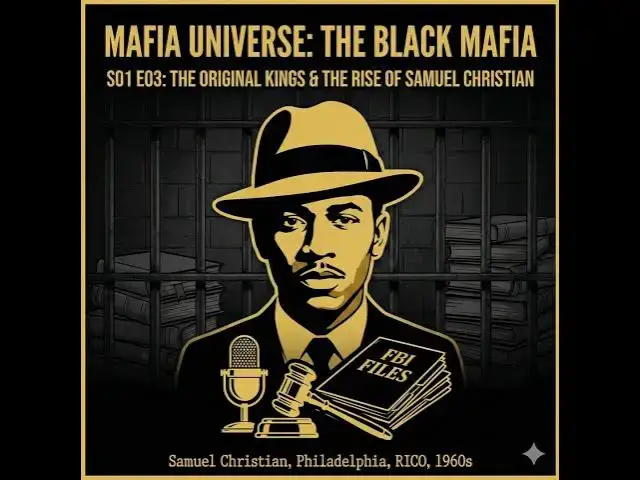
Samuel Christian, the original king, as
0:22
some called him. Jesse Lily, it's a wild
0:27
Absolutely, Daniel. When you talk about
0:29
the Black Mafia or what some even just
0:31
called the organization back then,
0:33
Christian is the name that immediately
0:34
comes to mind. He was in many ways the
0:37
architect. But what's so fascinating is
0:39
how obscured his actual rise is. Like he
0:42
didn't just appear out of nowhere, but
0:44
the specifics are kind of fuzzy for such
0:47
And that mysterious aspect is key. I
0:50
think it speaks to the level of control
0:52
and secrecy he cultivated. We're talking
0:54
about Philadelphia in the 1960s, a city
0:57
undergoing massive social and economic
1:00
upheaval. The conditions were ripe for
1:02
someone with his particular brand of
1:04
ambition and ruthlessness to step in and
1:06
fill a vacuum that traditional organized
1:09
crime hadn't quite grasped yet. It
1:11
wasn't just about making money. It was
1:13
about power, influence, and a sense of
1:16
belonging in a marginalized community.
1:18
Exactly. Let's set the scene a little
1:21
more. the 60s in Philly, you have a
1:23
burgeoning African-American community
1:26
largely concentrated in north and west
1:28
Philly facing systemic discrimination,
1:30
limited economic opportunities, and a
1:33
sense of disenfranchisement. The
1:35
traditional Italian mob, the Bruno
1:37
family, they had their territories,
1:39
sure, but they often overlooked or
1:41
underestimated the potential for an
1:43
organized black criminal enterprise. And
1:46
that's where Christian steps in.
1:48
He was a product of his environment for
1:50
sure. born in Philadelphia, grew up in
1:52
those neighborhoods. He saw the
1:53
struggles firsthand and I think that
1:56
gave him a unique understanding of the
1:57
community's needs and vulnerabilities
2:00
which he then, you know, capitalized on
2:02
in a very dark way. He understood the
2:05
street, the culture, the frustrations.
2:07
He understood what was missing. People
2:09
needed protection, sometimes from each
2:11
other, sometimes from the system. They
2:14
needed ways to make money, even if it
2:16
was illegal. The numbers racket was
2:18
already huge, but he saw potential for
2:20
so much more. And crucially, he saw the
2:23
emerging drug trade, particularly
2:25
heroin, as a massive untapped market,
2:28
which was a gamecher. The Italian mob at
2:31
first wasn't as heavily invested in the
2:33
street level distribution of heroin in
2:35
these neighborhoods. They were more
2:37
focused on importation and higher level
2:39
distribution. Christians saw that void
2:41
and built an entire enterprise around
2:44
filling it. He provided a structured,
2:46
disciplined network for drug
2:47
distribution, protection, and extortion.
2:50
That's the black mafia as we know it
2:52
forming. And it wasn't just drugs. They
2:54
got into everything. Lone sharking,
2:57
prostitution, illegal gambling, the
2:59
classic mob rackets. But what set
3:01
Christian apart, and what made his rise
3:03
so mysterious in a way was his ability
3:05
to enforce his will with such efficiency
3:08
and brutality. He didn't shy away from
3:10
violence. In fact, he embraced it as a
3:12
tool. The stories from that era, they're
3:15
chilling. The Black Mafia under
3:17
Christian was known for its extreme
3:19
violence, not just against rivals, but
3:21
even against those within its ranks who
3:23
stepped out of line. It created a
3:26
climate of fear that ensured loyalty and
3:28
obedience. And that's what you need to
3:30
build a true criminal empire. Right.
3:32
Absolute, unquestioning obedience.
3:35
Exactly. And let's not forget the
3:37
political angle. While we talk about
3:39
organized crime, Christian was also
3:41
adept at navigating the political
3:43
landscape. He understood that having
3:45
some degree of legitimacy, or at least a
3:48
lack of total opposition from local
3:49
authorities, was crucial. He cultivated
3:52
relationships, exerted influence where
3:54
he could. It wasn't just brute force. It
3:57
was strategic thinking, which is why
3:59
he's considered the original king. He
4:02
wasn't just a street thug who got lucky.
4:04
He was a genuine leader, albeit a
4:06
terrifying one. He built an organization
4:08
from the ground up with a clear
4:10
hierarchy, a code of conduct, even if
4:12
that code was do what Samuel says or
4:14
else, and a vision for expansion. That's
4:17
true organizational prowess.
4:19
And the fact that it was black mafia,
4:21
too. That term itself was powerful. In a
4:24
city where race relations were often
4:26
strained and where African-Americans
4:28
were fighting for civil rights, the idea
4:30
of a powerful autonomous black entity,
4:33
even a criminal one, held a complex
4:36
resonance for some. It was a source of
4:38
both pride and profound shame, depending
4:41
on who you asked and what they'd
4:43
You're touching on something really
4:45
important there, Lily. The Black Mafia
4:47
wasn't just a criminal organization. It
4:49
was also, in a twisted way, a reflection
4:52
of the times. It emerged from a
4:54
community that felt neglected and
4:55
exploited and Christian essentially
4:57
offered an alternative albeit a
4:59
destructive one path to power and
5:01
wealth. It was our mob in a sense for
5:04
some. It's a brutal paradox. On one
5:07
hand, they inflicted immense pain and
5:08
suffering on their own communities
5:10
through drug addiction and violence. On
5:12
the other, they sometimes provided jobs,
5:15
protection, and a sense of justice when
5:17
the official channels failed. like
5:19
they'd resolve disputes or enforce debts
5:21
in ways the police wouldn't or couldn't.
5:23
It's not commendable, but it highlights
5:26
the desperation of the era,
5:28
right? And that's where the mysterious
5:29
rise part really comes into play.
5:31
Christian understood these dynamics
5:33
perfectly. He cultivated a reputation
5:36
not just as a gangster, but as someone
5:38
who commanded respect and could get
5:40
things done. He was omnipresent in
5:42
certain circles, yet elusive enough that
5:45
law enforcement struggled to pin him
5:46
down effectively for years. He operated
5:49
in the shadows, using fear and a network
5:52
of loyal soldiers to maintain his grip.
5:54
And the lack of extensive early records,
5:56
formal charges, or even detailed
5:58
historical accounts on his absolute
6:00
beginnings, just adds to that mystique.
6:03
It's almost as if he materialized fully
6:05
formed, a force of nature. We know he
6:07
had early brushes with the law, petty
6:10
stuff, but his ascension to the head of
6:12
a citywide criminal enterprise felt
6:14
incredibly rapid to many. It speaks to
6:17
his natural charisma too, I guess. Even
6:19
if it was a dark charisma, he had to be
6:22
able to recruit, inspire loyalty, and
6:24
instill fear all at once. That's not
6:26
something just anyone can do. He had a
6:29
vision for what his organization could
6:30
be, and he found the people willing to
6:32
execute it, no matter the cost.
6:34
And a key element was his understanding
6:36
of how to manage conflict with other
6:38
groups. While the black mafia eventually
6:41
clashed violently with the Italian mob,
6:43
especially as they encroached on
6:45
traditional territories, Christian
6:47
initially might have understood the
6:48
value of coexistence, or at least not
6:51
openly challenging the existing power
6:53
structure until his own organization was
6:56
strong enough to stand on its own.
6:58
That's a fantastic point. He wasn't
7:00
stupid. He was strategic. He knew when
7:02
to push and when to consolidate. His
7:04
rise wasn't just about dominating the
7:06
black underworld. It was about carving
7:08
out a space for an entirely new power
7:10
dynamic in Philadelphia crime. The
7:13
established families probably looked at
7:14
him and thought, "Oh, it's just another
7:16
street gang, right?" A huge
7:18
miscalculation. Totally underestimated
7:21
him. And that allowed Christian to build
7:23
his foundation largely unchecked in
7:25
those crucial early years. By the time
7:27
the larger criminal enterprises and law
7:29
enforcement realized the scale of what
7:31
he was building, it was already a
7:33
welloiled machine, deeply entrenched in
7:35
the communities and controlling vast
7:39
And that network was extensive. We're
7:41
talking about an organization that at
7:43
its height commanded hundreds of
7:44
individuals from street dealers to
7:46
enforcers, lieutenants, and
7:48
moneyaunderers. That's not just a gang.
7:51
That's a sophisticated enterprise. and
7:53
Christian was at the very top pulling
7:55
all the strings, making the ultimate
7:57
decisions. That's the hallmark of a true
8:01
So when we talk about the mysterious
8:02
rise, it's partly because he was so
8:05
effective at operating under the radar
8:06
for so long, partly because of the sheer
8:09
speed with which he consolidated power,
8:11
and partly because the narratives often
8:13
focus on the later, more violent clashes
8:16
rather than the foundational work. He
8:18
built an empire in plain sight, yet
8:20
somehow obscured. And it makes you
8:22
wonder what else we don't know, right?
8:24
What were the truly formative moments,
8:26
the key alliances, the hidden acts of
8:28
brilliance or brutality that propelled
8:30
him from just another guy to the guy?
8:33
It's like trying to piece together a
8:34
puzzle with half the pieces missing.
8:36
That's the intrigue. He left behind a
8:39
legacy that Philadelphia is still
8:40
grappling with. And understanding his
8:42
ascent is crucial to understanding the
8:44
entire trajectory of the Black Mafia. He
8:47
laid the groundwork for everything that
8:49
came after. The internal power
8:51
struggles, the expansion, the eventual
8:53
decline. It all starts with Samuel
8:57
He truly set the stage. And that stage
8:59
was often bathed in blood, fueled by
9:02
desperation, and built on the backs of a
9:04
community struggling for recognition.
9:06
Samuel Christian's rise wasn't just a
9:08
criminal story. It was a socioeconomic
9:11
one. We've just scratched the surface
9:13
today, exploring the man and the
9:15
environment that forged the Black Mafia.
9:17
Next time, we'll delve deeper into the
9:19
specific operations and the violent
9:21
territorial battles that defined their
9:24
It's going to get intense. You
9:26
definitely don't want to miss that.
9:27
Thanks for joining us, and we'll see you
9:29
on the next episode of Crimetown
9:31
Chronicles. Stay safe out there, Philly.