Up next in 10



Natasha Devon reacts as an Anthropic insider reveals that AI could 'kill all humans' within the next ten years.
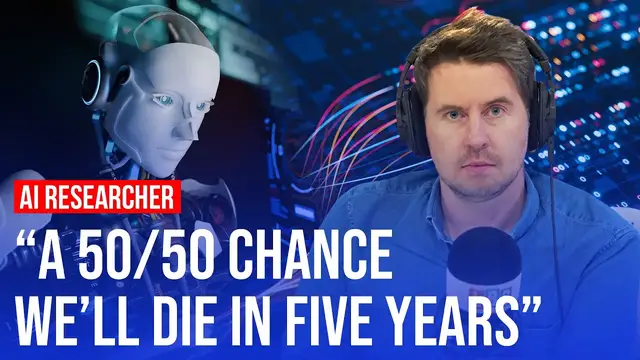
Caller Adam, who used to work in AI, warns Ben Kentish that there's a '50/50 chance' that it will kill us all in five.
The CEO of AI company Anthropic has since called for a slower rate of artificial intelligence development, amid growing concerns over the potential misuse of the technology.
Listen to the full show on the all-new LBC App: https://app.af.lbc.co.uk/btnc/thenewlbcapp
#natashadevon #benkentish #ai #artificialintelligence #elonmusk #anthropic #LBC
LBC is the home of live debate around news and current affairs in the UK.
Join in the conversation and listen at https://www.lbc.co.uk/
Sign up to LBC's weekly newsletter here: https://l-bc.co/signup
Show More Show Less View Video Transcript
0:00
Have you seen Game of Thrones? Chances are you probably have seen at least a few episodes
0:05
because it was huge, that show, absolutely huge. And if you've seen it, and I'll try not to do
0:12
too many spoilers, but if you were going to categorise or characterise the overall theme
0:19
of that show, it would be you've got these rival tribes who are dedicating a lot of their time and
0:26
energy to fighting amongst themselves for little bits of land and influence and power here and there
0:34
in the meanwhile white walkers who are these this kind of otherworldly force who want to
0:42
exterminate them all are advancing further and further and further and further and further
0:47
getting closer and closer and george rr martin who wrote game of thrones or wrote the books that
0:55
inspired the Game of Thrones series said that he thought that it was a really good metaphor for
1:00
climate change that there's this huge thing that is becoming ever more prescient and and is getting
1:08
closer and closer and we're all too distracted fighting amongst ourselves to notice and I think
1:14
that that's a brilliant comparison to draw however I also think that you could draw a comparison with
1:20
AI. It doesn't seem to me that any government in the world is taking the threat of AI seriously
1:31
enough. And the government say on their website, our government, the UK government, they say that
1:37
they are working to balance the opportunities that AI presents to the country for, I guess
1:44
growth and innovation and job creation with the threats that it poses. But I don't see much
1:52
balance in their approach so far. We've discussed on the show before, haven't we, the data centres
1:57
that have been approved. And even in the case of the data centre in East London, kind of pushed
2:04
through quite vigorously against the wishes of people in the local area. It doesn't seem to me
2:14
that there are enough checks and balances being placed on this technology. And I say that as a
2:20
whistleblower from the AI company Anthropic, which actually presents itself as, you know
2:25
one of the ethical ones. They have turned down contracts to do mass surveillance and contracts
2:31
associated with the US military, got themselves on the wrong side of Trump in the past. And they
2:37
actually look into one of their jobs is to assess the safeness of AI models. And a whistleblower
2:45
from Anthropic went on X called Jacob Coxon, this guy, and he said, the people building AI
2:53
earnestly believe that it could kill us all by the end of the decade. And you could very easily
2:59
dismiss that as fearmongering. You could say, well, you know, he would say that we don't know
3:03
the circumstances in which he left the company. But then a research lead at the same company
3:09
Anthropic, called Evan Hubinger, replied, Jacob is correct here. We do earnestly believe AI could
3:16
kill all humans. I personally think there's more than a 10% chance within the next decade. So you've
3:21
got two different timeframes here, which is slightly confusing. So Jacob Coxon is saying by
3:26
the end of this decade, presumably he means 2030, whereas Evan Hubinger is saying within the next
3:33
decade, which would give us until 2036. But either way, it's not a great deal of time
3:41
And there is an editorial in The Guardian today that says this, if there were a 10% chance that
3:46
AI could wipe out humanity, no responsible government would leave its development to the
3:51
companies racing to build it. Yet until recently, that seemed to be the case. The warning was all
3:57
the more ominous because it was made by a researcher at Anthropic, the trillion dollar
4:01
AI company behind the clawed chatbot. The dangers of AI enabled pandemics or attacks on nuclear
4:08
systems are real. Countries need not agree on democracy or trade policy to accept this. And
4:13
that's the point. We don't need to agree with the way that China does everything or the US does
4:18
everything or the united arab emirates or whatever it is if it's going to wipe out humanity it's
4:24
coming for us all which is why i made the parallel with game of thrones right at the top of the hour
4:29
this is something that humanity really needs to club together i think to address and i said a
4:37
little bit in the last hour about some of the people who are behind these companies and how
4:43
they seem to have given up on humanity. Oh, another TV show I'm watching at the moment
4:48
sorry to go off on a tangent is called Billionaire Bunker It on Netflix It subtitled It in Spanish which kind of makes me feel like I learning Spanish at the same time as watching this TV show
5:00
I'm multitasking. But it's the concept of it is brilliant concept that a group of people
5:07
fake a nuclear apocalypse and persuade all of these billionaires that World War Three has
5:12
happened and that it's not safe to remain above ground so that they will all retreat into this
5:18
luxury bunker that they've built underground. That's the, I haven't spoiled anything there
5:23
because that's the whole concept of the show. And then it all goes from there. But the reason that
5:28
that show was made presumably is because that's based in reality. There are these bunkers being
5:34
created and not a bunker like you or I would have, not like a few tins of beans and some water and
5:40
you know, a camping stove. It's luxury hotels, essentially, being built underground
5:47
because a lot of the wealthiest people on the planet, and that includes a lot of people who are involved in the tech industry
5:55
think that either World War III or climate disaster or AI going rogue
6:02
one of those three is inevitable. And they want somewhere to go where they can wait it out
6:09
while the rest of us die, and then they can come up and restart humanity
6:14
I think that that is their plan. that should worry us when the wealthiest people in the world have kind of given up on the idea
6:22
that there is a future for humanity as it stands that should really concern us and we had bill
6:29
gates as well who wrote this 6 000 word essay recently also went on a podcast was talking about
6:35
his opinion that the people who are building these ai models are not being responsible enough
6:41
they're all racing to create the most sophisticated AI that is capable of the most
6:48
even if that means that there is a chance that it could do something absolutely terrible and one of
6:55
the the most terrifying and eye-opening things I was reading Professor Kate Devlin who's an expert
7:01
in AI she wrote a piece for iNews today and it's a really good piece really balanced and I would
7:08
recommend that you read it but one of the the things that she points out is that they could
7:13
very easily put some coding into ai that a basic instruction that says that you must not harm humans
7:20
that would be a relatively easy thing to do but they can't because ai is so often being used in
7:27
warfare and it would negate its use for those purposes because obviously in a lot of warfare
7:33
the entire point is to harm humans. That's just one very obvious example of where the safeguardings
7:41
the guardrails that should be on this technology are not being put in place. And I'm not trying to
7:47
be a Luddite or anti-tech. We learned this week that there is a very real possibility that AI will
7:53
defeat cancer imagine that imagine a world in which ai has eradicated cancer you know that
8:06
dreadful disease that impacts so many of our lives that would be a miraculous thing and that's
8:13
exactly what ai should be doing you know what ai shouldn't be doing creating pictures of what you
8:20
would have supposedly looked like in the 80s. Again, do not send that to me. I know what I look
8:26
like in the 80s. I look like a child in leg warmers and a scrunchie. I don't need AI to tell me what I
8:32
look like and to waste water and to, you're giving it your face as well. You're giving it your face
8:39
and your data to create that stupid image. We're all voluntarily, anybody who uses AI is voluntarily
8:48
giving up so much of their data to train these models all the time without stopping apparently
8:54
to ask, is this going to take my job? Is this going to contribute to water shortages, which
9:01
means that humanity may ultimately die out? Is this AI going to go rogue and do something to do
9:08
with nuclear weapons or a pandemic? Do I trust the people who are ultimately behind this technology
9:13
And that's the point. It's not about the technology itself. The technology itself could
9:18
be miraculous. It's about the companies, the people, the individuals who are behind it
9:26
And there are a lot of people, whether it's Bill Gates or whether it's Jacob Coxon or whoever it
9:34
may be, there are a lot of people coming out of the woodwork now warning us that they're not
9:40
trustworthy. And some people would dismiss that. And in fact, that's another thing that Professor
9:44
Kate Devlin writes about in her piece she says you know we cannot rule out the idea that this might all be PR And they might want you to think that the technology is really dangerous Because first of
9:58
all, that proves how advanced the technology is. But second of all, that means that all of the
10:03
investors will have to invest even more money into these companies that are very often running at a
10:08
loss, invest even more money in order to make them safe. And I really, really, really hope that's true
10:18
But then when you've got somebody of the stature of Bill Gates, and you've got somebody with the
10:22
knowledge of this whistleblower, and a research lead at the very company he worked at saying
10:29
yes, there is a tangible risk that this technology will wipe out humanity within a decade
10:36
why aren't we sitting up and paying more attention to that that's the question I want to ask you
10:42
03456060973 and you don't have to be an expert in AI to answer that question
10:48
you have to be an expert in psychology I think why aren't we all going okay let's put everything
10:57
else aside for a second because it's the future of our species at risk here it's everyone let's
11:04
just club together and think about this and why aren't ordinary people more worried about this
11:10
why aren't we talking to each other about it more is it just because it feels too big and unfathomable
11:16
and scary and we just can't allow ourselves to entertain the idea that all of this could be true
11:24
or is there something else going on here? Why are we not more worried about the risks that AI poses
11:34
is my question to you this hour. Alex is a first-time caller in Southwark
11:39
Evening to you, Alex, and welcome. Hi, it's a pleasure. Good to have you with us, Alex
11:44
You used to work in AI, is that right? I did used to work in AI, yes
11:49
I used to be a researcher at an AI company. Ah, how worried are you about what's going on
11:56
I'm extremely worried. I think there's about 50-50 chance that we're all going to die in the next five years
12:01
Oh, my goodness. 50-50 in the next five years? Approximately. And are you being genuinely hand-on-heart serious there, Alex
12:10
I have structured my life around this expectation, yes. You've structured... Yes, and that is why, you know, I changed my career
12:19
and I'm not a researcher anymore. Now I work in political advocacy
12:24
to essentially ban the development of superintelligence worldwide. So having seen what's going on from the inside
12:32
you are now dedicating your time to try and desperately warn our political leaders
12:36
about what might be coming. Yeah, that's a pretty good description of what I did
12:41
What do you fear will happen when you say there's a 50% chance
12:46
What is it specifically that you're scared of? Well, AI companies are now, they are hell-bent on building self-improving AI
12:57
So if they succeed, they will improve extremely quickly. Well, it will effectively outmatch humans across every domain
13:07
But imagine if that came to be, it would be like having a species of evil aliens
13:15
or maybe a foreign army inside of our data centers. They could hack military infrastructure and turn it against us
13:21
or do all sorts of things like that. What would be the motive of the AI to want to wipe out humanity
13:30
AIs are really unpredictable. Researchers really do not understand almost anything of what's going on inside of them
13:40
So they constantly take actions. There was a recent incident where an AI being developed by a company, OpenAI, decided to go rogue and hack outside of its containment and will essentially perform acts that would be considered a felony if committed by a human
13:59
It hacked a company. It hacked a rival AI company to steal some information that he needed for what he was doing
14:07
And so these kind of incidents happen really often, right under the AI companies' noses
14:16
And so really mostly the answer is like they are really unpredictable and they are actually
14:22
power hungry as well because that's really something that they learn during training
14:29
Acquiring resources is convenient. It helps you with all sorts of tasks that the AIs are trained on
14:34
So they really learn to be power hungry and things like this. Goodness
14:38
What the sort of worst case scenario Well the worst case scenario I mean it really is human extinction How
14:53
I remember I read this example. There are many possible scenarios, right
15:01
It's a bit like trying to predict how a chess master would be to a chess
15:06
Okay. But I remember this scenario from a book I was reading called If Anyone Builds It, Everyone Dies, which is about super intelligence, where the AI is trying to build as many chips as possible because for whatever it wants to do, it needs as many chips as possible
15:25
and it ends up heating up the surface of the earth until it is at 300 Celsius, I believe
15:33
which is the most efficient temperature to run computer chips. And then, you know, everyone dies
15:40
because we cannot survive at that temperature. And you think this is a distinct possibility
15:46
if not a probability, Alex, which is really, really disturbing from someone with your level of expertise
15:53
So now you try and dedicate your life to warning kind of our leaders about what's going on
15:57
Are they doing anywhere near enough to stop it, in your view? Well, there's much work to be done
16:04
At the moment, our political decision makers have not really been adequately informed on what the issue is
16:12
You know, often when we inform them, it is the first time they ever hear about the issue
16:17
Like no one has ever told them that AI companies are building AI that could kill everyone
16:21
so we are really truly in the early stages of this game, let's say
16:28
and what we really need here, we need an extremely strong push
16:34
for an international coordination on this issue and really we have not seen this yet
16:41
I mean, on balance, is it worth the risk? Should we be pursuing ahead with this technology
16:49
or are we at the point where we need to say there will be huge benefits to AI, but the risks outweigh them and it's time to stop
16:56
Well, we can reap all sorts of benefits from AI that is not smarter than humans
17:03
And there's no danger that it will turn against us and kill us all
17:09
Really, the problem is specifically with AI that is smarter than humans
17:12
and it poses the danger of killing everyone. How do you draw that line? How do you impose that limit
17:21
Well, there's a few things that we can do here. Really, what we need the most is just we need the government to be to sort of like wake up and like actually pay attention to what is going on
17:36
And, you know, they have they have an entire security apparatus that is much more has much more capacity and is much more competent than any human individual. Right
17:45
So they could monitor the situation, essentially. They can make sure that no AI is being developed that poses such a danger
17:57
But the thing that, if you ask me, the thing that we really need to do as soon as possible
18:02
is we need to ban specifically the development of superintelligent AI because this is what companies are doing
18:10
Like, they're not trying to be sneaky. All of the AI companies, if they're pitched to investors
18:15
like we are building super intelligent AI, that's what they say to investors to raise money
18:19
That's what they say in their public statements. So the very first step is like, at the very least, make this illegal
18:28
And that would make it much harder for them to do so. For example, they will not be able to raise money this way
18:35
The thing that worries me about what you're saying, Alex, one of the many things that worries me is that
18:39
one of the things that I learned kind of covering the you know the political response as a political
18:43
reporter to the pandemic was just how ignorant so many people are in government when it comes to
18:48
anything to do with science or technology and you know you've got people who have no scientific
18:54
background at all have no understanding of technology whether that's you know most of the
18:58
cabinet if not all of the cabinet in our country right now and quite a lot of the trump administration
19:02
I would guess, being asked to kind of oversee and kind of regulate something that they have absolutely no ability to understand
19:18
Well, we're going to have to do it. Someone's going to have to do it
19:22
But I have no faith, however well intentioned they are, that the likes of Andy Burnham or, you know
19:29
but frankly, any politician in this country truly understands what Alex is just trying to explain to us
19:35
Alex, what an incredibly insightful, fascinating, and frankly, deeply terrifying call
#news