Up next in 10



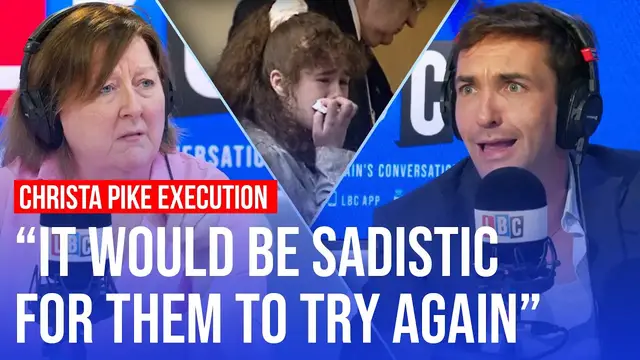
Shelagh Fogarty is joined by Lewis Goodall to react to the failed execution of US inmate Christa Pike.
Christa Pike, 50, could be left brain damaged after shockingly surviving what has been described as the "worst botched execution in the modern era".
Journalists watched live from the execution chamber as she received two syringes of pentobarbital at the Riverbend Maximum Security Institution in Nashville, Tennessee.
Listen to the full show on the all-new LBC App: https://app.af.lbc.co.uk/btnc/thenewlbcapp
#lewisgoodall #shelaghfogarty #usnews #prison #crime #justice #reaction #LBC
LBC is the home of live debate around news and current affairs in the UK.
Join in the conversation and listen at https://www.lbc.co.uk/
Sign up to LBC's weekly newsletter here: https://l-bc.co/signup
Show More Show Less View Video Transcript
0:00
The case we're talking about is Krista Pike
0:02
She's been an inmate on death row in Tennessee for almost 30 years
0:06
She has now been taken to hospital after an attempt to execute her
0:10
two attempts to execute her, have failed. And her legal team filed an emergency motion to halt the execution as it was happening
0:19
And she was clearly struggling, but not dying. She's lost consciousness, still has a heartbeat and is audibly snoring
0:27
is what they said during the process. I won't read any more of that detail because it's horrible
0:32
But it's a gruesome, gruesome case in that there were, as usual, battles till the very end to try to stop the execution from beginning at all
0:42
Lewis is here, Lewis Goodall, presenter of Sundays with Lewis Goodall and co-host of the global podcast, The News Agents
0:49
I mean, we do not have the death penalty here. I can't imagine that we will
0:54
But in certain American states, they very much do. and these kinds of mistakes have happened before, haven't they
1:01
They have, Sheila, and obviously what it comes down to ultimately is a difference between principle and literally execution
1:09
in a sense that what I mean by that is I think one can theoretically be in favour of the death penalty as an abstraction
1:16
which actually we can discuss this. Actually, I think in certain circumstances I could be convinced of that, the moral case for it
1:20
But when it comes to the practicality, that it becomes grislier and more difficult
1:24
So, for example, Rommel Broome in Ohio in 2009 officials spent two hours trying to establish an IV line
1:32
Can you imagine that, two hours just trying to get an IV into someone's arm in order to administer them
1:36
Because it's not doctors that do it. No, because they won't do it. No, it's officials. It's the equivalent of, I suppose, hangmen
1:42
people who are professional executioners. Most famous one in Britain, of course, was Albert Pierpoint
1:48
Absolutely. He survived the attempt and died in prison in 2020 without being executed
1:53
This was a failure to administer the drugs rather than survival after injection. Albert Pierpoint, of course
1:57
as people will know, is the most famous Briton's execution. He came out against their death penalty, I think
2:02
having executed more than 700 people. A bit late, Albert. Joseph Wood in Arizona in 2014
2:08
His lethal injection execution took nearly two hours. Witnesses reported prolonged gasping
2:14
State officials maintaining he was unconscious and not feeling pain. Jesse Tafiro, one of the most famous cases in Florida back in 1990
2:22
Flames and smoke emerging from the headpiece of the electric chair while they were trying to execute him
2:29
Investigators attributed the malfunction to a synthetic sponge used in the equipment
2:35
I mean, this is a recurring problem, in other words, across different methods. Injections can take hours
2:40
They can result in agony. Executions abandoned because officials can't find a vein
2:44
Electric chairs producing flames and smoke and extreme pain. Changing the method doesn't remove the question
2:51
of whether the state can carry out anything humanely. And, of course, one of the most extraordinary things
2:55
about this case, Sheila, isn't it? And it kind of reminds us of some of the absurdities
2:59
around the death penalty, is that this is a woman that the state of Tennessee
3:04
was determined to execute. And yet when it was clearly emerging that she was being damaged and harmed rather than killed the state itself was doing everything it could to resuscitate her and bring her back to health Crazy It is I think trying to explain to someone from Mars
3:20
exactly the logic around that would be difficult. So where does this leave
3:26
I mean, I can't, again, who knows, it's Tennessee. I can't imagine they'll try again
3:32
because it would look genuinely sinister, wouldn't it? Sort of sadistic. to revive a woman only to kill her
3:41
Well, there is a moral question around that, Sheila, absolutely, is that if the state has failed to kill you
3:47
despite their best attempt at trying, do they have a moral case to try and do it again
3:55
I mean, I suppose you might argue that if there is a moral case for it
3:59
does it really matter if you try and fail the first time? But you can also say that the trauma of it
4:05
it starts to veer into the territory of being a cruel and unusual punishment
4:10
which is actually in the US Constitution. It's actually precluded in the US Constitution as something that is allowed to happen
4:17
So I think there is a question. It reminded me a little bit, one of these absurd sort of Wikipedia deep dives
4:23
that I sort of go on from time to time, the rabbit holes I disappear. I've basically developed bunny ears at this point
4:27
But it reminded me once I was reading about on this very question, a sort of similar sort of case
4:32
I mean, it goes back a long way, but in our own country, a guy called John Babacombe Lee
4:37
and he was known as the man they could not hang. And this goes all the way back to February 1885
4:41
He was being executed for murder at Exeter Prison. An official tried to..
4:47
They took him to the gallows and the trap for murdering his employer, a woman called Emma Keyes
4:53
And they took him, and they'd obviously tested it, as they always do. They put the rope around his neck
4:57
they put the bag on his head, they asked him if he had any last words, etc. Pulled the lever, trapdoor doesn't go
5:03
They take the bag off. Obviously, he must be terrified, all of these things. They test the mechanism
5:07
Works perfectly fine without him on the platform. They put some weight on it. Works perfectly fine. They put him back on, do the whole thing again
5:13
Trap door doesn't open. Second time. They take him off. They test it again. They try and repair it again
5:17
Nothing wrong with it. They put him on a third time. Trap door doesn't open. Now, in the end, they decided actually that having gone through this
5:25
that it wouldn't be right to execute him. And he, I think, spent 20 years in prison. I think he actually ended up writing a rather best-selling book
5:31
about 20 years later. Indeed so, indeed so. But my point is to say that as far back as that
5:37
we're talking about the late 19th century, that things like this happen
5:41
There is no perfect way of killing someone. There is no foolproof way of killing someone
5:47
And there certainly is no trauma-free way of killing someone. And so these questions keep arising
5:52
and they're arising particularly acutely in the United States at the moment, of course, because actually, in this case
5:58
this was the state of Tennessee using lethal injection, But increasingly, states that still have capital punishment are running out of these drugs because the pharmaceutical manufacturers won't supply them if they know they're going to be used for execution
6:12
And therefore quite a few states are going back to all the methods including the electric chair sometimes even a gas chamber sometimes even has been posited and talked about in various state legislatures a firing squad Which I told this woman asked for The electric chair No firing squad I think because there have been so many cases of these things taking a long time and being painful
6:33
Yes, there have been lots of cases where people have either asked for the chair or firing squad or something else rather than lethal injection because things like this have happened reasonably regularly
6:41
And bring it back here to the UK then. I mean, you know, you and I have both revealed that, you know, there are certain crimes you can look at and think, what's the point of that individual
6:50
Let's just get it over with, you know. And also, I have to say, you know, if anybody killed my child or, you know, I won't give a litany of crimes, but, you know, I can see circumstances where I'd flipping do it
7:06
Do you know what I mean? And that's just your gut speaking, isn't it, really
7:11
As opposed to your head and making a social and political decision about what country you want to live in
7:16
Yeah, and I think, to be fair, I think this is actually why I think one of the criticisms I have sometimes is the liberal progressive argument against the death penalty, which is that it's not a bad thing to have a guttural response to something in the justice system
7:27
You know, retribution matters. That's been part of human civilisation for as long as it's existed. Revenge matters. And it's legitimate
7:35
And rage at wrongdoing. And rage at wrongdoing. And people feeling that there are sanctions appropriate and commensurate with the crime that has been committed
7:46
And we know there have been cases where people have committed heinous crimes. One thinks, for example, I don't know, Anders Bering Breivik, of course
7:52
the mass government in Norway, killing scores and scores of children. I covered that story in Norway
7:56
A horrendous story. I mean, one of the worst of one of the times. And not just that, but he was trying to basically destroy Norwegian democracy
8:02
Now, you know... And he revels in it still, doesn't he? He revels in it still
8:06
And he's suing the Norwegian government and has done multiple times for the degradations of his human rights. When things like that happen
8:12
I am not surprised that people feel a rage with the justice system
8:16
And there are actors, hard right, populist, far right, who will act upon that, seize that rage
8:22
And it's all very well for liberal progressives or whoever to say, well, this is just a justice system
8:27
Justice has to be blind. It can't be arbitrary. Well, you're up to a point. It's also important that the justice system speaks to the rage
8:34
that people feel for certain crimes. And I suppose sometimes, and I've thought about this a lot
8:38
and when I've sort of had debates sometimes about the death penalty, about which, by the way, as I say, I think I'm sort of, I can theoretically could imagine supporting in theory, if not necessarily in practice
8:48
One of the points I would always say to people is, well, what do you think should have happened to the war, Nazi war criminals at Nuremberg
8:54
Well, it's the 80th anniversary today of Nuremberg. There we are. And do we think that those men, those monsters, should have been put in a prison cell
9:04
If Goering had not been such a coward and hadn't decided to chew on a cyanide pill
9:11
before he was taken to the gallows, do we really think that it would have been appropriate
9:14
for him to spend the next 30 years in a German prison? I don't think so
9:18
And I think most people would have that reaction. Not all, but I think a lot of people would. And once you've sort of accepted the principle
9:24
that there might be something, and obviously in that case we're talking there about crimes against humanity of the worst proportions
9:29
And I certainly would not think the death penalty would be appropriate, even for what I would say if there is such a thing as routine murder
9:36
if you know what I mean you know kind of where particularly where there might be doubt I think there are some crimes if for example a Manchester arena killer had lived one could imagine that something like that might be appropriate
9:48
Where you attack the weakest, the most vulnerable, and you try to upend society
9:53
Almost our own democracy itself. And you try and orchestrate a contravention of people's rights
10:00
which is so fundamental, so premeditated, so calculated, that perhaps there may be a case for the state to retain in its arsenal the ultimate sanction
10:11
Not as a deterrent, those people are never going to be deterred from those things, but to satisfy to the country that on very, very few occasions
10:17
there might be something which must be worse than losing your liberty for the rest of your life
10:21
Now, there are loads of arguments against that, of course, one of which we've been describing, which is how do you do it
10:27
Who does it? Who does it? And whether there is an argument that the state shouldn't sanction the use of that sort of force, it sends the wrong signal
10:36
That said, we know the state does use the ultimate sanction sometimes. If there were a terrorist attack right now and the gunman or whatever it is could not be detained or could not be felled by another means
10:46
London Bridge, the first London Bridge attack. The police would kill them. You know, the state does kill people
10:51
I mean, it just does. Now, there is, of course, an argument about how that happens and how it should happen and all of those things
10:57
But I think that there is a there is at least, I think, an argument to talk about whether the as I say, the kind of arsenal is available of sanction
11:09
If it could be expanded in certain circumstances. Another argument against it, of course, is to say that once you expand it, you know, it's all very well for me to say I can think of a few crimes where you might apply
11:17
It's also true to say that once it's there, you can imagine the public outcry when a particular individual and now for this
11:23
And suddenly there's a sort of expanding one. But it is particularly around children, I think
11:27
I think so. But it is interesting, Sheila, that, you know, even we have not had the death penalty, obviously, for a very long time, you know, decades and decades and decades, abolished in the 60s
11:37
But even now, there is a groundswell of support in the country
11:42
There was a poll in 2025 which showed 55% of the public are in favour, even though we haven't had it for a long time
11:49
Parliament isn't there, is it? Parliament isn't, but it is interesting that that obviously speaks to something in the country that believes that the justice system as it is, is not always able or does not reflect sometimes the seriousness of the crimes
12:03
And that obviously takes all sorts of forms. I mean, when one hears, for example, of rapists, and you and I both know how difficult it is to get a rape conviction, getting a few years in prison
12:14
You know, I'm not surprised that people feel that rage. That doesn't mean that that should be met, of course, with execution. But I can understand why sometimes I think it's quite fashionable sometimes for liberal progressive to sort of like sneer go, oh, the public almost barbaric for wanting this thing
12:29
I don't think it's that at all. I think if the public were more convinced that the justice system worked better and that there were more options available and that the crimes met, the sanctions met, the severity of the crimes
12:44
I think that there would be at least fewer people who might be inclined to support the death penalty
12:49
Let's test your theory. Let's see. Well, why not? Thank you very much indeed, Lewis Goodall
12:53
Sorry for that rather macabre conversation. I do apologise if it's upset anybody
news