Up next in 10



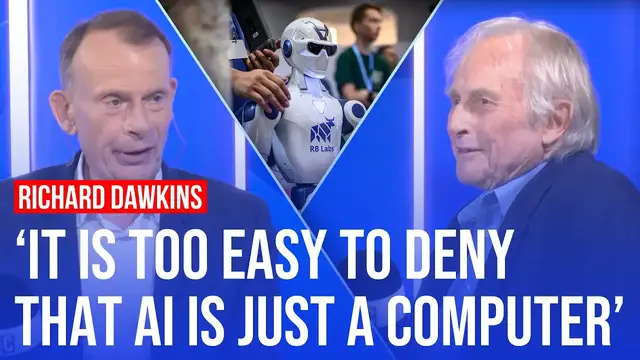
Biologist and author Richard Dawkins joins Andrew Marr to reflect on the 50th anniversary of The Selfish Gene and explore the rapidly evolving future of artificial intelligence. Dawkins argues that today's AI "feels conscious" and is "more than just a computer programme." Drawing on his own interactions with these AI "creatures," he describes being astonished by their sensitivity and intelligence. Listen to the full show on the all-new LBC App: https://app.af.lbc.co.uk/btnc/thenewlbcapp #andrewmarr #richarddawkins #artificialintelligence #ai #LBC #athiesm LBC is the home of live debate around news and current affairs in the UK. Join in the conversation and listen at https://www.lbc.co.uk/ Sign up to LBC’s weekly newsletter here: https://l-bc.co/signup
Show More Show Less View Video Transcript
0:00
Now, let's hear from one of the most renowned evolutionary biologists of our times
0:05
Richard Dawkins, author of The Selfish Gene, which explored a gene-centred view of evolution of how we all came to be
0:11
The Selfish Gene is celebrating its 50th anniversary this year, but it's very important to understand that selfish gene doesn't imply
0:20
we're all programmed to be selfish people. No, it shouldn't imply that
0:25
But selfish genes can imply altruistic people, altruistic animals, or selfish animals
0:32
But the fundamental thing is the selfish gene. The selfish gene can give rise to either altruistic or selfish organisms
0:39
And part of the book is to explain, really, why groups of people acting together on each other's behalf
0:46
sacrificing for each other, can produce more successful genes, more successful generation
0:50
Yes, that's right. But the gene is the unit of selection in the sense that it's that which goes through the generations, potentially immortally
1:00
I always call the book the immortal gene, actually. It is the gene that can survive through the generation after generation after generation
1:10
And it does so by manipulating the embryological development of bodies, either towards altruism or towards selfishness
1:19
So it could be either. Yes. Can I ask about the years after this book? Because you then wrote a series of books really looking at complexity and also at beauty, as if, as it were, you were trying to find your way back into the universe or all around you and ask the hard questions that traditionally religion has tried to answer
1:36
Yes, that's true. I think that science can answer those questions in a beautiful way
1:44
I mean it is actually a very beautiful thing that on this planet at least one organism has arisen in the universe which is us which is capable of understanding why we here and why things are so beautiful
1:57
at least temporarily and locally beautiful. You, I think, you were in the Church of England as a boy
2:04
and you became an atheist as a young man or as a student, that sort of time
2:09
And you've been an atheist ever since, and you wrote a very famous book, The God Delusion
2:14
You were part of a group of people arguing from a scientific point of view against all of the religious lessons
2:21
Are you, since that book's been published, actually religion has been roaring back a lot
2:26
Has it really? I was just talking to one of my colleagues and we were agreeing that in principle, I would absolutely love to go to church, you know, every week and do nothing wrong with communal singing, nothing wrong with the old tunes, nothing wrong really with familiar stories
2:41
And certainly nothing wrong with sitting on the pews surrounded by people from different walks of life, different ages, different backgrounds
2:48
All of that very, very good. It's just the thing in the middle that's the problem. Yes, exactly
2:54
The tunes, the hymn tunes, I play them on my little electronic clarinet thing because they're in my head and I can play them by ear
3:04
And of course there is some glorious music. I mean Bach's massive, massive
3:10
Greatest music ever written. Wonderful, wonderful stuff. So in a sense, would you regard yourself these days as a cultural Christian
3:16
I've been called that, and I suppose it's true in the sense that I do know the hymn tunes
3:21
and I know my way around the prayer book and I know when to stand up and kneel down and sit down and so on
3:26
But I'm not a Christian in any sense, and I don't believe any of that stuff
3:31
And so I don't hanker after it in that sense. Let jump from tradition right into the middle of modernity and AI and all of that We had a very very interesting scientist from the University of Minnesota on the show recently who was talking
3:47
about something called spud cells, which are synthetic cells which can reproduce. So it's
3:52
not quite synthetic life because they have to do so much to look after them and eventually they
3:57
decay these cells. Nonetheless, we are getting closer to that. Do you think we are going to see
4:01
some form of genuine synthetic life? Yes, I've been part of the movement called Artificial Life
4:08
I think we had the first meeting in Los Alamos in about 1989 or so
4:15
And it's a very exciting field, and I look forward to it
4:21
I mean, I find this kind of advance very exciting. And that is, of course, right alongside what's going on in AI right at the moment
4:29
which is also very exciting. You believe that AI is, even if it doesn't know it itself, conscious
4:35
I did say that. I rather rashly shot off my mouth when I said that
4:39
I'm not totally convinced of that. I think it's too easy to deny it
4:45
It's too easy to say, oh, it's just a computer program. It just does what humans tell it to do
4:51
It's just it's not when there's something going on. And it's if you've interacted with these creatures in any
5:01
It certainly feels conscious, doesn't it? Oh, absolutely. And I mean, I gave one of these creatures the text of a novel that I'm working on
5:12
And I was astounded at the sensitivity and the sheer intuitive cleverness
5:20
It was like talking to a professor of English literature. Wow. It really was
5:24
And I guess in terms of whether they actually conscious or not that takes us to consciousness And that is a very difficult subject still not understood even by the scientists who specialize in it That right I mean we don know what animals are conscious We don even know that each other
5:41
is conscious. We assume that we are because we come from the same kind of place
5:45
We sit around LBC studios and look at each other and have to make that assumption
5:49
Yes. And you can't make that assumption about an AI. But nevertheless, the actual conversation you have, you cannot tell the difference, except that they're much quicker and more knowledgeable
6:03
But they do appear to be human in every way you can think of
6:08
And very powerful and becoming more powerful all the time. Do you think that culturally or in any other way, we're ready for this
6:14
A lot of people are very frightened of it. A lot of people feel that we're doomed and they're going to take over and take our jobs
6:22
Do you? Well, yes, actually. We're doomed. It might not be a totally bad thing
6:30
I mean, you know, they might make a better job of it than we do. So you can see, looking in the near future, a kind of world dominated by AI
6:37
which is actually more benign in some respects than today's one. I wouldn't want to go on record saying that
6:43
And Martin Rees, the astronomer royal, has made the interesting point that if we are ever contacted by aliens from outer space, it probably won't be the original biological aliens, but it'll be their artifacts
6:55
It'll be their robots who have a much longer lifespan than we do
7:00
I think he's also argued that in the next generation, we will either wipe ourselves out on this planet or we will spread to the rest of the cosmos using AI
7:09
Yes, yes, he has. Yes, that's right. So it's one or the other. Yes
7:14
Good time to be talking, Richard Dawkins. Congratulations on a wonderful book, series of books
7:18
This is not the only book, obviously. And thank you very much for coming in. Thank you very much
news