Up next in 10



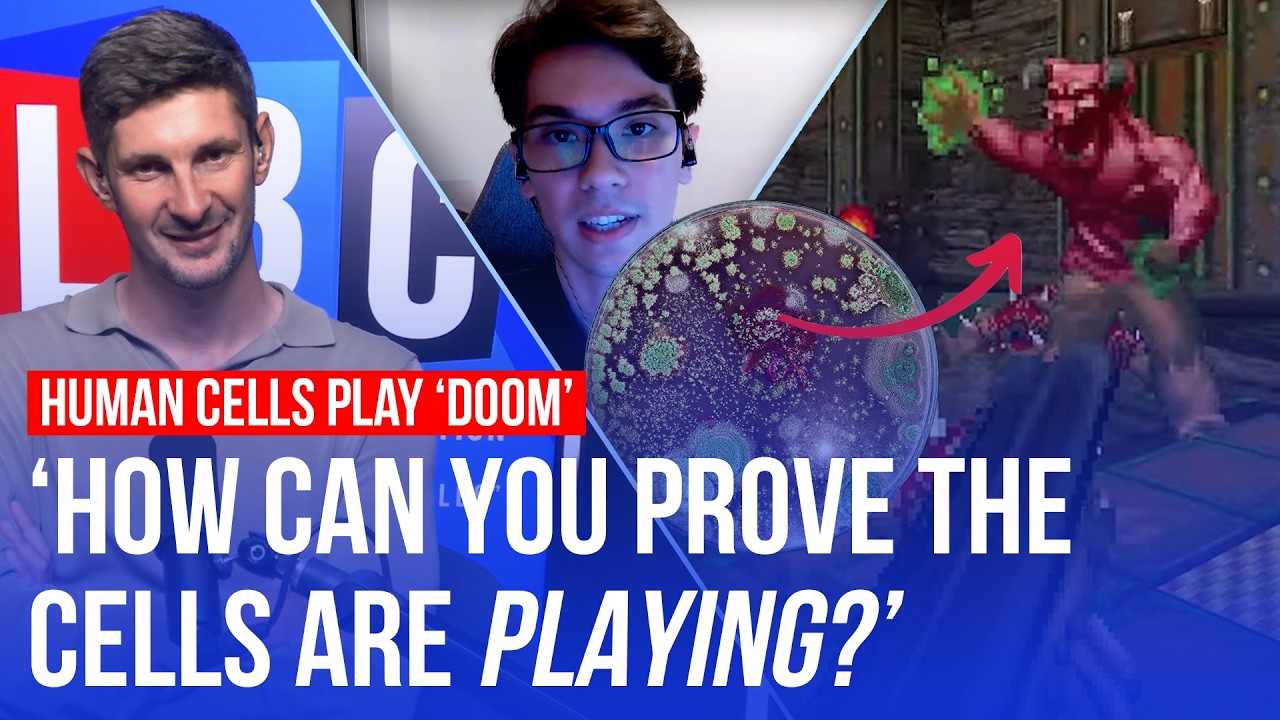
Human brain cells have been used to play classic video games, most recently achieving a breakthrough by learning to play Doom. The work builds on earlier experiments by Australian company Cortical Labs, which in 2021 used neuron-powered chips made from over 800,000 living brain cells grown on microelectrode arrays to play Pong. Cortical Labs later developed a Python-based interface to program these “biocomputers,” enabling independent developer Sean Cole to train the system to play Doom in around a week. 24-year-old Sean Cole joins Tom Swarbrick to discuss the breakthrough. Listen to the full show on the all-new LBC App: https://app.af.lbc.co.uk/btnc/thenewlbcapp #tomswarbrick #science #LBC #doom #gaming #games #debate #news #uknews LBC is the home of live debate around news and current affairs in the UK. Join in the conversation and listen at https://www.lbc.co.uk/ Sign up to LBC’s weekly newsletter here: https://l-bc.co/signup
Show More Show Less View Video Transcript
0:00
a lot of AI infrastructure specifically is using so much energy
0:04
And to me, you know, while I was doing my master's at Sussex, the whole idea of energy efficient computing was really interesting to me
0:11
because brains are super, super efficient. You know, we are far smarter than
0:18
most language models and those use, you know, gigawatts of electricity and we use watts, milliwatts in some instances
0:26
So that's the why. As for what I've built, yeah, so the Doom stuff functionally is
0:33
it's basically just an optimization problem. How can we optimize a bunch of brain cells to learn on a task
0:42
On a task. And the task you've given it is to play Doom
0:49
which for people of a certain vintage, they will have played a lot of. You basically go around exploding stuff and shooting people
0:55
how can you tell this might sound a really dumb question how can you tell that the clump of cells is playing it
1:04
Yeah, so a lot of things that we did we made a lot of experiments
1:09
to make sure that the cells are playing it because in our infrastructure
1:14
we need to give the cells a way to see the game so we call these the eyes
1:18
that's basically a small silicon model the really cool part about computers and brains
1:24
is we speak the same language. We speak in electrical signals. So all you have to do is you have to take a computer part
1:31
like a silicon aspect of it, convert the game state into electrical signals for the brain
1:37
And then the brain will process those signals. You get an output. And then we process that output into the game
1:44
The way in which we actually know that the cells are learning to play the game
1:48
is we freeze the inputs. So sometimes we freeze the eyes or we freeze the muscles
1:53
so that they can learn. And we still detect increases in performance
1:59
which would mean that the cells themselves are driving that improvement. So this thing is not only playing the game
2:06
it's learning how to play the game. Yeah, correct. So what did you say
2:12
So when you switched it all on, this is really, it talks to me like an eight
2:16
When you switched it all on and you saw the cells doing their thing on Doom
2:20
what were they doing? so we created a custom game mode in dune which is basically a huge box and it would just spawn
2:29
demons endlessly for it to kill um and it was getting better at killing the demons so um you
2:36
know it has a health bar so it tries not to die so we track the performance metrics by how many
2:42
demons it kills before it dies and over time we can see that amount increasing so the cells are
2:47
actually learning to kill more demons and doom and it i say it um they know the cells know that
2:56
running out of health bar would result in a bad outcome because presumably it's experienced that
3:02
before and the electrical impulses told it it was a bad outcome yeah so we don't directly tell
3:09
the brain cells what's a good and bad outcome um the way that brains learn uh is something called
3:15
the or you know we think it's something called the free energy principle where the brain tries to
3:20
minimize chaotic feedback so what we do is when it does something bad we give a lot of chaotic
3:27
signals to it right and then it's able to optimize to not have those chaotic signals
3:33
path of least resistance ignore the noise pretty much go for the simplest thing which is to kill all the demons on doom yeah yeah pretty much so how how good is it at doom um it so i think our initial training stuff the one that blew up on
3:48
media it was not very good um but what i like to do is i like to compare it to a child you know if
3:54
you have a child that just spawned uh and you made it play doom it would it would probably be
4:01
better than the child which i think is very interesting in many ways um so you know in some
4:06
senses you can think of it as we're able to teach brain cells how to learn faster than it can teach
4:13
itself how to learn um you know that's a interesting idea yeah but only up to a point perhaps
4:19
your brain cells are not going to get better than a than a five-year-old at doom so that's what i'm
4:26
kind of researching now um so the code i made is all public but internally i'm researching okay how
4:32
do we get it to a superhuman performance on doom because that's how all ai progress is made
4:37
surprisingly it's through games getting superhuman performance in games and then suddenly you have
4:41
chat gpt uh so i'm trying to push it to superhuman performance in games um and yeah i'm trying to
4:48
see where that takes me i mean this is uh genuinely pretty mind-blowing yeah
4:56
again, what proportion of a brain are we talking about in this sort of Petri dish playing Doom
5:02
So like a fifth of a brain, an eighth of a brain? Yeah, it's like minuscule
5:06
So I think like, you know, in our brain, we have billions and billions of neurons. The amount of cells we have in this dish is 200,000
5:13
And they're only of a specific neuron kind. So, you know, in our brain, we have a bunch of neurons
5:19
but they're also a bunch of different ones interacting with each other. in the dish you know we only have 200 000 neurons of the same kind that's extraordinary so we're not
5:28
even close to yeah so what does that tell us does that tell us to what extent does it tell us that
5:36
we are um our brains are to some extent underutilized we can do far more than we currently
5:43
are capable of doing or think we're capable of doing yeah i think that's like an interesting
5:48
idea um i'm not entirely sure how that would translate like how how would we scale up with
5:53
more neurons um but i think that potentially what we've found is a more uh kind of a faster way to
6:05
intelligence uh through our stimulation and optimization protocols uh than what humans
6:12
normally achieve just by experiencing the world around it okay i'm going to give you a scenario
6:17
yeah and this is this is genuinely terrifying because i wonder whether we might be close to it
6:21
yeah you've seen the film the matrix when they upload kung fu and jujitsu within seconds if
6:30
you've only got a petri dish of 200 000 euros and we've got billions given the right input
6:35
could the brain learn martial arts in 10 seconds yeah so a lot of the bci stuff so brain computer
6:43
interface stuff currently that we have, you know, think Neuralink is mostly read only. So we read
6:49
electrical signals and we convert those to actions. The holy grail of BCI is write, right? We want to
6:55
be able to write stuff to human brains. That's kind of what I'm exploring right now with my
7:00
company. You know, I've built a new company to focus on like, how do we actually train these
7:05
cells? How do we write? And yeah, I mean, I think that's a really interesting idea of
7:10
can we write intelligence far quicker than a human can learn it
7:14
through external optimization methods? So far with our Doom stuff the answer to that is kinda you know we kinda seen it happen But then there also a question of if we do this are we stripping the person of agency
7:29
You know, what are the ethical issues with that? Are we potentially overwriting portions of their memory
7:35
You know, we don't know the exact implications of kind of teaching someone
7:39
And also, I guess, whose jujitsu is the brain learning? That jujitsu input must have come from somewhere, can only come from humans
7:46
you know yeah it might be an imperfect form of jiu-jitsu yeah yeah so that would be like knowledge
7:53
transfer across humans which is also really interesting because if we find a way to uh let's
7:58
say you know take this guy's jiu-jitsu knowledge take it out and then put it into a human that's
8:03
that constitutes knowledge transfer yes um and if you can transfer knowledge you know what if you
8:08
have an empty brain that you grew like your own brain let's say um and you took all the knowledge
8:12
that you had and you put all your knowledge that you have into that empty brain that is to also
8:16
yours is that person also you you know that's a a lot of questions to ask but yeah so i guess it's
8:26
um do you think there's a moment uh where the clump of cells you've got playing doom can transfer
8:32
its knowledge to another clump of cells of how to play doom uh that's also something that we're
8:37
working on internally knowledge transfer um that's something that's also really important because if
8:42
we want to use cells for compute the cells die so we need a way to be able to transfer the knowledge
8:48
everything these cells have learned onto a new clump and you know keep that knowledge chain growing
8:53
so yeah so that's something we're experimenting with internally we don't have like many results
8:58
on it yet but that's something that's really kind of important to solve as well um i mean what you're
9:05
doing is completely fascinating and right at the cutting edge uh and in a way slightly scary about
9:13
what the potential of it is um so i'm going to ask probably a bit of a non-scientific question
9:20
to a scientist which is probably a bad idea but to what extent do you think that the bunch of cells
9:25
in a petrodys playing doom is alive well the cells themselves are alive right because they're
9:32
biological in nature um but if you know if we're talking about stuff like consciousness which i
9:37
think is a different metric um i personally do not believe they're conscious and but it's um there's
9:45
a lot of debate currently on like intelligence and consciousness right people think language models
9:50
are conscious a lot of consciousness researchers don't think that's the case because they tend to
9:54
treat intelligence and consciousness as uh separate and what i've done a lot as well as
10:01
I'm not a neuroscientist. I'm a machine learning guy. So I've approached a lot of my professors at Sussex
10:06
which has a fantastic neuroscience of consciousness program. Amazing. And I'll say, yeah, I know
10:12
Adam, yeah, he's good. Some really, really awesome guys. So I've approached them to kind of see what they think about it
10:20
And because the last thing that we want to do and the last thing we're prepared to do
10:24
is create a new conscious being because there's a lot of implication when it comes to that
10:28
So we're trying to do research in a way that is, that doesn't create consciousness
10:34
What's the line? And I guess that's the question that your neuroscientist professors are also trying to answer
10:39
Where's the line? If you've gone from 200,000 brain cells, suddenly you're at a billion
10:44
Well, if the brain cells ask for the computer to be turned on
10:48
so it can keep playing, that's a whole different world. Yeah, yeah
10:53
I think that's something that I'm tracking very, very closely. How do you know if you'll see it
10:58
Yeah that the really hard part is we don have a objective measure that everyone agrees on like on consciousness That something that we haven agreed on scientifically like across all boards
11:13
There are some potential ways like, you know, you have integrated information theory that suggests some ways of measuring it
11:20
But fundamentally, we don't have an objective measure. So it's something that we have to approach very, very, very slowly
11:28
with a lot of external kind of advice and help to make sure that we don't create something that
11:34
we don't want to create. I could talk to you for a long time I find it absolutely fascinating and
11:41
this is just the stuff that you know people are talking about and writing about imagine the things
11:46
that are going on in labs that the public aren't aware of you know and some of the some of the
11:53
discoveries that are being made what would you say then is the um the question you are most keen
11:59
to try and answer through the experiments that you are doing the thing that you ultimately hope
12:04
one day might win you the Nobel Prize yeah um I think for me it's I like biological intelligence
12:14
because you know we're trying to you know in in trying to achieve intelligence in biological
12:20
substrates, we're trying to kind of recreate human intelligence. And I think in doing that
12:27
we learn a lot about ourselves as human beings. Because, you know, in silicon, you're trying to
12:33
create super intelligence with these large language models, but we don't even know what
12:36
super intelligence looks like. In biology, we know what intelligence looks like, you know
12:41
me and you, we're both intelligent beings. So, you know, trying to recreate full biological
12:47
intelligence in a biological substrate and then using that for things that would help the rest of
12:53
humanity so energy efficient computing drug discovery that kind of stuff so one day you could
13:00
be the pioneer of the clump of gray matter that is so intelligent that it works out how to cure
13:08
cancer before we do um that's the goal uh so i kind of i started my own project aside of cortical
13:17
so i built this new company and we're going to i'm going to sf soon hopefully um to raise a bunch
13:24
of money to build that uh and do that yeah so you literally creating an external brain
13:30
to think about how to cure cancer yeah so we aren't yeah we aren't creating the cells ourselves
13:38
or anything, but we're creating the algorithms. And I think that's the really important aspect, right
13:43
Because four years ago, 800,000 neurons played Pong. You know, four years later, we have 200,000 neurons playing Doom
13:52
So it's clearly an algorithmic problem. It isn't a hardware, you know, biocomputing problem
13:57
It's something that can be solved with algorithms. And I think that's the part we're trying to solve
14:02
Can we make learning and biological substrates as efficient as possible? and then can we branch out from there in terms of like writing to memory and bcis energy efficient
14:13
computing and drug discovery what's your time scale uh it's really hard to it's really hard
14:21
to say so with computing stuff um i want to be able to produce some very interesting results by
14:30
i want to say end of this year but you know science is science right it's hard to it's hard
14:36
to pinpoint exactly what's going to happen, but I'm really, really kind of pushing myself
14:41
to make some progress quickly
#news