Up next in 10



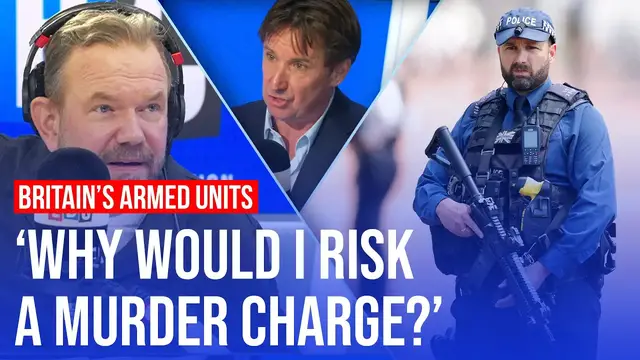
James O'Brien speaks to Jason Farrell, Sky News' Home Editor, who's been inside Trojan One, one of Britain's elite firearm units.
Jason reveals what life is like inside the unit, the struggles they face, and why UK police forces struggle to find people to do the job.
Should we make it easier for police officers to pull the trigger? Is it too easy already?
James and Jason discuss.
Listen to the full show on the all-new LBC App: https://app.af.lbc.co.uk/btnc/thenewlbcapp
#jamesobrien #police #armedpolice #crimenews #ukpolitics #behindthescenes #lbc
LBC is the home of live debate around news and current affairs in the UK.
Join in the conversation and listen at https://www.lbc.co.uk/
Sign up to LBC's weekly newsletter here: https://l-bc.co/signup
Show More Show Less View Video Transcript
0:00
I want to reintroduce you to the home editor over at Sky News, Jason Farrell, who's joined us a few times over the years because he has a knack of filing extraordinary stories to Sky News, which we can then piggyback on like, I don't know, seagulls following the trawler
0:16
And this is a story that LBC was obviously all over, Jason
0:22
Or rather, one of the reasons why you've undertaken this inquiry is because of the shooting of Chris Cabber in September of 2022
0:31
and the subsequent ordeal of the police officer who fired that single shot to the head
0:37
So we begin effectively, and indeed your report begins, with you on patrol with Trojan One
0:44
Why on earth did they let you in the car? Good question. In part, thanks to your crime correspondent, Andy Hughes, who'd built up a good relationship and was working at Sky at the time
0:54
And we agreed with them that we would give a balanced view
0:59
We would hear from the CABA campaigners as well, but that it was time to have a bit of scrutiny on what the officers did, how they were trained
1:07
And also just to witness firsthand the kind of pressures that they are under
1:12
and sitting in the back of Trojan One, which is the vehicle with oversight of all of the firearms operations
1:19
in London at any one time. And you see how magnetically drawn it is
1:23
to anything dangerous happening in London at any one time. And there's always something happening in London
1:28
be it a shooting, a stabbing, an acid attack, someone with a crossbow
1:32
and you're literally flying from one point to another and seeing how these teams operate
1:38
But the fascinating thing, obviously, was doing that in the light of the fact
1:42
that one of their own officers had been charged with murder. And we knew very little about the mood and the feelings within MO19
1:52
We knew that many officers, around 300 it was estimated, put their guns down at that time
1:58
and it caused problems for the firearms unit. But we'd never really spoken to them or heard from them
2:04
So to sit in the back of the vehicle and get their opinions on what that was like
2:08
and how they felt was a real eye-opener. Because they wanted to be humanised, I think, perhaps
2:14
Yeah, because they are human beings and they are incredible human beings in the sense that
2:18
I mean, imagine if you or I went back to our wives and said, look, we've decided as a job what we're going to do
2:23
is go with guns to the most dangerous things happening in London
2:27
And this was an added point to that job, which is, and by the way, if we open fire
2:33
we might end up being charged with murder. Our names might be made public and you might be at risk then
2:40
because the criminals who we deal with will know who you are. So those were the things that officers were conveying to me
2:49
It was A the fact that NX had been charged with murder and he was facing one of the highest charges in the land but secondly that he had been identified and that caused particular upset i think
3:01
that was because as you say it is it's it makes everybody else identifiable as well and i notice
3:07
you don't name him i mean you've had to in the report and you may do in the course of this
3:10
conversation because you're a proper journalist and i'm not so i made a point at the beginning of
3:15
not saying his name live on the radio because of precisely those concerns
3:19
Well, I knew those were the House rules here. In your manner. Thank you for respecting them
3:22
Yeah, I did. I did. But I do name him in the report because it's part of it
3:27
It's part of the story and we go through it and the impact that that has on the offices on the ground
3:35
So what they're hoping to achieve is clarity and even perhaps sympathy
3:41
Well, I think I'm not sure what they're hoping to achieve. what I was hoping to achieve was an understanding of how they're trained
3:49
actually, more than anything, on when to make that decision, when to pull the trigger, and how they go through that process
3:58
and what happens afterwards. What were you most surprised by? What were you most taken aback by
4:03
I mean, one of the things that surprised me was statistics on it, that we looked into it, and in 40,000 operations in 10 years
4:11
only 130 shots had been fired by the Met Police 80 of them at terrorist incidents
4:18
50 of them at one terrorist incident knowing that was a London Bridge attack and actually very, very few shots are fired
4:24
over the course of a year usually less than five a year
4:28
last year no shots at all fired so there is and you do see the levels of restraint
4:34
I think the other thing that really surprised me was just how well trained they are in first aid
4:38
so a lot of bandaging people you know they're much more likely to reach for the kit the first aid kit in their vehicles
4:46
than they are their weapons that's really interesting isn't it so they've got oxygen
4:51
they've got defibrillators they've got tourniquets i think when you were with them and they arrived
4:55
at the scene of a stabbing the injured man didn't want the officers to cut off his clothes but they
4:59
did so and then they find a wound under his armpit that could have been very very serious
5:04
and they've got a specialist bandage to deal with that potentially punctured lung immediately
5:09
Yeah, and you see them go through that process. And it's interesting, you know, just so you know
5:13
as the process of a journalist, it took us ages to get that footage from the Met
5:18
They weren't willing to hand it over. And I said, well, why not? You know, you'd think that would be good PR for them
5:24
Equally, the footage of the officer who doesn't open fire when he's faced confronting a man with a gun
5:31
this is all stuff that we forced out of them rather than they gave us
5:34
and this isn't i will add this isn't a pr for mo19 we do really look at how well they are scrutinized
5:42
let have a little listen to a clip of you taking part in a firearms training simulation and then then hear what some representatives of Chris Cabber family had to say as well about this report
5:56
and the broader issues that remain in place. But this is Jason Farrell taking part in a firearms training simulation
6:04
If you are familiar with our crime editor, Andy Hughes, there may be a voice in this clip that you recognise
6:12
If I fire, a laser hits the screen, and where the shot lands changes the outcome of the video
6:18
Drop the gun. Did you shoot? I don't know. So at that point, what was your honest whole belief
6:28
was about to happen in that room? That he was about to shoot at least one or more of those people
6:33
And that's all based on what you've seen in the room? What you've seen on our way into the room, yeah
6:37
Quite a lot. I don't think that was the right time to do it
6:41
and also you have the students in the back. I was disagreeing with you. He was holding it
6:45
Was he? So were you saying when he fired, he was in the air? I think it was, yeah
6:50
No, it wasn't. It wasn't. From what I saw, he was about to... He had... The gun was in a position where he could
6:55
if he pulled the trigger, kill someone. Cool. Nobody can change what you've seen and what you believe in process, can we
7:00
I can't tell you you're wrong, because that's what you think you've seen. But now you put you two in a court floor
7:06
and we're saying different stories. I mean, that is an extraordinary illustration
7:10
of how difficult it is, but also how important that certainty to fire
7:14
Is that the phrase? Yeah, honestly held belief. Honestly held belief. So, yeah, I mean, obviously Andy was wrong
7:20
Yeah, backseat driving. Backseat driving. But no, we have this, and we have the luxury of being able to see it played back
7:27
and discuss it, which an officer doesn't if they open fire. You know, they have to wait for the court hearing
7:33
or disciplinary hearing or the inquest. But their defence in a court of law
7:38
is if it's their honestly held belief, that there was a threat to life, then they have the right to open fire
7:44
And this is why NX121 was acquitted at his murder trial. And is that also why the misconduct hearing has also been shut
7:53
Because the law has changed. Very briefly, so he has, it was the case that honestly held belief
7:59
also had to be reasonable in misconduct hearings. That was decided by the Supreme Court about three years ago
8:05
so that police could learn from their mistakes, They could learn the reasonableness of their actions
8:11
But it was then decided to actually, by the Home Office, to go to have the criminal test in misconduct hearings as well
8:19
And that has upset the Kaba family and other campaigners who feel that that legal test is now too easy for officers
8:27
But it does mean that the process can be streamlined. So it doesn't have to take years
8:32
For example, W80, another police officer who shot Jermaine Baker, his process took 10 years to get through all the different processes So this is one way of kind of streamlining that process but it has raised questions about the accountability for campaigners and and the um some of the other the people you
8:50
spoken to who've never spoken to the media before members of nx121's unit um unnamed obviously but
8:56
some some of their comments which you can hear in the report include we don't get paid any extra to
9:01
do what we do why risk getting charged for murder when you can sit in an office somewhere and get
9:05
paid the same um there's there's a sort of constant vigilance in place and even though
9:13
they don't discharge their weapons very often and they don't people get shot incredibly rarely as
9:18
you've suggested every minute of every shift that's what could happen next and for some people
9:23
it was too much and there was an officer who we were on duty with who said i can't do this anymore
9:30
and at that time, I don't know what it's like now, but applications to become a firearms officer had halved
9:38
and there were people leaving and that officer, that was one of his last patrols
9:44
So this is a concern for the Metron Police Commissioner and I think that's why he wanted to be seen coming out in this piece
9:51
and defending his officers and I do challenge him quite robustly on some of the things that have happened
9:58
but I think there is a feeling and we did a survey as well of police officers there is a feeling
10:04
amongst the force that if they open fire they won't be supported yeah and that the public may
10:09
not support them and they may well face prosecution and that they won't be supported by their senior
10:13
officers and I think this is something that the commissioner is trying to get across that he's got
10:17
their backs that's certainly the message that he was given to me in those interviews it's an
10:21
extraordinary report as you say a very long time in the in the making and and also not not easy to
10:27
get a lot of the footage that Sky News viewers will be able to peruse, able to watch
10:32
Well, you don't often see these guys, you don't often see these guys from the back of
10:36
the vehicle and just go with them and see the operations as they unfold. And you very
10:41
rarely get to see how they're trained. And people may wonder, should they, for example
10:48
be trained to shoot for the arm or shoot for the leg so that it's not fatal? And we get
10:52
an explanation of why so often, actually, they do have to shoot for the body, for example
10:56
to neutralise threat. So there's lots of different aspects of it. We even get to see them play out a marauding terrorist attack
11:02
and see how they handle, you know, that kind of scenario and how they would, for example
11:08
triage all the people on the ground. So there's a good in-depth explanation and illustration
11:14
of how these officers go through their daily lives and how they're trained to do what they do
11:19
Amazing stuff. It'll be running on Sky News again. Nine o'clock tonight. You can see it on YouTube
11:23
That's the programme that you want and then available on YouTube as well. uh jason farrell home editor at sky news many thanks indeed for your time today and um a big
11:32
heads up on that nine o'clock broadcast tonight or of course uh on on youtube at your own convenience
news