Up next in 10



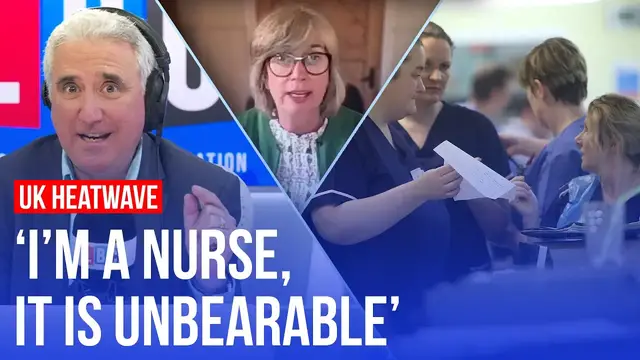
Hospitals across Britain are facing extreme heat, with nurses reporting temperatures above 30°C, staff fainting during shifts, and patients struggling in wards without air conditioning.
The Royal College of Nursing says some NHS facilities are becoming impossible and inhumane places to work and receive care.
00:00 | Patricia Marquis, executive director for England of the Royal College of Nursing, calls for hospitals to regulate temperatures and working conditions
06:59 | Alicia is a nurse and describes her experience working during the latest UK heatwave
10:36 | Dr Peter Carter, independent health consultant and Vice President of the Institute of Customer Service, joins Simon
13:37 | Beth's partner is a police officer who has worked in London heat for over 12 hours shift with no breaks
15:21 | Paul thinks we worry too much about doctors and nurses and they should just 'get on with it'
18:20 | Adam has a geopolitical analysis to wrap up the conversation.
Listen to the full show on the all-new LBC App: https://app.af.lbc.co.uk/btnc/thenewlbcapp
#simonmarks #heatwave #ukheatwave #nurses #doctors #doctor #nhs #ukheatwave #trump #russia #ukraine #uknews #heat #lbccallers #andyburnham #LBC
LBC is the home of live debate around news and current affairs in the UK.
Join in the conversation and listen at https://www.lbc.co.uk/
Sign up to LBC's weekly newsletter here: https://l-bc.co/signup
Show More Show Less View Video Transcript
0:00
The Royal College of Nursing said today dozens of its members were working in facilities not fit for humans
0:07
as temperatures never dipped below 30 degrees throughout their shifts. They say heat waves are making some hospitals impossible and inhumane places to work and to receive care
0:19
and said that there were even some NHS managers today who were not allowing staff to relax dress codes
0:26
which seems utterly ridiculous. One nurse reported that managers blocked the use of cooling systems in a facility where the mercury had topped 36 degrees
0:37
Some pregnant nurses said they were worried about the impact of working in 32 degree temperatures on the health of their babies
0:45
Both the public and private sectors are surely going to have no alternative but to take all of this seriously
0:52
If you were at work today, what was it like? If you're an employer, how much pressure are you under to spend money to make it more possible for your staff to endure these soaring temperatures
1:05
Have you got the money? And what kind of impact is it going to have on your business
1:10
Workplace stories. Between now and nine, you can call 0345 6060 973
1:17
It's the same number for WhatsApp that it is for the phones. You can text 84850
1:22
Joining me now is Patricia Marquis, Executive Director for England of the Royal College of Nursing
1:30
Patricia Marquis, thanks very much indeed for being with us on LBC today
1:35
I mean, these reports of nurses collapsing in some hospitals today and requiring medical treatment
1:42
in the very facilities where they were supposed to be providing medical treatment
1:47
I mean, how widespread was that? and more broadly how inundated were you and your colleagues today
1:56
with these concerns being expressed by your members. Good evening. Hi and thanks for talking about this
2:05
because it is a really, really important issue not just to nurses but as you can hear to everybody
2:11
I can't say that we've been inundated. We have certainly seen a significant increase in the number of calls
2:18
and a lot of them but it really is around nurses are incredibly tolerant and they will always prioritise their
2:26
patients over themselves so we know that it's the tip of the iceberg she says the people that are
2:34
actually contacting us it really is a small percentage we believe that are doing that but
2:39
the stories that you can hear are probably replicated time and again I spent the last
2:45
couple of days actually in a couple of hospital sites in the east of England and it was incredibly
2:52
hot when you're working in an environment that's often warmer anyway because of the nature of the
2:58
business that you're working in where there's lots and lots of people lots and lots of equipment
3:03
and very old estate that isn't geared up to these high temperatures at all sometimes doesn't have
3:09
opening windows and in the majority of cases has nothing like air conditioning. It is unbearable
3:17
and they are doing a very physical job stuck in a ward environment or a community environment in
3:24
their car for hours and hours at a time. And this of course is also happening at a time when the
3:30
health secretary Yvette Cooper has put the NHS on notice and said that from now on the NHS has to
3:36
treat summers in exactly the same way as it treats winters in terms of making plans to be inundated
3:45
with all sorts of cases relating to the weather? Absolutely. Your listeners will all have heard
3:52
about what we used to call winter pressures which over recent years have increasingly become year
3:58
round pressures with patients often being cared for then in corridors or other inappropriate spaces
4:04
which just creates more and more heat in reality, of course, the more people there are
4:09
But people's health is severely impacted by this extreme heat. It makes a lot of conditions worse
4:18
If you've got heart problems, if you've got chest problems, if you're elderly and vulnerable in other ways, it does make it worse
4:25
So people are coming to hospitals, going to their GPs, needing community services in increasing numbers throughout the summer and we just can't cope
4:36
We have to be able to reduce the temperatures in these workplaces to make it safe not just for staff
4:43
but probably as importantly for the patients because what the staff are trying to work in
4:48
is what the patients are trying to endure. They're sick, they're vulnerable and then we're making it
4:53
worse with the temperature Well that a very important point because of course it not just the staff that get affected by this It is the sick that are in hospital trying to get the assistance that they need for whatever medical ailments that they are suffering from
5:07
What do you want the government at this point to do? Because clearly providing air conditioning
5:13
for the entire NHS estate, that isn't going to be done by next summer, but presumably you want
5:22
to see some action on this as quickly as possible? Absolutely. Locally today, tomorrow, we want local
5:30
employers to take the action they can take. As you highlighted before, it's not acceptable for
5:35
employers to be ignoring the calls of their staff to say, please, can we relax the uniform policy
5:42
Please, can you provide us with fans? So we do need employers to actually step up, listen to their
5:49
staff and provide a working environment right now that is more manageable than it is with breaks
5:55
access to water, those sorts of things. The government has committed money towards investing
6:02
in the NHS estate. That's a step in the right direction. But some of that money absolutely has
6:09
to be to deliver modern climate adaptations. We cannot just, it cannot just be about fixing the
6:16
state's backlog. Some of it has to be to ensure that there is air conditioning, et cetera, in place
6:24
And finally, we would say to the government and indeed to all of us as individuals, we all need
6:30
to do what we can to prevent this situation getting worse. This is part of climate change
6:36
We all thought it was going to come in some years. We're living in it now. And absolutely
6:41
The government has to invest in the mitigations to reduce the emissions, which are part of what is causing this exponential rise now in the rate of climate change, which is impacting our health and impacting on our workplaces
6:59
To Alicia, first time caller to LBC from Tottenham. Alicia, good evening to you
7:06
How was your time in the workplace today? Hi Simon, thank you for having me
7:13
So I'm a nurse and I work on the oncology walls and it can get very, very hot up to mid 30 degrees Celsius
7:25
Our uniform policies are quite strict, unfortunately, and we have to wear quite thick material clothing as well while we're on walls
7:35
and that's obviously to help the patients identify our different roles. So I do understand that
7:42
But what I wanted to raise the point is that we don't even have air conditioning in the NHS
7:47
which is quite bad. My colleague actually has fainted on the walls due to this
7:52
I felt very lightheaded. One of the interviews has made a good point that we don't even actually fully get our breaks
8:00
So we are working 12 hours with no breaks, dehydrated as well
8:05
So it's very, very tough. I mean, and when you raise this with managers there
8:13
for example, I mean, I understand about the dress code, but when you raise with managers the fact that people are passing out
8:20
in this kind of heat, what do you hear back? Well, they're just told to go to the break room
8:28
get some time for themselves, drink some water, and essentially come back on the wards
8:32
and we're also always understaffed as well. So we can't really afford to be losing our colleagues
8:39
because then there's more workload on the rest of the colleagues. So it's just a knock-on domino effect
8:46
So, yeah. And Alicia, what is the impact of those kind of temperatures on patients
8:53
So our patients are immunocompromised due to the disease and cancer that they have
8:59
So they often tend to get very sweaty, which causes them to get quite flustered
9:06
which then in turn affects their immunity. And they are more likely to basically catch infections as well
9:13
Then they're not able to see their family as well. So they're now isolated in these hot temperatures because, you know, we have no AC
9:21
so they can't even cool down. So we just have to give them ice packs
9:25
That's the best we can do. I mean, someone has texted into the program. I've lost the text, but there was a listener that texted in saying that you've got to be very careful with air conditioning in hospitals because because air conditioning can spread germs and disease
9:38
I mean, I spend most of my time, Alicia, living in the United States
9:42
There are very few hospitals, certainly in Washington, D.C., that don't have air conditioning
9:48
In fact, I'm not sure there are any hospitals in Washington, D.C. that don't have air conditioning
9:52
I can imagine an American medical facility that in the summer didn have air con so they clearly dealt somehow with the spreading of disease via air conditioning units but also it has to be it has to mitigate in favour of better patient outcomes
10:12
never mind the situation that you and your colleagues are facing. Yeah, that's a good point. I was not aware that germs can be spread through AC
10:21
but I mean, I don't know what they're doing in the US hospitals to kind of manage the heat
10:27
because I'm sure it's hot over there. So, I mean, I'm going to do more research
10:31
and see what they're doing maybe. But yeah, we need to pick up whatever they're doing
10:34
to kind of put that in the UK. Peter Carter, Dr Peter Carter
10:38
Independent Health Consultant and Vice President of the Institute of Customer Service
10:43
He is a former interim chair of an NHS trust and also a former chief executive
10:50
of the Royal College of Nursing. Dr Carter, thank you very much as well
10:54
for being with us on the programme tonight. I mean, there were all sorts of reports today, as we heard there from Patricia Marquis, from members of the RCN
11:05
who were saying that they were getting pushback from managers when they said
11:10
we want cooling systems turned on, we want to be able to relax the dress code
11:15
we want some recognition of the situation in which we find ourselves
11:21
Why do you think that pushback was coming? well first of all simon thank you so much for covering this and as my former colleague patricia
11:29
who you spoke to with just a few moments ago said uh this is a time when all the stops have to be
11:36
pulled out in order to support not just nurses but the whole multidisciplinary team think of
11:43
hospital porters pushing trolleys around and all that so it's affecting the whole of the workforce
11:48
And it's incumbent on all managers to do everything they can to try to ameliorate the effects of these temperatures
11:56
And if it means relaxing dress code, that sort of thing, providing water, the sort of facilities that a lot of officers take for granted, which the NHS in some places do not
12:09
There is actually a lot of very good NHS management, but the poor is the enemy of the good
12:13
and the other thing that compounds all of this is that nowadays nurses work a 12 and a half hour
12:21
shift it's hard work at the best of the time and in this temperature it makes life pretty insufferable
12:28
and so people should be extra vigilant ensuring that nurses have easy access to cold drinks and
12:35
to try to take their breaks which in many occasions just trying to grab a cup of coffee or a drink of
12:41
water becomes quite tough because people are so busy. So it is very difficult. Now, the climate
12:49
change, the NHS, like the rest of society, has struggled to adjust to. We do need more money
12:56
but the current backlog maintenance is £13.8 billion. And I looked up the figures to get even
13:04
some basic air conditioning across the NHS would cost about £7 billion. To get it up to the
13:11
standard that we would wish would cost 25 billion and that's not going to happen because the money
13:17
isn't there and so the chickens have come home to roost this isn't the fault of the Andy Burnham
13:22
government this is a long-term problem but now is the time for the government to get a grip
13:27
and to begin to say okay the weather has changed it's here for the foreseeable future in the way
13:33
that we're currently experiencing now is the time to do something about it let's go to Beth
13:39
in Westmoreland in Kent. Good evening, Beth. How are you tonight? I'm good, thank you
13:44
How are you? Very well, thanks. What would you like to say? So my husband's a police officer for the Met
13:49
and during one of the recent heat waves, he was up in London policing one of the football celebrations
13:58
and he did a 15-hour shift in full riot gear with no break, no access to water or toilets
14:04
and, you know, there's not really much they can do in those situations
14:08
because the police need to be there, but I think it's a shame that they can't keep themselves safe
14:13
while having to keep the public safe. How did he describe that experience when he came home
14:20
Exhausting. And has he been back out there? Has he been back out there this week
14:26
He's not been up in central London, but he's obviously in work still
14:31
But, I mean, out on the streets or in an office environment? Out on the streets? No, out on the streets, yeah
14:36
Because even when he's out on the streets, not in riot gear uh he's still wearing a lot of gear and carrying a lot of stuff right oh yeah
14:45
thick trousers shirts and stab proof vests which all come home very sweaty and very stinky
14:50
and is does he talk about uh whether there's a conversation going on among
14:56
his mates and his colleagues about how much of this they can tolerate or is it that they tolerate it because they got no alternative but to tolerate it I think they tolerate it because there isn another option Well Beth thank him for his service
15:14
and I wish him well as this particular heatwave continues. Let's go to Swansea
15:20
Paul is on the line from there. Good evening, Paul. Good evening. Enjoy your show
15:25
Thank you very much. Thanks for listening. I'm just phoning in because listening to discussion about the climate
15:31
and the need for air conditioning in hospitals. I'm thinking we're about to divert so much more money into defence
15:38
and we are already the largest budget for defence in the world
15:42
So think of all the things that won't happen because of those funds that get diverted
15:48
Do you think that's a false economy, Paul? Or rather a false expenditure choice
15:55
I think it's a false expenditure choice, yes. I think it makes us more unsafe
15:58
and I think it's promoting a myth about Russia's coming for us
16:02
They're not. They are bogged down in Ukraine. And I don't think they're coming for Western Europe or the UK
16:10
And we're going to be putting hundreds of billions more into defence
16:15
and hearing people like George Robinson, who's heading up NATO and is a representative, I might say, for a defence lobby group
16:21
and others singing for their supper because that's what they're doing, is a dangerous narrative
16:26
Well, Paul, let me push back and suggest that it might not be promoting a myth
16:32
because it might be promoting the reality of the fact that we think we can no longer count on the United States for our security
16:41
But my point is Russia's not coming for us, OK? He might be interested, Putin might be interested
16:47
But somebody else might come for us. I don't think we need to be spending hundreds of billions more to defend ourselves
16:54
And you would earmark as much of that money as possible to use in the battle against climate change
17:00
And other things, yeah. I mean, infrastructure generally. I mean, we've got crumbling schools, crumbling hospitals
17:05
and even before we talk about air conditioning for hospitals, and we need housing to house people who are homeless
17:11
lots of people living in B&Bs, families in one room, people existing out of food banks
17:16
These are all things that need money. Councils need fair funding from central government
17:20
They need money for those things, not ever bigger spends into the military industrial complex
17:26
Which is another reason, Paul, why we need a big, all-encompassing national conversation, don't we
17:33
Well, I'd agree on that, especially when it's around climate. About government expenditure
17:39
I mean, you know, what was that number that we just heard from Dr Carter? there's £13.8 billion worth of maintenance issues within hospitals
17:51
that haven't been fixed dating back years. £13.8 billion. Well, yeah, that's the point I'm getting at, really
17:59
But we're going to be diverting the kind of money that's necessary to fix those things
18:03
and it's not just hospitals, as I've said, schools and homes to house homeless people
18:10
things like that. we do need that national conversation. It's not going to happen with increased defence funding
18:16
Fair enough, Paul. Thank you very much indeed. Paul in Swansea. Let's finish the hour by talking to Adam in Dartford
18:22
Evening, Adam. Hello there. Evening. I thank you for the great programme
18:26
Thanks for having me on. Thanks for calling. It summarised the whole problem in a nutshell
18:31
You've got half the callers ringing up saying people like Caroline Lucas and everyone else
18:36
you know, climate emergency, what's the government going to do, banning barbecues isn't enough
18:41
people are drilling for oil it's everyone's fault you know donald trump's fault whoever's fault it
18:46
is it's everyone's fault but our own fault and in fact it's probably all our individual faults
18:50
the climate crisis and the answer is let's put air conditioning in everything and can anyone think
18:57
of what the carbon footprint and the energy costs and the gases and the transistors and the rare
19:03
earths to give i don't know 20 million houses or hospitals or whatever air conditioning units it's
19:09
It's just totally nonsensical. What we're really saying, really, is it's everyone else's fault, the problem
19:16
But we don't like the inconvenience of it. So we'll add to the carbon footprint to make ourselves feel a bit more comfortable in hot weather
19:22
So what would you do instead, Adam? Well, I don't know. I just think it summarises the problem
19:27
I think that you cannot fight the climate crisis under any circumstances
19:33
by adding millions of air conditioning units, which by default will, all coming in from China
19:40
all the components, the servicing, the gases, I mean, it'll just make the climate position really worse
19:45
Yes, I mean... I think it just sums up the dichotomy, the sort of, it's everyone else's fault
19:51
when it's all our own fault, and we're not prepared to put up with the inconvenience
19:55
of trying to deal with it. Yeah, I mean, I think it's more than just putting up with inconvenience at this point
20:00
I mean, I think if you look at what has reportedly been taking place in hospitals over the last 24 hours
20:04
that suggests that it's more than inconvenience. But Adam, thank you very much indeed
news