Up next in 10



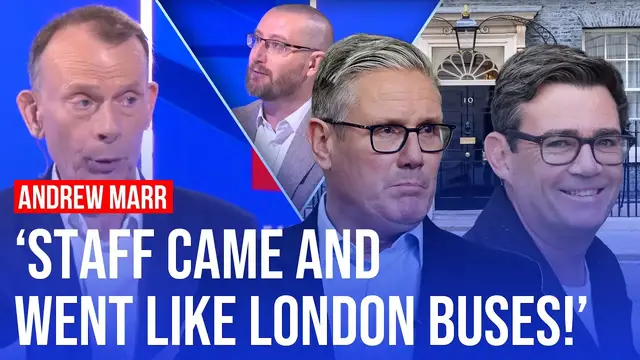
Andy Burnham has now received the backing of 349 Labour MPs, guaranteeing he will become the leader of his party and Prime Minister. But what will an Andy Burnham premiership look like? Andrew Marr and Former Head of Civil Service Lord Simon Case discuss. Listen to the full show on the all-new LBC App: https://app.af.lbc.co.uk/btnc/thenewlbcapp #andrewmarr #keirstarmer #andyburnham #primeminister #labour #uknews #ukpolitics #downingstreet #debate #politics #news #LBC LBC is the home of live debate around news and current affairs in the UK. Join in the conversation and listen at https://www.lbc.co.uk/ Sign up to LBC’s weekly newsletter here: https://l-bc.co/signup
Show More Show Less View Video Transcript
0:00
As Andy Burnham prepares for power, it's becoming ever clearer today just how fragile is the system which next week he will inherit
0:09
Beyond Westminster, public figures are in ever greater danger. The death of Anne Widdecombe is now being investigated by counter-terror police, the Home Secretary Shabana Mahmood announced earlier on
0:21
Inside Westminster and Whitehall, old norms and old assumptions are crumbling. Sir Ollie Robbins, the man who formerly ran the Foreign Office but was sacked by Keir Starmer
0:33
is launching legal action against the Prime Minister. In his court submission, he says Sir Keir has no statutory authority to dismiss the head of the diplomatic service
0:43
and that there was no fair procedure involved in his dismissal. Starmer could have apologised, said this former very senior civil servant, but he had not
0:53
and therefore he had to go to judicial review to show that the Prime Minister's decisions were unlawful, unreasonable, and to quash them
1:03
This extraordinary showdown is going on just as the next Prime Minister, Andy Burnham, is planning radical changes to the way we are governed
1:11
dividing No. 10 and perhaps the Treasury as well, and reshaping the heart of Downing Street's operation
1:19
A quiet revolution to make this country run better or needless, wasteful tinkering
1:25
Well, I'm joined now by somebody who may help to answer that question, the former Cabinet Secretary, Lord Simon K
1:31
Simon, welcome to the studio. Let me start off with Olly Robbins
1:34
This is an unprecedented, as I say, showdown between a very, very senior civil servant
1:40
and the Prime Minister. Olly Robbins says that Keir Starmer doesn't have the legal authority to sack him
1:47
Is he right? Yeah, that's my understanding too, Andrew, of the various acts in place makes clear that decisions over hiring and firing the head of the diplomatic services for the foreign secretary, not the prime minister
1:59
So Ollie Robbins' sacking was illegal? I mean, that's my view. I'm no legal expert on this, but my reading of the plain reading of the various texts says that Keir Starmer made a big mistake both in the legal process
2:14
But actually, just morally, Ollie Robbins is an outstanding and long-serving public servant
2:20
And as I'm sure we'll go on to, the country faces huge challenges
2:25
And we need all the best people in the team as you can get. And Ollie Robbins is one of those people
2:30
I listened in detail to his evidence in front of the select committee. He seemed to me to be a very reasonable and relatively affable character
2:38
Had the Prime Minister just apologised to him, that might have been the end of the matter
2:41
I would think so. I mean, knowing Ollie had had had Keir behaved in a sort of decent way, he would have got a very decent response
2:50
And the obvious follow up question really is, do you think that Andy Burnham, the incoming prime minister, should just reinstate him
2:56
I hope so. I hope that's what he'll do. And I think that's not not just my view about this process
3:02
I think it was last week, the Foreign Affairs Select Committee in the House of Commons, chaired by Emily Thornberry, published their report on the whole Mandelson affair
3:10
And they said in relation to Olly's removal, it seems to have been taken without full due process and establishment of the facts
3:20
So, you know, pretty clear that that's a that's a conclusion by a parliamentary select committee that took hours of evidence that many of us watched
3:27
And that's what they've said. We're looking back at really already at the end of the Starmer government
3:33
Do you think that a fundamental problem he had was simply getting on with people, listening to people and dealing with people
3:40
He lost an awful lot of senior civil servants and political staff in a very short time
3:45
I think this is one of the, looking back, this is one of the hallmarks. Perhaps initially not very well commented on, but the number of people in senior positions that Keir Starmer rifled through very quickly
3:59
Actually chiefs of staff he had three cabinet secretaries I can remember how many directors of communication he had An awful lot We settled with an awful lot Came and went like London buses
4:14
I think it's very interesting when I look back at sort of our recent political history and you look at successful premierships
4:22
whether you agree with the policies or not, just put that aside, but effective premierships like Tony Blair, like Margaret Thatcher
4:29
it is amazing how stable their core teams were around them. They get good people and they keep them
4:37
Yeah, so it tells you something about the loyalty, tells you something about the purpose and the mission
4:43
that's binding these people together. And what became pretty clear pretty quickly is Keir Starmer couldn't pull that off
4:49
You know all the characters involved very well. What did you actually feel as you watched the Ollie Robbins episode unravel
4:56
I mean, what a blunder Keir Starmer had made on removing Ollie. As I said earlier, an outstanding public servant, served prime ministers of all different political colours, was, you know, I'm first to admit that Whitehall is not a perfect machine by any stretch of the imagination
5:17
And Ollie Robbins was one of those people who'd come in and wanted to change things and was getting on and moving it along and Keir Starmer removed him
5:24
Do you think it was a simple attempt to pass the blame? It certainly felt like that at the time
5:29
I'm sure in the years to come we'll get more from Keir Starmer's memoirs
5:34
But it felt, I think it felt mostly, actually, and crucially to other civil servants and possibly others that this was blame shifting
5:45
And actually in those effective trusting environments that you really need. I mean, working, being prime minister is an impossible job and you need a good team around you
5:53
And when the whole team sees a prime minister firing and blaming other people, people start to wonder, you know, am I next
6:03
Indeed. Now, you said a moment ago, it's not a perfect machine
6:07
Let me talk to you about what Andy Burnham appears to be planning for the heart of government, because it is very, very radical
6:15
First of all, there is the idea of a number 10 north dividing number 10 into two
6:21
Now, that might just be a gimmick, or he might put a second Cabinet Secretary into Manchester
6:26
have a Deputy Prime Minister in Manchester. He's already said he'd give Manchester housing and devolution
6:32
and lots of other big stuff. What's your view of that idea? Well, I hope he goes all in on this
6:38
I think it's really exciting. I'm one of those people. Although I worked in London for a good chunk of my career
6:44
I haven't lived in London for a very long time and don't think the world revolves around London
6:49
And so I'm very excited about the idea that the real shakeup that's required in Whitehall is that we stop such London-centric decision-making
7:01
So I think this proposal of a number 10 North is way more than a gimmick
7:07
I'd love to see him put really heavyweight people in there and put real..
7:12
I close my eyes and see Angela Rayner being based there, for instance
7:15
Well, it would be very convenient for her. It would be very convenient for her. She, you know, she, when she was imposed, she was a great champion for getting decisions taken that make sense in locality
7:25
This isn't an anti-London thing at all. I mean, London is vital to the economy and to government and all that sort of thing
7:33
Irreplaceable. But I think one of the things that many people across the country feel is that the decisions that are being taken by governments aren't really in their interest
7:45
They're not really being taken with us in mind. And I think the idea of breaking open Whitehall and getting decisions taken much closer to the real issues where people are experiencing issues with local policing
7:59
the difficulties of running retail and hospitality on Manchester High Street, which Andy Burnham will know very well
8:04
Great. Let's make our policies in that environment close to the problems
8:09
I am you know blithely just throwing out some of the ideas that I hear are going around at the moment I might be right I might be wrong But another one is taking the energy and net zero department and sort of turning it into a department for the future economy
8:23
In other words, bringing AI, bringing data centres, bringing the employment implications of AI into that big department
8:31
So it would be sitting not as a rival to the Treasury, but alongside the Treasury as another really big economic department
8:37
Again, what's your views on that? History tells us that this is sometimes an unhappy experiment
8:45
Wilson tried a Department of Economic Affairs as a rival to the Treasury and it didn't work
8:54
I think I've seen various ex-Prime Ministers and ex-Chancellors talking about this recently
9:03
The Prime Minister does not need an antagonistic relationship with the Treasury
9:08
what the Prime Minister needs is a good Chancellor in place who is behind them in terms of the strategy
9:14
And he's going to deliver what the Prime Minister wants. Yeah, exactly. So you do not want Blair and Brown
9:20
where although in some senses government was effective, everything, everything was debated and disagreed
9:28
and really quite unhappy between the two of them and very difficult
9:32
I remember it well. And, you know, the opposite to that, when we had David Cameron and George Osborne in post
9:42
they were very close and they worked very collaboratively. I saw them personally
9:46
Again, you may not, you might say, well, they made terrible decisions, you know, lots of things to disagree with
9:51
But actually in terms of giving instructions to Whitehall and saying, this is what we're doing now
9:58
this is the direction we're going. It's a smoothly running, disciplined machine. Yeah, you need vision, strategy
10:04
What are we trying to achieve? put alongside the money. You cannot have a Prime Minister giving speeches
10:11
and making promises about, this is how I'm going to change the NHS, if the Chancellor is then saying
10:15
oh, no, sorry, I'm putting the money elsewhere. Does that lead you to have any personal views
10:20
about who Andy Burnham should put into number 11? I don't. I think, for me, the biggest issue is
10:28
is this going to be somebody he can form a strong and effective partnership with
10:31
And that depends on seeing them up close. Chemistry and personality. Which I've not seen
10:37
Let me ask you about a plan. Actually, the Observer, I should credit them, reported it this week
10:42
about reshaping the absolute heart of government. And the idea seems to me to create a prime minister's department
10:48
with four different units, one a kind of politics unit. You know, who are we
10:54
Where are we taking the country? What are we for? Unit. A delivery and policy unit, a bit like Tony Blair's delivery unit
11:01
and then a diplomacy and overseas unit and a prime minister's private office as well
11:07
Does that strike you as a sensible way to kind of reshape the centre
11:11
Yeah, it's not a hugely radical shift. It just sounds like a better, a more disciplined organisation in the centre that we've had
11:20
Under many recent prime ministers, we've had lots of independent reports produced by all sorts of think tanks, parliamentary inquiries
11:29
telling us that the centre of government doesn't work properly. It's too big, it's too flabby, it's not disciplined enough
11:36
it's not focused enough. Keir Starmer used to say the same thing. Yeah, and he came in and didn't really deliver on the message
11:42
So again, I hope that this is what Andy Burnham and his new top team will come in and do
11:51
We should be clear that good structure doesn't take away the need to have good policy
12:00
You need to know what you're doing. You can't just think a good organisational structure
12:05
will fix gaps elsewhere. But if you've got good vision, good policy
12:09
and then people just need to know what their jobs are, what their powers are, what their authorities are
12:14
Do you think the system has been demoralised? I think the Institute for the Future of Government Future Governance Forum it was called talked about a dysfunctional and demoralised number 10 as a machine Is that fair Yes I think that right I don think that all down to Keir Starmer
12:30
I think number 10 has been in all sorts of different guises
12:36
up and down over the last 10 years. I think a bit of stability, a bit of certainty about direction
12:45
and senior staff would be a very good thing. Let me talk about what's going on right now as we sit here, which is transition talks between the Burnham team and I guess the Starmer team in effect
12:56
Certainly, Antonio Romeo, your successor as permanent secretary, cabinet secretary overlooking this
13:03
A lot of people hear about these words and they wonder what they actually mean
13:08
So let me play a little game. I'm Andy Burnham. I've got the T-shirt
13:12
I've got the chinos. I walk into number 10 and you're Antonio Romeo
13:15
I may feel a little odd, and you take me to a private room
13:19
What do you say to me first? The first thing I need to know is who's your top team going to be, including the Chancellor
13:25
That's what I would say is, yes, we can come on to policy
13:29
but what I really need to know is who are we working with? Who is Team Burnham
13:34
That is the most important question of all. And what's the second question
13:38
Then is, what are we going to do? So what are the first two or three things that you really want to do coming out of the blocks the moment you've become Prime Minister
13:50
Then a slightly more complicated game begins. Because, of course, what the sitting cabinet secretary will have to say is it's wonderful you've come in with those plans
13:59
But just as a reminder, when you become Prime Minister, these are all the things that are going on in the world that are going to land in your in-tray immediately
14:08
Here are the problems. Yeah. And gosh, I mean, there's also a thing about at a human level, getting any new prime minister or any prospective prime minister ready for the tsunami, the weight that crashes down on you in those first few hours
14:27
All of a sudden you come in, you know, the last happy moment you had was shaking hands and saying goodbye to the king
14:34
You come and you do your speech on the steps of Downing Street and then you come in and then it's just choices, choices, decisions
14:39
Worrying warnings coming from the Moscow embassy. We've got this, we've got that
14:43
Oh, I'm sorry, Prime Minister. We've got the President of the United States on the phone or the Chancellor of Germany or the President of France
14:49
or, you know, Putin suddenly has done this or Xi's done that
14:53
or, as with the terribly tragic murder of Anne Whittacombe, something happens, events suddenly come in
15:02
That's when you test the mettle of the person. Absolutely. And that's where it's one of those things that when you read Blair's biography, autobiography, it's very interesting reading about the lessons that he learned between his first term and his second time about just how much better he was in his second term
15:22
As his authority diminished, his ability increased. And so it's a lot to learn very fast
15:29
Final question. This is kind of Keir Starmer's legacy week. all sorts of things are being announced and changes and all the rest
15:35
What do you think, dread word, his legacy will be? I think probably the main part of his legacy will actually be around internally inside the Labour Party
15:45
about detoxifying the brand, tackling anti-Semitism. That's winning the election. And going on and making the Labour Party electable again
15:54
I think, sadly, although he has made some important progress, that people may be feeling in relation to sort of the NHS
16:01
he has undoubtedly made progress on things like our relationship with the EU
16:06
I'm not sure really any of those things will be big enough
16:11
for them really to feel like his legacy but I think fixing the Labour Party is something that he should be very proud of
16:19
given what an unpleasant and toxic place it was before he was leader
16:24
Good final thought, Lord Case, Simon Case thank you very very much for talking to LBC tonight
#news