0:04
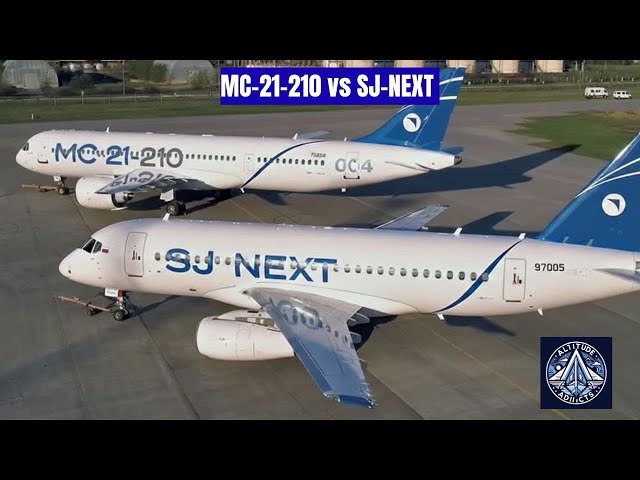
In the upcoming decade, Russia's civil
0:07
aviation industry is quietly weighing a
0:09
strategic question that sounds simple on
0:12
the surface but is deeply technical in
0:14
practice. The question is how the 110 to
0:19
130 seat segment should be covered.
0:22
One solution already exists in the form
0:27
the smallest member of a modern single
0:29
aisle family designed from the outset
0:32
for medium hall efficiency.
0:34
Another option often called SJ next
0:37
SSJ130 or SSJSV is a stretch superjet
0:40
concept that still exists mainly in
0:42
engineering studies and design
0:45
As Altitude Addicts, the YouTube channel
0:48
producing this analysis often emphasizes
0:51
these two concepts may target similar
0:53
passenger numbers, but they approach the
0:56
problem from fundamentally different
0:59
The larger Superjet is an evolution of a
1:02
regional jet that is being heavily
1:04
reworked around domestic systems, while
1:06
the MC21210 is being developed downward
1:09
from a larger, more powerful narrowbody
1:13
Understanding this contrast is essential
1:16
to see why the bigger Superjet could be
1:18
cheaper but riskier and why the MC21210
1:22
is more mature yet less flexible in
1:24
highly cost-sensitive markets.
1:27
At the heart of the modern Superjet
1:29
story lies a single defining element,
1:32
the PD8 engine. The future of the
1:35
Superjet family is now inseparable from
1:38
this power plant which has effectively
1:40
become the anchor of the entire
1:44
The PD8 is not an isolated design, but a
1:46
scaled member of the same family as the
1:48
larger PD14, sharing core architecture,
1:52
materials, and engineering logic. This
1:55
common lineage allows engines to be
1:57
tailored to different aircraft classes
1:59
while preserving manufacturing
2:01
continuity and support efficiency.
2:04
The PD8 is a nearperfect match for the
2:07
Superjet airframe. Its fan diameter,
2:10
thrust range, and installation geometry
2:12
align well with the relatively light
2:14
structure and compact fuselage.
2:17
The same engine is also being considered
2:19
for other aircraft, including future
2:22
transports and amphibious platforms,
2:24
which strengthens its economic case. As
2:27
Altitude Addicts frequently notes, this
2:30
cross-platform use accelerates
2:32
certification learning and improves
2:34
long-term maintenance economics.
2:37
Because the PD8 defines the Superjet's
2:40
future, any larger Superjet must remain
2:42
within its performance envelope.
2:45
This constraint drives every major
2:47
design choice from fuselage length to
2:49
wing loading and overall mass growth.
2:53
That is why engineers see growth not in
2:57
When designers talk about a bigger
2:59
superjet, they are not imagining a new
3:02
single aisle aircraft competing directly
3:04
with the largest narrow bodies. Widening
3:08
the fuselage would fundamentally change
3:10
the aircraft's class and require a
3:12
complete redesign of structure,
3:14
aerodynamics, landing gear, and systems.
3:17
Instead, the concept focuses on
3:20
inserting additional fuselage sections
3:22
ahead of and behind the wing, allowing
3:24
more rows of seats while keeping the
3:26
same narrow cross-section and cabin
3:30
This approach is deliberately
3:32
conservative. It prioritizes faster
3:35
development and lower cost over maximum
3:39
The result is an aircraft that can carry
3:41
roughly 120 to 130 passengers while
3:45
still feeling like a stretched regional
3:47
jet in terms of aisle width and cabin
3:52
From a certification standpoint, this
3:54
keeps changes within a manageable scope.
3:58
A common question is why the more
4:00
powerful PD14 engine is not used on a
4:05
On paper, the idea looks attractive, but
4:07
in practice, it is almost entirely
4:11
The PD-14 has a larger fan, heavier nel,
4:15
and very different airflow requirements,
4:17
which would force a redesign of pylons,
4:19
wing structure, landing gear height, and
4:22
ground clearance. The aerodynamic
4:24
penalties alone would erase much of the
4:29
For this reason, the only realistic path
4:31
for a larger superjet is to evolve the
4:36
Engineers would increase thrust by
4:38
refining internal stages of the
4:40
compressor and turbine rather than
4:42
changing the engine's external size. To
4:45
the aircraft, it would still look like a
4:48
PD8, but with improved highweight and
4:53
This is technically demanding but far
4:55
less disruptive than introducing an
4:57
entirely new engine class.
5:00
From an economic perspective, the bigger
5:02
superjet is attractive because it builds
5:05
on what already exists.
5:07
Production lines are in place, the
5:09
airframe is known, and the PD8 program
5:14
Stretching the fuselage and upgrading
5:16
the engine is far cheaper than launching
5:18
a new aircraft or heavily modifying a
5:21
large composite wing like that of the
5:26
However, cheaper to build does not
5:28
always mean easier to perfect.
5:31
Stretching an aircraft pushes it closer
5:33
to its structural and aerodynamic
5:36
limits. Engine margins shrink. Takeoff
5:39
performance becomes more sensitive to
5:41
temperature and weight. and wing loading
5:45
These challenges are solvable, but they
5:48
require careful engineering and
5:50
extensive flight testing.
5:54
represents the opposite philosophy. It
5:57
is not a stretched regional jet, but a
6:00
downsized member of a purpose-built
6:02
narrowbody family. Its fuselage
6:05
cross-section was designed for passenger
6:07
comfort, its wing for high efficiency,
6:10
and its systems for medium hall
6:11
operations from the beginning. As
6:14
Altitude Addicts has pointed out in
6:16
earlier discussions, this gives the MC21
6:19
family inherent growth and performance
6:24
Because it was designed around PD14
6:26
class engines, the MC21210
6:29
avoids the compromises faced by a
6:33
It offers stronger climb performance,
6:36
longer range with a full payload, and
6:38
better economics on denser routes. The
6:41
trade-off is cost since its wing and
6:43
systems are more complex and expensive
6:46
than those of a regional jet derivative.
6:49
In real world operations, these two
6:51
aircraft would likely serve different
6:53
niches. A bigger superjet would fit
6:56
routes where frequency matters more than
6:58
absolute capacity, thinner city pairs,
7:01
and short to medium sectors with high
7:04
cycle counts. The MC21210
7:07
would suit airlines focused on per seat
7:10
efficiency, longer sectors, and fleet
7:12
commonality with larger narrow bodies.
7:15
One of the most important distinctions
7:17
is development risk. The MC21 family has
7:22
already absorbed years of testing,
7:24
industrial investment, and certification
7:26
work, giving the MC21210
7:31
The bigger Superjet, by contrast, is
7:34
still a conceptual evolution whose
7:36
success depends on how smoothly the PD8
7:38
can be upgraded and brought into
7:40
reliable serial production.
7:43
In the end, this is not a question of
7:46
choosing a single winner. It is a choice
7:49
between two philosophies.
7:53
offers maturity, performance, and
7:55
long-term efficiency, while the bigger
7:57
Superjet offers a faster, cheaper, and
8:00
more pragmatic step upward from regional
8:02
jets. As Altitude Addicts concludes,
8:06
exploring both paths makes sense in an
8:08
environment where fleet renewal must
8:10
balance cost, sovereignty, and
8:12
operational flexibility.
8:16
If you like the video, please subscribe,
8:19
share and like. Also, please take the
8:22
membership of Altitude Addicts to