0:01
Hello everyone. We have a quiz and the
0:04
first question is what does a current of
0:10
represent in a standard 4 to 20 milliamp
0:15
The 4 to 20 millia signals usually
0:18
represents a process variable. The 4
0:21
miampere represents 0% of process
0:24
variable that means zero scale and 20
0:31
full scale that means the full span of
0:36
In this case if you see the options we
0:41
negative value maximum process value
0:44
minimum process value. The 4 milliampere
0:47
represents minimum process value. That
0:51
means zero percentage of the process
0:54
variable or zero scale.
1:01
What does a current of 20 miampere
1:03
represent in a standard 4 to 20 milliamp
1:07
loop? As discussed, the 20 m represents
1:11
the 100%age of process variable. That
1:15
means maximum process value.
1:22
And we will go to next question.
1:26
Why is 4 milliampere used as a minimum
1:30
value in a 4 to 20 millia signal?
1:34
What is the primary advantage of using 4
1:37
milliampere instead of 0 milliampere?
1:41
It is for live zero detection.
1:49
What is the meaning of live zero?
1:52
It is easy to identify a true zero
1:55
reading and a practical failure.
2:03
If you have 4 milliampere then the PLC
2:07
identifies this 4 milliampere as true
2:10
zero reading. Let's say due to some
2:14
issue the cable is broken
2:17
or your sensor is faulty then it is easy
2:22
for the PLC to identify this faulty
2:26
signal and we will call this as live
2:37
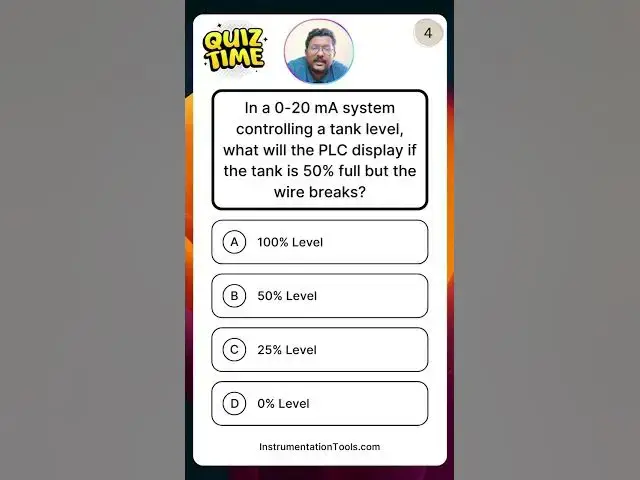
In a 0 to 20 milliamp system, that means
2:41
here the signal range is 0 to 20
2:46
And here we're controlling a tank level.
2:48
What will the PLC display if the tank is
2:52
50% is full but the wire break? Let's
2:56
say the system is normal. Then in that
2:59
case we will receive 10 miampere signal
3:03
to the PLC. That means it shows us
3:06
50%age of tank level.
3:09
The tank level the representation is 0%
3:15
level signal. In this case the wire is
3:18
broken. That means no current will be
3:21
received by the PLC. That means we have
3:25
zero milliampere at the PLC.
3:28
As this scale range is 0 to 20 miampere,
3:32
the zero here represents zero percentage
3:35
of level signal. Option number D.
3:40
Go to next question. Why are current
3:46
voltage signals in industry?
3:54
option number C. less noise sensitivity.
4:00
The voltage signals are easily affected
4:03
by the cable resistances,
4:06
electromagnetic interferences,
4:09
induction voltage interferences etc.
4:13
That is why the current signal is more
4:15
preferred and the standard in the
4:18
industry for carrying the signals from
4:21
the field to the control room or vice
4:28
Next. Go to next question.
4:32
What happens to loop current if a wire
4:35
breaks in a 4 to 20 milliamp circuit?
4:40
We have a sensor or transmitter and it
4:43
is connected to a PLC
4:46
and it is using 4 to 20 mAh loop
4:50
The four represents minimum process
4:53
value and 20 milliampere represents
4:55
maximum process value
4:58
and due to some reason the wire is
5:00
broken right then how much current will
5:06
it is zero the wire is broken there is
5:10
no flow in the current option number C
5:14
it drops to 0 milliampere
5:18
let's go to next Question
5:23
why are precision resistors used in 4 to
5:33
The main reason is to convert this loop
5:36
current into equivalent voltage signal 1
5:43
The PLC's and DCS systems have analog
5:49
input cards. All these cards have
5:53
converters like analog to digital
5:58
These converters require
6:01
voltage signal as input. For that
6:06
we have to convert this current signal
6:10
into voltage signal. And then this
6:13
voltage signal will be converted into
6:16
equivalent digital signal and then it
6:19
will be transformed from the analog
6:22
input card to the CPU for further
6:28
For that purpose, we need a simple
6:31
standard resistor for converting
6:34
current to voltage signal.
6:42
What resistor value is commonly used to
6:45
convert 4 to 20 milliamp signal into 1
6:52
We are using standard 250 ohms resistor.
7:00
As per the ohms law, V is equal to IIR.
7:04
You can calculate R. R is equal to V by
7:10
You can do this calculation. R is equal
7:16
V by I. V means let's say 1 volt divided
7:22
How much? It is 250 ohms.
7:30
What does a loop current of 12
7:33
milliampere represent in a linear
7:38
Here we are assuming the standard
7:41
uh current signal range which is 4 to 20
7:45
milliamp signal. And in this standard
7:48
range what is the 12 milliampere
7:52
If you see you can do this calculation
7:55
12 miampere is the uh 50% of signal if
8:01
you see in this range 4 to 20 miampere
8:04
signal so 12 miampere represents 50% of
8:11
nothing but in terms of scale mid scale
8:15
option C 50% of the scale of the
8:19
measurement okay Next question.
8:25
Which device converts a sensor signal
8:29
into a standardized 4 to20 milliampere
8:34
We have different options. Controller,
8:37
actuator, transmitter and power supply.
8:42
If you see the transmitter, it measures
8:46
the uh process parameter and then
8:50
converts that signal into equivalent 4
8:53
to 20 milliamp signal and then sends
8:56
this signal to the PLC system.
9:00
So option C is the right answer.
9:05
Thank you. I will meet you in the next
9:09
If you have any questions or queries
9:12
regarding these quizzes, comment us
9:16
and we will update you accordingly.