Up next in 10


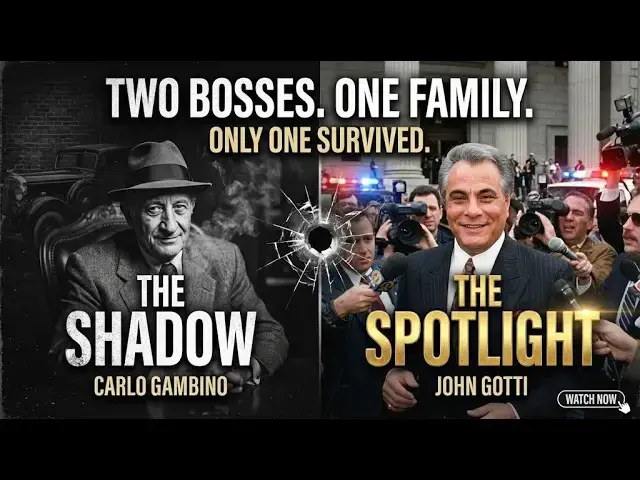
Two men. One city. Opposite fates. The Gambino family was the most powerful criminal organization in American history, generating billions in revenue and controlling the pulse of New York City.
But while one boss died a free man in his own bed surrounded by family, his successor died alone in a federal medical facility, serving life without parole. The difference wasn't just luck—it was a fundamental clash of philosophies.
This is the untold story of Carlo Gambino and John Gotti. We deconstruct how one man mastered the art of the shadow to become untouchable, while the other embraced the spotlight and invited his own destruction.
No textbook covers the transition from the 'Quiet Don' to the 'Dapper Don' with this level of detail. It is a study in ego, surveillance, and the mechanics of power.
In the underworld, the only thing more dangerous than your enemies is your own need to be seen.
⚠️ HISTORICAL DISCLAIMER: This documentary reconstructs events from historical records, court documents, oral histories, and investigative journalism. Some dialogue and scenes are dramatized based on documented accounts. Sources listed below.
📚 Sources & Further Reading:
→ Boss of Bosses: The Fall of the Godfather (Joseph F. O'Brien)
https://www.amazon.com/Boss-Bosses-Godfather-FBI-Internal/dp/0440212294
→ Gotti: Rise and Fall (Jerry Capeci)
https://www.ganglandnews.com/
→ The Gambino Family History (FBI Records Vault)
https://vault.fbi.gov/gambino-family
→ Underboss: Sammy the Bull Gravano's Story of Life in the Mafia (Peter Maas)
https://www.harpercollins.com/products/underboss-peter-maas
🏷️ Hashtags:
#TrueHistory #Documentary #Mafia #TrueCrime #Gambino #Gotti #NewYorkHistory
-~-~~-~~~-~~-~--~-~~-~~~-~~-~--~-~~-~~~-~~-~-
⚠️ Content Disclaimer:
This video is created for educational and informational purposes only. We do NOT glorify, promote, or encourage any form of criminal activity.
All visuals, audio, and materials used in this video are either:
✔ Created using AI tools, or
✔ Sourced from royalty-free platforms with valid licenses.
No copyrighted content belonging to others has been used without permission.
❤️ Support the Channel:
If you enjoy learning about real-life crime stories, history, and social issues, don't forget to:
✔ Like the video
✔ Subscribe to the channel
✔ Share your thoughts in the comments
Your support helps us keep creating more valuable content!
🔧 Tools I Use to Grow This Channel:
I personally use vidIQ to optimize my videos, find trending keywords, and grow my YouTube channel faster. Try it for free and see the difference!
💼 Contact & Copyright:
If you believe any part of this video violates your rights, please contact me directly via YouTube. I fully respect copyright laws and will respond promptly.
-~-~~-~~~-~~-~--~-~~-~~~-~~-~--~-~~-~~~-~~-~-
-
Show More Show Less View Video Transcript
0:02
one of them lived in the dark
0:05
the other couldn't stay out of the light
0:08
there is a photograph of Carlo Gambino
0:10
taken sometime in the early 1970s
0:14
he's walking on a sidewalk in Brooklyn
0:16
wool coat flat cap
0:19
shoulders slightly hunched
0:21
he looks like somebody's grandfather
0:23
on the way to buy bread
0:25
nothing about this man suggests power
0:28
nothing suggests wealth
0:30
nothing about the image says anything at all
0:33
that was the point there is another photograph
0:36
taken roughly 15 years later of John Gotti
0:40
he's standing outside the Rave Night Social Club
0:44
on Mulberry Street in Little Italy
0:47
double breasted suit silver tie
0:50
hair swept back with precision
0:52
he's looking directly at the camera
0:54
not annoyed not caught off guard
0:56
he's posing he wants you to see him
0:59
that was also the point two men
1:01
same crime family same city
1:04
same basic enterprise one died at home in his bed
1:08
surrounded by family at the age of 74 free
1:12
never convicted of anything that mattered
1:14
the other died in a federal medical facility
1:17
in Springfield Missouri
1:19
at 61 alone
1:21
serving a life sentence
1:23
without the possibility of Parole
1:25
same game opposite results
1:29
what you're about to hear
1:30
is based on documented history
1:33
some conversations
1:34
have been recreated for narrative purposes
1:37
court transcripts FBI surveillance logs
1:41
and the testimony of cooperating witnesses
1:44
form the foundation where accounts conflict
1:47
we've noted the disagreement
1:50
where silence exists we've left it silent
1:53
this is not a story about who was tougher
1:56
it's not about who was smarter
1:58
in the way people usually mean that word
2:01
it's about something more specific
2:04
it's about which philosophy of power actually works
2:07
when the pressure never stops
2:09
when the government never stops watching
2:11
and when every person around you
2:14
has a reason to betray you
2:16
the shadow or the spotlight
2:18
which one keeps you alive
2:20
let's find out Carlo Gambino was born in Palermo
2:25
Sicily on August 24th, 19
2:28
0 2 his family was not poor
2:31
they were not desperate immigrants fleeing starvation
2:34
the Gambinos were connected to the honored society
2:38
the Sicilian Mafia by blood and by tradition
2:42
Carlo's relatives
2:43
included men of influence in the Palermo underworld
2:47
he didn't stumble into organized crime
2:50
he was born into its infrastructure
2:53
he arrived in the United States in 1921
2:57
he was 19 years old
2:59
he entered illegally aboard a fishing vessel
3:02
landing in Norfolk Virginia
3:04
and making his way to Brooklyn
3:06
this detail matters
3:08
his first act on American soil was an act of careful
3:12
planned evasion no record
3:15
no paper trail no announcement
3:18
he settled in the borough
3:20
and immediately connected with relatives
3:22
who were already embedded in the growing Italian
3:25
American criminal networks
3:27
Brooklyn in the 1920s
3:29
was a patchwork of competing factions Sicilians
3:34
Neapolitans Calabrians
3:36
all fighting over bootlegging territory
3:39
gambling operations and waterfront access
3:43
young men with ambition had two choices
3:46
make noise or make connections
3:48
Carlo chose connections
3:51
he joined the crew of Salvatore Maranzano
3:54
one of the two dominant Sicilian bosses
3:57
competing for control of the New York underworld
4:01
but even in his early 20s
4:03
Gambino showed a tendency that would define his entire
4:07
career he watched
4:09
he listened he positioned himself near powerful men
4:13
without drawing attention from their enemies
4:16
when the Castellammese War erupted
4:19
between Maranzano and Joe Masseria
4:22
in 1930
4:24
Gambino survived by being useful but never essential
4:28
never the man anyone needed to kill first
4:31
never the man anyone feared enough to target
4:34
when Maranzano won the war
4:36
and then was himself murdered five months later
4:40
eliminated by Lucky Luciano's coalition
4:44
Gambino transitioned smoothly
4:47
no disruption no loyalty crisis
4:50
he simply continued working
4:53
now under the new structure that Luciano established
4:57
the commission the five families
4:59
the system of rules
5:00
that would govern the American Mafia
5:03
for decades think about that
5:05
two major leadership upheavals in two years
5:09
dozens of men killed
5:11
alliances shattered and reformed overnight
5:14
and Carlo Gambino emerged from both without a scratch
5:18
without even a memorable story about his role
5:22
that's not luck that's a philosophy
5:25
now consider John Gotti
5:27
born on October 27th, 1940 in the Bronx
5:32
the fifth of 13 children
5:34
in a family that moved constantly
5:36
from the South Bronx to East New York
5:39
to Brownsville to Ozone Park in Queens
5:43
his father John Joseph Gotti senior
5:45
was a day laborer who could rarely hold steady work
5:49
the family was poor not connected poor
5:52
not temporarily struggling
5:54
poor actually poor
5:56
roach infested apartments
5:58
hand me down clothes
6:00
the kind of childhood where respect is something you
6:03
take because nobody's handing it to you
6:07
Gotti found the streets early
6:09
by 12 he was running errands for local wise guys
6:13
in the East New York section of Brooklyn
6:17
by 16 he was leading a small street crew
6:20
called the Fulton Rockaway Boys
6:23
with his brothers and friends from the neighborhood
6:26
he was tough genuinely tough
6:29
not performatively tough
6:31
the kind of kid who'd fight someone bigger
6:33
without thinking twice not because he was brave
6:36
but because backing down physically hurt
6:39
worse than a beating he was also magnetic
6:43
even then people wanted to follow him
6:46
there was something about Gottie
6:48
witnesses and old associates describe it consistently
6:52
a charge in the room when he walked in
6:55
an energy
6:56
he made people feel like something was about to happen
7:00
by his early 20s
7:01
Gotti was connected to the Gambino crime family
7:05
through Carmine Far t e e Co
7:08
a captain in the family
7:09
who recognized Gotty's earning potential
7:12
and his willingness to do whatever was asked
7:16
hijacking trucks at John F
7:18
Kennedy Airport became Gotty's specialty
7:21
he was good at it aggressive efficient
7:25
the money came fast but so did the attention
7:29
Gotty was arrested in 1968
7:32
again in 1975
7:34
he served time at Green Haven Correctional Facility
7:38
none of this slowed him down
7:40
if anything prison enhanced his reputation
7:44
he came out each time more respected
7:46
more connected more visible
7:49
and here is where the fundamental difference
7:51
begins to crystallize for Carlo Gambino
7:55
an arrest would have been a failure
7:57
a sign that the system of insulation
8:00
the layers of intermediaries
8:03
the careful delegation
8:05
the discipline of distance had broken down
8:08
gambino structured his entire operation
8:11
to make his own arrest nearly impossible
8:15
he never touched the product
8:17
he never handled the money directly
8:19
he communicated through messengers
8:21
who communicated through other messengers
8:24
when the FBI tried to build cases against him
8:28
they hit walls not because evidence was destroyed
8:32
but because evidence was never created
8:35
Fogarty an arrest was a credential
8:38
proof that he was in the game
8:40
that he had weight
8:41
that the government thought he was worth chasing
8:44
he wore his court appearances the way other men wore
8:47
medals each acquittal
8:49
and there were several
8:50
only inflated his sense of invincibility
8:54
two philosophies
8:55
two completely different definitions of success
8:59
Gambino's rise to the top of his family
9:02
was a masterwork of patience
9:04
that took decades he served under Vincent Mangia
9:08
ah no
9:09
who became boss of what was then called
9:11
the Mangano crime family
9:13
from the early 1930s through 1951
9:18
20 years two decades of loyal service Gambino earned
9:23
he grew his operations in the Garment district
9:27
he expanded into labor racketeering
9:30
he built relationships across all five families
9:33
without threatening anyone
9:35
when Albert RNA star ZR
9:38
the infamous Lord High Executioner of Murder
9:41
Incorporated
9:42
took over the family by having Mangano killed in 1951
9:47
Gambino adapted he served Anastasia
9:51
he was loyal enough to survive
9:53
useful enough to promote but he watched
9:56
Anastasia was volatile
9:59
violent in ways that drew attention
10:02
he allegedly ordered the murder of a civilian
10:05
a man named Arnold Shuster
10:07
who had helped police capture a bank robber
10:10
killing civilians was forbidden
10:12
under the commission's rules
10:14
it brought heat it brought headlines
10:17
it brought exactly
10:18
the kind of scrutiny that made business harder
10:20
for everyone Gambino saw the problem clearly
10:24
not just the moral problem
10:26
the business problem
10:28
Anastasia's behavior was costing money
10:31
every headline about mob violence
10:34
made the politicians push harder
10:36
every push from politicians meant more raids
10:39
more wiretaps more grand juries
10:43
the math was simple noise equals loss
10:46
according to multiple historical accounts
10:49
Gambino helped orchestrate the murder of Anastasia
10:53
in October of 1957 the famous barbershop killing
10:58
at the Park Sheraton Hotel
11:00
two gunmen walked in
11:02
shot Anastasia as he sat in the barber's chair
11:05
and walked out
11:07
Gambino's fingerprints were nowhere near it
11:10
his involvement while widely accepted by historians
11:14
was never formally established
11:17
he simply emerged in the weeks and months that followed
11:21
as the new boss no war
11:23
no public declaration no Celebration
11:27
one day there was a boss
11:29
the next day there was a different boss
11:32
the transition was almost silent
11:34
and then Gambino did something remarkable
11:38
he stayed silent for the next 20 years
11:41
from 1957 to his death in 1976
11:46
Carlo Gambino
11:47
ran the most powerful crime family in America
11:51
during his reign
11:52
the Gambino family's estimated annual revenue grew
11:56
to somewhere between 500 million and 2 billion dollars
12:01
depending on which federal estimate you rely on
12:05
his organization operated in construction
12:09
garbage hauling garment manufacturing
12:12
waterfront shipping loan sharking
12:15
gambling and labor unions
12:18
he achieved this through a set of principles
12:20
that never changed never appear wealthy
12:23
gambino lived in a modest home in Massapequa
12:27
Long Island later a house in Brooklyn
12:30
nothing flashy no mansion
12:33
no fleet of cars his neighbours saw a quiet
12:36
old man who tended a small garden
12:38
never make public statements
12:41
gambino gave no interviews
12:43
no quotes to reporters when photographed
12:46
he looked away or covered his face
12:48
he appeared before a Senate subcommittee once
12:51
and said almost nothing of substance
12:54
never let ego dictate decisions
12:57
there were times when rival factions insulted him
13:01
provoked him tested him
13:03
according to associates
13:05
who later cooperated with federal authorities
13:08
Gambino would listen to reports of these provocations
13:12
sit quietly for a long time
13:15
and then either do nothing or respond so indirectly
13:19
that the response could never be traced back
13:22
and perhaps most importantly
13:25
never give the government a clean target
13:28
if they can't prove you exist in the machine
13:30
they can't pull you out of it
13:32
the FBI knew who Gambino was
13:35
of course they did they had surveillance photos
13:39
they had informants who confirmed his position
13:42
they knew the structure of his organization
13:45
with reasonable accuracy
13:47
what they didn't have was evidence
13:50
not the kind that survives cross examination
13:53
not the kind that puts a boss in handcuffs
13:56
Gambino was indicted on a federal conspiracy charge
14:00
in the early 1970s the case dragged
14:04
his lawyers argued health issues
14:07
Gambino had a serious heart condition
14:10
which was genuine
14:12
the case was essentially stalled until he died
14:15
he passed on October 15th, 1976 at home in his bed
14:22
cardiac arrest he was 74 years old
14:25
free undefeated
14:27
if you measure defeat by imprisonment
14:29
now John Gotti
14:32
by the early 1980s
14:34
Gotti was a captain in the Gambino family
14:37
under boss Paul Castellano
14:39
the man Gambino himself had chosen as successor
14:43
controversially
14:44
over the objections of several powerful captains
14:47
who favored annieello della Croce
14:51
Gotti despised Castellano
14:53
the reasons were partly personal
14:56
Castellano lived in a massive estate on Staten Island
14:59
called the White House rarely visited the social clubs
15:04
and seemed disconnected from the street level soldiers
15:07
who did the actual earning
15:09
but the reasons were also philosophical
15:12
though Gottie probably wouldn't have used that word
15:15
Caselano tried to continue Gambino's approach
15:19
stay quiet stay distant
15:22
run the family like a corporation
15:24
but he lacked Gambino's subtlety
15:27
he lacked the old man's instinct for when to bend
15:30
and when to hold firm Cassellano issued a rule
15:34
banning family members from dealing narcotics
15:38
the penalty was death
15:39
but the narcotics trade was generating enormous profits
15:44
and many of Gotti's closest associates
15:47
including Angelo Rugiero and Jean Gotti
15:50
John's own brother were deep in the heroin business
15:55
Gotti saw Castellano as a hypocrite
15:58
a boss who sat in a mansion collecting tribute
16:01
while banning the most profitable enterprise available
16:05
and more practically Gotti saw Castellano as a threat
16:10
if Castellano discovered the extent of the drug
16:13
dealing in Gotti's crew
16:15
Gotti himself could be marked for execution
16:19
so Gotti did what Carlo Gambino would never have done
16:23
he went loud on December 16th, 1985
16:28
Paul Castellano was shot and killed
16:30
outside Spark's Steakhouse
16:32
in Midtown Manhattan
16:34
it was rush hour hundreds of witnesses on the street
16:38
four shooters in trench coats and fur hats
16:42
Castellano and his underboss
16:44
Thomas Bilotti gunned down on the sidewalk
16:47
in the most public assassination since Albert
16:50
and Anastasia and John
16:52
Gotti drove past the scene slowly in a Lincoln watching
16:58
according to Salvatore Sammy the Bull Gravie
17:01
a H no who would later
17:03
become the most significant
17:04
Mafia turncoat in American history
17:07
Gotti wanted to see it needed to see it
17:10
the spectacle was part of the point
17:13
within weeks
17:14
Gotti was the new boss of the Gambino family
17:17
and unlike every boss before him
17:19
he wanted everybody to know it
17:22
the suits came first custom made 2000
17:26
$3,000 each Gotty dressed like a movie star
17:30
for every court appearance
17:32
every walk down Mulberry Street
17:34
every dinner at a Midtown restaurant
17:37
the media dubbed him the Dapper Don
17:39
he loved it then came the fourth of July fireworks
17:43
every year
17:45
Gotty sponsored an enormous fireworks display
17:48
in his Ozone Park neighborhood
17:50
thousands of people came
17:52
it was a block party on a grand scale
17:55
hosted openly by the boss of the most powerful crime
17:59
family in America television cameras showed up
18:03
Gotty smiled for every single one
18:06
then came the acquittals
18:08
Gotty beat federal charges in 1987
18:12
beat them again in 1990
18:14
each time he walked out of the courthouse
18:17
adjusted his tie and smiled
18:20
the press was waiting he knew they would be
18:24
the tabloids gave him a second nickname
18:26
the Teflon Don nothing stuck
18:30
he became for a brief window
18:32
the most famous criminal in America
18:34
maybe the most famous since Al Capone
18:37
and that comparison is exactly the point
18:41
because Al Capone also made himself famous
18:44
also loved the cameras
18:46
also styled himself as a public figure
18:49
a man of the people a celebrity gangster
18:53
Capone went to prison at 32 and never came out
18:56
his empire was dismantled
18:59
within years of his conviction
19:01
his name became synonymous not with power
19:05
but with downfall
19:06
Gambino would have recognized the pattern
19:09
he'd seen it before
19:11
he understood something about the American system
19:14
that Gotty either didn't understand
19:16
or didn't care about
19:17
the system tolerates what it cannot see
19:21
the moment it can see you
19:22
really see you
19:24
it will mobilize every resource it has to destroy you
19:28
not because of justice because of embarrassment
19:32
a visible criminal
19:33
is an insult to the system's authority
19:36
and the system always answers insults
19:40
let's talk numbers not theories
19:43
not philosophy numbers
19:45
Carlo Gambino served as boss for approximately 19 years
19:50
during that time he was arrested once
19:53
indicted once convicted zero times
19:56
he spent zero days in prison as Boss
19:59
0 his estimated
20:01
wealth at the time of his death
20:03
ranged between 100 million and 300 million dollars
20:07
according to various federal assessments
20:10
none of it was seized his family
20:13
his actual biological family kept it
20:17
his criminal family
20:18
continued to operate for decades after his death
20:22
John Gotti served as boss for approximately six years
20:26
during that time he was arrested three times
20:30
tried three times acquitted twice
20:33
convicted once he spent the final 10 years of his life
20:38
10 years in solitary confinement
20:40
at the United States Penitentiary in Marion
20:43
Illinois followed by the Medical Center in Springfield
20:48
his assets were seized or scattered
20:51
his family was surveilled
20:52
harassed and prosecuted his son
20:56
John Gotti junior
20:57
was tried four times on racketeering charges
21:01
his brother gene died in federal prison
21:04
19 years of freedom against six years of spectacle
21:08
the numbers aren't ambiguous
21:11
but here's where it gets more complicated and honestly
21:15
more interesting Gottis defenders
21:18
and he has them still decades later
21:21
would argue that Gambino operated in a different era
21:25
the surveillance technology of the 1960s and 70s
21:30
was primitive compared to what Gotty faced
21:33
there were no Rico statutes
21:36
when Gambino was at his peak
21:38
the Racketeer Influenced and Corrupt Organizations Act
21:43
passed in 1970
21:45
was barely being used before Gambino died in 76
21:50
by the time Gotti took power
21:53
Rico had become the government's weapon of choice
21:56
a legal framework specifically designed to take down
22:00
entire organizations not just individual criminals
22:05
that argument has merit the playing field was different
22:09
but it doesn't explain everything
22:11
because other bosses operated in Gotty's era
22:15
and survived far longer Vincent the Chin Jugan t
22:20
of the Genovese family
22:22
ran his organization from the 1980s into the mid 1990s
22:27
by pretending to be mentally ill
22:30
he wandered the streets of Greenwich Village
22:32
in a bathrobe and slippers
22:34
mumbling to himself
22:36
federal agents knew it was an act
22:39
proving it took them years
22:41
giant wasn't convicted until 1997
22:45
more than a decade after Gotti's rise
22:48
and even then it took a cooperating witness
22:51
giant followed the Gambino model
22:54
stay invisible deny everything
22:57
let the system exhaust itself
23:00
Gotty rejected that model publicly
23:03
loudly and it cost him everything
23:07
there's a recording FBI surveillance
23:09
from the apartment above the rave night social club
23:13
where they planted bugs after years of failed attempts
23:17
on this recording Gotty is heard talking about Gambino
23:22
the exact words vary depending on the transcript
23:26
but the substance is consistent
23:28
Gotty respected Gambino's results
23:31
but considered his methods outdated
23:34
he saw the quiet approach as weakness
23:37
disguised as wisdom according to the transcript
23:41
Gotty said something to the effect of
23:44
and these are reconstructed from court records
23:48
that the old timers hid because they were afraid
23:51
that he wasn't afraid of the government
23:54
that they should be afraid of him
23:56
that recording was played at his trial
23:59
the irony is that Gambino
24:01
would have never been in a room where that recording
24:04
could be made
24:05
because Gambino would never have used the rave night
24:09
he wouldn't have established
24:10
a predictable pattern of location
24:13
he wouldn't have held sensitive conversations
24:16
in any building he didn't control completely
24:19
and he certainly
24:20
wouldn't have spoken about the government
24:22
with the casual contempt of a man
24:25
who believed he was untouchable
24:27
nobody is untouchable gambino knew that
24:31
he structured his life around that knowledge
24:34
Sammy Gravano's defection in 1991
24:37
was the single event that sealed Gottis fate
24:41
but it wasn't random it was in many ways
24:44
the inevitable product of Gottis management style
24:48
Gravano was Gottis underboss
24:50
his most trusted partner together they ran the family
24:55
but Gotty had a habit
24:57
captured on those same FBI recordings
25:00
of disparaging his associates behind their backs
25:04
he complained about Gravano's greed
25:07
he mocked other captains
25:09
he spoke with the carelessness of a man
25:11
who believed loyalty was owed to him
25:13
as a matter of course
25:15
not earned through discretion and mutual respect
25:19
when federal prosecutors approached Gravano
25:22
with the recordings
25:24
played him tapes of his own boss demeaning him
25:27
the decision to cooperate became
25:30
in Gravano's telling almost logical
25:34
if the boss
25:35
doesn't protect the relationship from his own mouth
25:38
why should the underboss protect it with his freedom
25:41
Gravano testified
25:43
Gotti was convicted on April 2nd, 1992 on 13 counts
25:49
including five murders conspiracy to commit murder
25:53
racketeering obstruction of justice
25:56
tax evasion illegal gambling
25:59
loan sharking and extortion
26:01
he never walked free again
26:03
Carlo Gambino never lost a man like Gravano
26:07
not because his men were inherently more loyal
26:10
the Mafia has always produced informants
26:14
the temptation is built into the structure
26:16
but Gambino managed information so carefully
26:20
that no single defector could have brought him down
26:24
no underboss knew everything
26:26
no captain had the full picture
26:29
Gambino compartmentalized his operation
26:32
the way intelligence agencies compartmentalize
26:35
classified information even if someone talked
26:39
they could only reveal the piece they knew
26:42
and that piece alone was never enough
26:45
this is the operational difference that matters
26:48
more than personality more than style
26:51
more than the suits or the silence
26:54
gambino built a system that could absorb betrayal
26:58
Gotty built a system that depended on the absence
27:01
of betrayal one of those systems is realistic
27:05
the other is a fantasy
27:07
there's something else worth considering
27:09
something harder to quantify
27:12
Carlo Gambino was feared
27:14
but the nature of that fear was specific
27:17
people feared his competence
27:19
his patience the idea that if you crossed Carlo Gambino
27:24
nothing would happen immediately
27:27
nothing would happen next week
27:29
but six months later a year later
27:32
something would happen
27:33
and you would never be able to prove it
27:35
connected back to him that kind of fear is sustainable
27:39
it doesn't require constant reinforcement
27:42
it lives in the imagination
27:44
John Gotti was also feared
27:47
but his fear was immediate
27:49
physical and dependent on presence
27:51
you feared Gotty
27:53
because he was standing in front of you
27:55
because you knew about the Casalano hit
27:58
because he projected violence as a personal quality
28:02
that kind of fear works in a room
28:04
it works on a street corner
28:06
but it doesn't scale and it doesn't survive the moment
28:10
you're no longer standing in the room
28:12
when Gotty went to prison
28:14
his fear went with him
28:16
the organization struggled immediately
28:18
his son tried to lead it didn't hold
28:22
the family's power diminished year by year
28:25
when Gambino died his fear outlived him
28:28
for years after his death
28:30
the name still carried weight
28:33
the structures he built continued to function
28:35
captains who had served under him
28:38
continued to follow the principles he'd established
28:41
not because they were afraid of a dead man
28:44
but because those principles worked
28:47
there's a temptation when telling this kind of story
28:51
to make it clean
28:53
to say Gambino was right and Gotty was wrong
28:56
to reduce it to a fable with a moral
28:59
the quiet mouse outsmarts the roaring lion
29:02
but that's too simple
29:04
Gambino's era was by many measures
29:07
the golden age of organized crime in America
29:11
law enforcement was underfunded
29:14
often corrupt and
29:15
structurally incapable of addressing organized crime
29:19
as a systemic problem J
29:22
Edgar Hoover famously denied the Mafia's existence
29:25
for decades the tools simply weren't there
29:29
Gambino's invisibility was effective yes
29:33
but it was also much easier to achieve
29:36
in a world that wasn't really looking
29:39
Gotty operated
29:41
in the full glare of modern law enforcement
29:44
electronic surveillance
29:46
cooperating witness programs with witness Protection
29:50
Rico
29:51
federal task forces staffed with hundreds of agents
29:55
state and federal cooperation
29:58
media scrutiny
29:59
that created public pressure for convictions
30:02
the environment was hostile
30:04
in ways that Gambino never faced
30:07
would Gambino have survived in Gottis era
30:10
some historians say yes the principles of invisibility
30:15
compartmentalization and patience are timeless
30:20
others say no
30:21
that the technology would have found him eventually
30:24
that nobody can stay invisible
30:26
when the government is spending millions
30:28
to make you visible we can't know
30:31
and anyone who claims certainty is selling something
30:35
what we can say is this Gotty made it easier
30:39
dramatically easier he handed the government gifts
30:42
that they didn't even have to work for
30:45
predictable locations
30:47
recorded conversations a public profile
30:51
that made him a priority target
30:53
for every ambitious prosecutor
30:56
in the Eastern District of New York
30:59
a management style that alienated his closest ally
31:04
a personality that demanded attention
31:06
from the exact institutions
31:08
most capable of destroying him
31:11
every single factor that contributed to Gottis downfall
31:15
was at least in part
31:16
a product of his own choices
31:18
not his circumstances his choices
31:22
Gambino made different choices and he died free
31:26
the Gambino crime family still exists today
31:30
it is diminished it is a fraction of what it was
31:34
federal prosecutions cultural shifts
31:37
the decline of the industries it once dominated
31:40
all of these have reduced its power
31:43
but it exists it operates
31:45
men still identify with it
31:47
still earn under its name
31:49
still follow some version of the structure
31:51
that Carlo Gambino refined
31:54
John Gotti's legacy is a different kind of thing
31:57
it's cultural it's a story
32:00
it's the suits
32:01
and the smile and the fireworks and the nickname
32:04
it's a dozen movies and 100 documentaries
32:08
it's fame but fame is what kills you in that world
32:12
Gambino understood that
32:14
maybe he understood it because he was smarter
32:17
maybe he understood it because his era
32:19
allowed him the luxury of understanding it
32:22
maybe both the question isn't really who was better
32:26
it's what do you optimize for
32:28
if you optimize for legacy
32:31
for the story people tell about you
32:33
then Gotty won his name is known worldwide
32:37
children who have never heard of Carlo Gambino
32:40
can tell you who the Dapper Don was
32:42
Fame was the prize and Gottie took it
32:46
if you optimize for survival
32:48
for the continuation of your enterprise
32:50
for dying free for your family
32:53
keeping what you built then Gambino won
32:56
and it wasn't close
32:58
the shadow doesn't make the highlight reel
33:00
it doesn't get the documentary poster
33:03
it doesn't trend on social media
33:05
but the shadow is still there
33:07
long after the spotlight burns out
33:10
gambino knew something that Gotty Learned too late
33:14
in the dark
33:15
nobody can aim at you if this story stayed with you
33:19
and you know what to do
#Arts & Entertainment