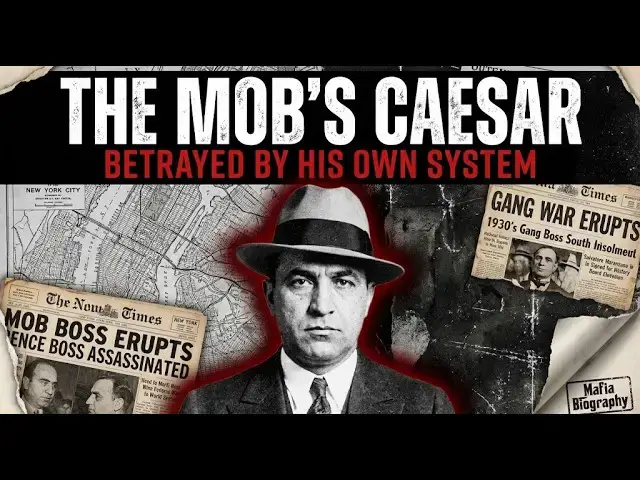
Up next in 10


He won the bloodiest mob war in American history.
He created the system that would govern organized crime for the next century.
He crowned himself the Boss of All Bosses.
And within five months... his own creation destroyed him.
Salvatore Maranzano was a scholar, a strategist, and a visionary. He quoted Julius Caesar. He restructured an entire criminal empire. He designed the Five Families model that still exists today.
But he made one fatal miscalculation.
This is the true story of the man history nearly forgot — the architect who didn't survive to see his own blueprint flourish.
📚 Based on court records, F-B-I files, and historical accounts.
📚 Sources and Further Reading:
→ "Five Families" by Selwyn Raab (comprehensive mafia history)
→ "The Last Testament of Lucky Luciano" by Martin Gosch and Richard Hammer
→ "The Valachi Papers" by Peter Maas (insider testimony on structure)
→ F-B-I files on Castellammarese War (declassified documents)
→ "Mob Star" by Gene Mustain and Jerry Capeci (organizational context)
→ New York Times archives — September 1931 coverage of Maranzano killing
#SalvatoreMaranzano #FiveFamilies #MafiaHistory #OrganizedCrime #LuckyLuciano #CastellammareseWar #MobDocumentary #TrueCrime
-~-~~-~~~-~~-~--~-~~-~~~-~~-~--~-~~-~~~-~~-~-
⚠️ Content Disclaimer:
This video is created for educational and informational purposes only. We do NOT glorify, promote, or encourage any form of criminal activity.
All visuals, audio, and materials used in this video are either:
✔ Created using AI tools, or
✔ Sourced from royalty-free platforms with valid licenses.
No copyrighted content belonging to others has been used without permission.
❤️ Support the Channel:
If you enjoy learning about real-life crime stories, history, and social issues, don't forget to:
✔ Like the video
✔ Subscribe to the channel
✔ Share your thoughts in the comments
Your support helps us keep creating more valuable content!
🔧 Tools I Use to Grow This Channel:
I personally use vidIQ to optimize my videos, find trending keywords, and grow my YouTube channel faster. Try it for free and see the difference!
💼 Contact & Copyright:
If you believe any part of this video violates your rights, please contact me directly via YouTube. I fully respect copyright laws and will respond promptly.
-~-~~-~~~-~~-~--~-~~-~~~-~~-~--~-~~-~~~-~~-~-
-
Show More Show Less View Video Transcript
0:00
September 10th, 1931.
0:03
A man sits behind a mahogany desk on the
0:06
9inth floor of the New York Central
0:08
Building, Park Avenue address, corner
0:11
office, view of Grand Central Terminal
0:14
below. His name is Salvata Marenzh. No,
0:18
and 5 months ago, he became the most
0:21
powerful criminal in America. He doesn't
0:23
look like a gangster. The desk is
0:26
covered with books, Latin texts,
0:29
military history, biographies of Roman
0:32
emperors. He's been reading Julius
0:34
Caesar again. He always comes back to
0:37
Caesar. The afternoon appointment is
0:40
routine. Four men. A meeting about real
0:44
estate holdings. Nothing unusual except
0:48
the men coming up the elevator aren't
0:50
who they claim to be. This is the part
0:53
of the story where we usually know
0:55
what's coming. The door opens, the guns
0:58
come out, another mob boss dies. But
1:02
here's what makes this particular death
1:04
worth examining. The man about to be
1:07
killed had just months earlier
1:09
reinvented the entire structure of
1:12
American organized crime. He'd ended a
1:15
war that had killed dozens. He'd created
1:18
a system designed to prevent exactly
1:20
this kind of assassination.
1:23
And now that system was about to eat its
1:26
creator. How does a man build something
1:28
so durable that it lasts a century
1:31
[music]
1:31
and so fragile that it couldn't protect
1:34
him for 6 months? That question has an
1:37
answer. But finding it means going back,
1:41
way back, to a town on the coast of
1:44
Sicily that most [music] Americans have
1:46
never heard of. What you're about to
1:48
hear is based on documented history,
1:51
court records, and FBI files. Some
1:55
conversations have been recreated for
1:57
narrative [music] purposes. Where the
1:59
record goes silent, we've used informed
2:02
interpretation.
2:04
This is the story of the first Caesar of
2:06
American crime. A man who saw the future
2:09
clearly and his own death not at all.
2:13
Castell lumere delo.
2:16
It's a fishing town on the northwestern
2:18
coast of Sicily. Small, poor,
2:22
unremarkable by most measures. The name
2:25
means castle by the sea of the Gulf.
2:28
There's an old Norman fortress, a
2:31
harbor, churches, the kind of place
2:33
people [music] leave. Salvata Moranzano
2:36
was born here in 1886.
2:40
The exact date isn't certain. Records
2:43
[music] in Sicily during this period
2:45
weren't always reliable, and men who
2:47
later became criminals had reasons to be
2:50
imprecise about such things. What we
2:53
know, he [music] was educated. Unusually
2:56
so for a man from his background. He
2:59
studied for [music] the priesthood as a
3:01
young man which meant Latin, theology,
3:04
rhetoric. He never took vows but the
3:08
training stayed with him. He could quote
3:10
ancient texts. He understood the
3:13
architecture of hierarchies. Some
3:15
[music] historians believe this
3:17
education shaped everything that came
3:20
later. [music]
3:20
The priesthood taught structure. The
3:23
church had survived for nearly 2,000
3:26
years using a system of ranks, rules,
3:29
and succession protocols. Maranzano paid
3:33
attention, but there was another
3:35
education happening in Castilame del
3:37
Gulfo, one that didn't involve books.
3:41
The town was a stronghold for a
3:43
particular faction of the Sicilian
3:46
mafia. Young men growing up there
3:49
absorbed [music]
3:49
certain ideas about loyalty. territory
3:53
and the [music] proper use of violence.
3:56
The code wasn't written down anywhere.
3:58
It didn't need to be. Moranzano absorbed
4:02
both educations, the books, and the
4:05
streets. That combination would prove
4:08
significant. By 1918, he'd attracted the
4:11
attention of Don Vito Ferrara, a local
4:14
mafia leader. Maranzano became a trusted
4:18
[music] associate handling business that
4:20
required someone who could think
4:22
strategically and also apply pressure
4:25
when strategy wasn't enough. Then came
4:28
America. The timing of his arrival is
4:31
disputed. [music] Some accounts say
4:33
1918. Others say later, perhaps the mid
4:37
[music] 1920s.
4:39
Immigration records from this era are
4:42
incomplete. [music] And men like
4:44
Maranzano often entered through
4:47
unofficial channels. What matters is
4:50
this. When prohibition created
4:52
unprecedented opportunity for organized
4:56
crime in America, Maranzano was
4:59
positioned to take advantage. He didn't
5:02
come alone. He came as part of a
5:04
network. Other men from Castile del
5:07
Gulfo had already established themselves
5:10
in New York. They had connections,
5:13
operations, territory. Maranzano,
5:16
slotted into this network as an
5:18
organizer and planner. But there was a
5:21
problem, a big one. New York in the
5:24
1920s [music]
5:25
was controlled by a different faction,
5:28
different bosses, different loyalties.
5:31
And at the top of that faction sat a man
5:34
who didn't appreciate competition from
5:36
Sicilian newcomers. His name was Jusp
5:40
Mas II R. Joe Maseria. To the Americans,
5:45
they called him Joe the boss. Maseria
5:48
was old school, crude, effective. He'd
5:51
clawed his way to power through violence
5:54
and intimidation. He controlled
5:56
bootlegging operations, gambling, and
5:59
labor racketeering across Manhattan and
6:01
Brooklyn. He didn't read Latin. He
6:04
didn't quote Caesar. He solved problems
6:07
with bullets and bribes, and he looked
6:09
at the Castle faction as a [music]
6:12
threat. For several years, an uneasy
6:15
coexistence held. The Castle operated in
6:18
their territories. Massyria operated in
6:22
his. Both sides made money. Both sides
6:25
watched each other, but territorial
6:28
disputes accumulated. Slights went
6:30
unanswered, then remembered, and Massia,
6:33
who trusted no one, began to see the
6:36
[music] Castellamese as something that
6:38
needed to be eliminated. In late 1930,
6:41
the tension broke. The Castellamese war,
6:45
that's what historians call it now. At
6:48
the time, it was just killing. The war
6:51
began when Maseria demanded tribute from
6:54
Castileame [music] faction leaders and
6:56
started eliminating those who refused.
6:59
Bodies began appearing. Men who had
7:02
operated peacefully for years suddenly
7:05
found themselves hunted. [music]
7:07
Salvata Maranzano emerged as the leader
7:10
of the Castileame resistance. Whether he
7:13
sought this position or had it thrust
7:16
upon him isn't entirely clear. [music]
7:19
The record suggests he was chosen
7:21
because he could think beyond the
7:23
immediate violence. He could plan and
7:26
his plan was patient. Instead of
7:29
matching Maseria murder for murder,
7:32
Maranzano built alliances. He reached
7:35
out to other bosses who [music] had
7:37
grievances with Joe the boss. He
7:40
promised a new order after victory. He
7:43
suggested that Massy's old-fashioned
7:46
brutality was bad for everyone's
7:49
business. [music] He also studied his
7:51
enemy. Massia had one significant
7:54
weakness. [music] He surrounded himself
7:56
with ambitious young men who were
7:58
growing tired of his leadership. Men who
8:01
saw the future differently. Men who
8:03
might be persuaded to switch sides if
8:05
the price was right. One of those young
8:08
men was Charles Luchiano.
8:10
Lucky Luchano. Luchano was Maseria's top
8:15
left tenant. Capable, connected,
8:18
pragmatic. He built relationships
8:21
[music] across ethnic lines that the old
8:23
guard found distasteful. He did business
8:26
with Jewish gangsters, [music]
8:28
Irish gangs, anyone who could help make
8:30
money. And he was growing tired of Joe,
8:33
the boss. Maranzano recognized this.
8:36
[music] According to some accounts,
8:38
secret negotiations took place. Messages
8:42
passed between the waring [music] camps.
8:44
Luchano and his allies were offered a
8:47
deal. Help eliminate Maseria and there
8:50
would be a place in the new
8:51
organization,
8:53
a good place. Whether Luchano was
8:56
motivated by ambition,
8:58
self-preservation, or genuine belief
9:01
that Maranzano's vision was superior, we
9:05
can't know [music] for certain. Probably
9:07
all three. What we know is what
9:09
happened. April 15th, 1931.
9:13
Maseria ate lunch at a restaurant in
9:16
Canai Island called Newover Villa
9:18
Tamaro. [music]
9:19
Luchano was there. They played cards
9:22
after the meal. At some point, Luchano
9:25
excused himself to use the restroom.
9:27
Four gunmen entered. [music]
9:29
20 bullets hit Joe, the boss. He died
9:32
holding the Ace of Diamonds. Or maybe
9:35
that's just a good [music] story someone
9:37
added later. The record isn't clear.
9:40
What's clear is that the Castile MS war
9:43
was over and Salvatano
9:46
had won. Now comes the part that
9:49
makesano historically significant.
9:52
[music] the part that separates him from
9:54
dozens of other mob bosses who rose and
9:57
fell [music] during this era. He didn't
9:59
just seize power, he redesigned power.
10:03
Within weeks of Maseria's death,
10:05
Maranzano called a meeting. Not just the
10:08
[music] Castilame faction, everyone.
10:11
Bosses from across New York,
10:14
representatives from Chicago, Detroit,
10:17
Philadelphia, Buffalo. According to
10:20
witnesses who later testified, the
10:22
meeting took place in a large hall.
10:25
Hundreds of men attended. Maranzano
10:28
stood at the front and explained what he
10:30
was creating. First, the structure. New
10:34
York's chaotic criminal landscape would
10:36
be organized into five distinct
10:39
families. Each family would have a boss
10:42
and under boss and beneath them a
10:45
hierarchy of captains and soldiers.
10:47
Territory would be defined, lines would
10:50
be respected. This was the birth of what
10:53
we now call the [music] five families.
10:56
Luchano would lead one, other bosses
10:59
would lead the others. The names would
11:02
change over the decades, but the
11:04
structure the structure proved
11:06
remarkably durable. Second, the rules.
11:10
Maranzano established protocols for
11:13
settling disputes. No boss could kill
11:16
another boss without approval.
11:18
Territories would be respected. Family
11:21
business stayed within families. A
11:24
system of tribute and respect kept
11:26
everything flowing upward. He borrowed
11:29
from what he knew. The Catholic Church's
11:32
hierarchy. The Roman military's chain of
11:35
command. Caesar's organizational genius
11:39
adapted for the streets of New York. And
11:42
at the top of this new structure,
11:45
Maranzano placed himself. He took a
11:48
title Karpo Dati Cappy, boss of all
11:51
bosses, the supreme authority over all
11:55
families. This is where the Caesar
11:57
obsession became literal. Maranzano saw
12:01
himself as a transformative figure, not
12:03
just another gangster, but an architect,
12:06
a lawgiver, someone who would impose
12:09
order on chaos. According to several
12:12
accounts, he compared himself explicitly
12:14
to Caesar [music] at these meetings. The
12:17
Roman imperator who transformed a
12:20
republic into an empire, [music] who
12:22
imposed systems that lasted centuries.
12:26
The comparison wasn't entirely [music]
12:28
wrong. Maranzano genuinely was a
12:31
visionary. His organizational structure
12:35
would outlive him by generations. The
12:38
five families still exist. [music]
12:40
The basic hierarchy he designed is still
12:44
recognizable 90 years later. But
12:47
Moranzano forgot something about Caesar.
12:50
Caesar died on the Senate floor, stabbed
12:53
by men he thought were allies. The
12:55
problem was the title. Boss of all
12:58
bosses sounded impressive. It satisfied
13:01
Moranzano's ego. It established a clear
13:05
apex in the hierarchy he was building.
13:07
But the men beneath him heard something
13:10
else. They heard permanent [music]
13:12
subordination. They heard, "Your
13:14
ambition ends here." They heard, "I will
13:17
always be above you." Lucky Luchano, who
13:20
had just helped Moranzano win the war,
13:23
found himself [music] in an interesting
13:25
position. He was a boss now. Yes, one of
13:28
the five families. But above him sat a
13:31
man who would never leave. A man who
13:33
demanded tribute and respect. A man who
13:36
kept talking about Caesar. Luchano was
13:40
pragmatic. He smiled at the meetings. He
13:43
paid his respects. He waited. And
13:46
according to later testimony, Maranzano
13:49
gave him reason to stop waiting. Here's
13:52
where the historical [music] record gets
13:54
complicated. We have multiple accounts
13:56
of what happened next, and they don't
13:59
entirely agree. What seems [music] clear
14:02
is this. Maranzano became increasingly
14:05
paranoid. Whether this paranoia was
14:08
justified or self-fulfilling is
14:11
difficult to determine. According to
14:14
several sources, Maranzano began
14:17
planning to eliminate potential rivals
14:20
before they could move against him. The
14:22
list allegedly included Luchano, Veto
14:26
Genov, Frank Costello, Joe [music]
14:29
Adenis, and others. The men who had
14:32
helped him win the war were now seen as
14:34
threats [music] to his throne. Some
14:36
accounts claim Maranzano hired an
14:39
outside [music] assassin for the job. A
14:42
man named Vincent Mad Dog Cole, an Irish
14:46
gunman known for brutality. Using an
14:49
outsider meant the killings couldn't be
14:51
traced back to Moranzano directly. But
14:54
here's the question the record [music]
14:56
doesn't fully answer. Did Luchano learn
14:59
about this plan or was he already moving
15:02
against Moranzano for his own reasons?
15:05
Witnesses later suggested that
15:07
Maranzano's plotting [music] was
15:09
discovered. Word leaked. Maybe Moranzano
15:13
trusted the wrong person. Maybe the
15:16
walls had ears. In this world, secrets
15:20
rarely stayed secret [music] for long.
15:22
What we know for certain is what
15:24
happened on September 10th. Maranzano
15:27
was in his [music] office. The real
15:29
estate company he ran as a front
15:32
occupied the 9inth [music] floor of the
15:34
New York central building. Four men
15:36
arrived, claiming to be investigators
15:39
from a government agency. They were not
15:42
from the government. The accounts of
15:44
what happened inside vary. Some say the
15:47
men had badges and credentials. Some say
15:51
Maranzano's bodyguards were sent out of
15:53
the room. Some say he was stabbed first,
15:57
then shot. Others reverse the order.
16:00
What's consistent? Maranzano fought
16:03
back. He was stabbed multiple times.
16:06
Shot multiple times. He died in his
16:09
office surrounded by his books on Roman
16:12
history. Caesar on the shelf, blood on
16:15
the floor. He was 45 years old. He had
16:18
been boss of all bosses for
16:20
approximately [music]
16:21
5 months. The men who killed him were
16:23
not Italians. This was deliberate. Using
16:27
Jewish gangsters meant the killers
16:29
wouldn't be recognized by Moranzano's
16:31
guards. It also created confusion about
16:34
who had ordered the hit, but everyone
16:37
knew. Luchano moved fast. Within hours,
16:41
words spread through the underworld. The
16:44
boss of all bosses was dead. The title
16:46
died with him. No one would ever hold
16:49
that position again. This was Luchano's
16:52
first major decision. The structure
16:55
Moranzano had created would remain. The
16:58
five families would continue. The
17:00
hierarchy stayed intact, but the apex
17:04
position was eliminated. [music]
17:06
Instead, Luchano proposed something
17:08
different. A commission, a ruling
17:11
council of bosses who would meet as
17:13
equals, no single supreme leader,
17:16
decisions made collectively, power
17:19
distributed. It was in a sense a
17:23
rejection of everything Maranzano
17:26
represented. Caesar was dead. Rome would
17:30
become a republic again. Or at least
17:32
that was the story. [music] Some
17:34
historians argue that Luchano simply
17:37
became a quieter kind of Caesar, first
17:39
[music] among equals who was more equal
17:42
than others. The power didn't disappear,
17:45
it just became less visible, but the
17:47
principle mattered. The commission model
17:50
lasted decades. It survived wars,
17:54
prosecutions, and generational changes.
17:57
It proved more durable than any single
17:59
boss could have been. Maranzano's
18:02
structure survived. His title didn't.
18:05
[music] There's something fitting about
18:07
that. The night of September 10th became
18:10
known as the night of the Sicilian
18:12
Vespers. According to legend, dozens of
18:15
old guard bosses across the country were
18:18
killed simultaneously.
18:20
A coordinated purge of the Maranzano
18:23
faction. [music] The reality was
18:25
probably less dramatic. Historical
18:28
research suggests the actual [music]
18:30
death toll was much smaller, perhaps
18:33
three or four men total. The legend grew
18:36
in the telling, but the perception
18:38
mattered as much as the reality. The
18:41
message was clear. The old way was over.
18:44
The new generation had taken control.
18:47
Luchano consolidated [music] power over
18:50
the following months. He brought in men
18:53
like Mayor Lansky and Frank Costello as
18:56
key advisors. He built relationships
18:59
across ethnic lines that Maranzano would
19:02
never have tolerated. He modernized
19:05
operations, reduced [music]
19:07
unnecessary violence, and focused on
19:10
profit over pride. The world Maranzano
19:14
designed became the world Luchano
19:16
[music]
19:17
inhabited, but with one crucial
19:19
modification. No more Caesars. [music]
19:22
So what do we make of Salvata Maranzano?
19:26
He was brilliant. Clearly the
19:28
organizational structure he created in
19:31
1931 [music] has survived longer than
19:34
most legitimate corporations.
19:37
The basic framework of the American
19:39
mafia remained recognizable for the rest
19:42
of the 20th century. He was also blind.
19:47
He couldn't see that claiming the
19:48
[music] title of supreme leader made him
19:51
a target. He couldn't recognize that the
19:54
men he'd used to win the war would never
19:56
accept permanent subordination.
19:59
He couldn't understand that the very
20:02
ambition that drove him to the top would
20:05
drive others to pull him down. Was he
20:08
betrayed? In the narrow sense, yes,
20:11
[music] men he thought were allies
20:12
killed him. But in a larger sense, he
20:15
betrayed himself. He built a system and
20:18
then tried to [music] place himself
20:19
above it. He created rules and then
20:22
imagined he was exempt. He studied
20:25
Caesar and missed the lesson. The lesson
20:28
isn't complicated. [music] Men who
20:30
declare themselves indispensable become
20:33
targets. The moment you claim the
20:35
[music] throne, you create the
20:37
conspiracy that will take it from you.
20:39
Maranzano knew this. He had to know it.
20:43
He'd read the histories. He'd seen what
20:46
happened to Caesar. Maybe he thought he
20:48
was different. Maybe he thought his
20:51
organizational genius would protect him.
20:54
Maybe he thought the system he designed
20:57
would make [music] assassination
20:59
impossible. He was wrong. There's a
21:02
detail that historians mention about
21:04
Moranzano's final days. Small, but worth
21:08
considering. In the weeks before his
21:10
death, he apparently became increasingly
21:13
isolated. He trusted fewer people. He
21:17
spent more time alone with his books. He
21:19
kept reading about Caesar. [music]
21:21
Some accounts suggest he sensed what was
21:24
coming, that he knew he'd made enemies
21:26
he couldn't eliminate quickly enough,
21:29
that the walls were closing in. If true,
21:32
it raises another question. Why didn't
21:34
he run? He had money. [music] He had
21:37
connections in Sicily. He could have
21:40
disappeared, retired, lived quietly
21:42
[music] somewhere far from New York. But
21:45
men like Maranzano don't retire. The
21:48
power that drives them to the top is the
21:51
same power that keeps them there until
21:53
someone removes them. Walking away would
21:56
have meant admitting that the crown
21:58
wasn't worth the risk. And for men who
22:01
see themselves as Caesar, the crown is
22:04
everything. They buried Salvata
22:06
Moranzano in St. John's Cemetery in
22:09
Queens. A modest headstone, just a name,
22:13
dates, and silence. [music] His wife and
22:16
children, who had stayed largely
22:18
separate from his business life, mourned
22:20
privately. The organization he created
22:24
barely noticed his absence. Within
22:27
weeks, the commission was meeting
22:29
regularly. The five families were
22:32
dividing territory peacefully. The
22:34
structure worked exactly as he designed
22:37
it to work. It just worked without him.
22:40
Luchano would go on to become arguably
22:42
the most powerful crime boss of the 20th
22:46
century. He would be arrested,
22:48
convicted, deported, and still somehow
22:51
remain influential from exile in Italy.
22:55
He died in 1962 at an airport in Naples
22:59
of a heart attack. Natural causes. Mayor
23:03
Lansky lived until 1983.
23:06
Frank Costello until 1973.
23:09
These men understood something Moranzano
23:12
didn't. Visibility is vulnerability.
23:16
The boss who gets quoted in newspapers
23:19
is the boss who gets prosecuted or
23:22
assassinated. The generation that
23:24
followed Moranzano learned from his
23:27
mistakes. They became more careful about
23:30
titles, more cautious about exposure,
23:33
more strategic about the appearance of
23:35
power versus its reality. In that sense,
23:39
Maranzano's death was his greatest
23:42
lesson, his final gift to the
23:45
organization he'd built, a demonstration
23:48
of what not to do. Some secrets [music]
23:51
die with the men who kept them. We'll
23:53
never know exactly what Moranzano was
23:56
thinking in those final weeks. We'll
23:58
never [music] know if he really planned
24:00
to kill Luchano or if that was a story
24:03
invented later to justify what happened.
24:07
We'll never know if different choices
24:09
might have led to different outcomes.
24:11
What we know is the system he built, the
24:15
structure that survived him by
24:17
generations. the five families that
24:20
became the framework for organized crime
24:22
in America for the rest of the century.
24:25
His empire flourished, just not with him
24:28
in it. There's a particular cruelty in
24:31
that. Building something that outlasts
24:34
you is supposed to be the goal. Legacy,
24:37
permanence, the continuation of your
24:40
vision after you're gone. But Moranzano
24:43
didn't get to see his vision mature. He
24:46
didn't [music] get to watch the
24:47
commission system work out its early
24:49
problems. He didn't get to refine his
24:52
creation over decades of experience. He
24:55
built the house and was thrown out
24:57
before the paint dried. Maybe that's the
25:00
real lesson here. Not about power or
25:03
ambition or the dangers of declaring
25:06
yourself Caesar. Maybe it's simpler than
25:08
that. Some men are builders. Some men
25:11
are inhabitants. The skills required for
25:14
one aren't always the skills required
25:17
for the other. Maranzano could see the
25:20
blueprint. He could design the
25:22
structure. He could imagine a system
25:24
that balanced competing interests
25:26
[music] and channeled violence into
25:28
productive directions. But living inside
25:31
that system required different talents.
25:34
[music]
25:35
Patience, subtlety, the ability to wield
25:39
power without appearing to. Those were
25:41
Luchano's talents, [music] not
25:43
Moranzano's.
25:45
The first Caesar of American crime
25:48
designed an empire. His successors
25:50
figured out how to actually live [music]
25:52
in it. 85 years later, federal
25:56
prosecutors still used the five families
25:58
model to understand and target organized
26:01
crime in New York. [music] The structure
26:04
has evolved, weakened, been damaged by
26:08
decades of prosecution. But the basic
26:11
architecture [music] remains
26:13
recognizable. Maranzano's ghost haunts
26:16
every RICO [music] case, every mob
26:19
trial, every organizational chart the
26:23
FBI puts together. He's there in the
26:26
structure. Even if his name is
26:28
forgotten, maybe that's a kind of
26:31
immortality. Not the kind he [music]
26:33
wanted, not the kind he imagined when he
26:36
compared himself to Caesar, but real
26:38
nonetheless. The commission still meets.
26:41
The families still exist. The rules
26:44
Maranzano wrote, modified and adapted
26:47
over decades, [music] still provide the
26:50
framework for how disputes are settled
26:52
and territory is divided. He got what he
26:55
wanted. He just wasn't there to see it.
26:58
Some legacies are visible. Statues and
27:02
monuments and names on buildings. Others
27:05
operate in the spaces between what's
27:07
said and what's done. His operates in
27:10
both and neither. The boss of all
27:13
bosses, five months in power, 90 years
27:16
of influence. Was he a genius who built
27:19
something that outlasted empires? Or was
27:23
he a fool who couldn't see that his own
27:25
creation would destroy him? The answer
27:28
probably is yes to both. If this story
27:31
stays with you, you know what to
#Arts & Entertainment