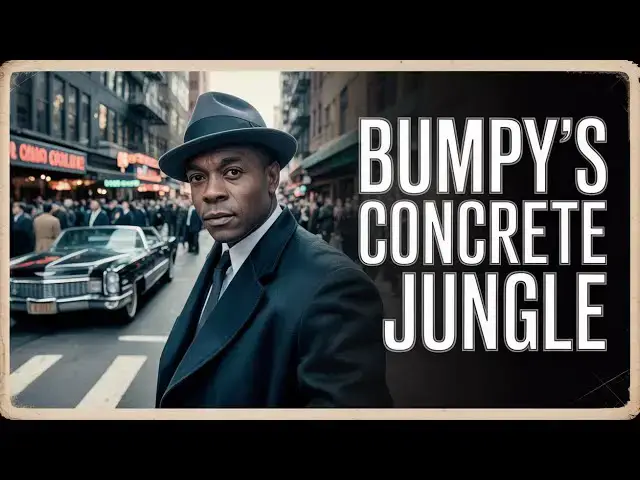
Up next in 10

The Forgotten Godfather Who REALLY Controlled Harlem | Bumpy Johnson's Untold Story
Nov 6, 2025
Before Al Capone, before Lucky Luciano... there was one man who controlled Harlem with absolute authority. Meet Bumpy Johnson - the forgotten Godfather whose name terrified even the Mafia.
🎬 This is the UNTOLD story of Ellsworth "Bumpy" Johnson, the most powerful figure in Harlem from the 1930s to 1960s. While history remembers Capone and Luciano, few know about the man who ruled uptown Manhattan with intelligence, strategy, and unmatched influence.
📍 From a religious family in Charleston to becoming the key figure in Harlem's underworld, discover how a young boy nicknamed "Bumpy" rose to power in one of America's most vibrant neighborhoods.
✨ In This Documentary You'll Discover:
• How Bumpy became more powerful than the Italian Mafia in Harlem
• Why politicians and law enforcement sought his approval
• Frank Lucas's shocking statement about doing business in Harlem
• The tragic family incident that changed everything
• How a 10-year-old boy became Harlem's ultimate authority
This is the real American Gangster story that Hollywood barely touched. The truth about the man who inspired legends.
📚 Historical Documentary | True Crime History | American Organized Crime
#BumpyJohnson #TrueCrime #HarlemHistory #Documentary #UntoldStory #AmericanHistory #GangsterHistory #Harlem #HistoricalDocumentary
-~-~~-~~~-~~-~--~-~~-~~~-~~-~--~-~~-~~~-~~-~-
⚠️ Content Disclaimer:
Show More Show Less View Video Transcript
0:00
Harlem, New York, 1930s.
0:02
The air isn't just thick with the smell
0:04
of coal smoke and fried fish. It's
0:06
electric with something else. It's the
0:08
sound of jazz pouring from tavern doors,
0:11
the shuffle of feet on crowded
0:13
sidewalks, and underneath it all, the
0:15
quiet humming engine of a shadow
0:16
economy. This is the Harlem Renaissance,
0:19
but it's also a kingdom. A kingdom built
0:21
on ambition, desperation, and numbers.
0:24
And every kingdom needs a king. But in
0:26
1932, the throne is under siege. The man
0:30
who runs Harlem's numbers game, the
0:32
multi-million dollar illegal lottery,
0:34
isn't a man at all. She is Stephanie St.
0:37
Clare, the queen of policy. She's
0:39
elegant, brilliant, and absolutely
0:41
ruthless. She is also a target. But in
0:44
1932, the throne is under siege. The man
0:48
who runs Harlem's numbers game, the
0:50
multi-million dollar illegal lottery,
0:52
isn't a man at all. She is Stephanie St.
0:55
Clare, the queen of policy. She's
0:58
elegant, brilliant, and absolutely
1:00
ruthless. She is also a target because
1:03
downtown, the white mob, fresh off the
1:05
repeal of prohibition, is hungry.
1:08
They're looking up town. They see Harlem
1:10
not as a home, but as a territory, a
1:13
fat, juicy prize waiting to be plucked.
1:16
And the man they've sent to pluck it is
1:18
a brute named Dutch Schultz. Schultz
1:20
doesn't negotiate. He doesn't ask. He
1:23
arrives with saw-edoff shotguns and
1:25
baseball bats. He starts breaking heads,
1:28
firebombing storefronts, and murdering
1:31
policy runners in broad daylight. Harlem
1:34
is bleeding, and its queen is desperate.
1:36
She needs more than just soldiers. She
1:39
needs a general. She needs a strategist.
1:42
She needs Ellsworth Raymond Johnson. We
1:44
just know him as Bumpy. When Bumpy
1:48
Johnson returned to Harlem in 1932 after
1:50
a stretch in prison, he wasn't a king.
1:53
He was just another tough guy trying to
1:55
find his angle. But Bumpy was different.
1:58
Most street toughs had muscle. Bumpy had
2:01
muscle, but he also had a mind. He was a
2:03
voracious reader. He studied history,
2:06
read philosophy, and wrote poetry. And
2:09
he played chess. He saw the world as a
2:11
chessboard. Every move had a
2:14
consequence. Every piece had a purpose.
2:16
Stephanie St. Clair saw this in him.
2:19
While other gangsters were just
2:20
brawlers, Bumpy was a tactician. She
2:24
hired him as her chief enforcer. It was
2:26
a job title that barely scratched the
2:28
surface. He wasn't just muscle. He was
2:31
her sword and her shield. The war with
2:34
Dutch Schultz began immediately, and it
2:36
was brutal. Schultz was a psychopath in
2:39
a tailored suit. He had a bottomless
2:41
well of violence and the backing of the
2:43
Italian syndicate, including the new
2:45
boss of bosses, Charles Lucky Luciano.
2:49
Schultz's method was simple.
2:51
Overwhelming force. He sent dozens of
2:54
gunmen uptown expecting Harlem to just
2:56
roll over. He didn't count on Bumpy
2:58
Johnson. Bumpy didn't have Schultz's
3:00
endless army. He had something better.
3:03
Harlem. He knew every alley, every
3:05
rooftop, every tenement basement. He
3:08
knew the people. While Schultz's men
3:10
were invaders, Bumpy's men were ghosts.
3:13
The war for the numbers was not a series
3:14
of grand battles. It was a campaign of
3:17
surgical terrifying strikes. A Schultz
3:19
dropoff man would be walking down 135th
3:22
Street, and suddenly he'd be surrounded,
3:25
not by gunmen, but by half a dozen of
3:27
Bumpy's men with ice picks and knives.
3:30
The message was clear. Your money is
3:33
ours now. Get out. Schultz would send a
3:36
car full of shooters. Bumpy getting a
3:39
tip from a shoe shine boy would have the
3:42
street blocked off. The car would be
3:44
trapped and Bumpy's men would open fire
3:46
from the rooftops. Schultz enraged
3:49
escalated. He started kidnapping and
3:51
murdering St. Clare's runners. It said
3:53
that over 40 men died in this war. The
3:56
streets ran red. Schultz with his vast
3:59
resources was simply bleeding the Harlem
4:01
operation dry. He could replace his dead
4:04
men. St. Clare and Bumpy could not.
4:07
Bumpy knew they couldn't win a war of
4:09
attrition. You can't beat a title wave
4:11
by punching it. You have to be smarter.
4:13
So Bumpy changed the game. He stopped
4:16
fighting Schultz's soldiers and started
4:18
fighting Schultz's wallet. He organized
4:20
a lightning fast campaign. He and his
4:23
men began identifying Schultz's own
4:24
numbers banks, the places the Dutchman
4:27
thought were safe. In one night, Bumpy's
4:29
crews hit over a dozen of them, burning
4:32
the betting slips, stealing the cash,
4:34
and disappearing before the police, who
4:37
were, of course, on Schultz's payroll,
4:39
even arrived. Bumpy was playing chess.
4:42
He wasn't just taking pawns. He was
4:44
putting the king in check. Schultz was
4:46
bleeding money. Every day the war
4:48
continued, his profit margins shrank.
4:51
The one thing his Italian backers hated
4:53
more than a rival was an unprofitable
4:55
partner. But the war had to end. The
4:58
breaking point came not from Bumpy, but
5:00
from the system itself. The law, in the
5:03
form of prosecutor Thomas Dwey, was
5:06
closing in on Dutch Schultz. Schultz,
5:08
paranoid and cornered, made a fatal
5:11
mistake. He went to the Italian
5:13
Commission to Lucky Luciano and proposed
5:15
a hit on Dwey. Luchiano was a
5:18
businessman, not a mad dog. He knew
5:21
killing a high-profile prosecutor would
5:23
bring the full unholy wrath of the
5:25
federal government down on all of them.
5:27
It was bad for business. The commission
5:30
told Schultz no. Schultz, in his
5:32
arrogant rage, said he'd do it anyway.
5:34
And just like that, Dutch Schultz signed
5:37
his own death warrant. The commission,
5:39
the very people backing his war in
5:41
Harlem, decided he was too volatile. On
5:44
October 23rd, 1935, gunman from Murder
5:47
Incor walked into the Palace Chop House
5:49
in Newark and riddled Dutch Schultz with
5:51
bullets. He clung to life for 22 hours,
5:54
rambling incoherently before he died.
5:57
The war for Harlem was over. With
5:59
Schultz gone, there was a power vacuum.
6:02
Stephanie St. Clare was the queen, but
6:05
she was tired of the violence. The war
6:07
had cost her too much. Bumpy Johnson,
6:10
the general who had survived the war,
6:12
saw his opening. He didn't stage a coup.
6:16
He didn't need to. He went directly to
6:18
the top. He requested a meeting with the
6:21
man who really controlled the New York
6:22
underworld, Lucky Luciano. This meeting
6:26
was legendary. It was the young black
6:28
strategist from Harlem walking into the
6:30
lion's den to face the Italian Capo
6:32
Duty. Copy. Bumpy laid out his
6:36
proposition. It was simple. Harlem was
6:39
his. The numbers, the bookmaking, the
6:41
lone sharking, it all belonged to the
6:43
people who lived there. He would run it.
6:46
But Bumpy was a realist. He knew he
6:48
couldn't just tell the most powerful
6:49
gangster in America to stay out. So he
6:52
offered a deal. He would run Harlem, and
6:54
in return, he would pay a tribute, a
6:57
street tax. A percentage of the profits
7:00
would flow downtown to the commission.
7:02
Luciano, a pragmatist, saw the genius in
7:05
it. The Italians wouldn't have to fight
7:07
for every block. They wouldn't have to
7:09
deal with the resentment of an occupied
7:11
territory. They would simply sit back
7:14
and collect a check. Bumpy wouldn't just
7:16
be an enemy. He'd be a business partner.
7:20
A vassel, yes, but a very powerful, very
7:23
rich vassel. The deal was struck, and
7:26
Ellsworth Bumpy Johnson became the
7:28
undisputed godfather of Harlem. For the
7:31
next two decades, Bumpy's rule was
7:34
absolute. He was a paradox, a criminal
7:36
and a protector, a parasite and a
7:39
benefactor. His business was vice. He
7:42
ran the numbers, a game that gave people
7:44
a sliver of hope while simultaneously
7:46
draining their pockets. He controlled
7:48
bookmaking and in a move that would
7:50
later haunt his legacy. He became the
7:53
main distributor for the Italian mob's
7:55
heroin trade in Harlem. He was, by any
7:58
legal standard, a predator. He was
8:01
flooding his own community with poison
8:03
for a profit. He was ruthless to his
8:05
rivals. If you crossed Bumpy Johnson,
8:08
you might get a warning. You would not
8:10
get a second one. His enforcers were
8:13
feared, and his reputation for
8:15
calculated violence was unmatched. But
8:17
then there was the other bumpy. The
8:20
Bumpy who walked 125th Street like a
8:22
mayor. Citizens wouldn't just nod. They
8:26
would come to him with their problems.
8:28
An old woman couldn't pay her rent.
8:30
Bumpy would cover it. A family got
8:32
burned out of their apartment. Bumpy
8:35
would find them a new one. At
8:36
Thanksgiving and Christmas, he was
8:38
famous for handing out hundreds of free
8:40
turkeys to the neighborhood's poorest
8:42
families. He was known to pay for the
8:44
college tuitions of promising kids from
8:46
the neighborhood. He was Harlem's
8:48
unofficial justice system. If a local
8:51
shopkeeper was robbed by some petty
8:53
thief, they didn't call the cops, who
8:55
they didn't trust anyway. They went to
8:58
Bumpy. Bumpy and his men would find the
9:00
thief and justice would be swift. The
9:03
thief might be beaten. He might be
9:05
forced to return the money with
9:06
interest. But the message was clear. We
9:09
don't steal from our own. Bumpy was a
9:11
man of intense contradictions. He was a
9:14
gangster who read Shakespeare. He was a
9:16
pimp and a drug dealer who would sit in
9:18
a cafe for hours playing chess,
9:20
contemplating his next move five steps
9:22
ahead of everyone else. He was beloved
9:25
and he was feared. He was a Robin Hood
9:27
who stole not from the rich to give to
9:29
the poor but from the poor to give back
9:32
to the poor. He kept them in a cycle of
9:35
dependency with himself at the very
9:37
center. He was the king and Harlem was
9:40
his court. He had a beautiful wife, my
9:43
daughter. He lived in a fine home. He
9:46
ate at the best restaurants. He was for
9:49
a time untouchable. But no kingdom lasts
9:52
forever.
9:53
As the 1940s bled into the 1950s, the
9:57
world was changing. The Italian mob he
10:00
partnered with, the Genevesei family,
10:02
was becoming greedier. The drug trade
10:04
Bumpy had helped build, was now ravaging
10:07
his community in ways the numbers game
10:09
never had. He saw the walking ghosts on
10:12
the street corners, the lives hollowed
10:14
out by the heroine he sold, and the law,
10:17
which had long been content to let Bumpy
10:19
rule Harlem as his own thief, was
10:22
starting to look closer. The federal
10:24
government was cracking down on
10:26
organized crime, and Bumpy Johnson was a
10:28
very big name. In 1951, the feds finally
10:32
got him. Not for murder, not for running
10:35
the numbers, but for conspiracy to sell
10:38
heroin. It was a charge that stuck.
10:41
Bumpy Johnson, the king of Harlem, was
10:43
sentenced to 15 years. They didn't just
10:45
send him to any prison. They sent him to
10:48
the most infamous prison on earth, The
10:50
Rock, Alcatraz. He entered Alcatraz in
10:54
1952. He was now prisoner number 1117.
10:58
On the inside, Bumpy was just another
11:00
number. But even in hell, he found a way
11:03
to be a leader. He was isolated from his
11:06
empire, but his mind was still sharp. He
11:09
read, he wrote, he studied. There's a
11:11
famous, perhaps apocryphal story about
11:13
his time there. Bumpy was in the messaul
11:16
when another inmate, a white racist,
11:18
threw something at him and called him a
11:20
racial slur. The entire messaul went
11:23
silent. Bumpy, without a word, slowly
11:26
picked up his knife and fork. He walked
11:29
over to the man's table. The man stood
11:31
up, ready for a fight. Bumpy didn't
11:33
attack. He just looked at him, his eyes
11:36
like cold steel, and said in a low, calm
11:39
voice, "I'm Bumpy Johnson. I am a man of
11:43
respect. You will apologize to me, or
11:46
one of us will not be leaving this
11:47
island alive." The man facing the icy
11:51
calm of a killer and a philosopher
11:53
backed down. He apologized. Even in
11:56
Alcatraz, Bumpy Johnson commanded
11:58
respect. In 1963, Bumpy Johnson was
12:02
released on parole. He returned to a
12:04
Harlem he barely recognized. This wasn't
12:07
the Harlem of the Jazz Age. This was the
12:10
Harlem of the Civil Rights Movement. The
12:12
streets were filled not just with
12:14
junkies, but with activists. The air was
12:16
thick, not just with music, but with the
12:19
fiery speeches of change. And the most
12:21
powerful voice in Harlem belonged to a
12:23
man named Malcolm X, the old gangster
12:26
and the new revolutionary.
12:28
They were two sides of the same coin.
12:30
Two brilliant, powerful black men who
12:32
had fought the white establishment their
12:34
entire lives, just in different ways.
12:37
Bumpy was by this time an old man. He
12:40
was in his late 50s. His body was
12:42
starting to fail him, but his mind and
12:44
his authority were as sharp as ever. He
12:47
and Malcolm X formed one of the
12:49
strangest and most powerful alliances of
12:51
the era. They would meet often,
12:54
sometimes at Bumpy's favorite spot,
12:56
Wells restaurant. Sometimes at the
12:58
Shabbaz mosque, they would talk for
13:01
hours, the gangster and the minister,
13:03
discussing theology, politics, and the
13:06
future of their people. Bumpy saw in
13:08
Malcolm a new kind of power, one that
13:10
didn't come from a gun, but from an
13:12
idea. Malcolm X, in turn, respected
13:15
Bumpy. He knew Bumpy was a criminal, but
13:18
he also saw him as a man who had
13:20
successfully stood up to the white power
13:22
structure and built an empire of his
13:24
own. When Malcolm X split from the
13:26
Nation of Islam, his life was in
13:28
immediate danger. He was marked for
13:31
death. He had the FBI monitoring him and
13:34
he had his former brothers in the nation
13:36
hunting him. He needed protection. And
13:39
in Harlem, there was only one man who
13:41
could provide it. Bumpy Johnson became
13:43
the unofficial head of security for
13:45
Malcolm X. He assigned his best men to
13:48
guard Malcolm. He personally oversaw the
13:50
security at his speeches. It was the
13:53
ultimate paradox. The man who had
13:55
poisoned Harlem with drugs was now
13:57
protecting the man who was trying to
13:58
save its soul. Bumpy warned Malcolm. He
14:02
knew the nation. He knew the streets. He
14:05
told him, "Brother, you can't just talk.
14:08
You've got to be prepared to defend
14:10
yourself." He allegedly offered Malcolm
14:12
guns, men, whatever he needed. But
14:15
Malcolm was on a different path. On
14:18
February 21st, 1965,
14:20
Bumpy's men were not handling security
14:22
at the Ottabon Ballroom. Men from the
14:24
Nation of Islam were. As Malcolm X
14:27
stepped up to the podium, the assassins
14:30
struck. Bumpy was devastated. He felt he
14:33
had failed his friend. He attended the
14:35
funeral, a grim, silent figure among the
14:38
mourners, a king who had lost a part of
14:40
his kingdom that he was just beginning
14:42
to understand. After Malcolm's death,
14:44
Bumpy went to war. He didn't do it with
14:47
speeches. He did it the only way he knew
14:49
how. He allegedly began targeting the
14:52
men he believed were responsible. The
14:54
drug dealers and mosque leaders he felt
14:56
had betrayed Malcolm. But this was
14:59
Bumpy's last fight. He was old. He was
15:02
tired. His empire was crumbling. The new
15:05
generation of gangsters had none of his
15:07
code, none of his style. They were just
15:10
violent. and the Italian mob. His old
15:12
partners were flooding Harlem with so
15:14
much heroin that Bumpy himself tried to
15:17
stop it. He tried to go to the Genevese
15:19
family to his old contacts and tell them
15:21
to pull the drugs back. He told them,
15:24
"You're killing the neighborhood. You're
15:25
killing my customers." They laughed at
15:28
him. He was a relic, a king with no
15:30
army. In the summer of 1968, Bumpy
15:34
Johnson was sitting in his regular booth
15:35
at Wells restaurant on 132nd Street. It
15:39
was the early hours of the morning. He
15:41
was eating his favorite meal, a chicken
15:43
leg and harmony grits. He was laughing,
15:45
telling stories to his friends. And then
15:48
he stopped. He clutched his chest. His
15:52
heart, which had carried the weight of a
15:53
kingdom, the guilt of a drug epidemic,
15:56
and the grief of a lost revolution,
15:58
finally gave out. Bumpy Johnson, the
16:01
godfather of Harlem, was dead before he
16:04
hit the floor. He didn't die from a
16:06
bullet. He didn't die in a prison cell.
16:09
He died in the heart of his kingdom,
16:11
surrounded by the people he loved, in
16:13
the neighborhood he owned. Ellsworth
16:15
Bumpy Johnson's funeral was one of the
16:17
largest Harlem had ever seen. Thousands
16:20
of people lined the streets, the
16:22
respectable and the disreputable, the
16:24
preachers and the pimps, the old women
16:26
he'd helped, and the young men he'd
16:28
corrupted. They all came to say goodbye
16:30
to their king. His legacy is a
16:32
complicated, messy, and uniquely
16:34
American story. Was he a hero? No. He
16:39
was a drug kingpin. He was a violent
16:41
racketeer. He profited from the
16:43
destruction of his own community. Was he
16:46
a villain? Not entirely. He was a
16:48
product of a system that offered a
16:50
brilliant black man few legitimate paths
16:52
to power. He was a protector, a
16:55
philanthropist, a man of intellect and
16:57
honor, twisted by the world he was born
16:59
into. Bumpy Johnson was a chess player
17:02
in a rigged game. He saw the board,
17:05
understood the rules, and decided to
17:07
play anyway. He was a poet and a killer,
17:10
a benefactor and a blight. He was, for
17:13
better and for worse, the true godfather
17:15
of Harlem. And his shadow, long and
17:18
complex, still stretches over the
17:20
streets he once ruled.