Up next in 10

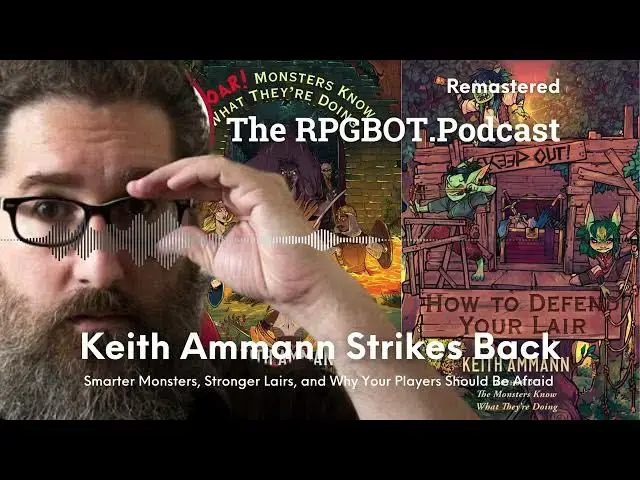
KEITH AMMANN STRIKES BACK (Remastered) – Smarter Monsters, Stronger Lairs – RPGBOT.Podcast S5E17
Jun 29, 2026

The RPGBOT.Podcast is back with a new episode, revisiting our masterclasses with Keith Ammann. This time, we're taking a deep dive into MOAR! The Monsters Know What They’re Doing and How to Defend Your Lair.
This episode originally aired on February 5th, 2025, and we're currently working to upload our episode backlog. For the latest from the RPGBOT.Podcast, find us in your favorite podcatcher.
Full show notes for this episode are available on RPGBOT.net: https://rpgbot.net/keith-ammann-strikes-back-remastered-smarter-monsters-stronger-lairs-and-why-your-players-should-be-afraid-rpgbot-podcast-s5e17/
Find us on socials and stuff:
🦋 https://bsky.app/profile/rpgbot.bsky.social
⏰ https://www.tiktok.com/@rpgbotdotnet
🔍 https://RPGBOT.net/
Show More Show Less View Video Transcript
0:20
Welcome to the RPGbot. News. I'm Randall
0:22
James and with me is Tyler Camstra.
0:24
>> Hi everybody.
0:25
>> And also Ashi.
0:26
>> Hail and well met dunge engineers.
0:29
>> And tonight we have a special guest with
0:30
us, Keith Almond. Salutations. Perfect.
0:32
All right, Tyler. What is happening?
0:34
>> Well, I'm very excited. Keith Almond has
0:37
joined us again on the podcast. If you
0:39
missed our previous episode with Keith,
0:41
Keith is the author of the blog The
0:43
Monsters Know What They're Doing, which
0:45
is absolutely fantastic and you should
0:47
go read it. He's also the author of the
0:49
book of the same title, The Monsters
0:50
Know What They're Doing, the sequel,
0:53
More The Monsters Know What They're
0:54
Doing, and Live to Tell the Tale: Combat
0:57
Tactics for Player Characters. And we've
0:59
brought Keith back on because he he has
1:01
recently published a new book, How to
1:04
Defend Your Lair. It's really good and
1:06
we're very excited to talk about it. and
1:07
we're going to talk to Keith about
1:08
what's in it today. All right. So, so I
1:10
did something a little self-indulgent,
1:12
so bear with me here. So, I pulled a I
1:14
pulled a cool reading from the book, and
1:16
I think this one is just on the book
1:18
jacket, so I don't think your your
1:19
publisher is going to get angry with me.
1:21
Keith, do you want me to read that bit?
1:22
Cuz I can do that bit. Yes, please. That
1:24
would be so cool. The world is a
1:26
dangerous place, especially when you're
1:28
up to no good. But even a person of
1:31
unblenmished character and sterling
1:33
repute may make enemies, especially
1:36
among those of more blemished character
1:38
and more tarnished repute. Perhaps your
1:41
deeds have intruded on someone else's
1:43
interests, or soon will, and they're
1:45
determined to stop you. Perhaps the
1:47
wealth you've amassed is becoming an
1:49
irresistible temptation to larsenous
1:52
minds. Perhaps you're making discoveries
1:54
that others would prefer to keep under
1:56
wraps or would appropriate for reasons
1:59
of their own. Whether you're a rampaging
2:01
monster, a renowned hero, a despised
2:04
tyrant, an ambitious schemer, a paranoid
2:08
recluse, or the current possessor of the
2:10
golden mcguffin. Someone's going to come
2:13
at you. Probably more than one someone.
2:15
You need to be ready. You need a lair.
2:20
>> I flubbed a couple of words in there.
2:22
No, it was perfect.
2:23
>> That was perfect. Perfect.
2:24
>> I'll do a second take if you need me to.
2:26
>> That was awesome.
2:27
>> So, yeah, let's hop into it. I guess I
2:29
want to ask the meta question and the
2:30
real question. So, the meta question is
2:32
why did you want to talk about layers
2:34
next? You know, with the history of your
2:36
work, it it wasn't necessarily that I
2:39
felt like that was the next thing I
2:42
needed to talk about. There was a there
2:45
was an article that I put on the blog
2:47
one time that was sort of a meta
2:49
article. Yeah. every every once in a
2:51
while I deviate from the basic monster
2:55
profiles and just start thinking out
2:58
loud onto the blog. And this came out of
3:00
one called thoughts on building
3:02
encounters where my mind was just
3:04
roaming around and I was thinking about
3:06
some issues partly related to defensible
3:09
space. And so when I was thinking about
3:13
what topic to explore in my fourth book,
3:16
one of the thoughts that I had had was
3:19
expanding that out into a more thorough
3:22
treatment of how to defend a lair, how
3:25
to how to defend space. And I think I
3:30
threw up a survey on Twitter and
3:32
included that with a couple of other
3:34
options. And that was the one that got
3:36
the strongest response. And I took that
3:39
as a mandate to go ahead and develop it.
3:41
>> Awesome. And then let's hop into the
3:43
real. Why as a monster or or a being do
3:47
I need a layer? Well, and the answer is
3:49
to defend assets. And that's something
3:52
that I address most extensively in the
3:56
first chapter of the book, which is all
3:57
about the the basics. And the two most
4:02
salient basics, the two most fundamental
4:05
fundamentals are the three components of
4:09
a defensive plan and what are assets and
4:12
how do you determine their value. So the
4:15
the basic elements of any defensive plan
4:17
are detection, deterrence, response. You
4:21
have to know that somebody is coming for
4:24
you or may be coming for you. You have
4:26
to have something in place to discourage
4:29
them from doing that and or slow their
4:32
progress. And if they do breach the
4:36
envelope, you have to have a way of
4:38
countering that. So that's detection,
4:40
deterrence, and response. And then
4:43
assets are anything that is anything
4:47
that's of value to you. Anything that
4:50
you have that you don't want to be
4:52
deprived of. So they might be something
4:55
intrinsically valuable like your own
4:57
life. It might be something of monetary
5:00
value like a large cash of treasure. It
5:03
might be something of economic value,
5:06
something that you use to produce wealth
5:08
or some kind of investment that's going
5:12
to increase in value over the long term.
5:15
It might be something of operational
5:17
value, something that you use in your
5:20
activities and can't do without. It
5:22
might be something of regulatory value,
5:27
something that entitles you to act
5:29
within the cover of law. Or it might be
5:33
intangible value, which means basically
5:36
it's not valuable for any other reason,
5:38
but it just holds a special place in
5:41
your heart.
5:41
>> And my enemies want might want to take
5:43
this away from me just to hurt me. I
5:45
better protect it.
5:46
>> Possibly. Yeah, possibly. Yeah. I mean,
5:48
your freedom could be an an in something
5:51
of intangible value, you know, or it
5:53
could be a a collection of saded kitten
5:56
figurines, you know, you don't know, but
5:57
the but but it's it's something that is
6:00
important to you for some personal
6:02
reason. And so all of these different
6:07
types of value are things that that
6:10
might make an asset something that you
6:14
consider to be worth protecting. Now, if
6:16
nobody's ever going to come after it,
6:18
then you don't really have to do
6:21
anything to defend it. If you don't have
6:23
to worry about it being taken, you don't
6:25
have to protect it from being taken. So,
6:27
you want to focus on things that are
6:30
valuable, vulnerable, andor critical.
6:34
And and and what I'm recommending in the
6:36
book is that game masters and I say game
6:39
masters instead of dungeon masters
6:41
because although the examples I use in
6:43
this book are D and D fifth edition
6:46
examples, the issues that I'm discussing
6:50
are not exclusive to D&D at all. They're
6:52
they're more broadly applicable to other
6:55
tabletop role playing games than my
6:57
previous works have been. But when when
6:59
you are planning a a villain base, a a
7:04
location where a uh an antagonist is
7:07
conducting its activities to to give
7:10
that measure of ver similitude that's
7:12
always so important to me and is
7:15
presumably important to other game
7:17
masters since they buy my books. You
7:19
want to begin with the fact that your
7:22
villain, your antagonist has these
7:24
assets that they or that it wants to
7:28
protect. And so the function of the lair
7:33
is to provide that protection. So given
7:37
what the villain cares about and is
7:40
capable of, how is that villain going to
7:44
construct the defenses and what are
7:46
those going to look like? So, I'm going
7:48
to ask a a very very basic question. How
7:51
do we define a layer? Like, is my
7:54
basement a layer? Can my basement be a
7:56
layer? Your basement can be a lair if
7:58
it's a place where you conduct your
8:01
activities and defend those activities
8:04
from intrusion. I don't think you
8:06
necessarily even do my kids count as
8:09
intrusion
8:09
>> potentially if you know if they're
8:11
threatening your assets. Uh,
8:13
>> oh well I I you know I I assume in all
8:17
of my sample layers in the book that the
8:20
antagonist lives in the lair, but that
8:23
doesn't necessarily have to be the case.
8:26
It complicates things if they don't live
8:29
in the lair because it means that they
8:32
have to be going in and out on a fairly
8:34
regular basis and while they're gone,
8:37
they have to have some other means of
8:39
protecting it. But generally speaking, I
8:41
would I would say the key things are
8:43
that you conduct your activities there,
8:45
you keep your assets there, and you
8:47
defend your assets using the
8:51
characteristics of the layer itself and
8:53
the terrain around it. So obviously
8:55
human a lot of humanoid antagonists will
8:58
have a type of layer like the evil
9:00
wizard or you know the evil band of
9:02
bandits or whatever. What but what kind
9:04
of creatures would you say typically
9:06
have layers? Obviously, the first one I
9:08
would think of is dragons, but obviously
9:11
not every creature would have the means
9:13
to make a lair.
9:15
>> Yeah. And having a lair isn't
9:18
necessarily a function of intelligence
9:22
or sapiens, but an intelligent or
9:25
sapient antagonist is definitely going
9:28
to be more likely to have a lair than
9:30
just a beast, a plant. I don't think
9:33
you're going to have too many ooze
9:36
layers.
9:38
Although coming up with one might be a
9:40
really interesting exercise. But the
9:43
thing is an ooze. What kind of assets is
9:46
an ooze going to a crew? You know what
9:50
are they going to collect?
9:53
>> You know snacks.
9:55
>> The most the most interesting ooze that
9:58
I think you have in the in in fifth
10:01
edition Dn D is the Oblex. And the oblex
10:05
isn't collecting anything tangible. It's
10:08
collecting memories. It collects those
10:10
inside itself. So it doesn't necessarily
10:13
need a layer for any purpose except
10:17
possibly defending its own life. But any
10:21
kind of antagonist that's engaging in
10:26
ongoing activity, it's going to need a
10:28
place to do that. If it's amassing
10:31
wealth or resources or what have you,
10:35
anything valuable, anything vulnerable,
10:38
anything critical that is going to call
10:41
for the building of a lair. So would you
10:43
say there's like a distinction between a
10:45
a creature's home or its den, let's say,
10:48
and a lair? Like obviously an owl bear
10:51
or just a bear might have a den that it
10:53
goes to to hibernate. And you mentioned
10:54
the oblex, which it only really has to
10:56
defend its life. So it might set up shop
10:58
in a place where it can defend itself,
11:00
but it doesn't have anything tangible.
11:02
So would you say that like the
11:03
difference between like just a home base
11:05
and a lair is the tangible stuff that
11:08
the the creature is trying to protect?
11:11
There's that and there's also the fact
11:12
that for example a bear has a den, but
11:16
it's not conducting its bear activities
11:20
in that den.
11:21
>> The den is just a place where it goes to
11:24
sleep. It doesn't even have to really
11:27
construct any defenses for it. The bear
11:30
is the bear's den defenses, you know.
11:34
It's not it's not setting traps.
11:36
>> It's pretty much the bare necessities
11:37
and that's it.
11:38
>> Yeah.
11:42
Forget about your worries and your
11:45
strife. Oh, yeah. So, yeah. So, so your
11:49
basic your basic predatory monstrosity
11:53
is not going to have much need for a
11:56
lair any more sophisticated than, like
11:58
you said, a bear's dent. It's when it's
12:01
it's when you're gathering assets and
12:04
using them for something that the
12:07
building of a layer becomes necessary.
12:09
>> So, let's actually let's hop into that.
12:11
What is the advice in the book that you
12:13
give about how to construct a layer?
12:15
Well, there are multiple chapters on
12:18
that beginning with the fundamentals of
12:20
detection, deterrence, and response
12:22
talking about uh what kinds of assets
12:25
you have and their relative value and
12:28
prioritizing
12:30
the defense of those that are most
12:33
valuable, vulnerable, and critical. And
12:35
in order to do that, you always want to
12:37
start by by sorting the relative value
12:41
of the different assets. So you want to
12:43
know which one is most valuable and then
12:45
look at that first and say how
12:48
vulnerable is this, how critical is
12:49
this? And then work your way down the
12:51
list to figure out where you need to
12:53
devote your resources because your
12:55
resources are finite and defense is an
12:58
exercise in risk management. You cannot
13:01
eliminate the risk. You can only manage
13:05
the risk. you can defend against the
13:08
risks that you think are most likely to
13:11
come to pass and devote the most
13:13
resources to those. And then well, okay,
13:16
this could happen, but it's a lot less
13:19
likely if it's if it's, you know, if the
13:23
consequences of of a breach like that
13:26
would be serious, then yes, you have to
13:28
devote some attention to it. But you're
13:30
not going to devote as much attention to
13:32
that. You're not going to devote as many
13:33
resources to that as you devote to the
13:38
intrusion attempt that's going to be
13:39
most likely, the threat that's most
13:41
likely. You want to examine the various
13:44
weak spots in your defense, which are
13:47
going to include things like when people
13:51
or goods have to move in and out of the
13:53
lair. How do you handle that? What do
13:56
you do when you're asleep? What do you
13:58
do when you're away? What do you do when
13:59
you have a legitimate guest? those kinds
14:02
of things. You want to look at the
14:04
various forms of magic that you can use
14:08
in your defense. If if yours is a
14:11
magical campaign, and especially if
14:12
yours is a high magic setting, you
14:15
really need to think about that. what
14:17
kinds of hired minions you're going to
14:20
have to conduct your your defense. What
14:24
kinds of native creatures might exist in
14:29
the land around your lair that provide a
14:32
measure of protection, not because
14:34
they're loyal to you, but just because
14:37
they are out there and they present a
14:40
threat to anyone who tries to intrude
14:42
upon you. You want to have a battle
14:45
plan. If you if you consider it
14:48
important to question prisoners, you
14:51
need to have some knowledge of effective
14:54
interrogation, which is not simple and
14:57
brute force is not an effective way to
14:59
do it. So, and and and terrain is very
15:03
very important because different types
15:05
of terrain impose different requirements
15:09
upon you as the owner and builder of the
15:12
lair. They also often times, especially
15:16
in more hostile environments, are a
15:18
component of your deterrence. If you're
15:21
in an Arctic or a desert or a swamp
15:24
location, if you're underground or
15:26
underwater, the terrain itself is a very
15:30
important part of your defense. I really
15:32
enjoyed the section in the book on
15:35
picking a location for your layer.
15:37
There's a Do I get to call it a sidebar?
15:39
It's a couple of pages of text. I anyway
15:42
it's there's a section in the book on
15:44
some rules Keith that you wrote for
15:46
handling uh pressure underwater
15:49
>> dive trauma because yes exactly uh and
15:52
the fifth edition rules are just like if
15:54
you're 5t underwater or 500 ft
15:56
underwater whatever it's fine so you
15:58
introduce some really really cool rules
16:01
for that and I think for for people
16:04
looking to you know plunder an
16:05
underwater layer I think that's going to
16:07
add some really really cool mechanics to
16:09
make that a lot more fun and then just
16:10
like, "Oh, this is basically flying but
16:12
wet." Yeah, that that I you know, I
16:15
didn't really have to do that part, but
16:17
I felt that, you know, I love that you
16:20
did. I hate coming into a setting and
16:24
seeing something that's just completely
16:27
implausible. And yet, well, there's
16:29
magic. Dragons fly. Okay. Yeah, there
16:32
are certain things we agree on that
16:34
magic does, but whenever
16:38
magic might make a dragon fly, but it
16:41
doesn't make 1,000 ft underwater not
16:44
1,000 ft underwater. Like, you know,
16:47
magic magic can enable you to breathe
16:50
underwater. And if magic is helping you
16:53
breathe underwater, then maybe it's also
16:56
protecting you from the pressure. Okay,
16:58
but what happens when you lose the
16:59
magic? you know, if you are 1,000 ft
17:02
underwater, something bad is going to
17:05
happen to you. And and I I really think
17:08
that that is one of the things, you
17:11
know, for example, the the fifth edition
17:12
dungeon master's guide makes a nod
17:15
toward the effects of high altitude.
17:18
It's very non-granular, but at least
17:21
it's there. But it doesn't talk about
17:23
the effects of water pressure even to
17:27
the extent that it talks about the
17:29
effects of cold thin air at high
17:31
altitude. And so I felt like I needed to
17:34
say, listen, your abil does not live at
17:38
the bottom of the ocean. Your crocken
17:40
does not live at the bottom of the
17:42
ocean. That is 20 or 30,000
17:46
ft down. 400 atmospheres of pressure, no
17:51
light, no oxygen. It is it is
17:54
impractical and infeasible to put a
17:57
layer here. However, the quote unquote
18:01
bottom of the ocean, if you go to a
18:03
continental shelf, it's only about 300
18:06
to 700 ft deep. Well, now this is
18:09
workable. This is actually doable. a
18:13
person could, if they were very
18:15
well-trained and and were willing to put
18:17
their lives at risk, could free dive to
18:21
that depth, even without magic, can be
18:24
done. So, let's talk about then if we're
18:27
having a layer on the bottom of the
18:28
ocean, saying that this part of the
18:31
ocean is over a continental shelf, and
18:33
let's go from there. And then let's talk
18:35
about what is it going to take to reach
18:37
this depth if you don't have water
18:39
breathing or if your water breathing
18:41
goes away. And from the creature's
18:43
perspective, like I I'll offer an
18:45
example. The green hag is amphibious. It
18:46
can breathe underwater.
18:47
>> Mhm.
18:48
>> And so having a green hag or a green hag
18:50
coven as a monster where they're they're
18:52
stealing things. They're they're
18:53
gathering, you know, maybe they're
18:55
gathering folks and they're trapping
18:56
them down here. So the reason that you
18:58
want to go and you're going to take the
18:59
risk to go to their layer might be to
19:02
rescue some folks. there's a huge
19:04
advantage because if things start going
19:06
poorly for them, they can just flood the
19:07
space.
19:08
>> So what what is the player character's
19:10
plan at that point
19:11
>> building that layer would be a lot of
19:14
fun, but then we need to answer the
19:15
questions on the the world building and
19:17
the role playing side that you're
19:18
getting at. Okay, cool. How do they
19:20
leave? Do they just swim out? How do
19:22
they bring people? If they're kidnapping
19:23
people and bringing them, is there a
19:25
mechanism for getting things down there?
19:27
What are the goods that they have to
19:28
have? Are they bringing food? Are they
19:30
bringing food to feed the people they've
19:31
kidnapped? in the, you know, the story
19:33
that I've just created. Yeah. Walking
19:35
through all of this ultimately is going
19:38
to give the player characters the best
19:40
experience and is going to make the
19:41
world feel real and complete. I mean,
19:44
that's my point of view at least. Yeah,
19:46
I I agree with that. And just from a
19:48
defensive point of view, the dangers of
19:52
free diving beyond 30 to 60 ft are part
19:57
of the defense. They are part of the
20:00
deterrent. They are a threat that the
20:03
lair owner says, "You want to come at
20:06
me? You have to run this gantlet. You
20:09
know, you have to you have to deal with
20:12
these obstacles that are in your path.
20:15
Find a way to do it."
20:16
>> Now, I'm curious. What creatures would
20:18
you put at like the the insane deep
20:22
depths of the ocean?
20:23
>> At the insane deep depths depths like
20:26
the the 20 30,000 ft.
20:28
>> Yeah. Do you think like can you think of
20:30
a creature that might put a layer down
20:32
there? Like real world animals, they get
20:34
real weird down there like the
20:36
>> the thing is even like your your your
20:39
giant squids and things like that. They
20:42
don't go that low. They they don't I
20:44
don't know exactly how deep they go. I'm
20:46
not a marine biologist. Yeah. This is
20:48
the kind of thing that I like this is
20:50
the kind of thing I look up and then I
20:52
write about it and then I forget about
20:54
it. But I mean down, seriously down on
20:57
the bottom of the ocean, you are not
21:00
looking at giant squids. You are looking
21:04
at bacteria. You're looking at these
21:07
microorganisms that that gather around
21:11
geothermal vents. You know, you're
21:13
looking at tubeworms. You're not looking
21:15
at at something that might be doing
21:18
something interesting enough for player
21:20
characters to break in on. I'm actually
21:22
wondering I'm trying to think through if
21:24
there's any Spell Jammer monsters that
21:25
you would have like a reasonable thought
21:26
that maybe they would do fine at that
21:28
kind of depth. But then I'm also
21:29
thinking of like the Futurama jokes
21:31
about, you know, how well do you expect
21:32
a spaceship to do at the bottom of the
21:34
ocean? Not great at all. It's not what
21:35
they're built for.
21:36
>> Yeah. Because spaceships are built to
21:39
resist absence of pressure outside.
21:42
>> Yeah.
21:43
>> Not crushing pressure outside.
21:45
>> Not just all the pressure. Yeah.
21:47
>> Cool. No, I I think if you if you want
21:49
to go to a a land that is completely
21:53
dominated by Krakens and and things like
21:56
that, you go to the elemental plane of
21:58
water.
21:58
>> Yeah. Where, funnily enough, you don't
22:01
have dive trauma because there's nothing
22:04
but water in every direction. So,
22:08
there's basically no gravity.
22:09
>> Yeah. Hey, hope you're not afraid of
22:11
deep water.
22:12
>> Yeah.
22:14
>> For the wind.
22:16
>> Yeah. Oh god,
22:18
>> I'm I'm afraid of that.
22:20
>> Subnotica.
22:21
>> Yeah.
22:21
>> Yeah.
22:23
>> So Keith, you you also talk about
22:25
construction of more mundane layers,
22:29
specifically castles based on real world
22:31
castles. And me as someone who's read
22:33
lots of things about Dn D, I still found
22:35
myself learning a like a ton of stuff
22:38
that I just didn't know about real world
22:40
castle construction. like the the Mont
22:42
and Bailey style castle. I don't know
22:45
how I'd never encountered that concept
22:47
before. It feels kind of obvious in
22:48
retrospect, but like that is like the
22:50
floor of the learning of like how these
22:51
things were constructed, why, what
22:53
materials were used, where they were
22:55
placed, and then like you go into more
22:57
and more detail on a lot of these like
23:00
important architectural features for
23:02
these castles and why they were there.
23:05
And like it's such a good example of why
23:09
a real world person would need what is
23:12
functionally a layer. Like I have to
23:14
defend either something inside this
23:16
castle or the things around this castle
23:18
or potentially both. The emphasis on
23:22
what building materials were available.
23:24
Like I found that really really
23:25
insightful. And I feel like that adds a
23:28
ton of detail to my my antagonist is
23:32
building their lair in the middle of a
23:35
desert. And I don't know, why not just
23:38
make it out of wood? That makes sense,
23:40
right?
23:40
>> Yeah.
23:41
>> Yeah. And I do make the point in the
23:42
book, a castle is not a lair, and a lair
23:45
is not a castle. They have things in
23:47
common. What a castle represents is the
23:50
the state-of-the-art of defensive
23:53
architecture around the end of the
23:55
medieval period, beginning of the
23:57
Renaissance period, which is a setting
23:59
that a lot of D&D settings emulate. A
24:02
castle was both defensible space and a
24:06
very public place. It was also in some
24:09
cases an act of conspicuous consumption.
24:12
Generally speaking, if you're a role-
24:14
playinging game villain creating a lair,
24:17
conspicuous is not what you're going
24:19
for. Public is not what you're going
24:22
for. You can still use the same
24:25
architectural elements to defend your
24:29
space. And when you look at the various
24:31
forms of castles and whatnot and you
24:35
look at the role of the tower and then
24:37
you think about something like the
24:39
wizard's tower, what's the benefit of
24:42
just building a tower that doesn't have
24:46
a wall around it? The function of a
24:49
tower is detection. You put your
24:53
soldiers at the top and they can see
24:55
farther. And so if somebody's coming at
24:58
you, they see them coming. Why does a
25:01
wizard need that, you know? Oh, the
25:03
wizard has the tower to conduct his
25:06
experiments in seclusion. Why doesn't he
25:08
just have a cabin, you know? Why doesn't
25:11
he You got to climb those stairs for
25:13
>> Why not just dig something underground?
25:16
Alternatively,
25:18
what if the wizard acquired this tower
25:22
from a local noble who didn't need their
25:24
castle anymore? Well, okay. So, now
25:26
they've got the tower, but they've also
25:28
got a wall around the tower because
25:30
that's what was there before. How are
25:32
they going to use that wall to protect
25:35
their privacy? And so you you can you
25:38
can take some of this information about
25:41
the forms and functions of castles and
25:44
extend it into well now we not only have
25:48
an explanation for why this wizard is in
25:51
a tower, but we also have some uh
25:54
vestigial stuff around that allows the
25:57
wizard to defend this tower in some ways
26:01
that you might not otherwise think of.
26:03
So, I'm I'm going to point to one of the
26:04
examples from the book because the book
26:06
includes a bunch of flares, and we'll
26:08
touch on those some more in a bit. One
26:10
of the examples is a wizard's tower,
26:12
just as you described. A wizard has
26:14
acquired the tower. It has a wall around
26:17
it, and the wizard has turned that into
26:20
their home base to do their experiments
26:21
and all those things. Like, you you read
26:24
through the entire book, you learn all
26:25
these things, you learn all these things
26:26
like, "Okay, I have the theory here. I
26:28
think I get it." And then like you hit
26:30
the examples like, "Oh, this all makes
26:33
perfect sense as it's laid out in front
26:34
of me. You've got like the the assets
26:37
listed out and the structures and the
26:38
defensive plans. Yeah, it absolutely
26:41
makes a lot of sense. I agree with you.
26:43
Why would a wizard have a tower other
26:45
than that maybe the top looks kind of
26:47
like a wizard's hat and that might be
26:48
neat?" Now, if the wizard is working in
26:53
somebody else's castle, Yeah. If it's
26:55
not the wizard's castle, but the wizard
26:58
just has a place in the castle. Well,
27:00
now now the tower is a pretty attractive
27:03
place because it's private. It's out of
27:06
the way. Towers in castles tend to be
27:10
some of your more inaccessible
27:12
locations. So, you've got you've got
27:14
some privacy. You got some seclusion.
27:16
People are not going to interrupt you if
27:18
you are all the way at the top of the
27:20
tower. They're not going to be heading
27:21
through the tower on their way to get
27:23
somewhere else. In that I think that may
27:26
actually be like the context where the
27:28
original wizards tower trope came from.
27:31
Wasn't originally the wizard owned the
27:34
entire place. It was probably
27:36
originally, you know, the wizard had a
27:38
role to play in this castle that
27:40
belonged to somebody else. But in any
27:43
event, we have this trope. Now, let's
27:45
figure out how to make it make sense in
27:46
the context. Well, and yeah, like when
27:48
when a fireball takes out a wall, it
27:50
isn't taking out the main wall of my
27:52
castle. It's up and away from other
27:53
people to where people aren't going to
27:54
die. You know, I I would argue one of
27:56
the best assets that a wizard likely has
27:58
is their secrets.
27:59
>> Yeah. And so having this place where you
28:01
can keep your secrets locked in, locked
28:03
down where people can easily get access,
28:05
yet still being able to get the things
28:08
you need, being able to make requests of
28:10
the king or the noble that I need these
28:12
materials and these materials and these
28:13
materials if you want me to solve that
28:15
problem that I'm pretending to solve for
28:17
you or maybe legitimately solving but
28:20
doing it in my own way on my own time.
28:22
Yeah.
28:22
>> Yeah, that's what I said. Yeah. And uh
28:25
and you know I I I I whimsically refer
28:29
to assets as generally falling into
28:32
three categories that I call the three
28:33
L's. Loot, life, and lore. Pretty much
28:37
every creature, aside from your
28:40
brainless undead, care about their own
28:42
lives. Many creatures care about their
28:45
loot. Not everyone cares about lore, but
28:47
a wizard definitely would. We've talked
28:49
a lot about defending your letter, you
28:51
know, like putting defenses and how to
28:53
keep people out, but is there value in
28:56
having an exit strategy? Like let's say
28:58
that they've gotten past all your
29:00
defenses. Is it is it something that a
29:02
person would actually think about?
29:04
Because you said like a person builds a
29:06
layer for the sole purpose of protecting
29:07
an asset and if they're fleeing, it's
29:10
probably because they might be
29:12
abandoning that asset.
29:14
>> Absolutely. Absolutely. you need to
29:16
think about retreat. And there are a few
29:19
things to be factored into that
29:21
equation. One is whether the environment
29:26
around your layer is one that you're
29:28
adapted to or if it's one that means
29:32
certain death just as much as sitting
29:34
tight and dealing with the intruders
29:36
does. For example, if you have a desert
29:40
layer and you're not adapted to the
29:41
desert, chances are you have built your
29:44
layer over a source of water. And if you
29:47
abandon the lair, you're leaving your
29:49
water behind and you better have
29:52
someplace to go where you can get
29:54
yourself water or you're dead for sure.
29:57
So the owner of a desert lair, unless
30:00
they are specifically adapted to living
30:02
in the desert, is going to be much more
30:04
likely to fight to the death to defend
30:07
that lair than somebody who is, you
30:11
know, just defending, for example, an a
30:14
former monastery in a in a in a
30:17
woodland. There's also when when it
30:20
comes to when you do that asset
30:22
valuation, when you go through all of
30:24
the different things that you're trying
30:26
to defend, what you're going to see is
30:29
that some of them have greater relative
30:32
value than your own life. Now, does that
30:34
mean that you'll die to protect them?
30:37
Maybe, but not necessarily. What it
30:40
means is that you are going to invest
30:43
more resources in their protection than
30:46
you're going to invest in your own life.
30:48
Like you might you personally might own
30:52
a piece of jewelry or a a I don't know
30:55
some some other thing very expensive
30:58
that you think I need to protect this
31:00
from burglars. So, I'm going to invest
31:02
in a safe. I'm going to put it in a wall
31:04
safe. I'm going to spend about $1,500 on
31:07
this wall safe. Maybe you have never
31:09
spent a single penny protecting your own
31:12
life. But does that mean that you value
31:15
your own life less than you value this
31:19
piece of jewelry? No. It just means that
31:22
the jewelry has a certain kind of value
31:25
that you are willing to invest resources
31:29
into protecting. So now let's say that
31:33
your house catches fire. There are lots
31:35
of things that you own that you consider
31:38
valuable to some extent or another that
31:41
you are not going to take with you, but
31:43
you might take the time to grab this
31:45
piece of jewelry and take it with you.
31:47
And so that's that's where the escape
31:51
plan and the need to protect assets
31:54
intersect. There are some things that
31:58
you will be sure to take with you when
32:00
you flee. And there are other things
32:02
that you'll say, "These are not
32:04
important. They're certainly not as
32:06
important as saving my own skin. I'm
32:09
going to leave them behind, but this
32:10
other thing I'm going to take with me."
32:12
Like, if you're a wizard, you're going
32:14
to take your spell book. You may care
32:15
about nothing else, but you're going to
32:17
take your spell book. There may be
32:19
intangibles. You know, you might there's
32:22
there's a line in the analcts of
32:24
Confucious about uh there being a fire
32:28
in a stable and Confucious asks, "Is
32:31
anybody hurt?" He didn't ask about the
32:33
horses because to him, the people were
32:35
what mattered. The horses were just
32:37
possessions. What mattered was did they
32:40
save all the people. It's that kind of
32:43
calculus. You get into the head of your
32:45
antagonist and you say, "What are the
32:47
things that they will not abandon?" And
32:50
does this mean that they will stay
32:53
behind to protect them or does it mean
32:55
that they will gather these things up
32:57
and take them as they go?
32:58
>> Yeah, I think that makes sense. It's
32:59
It's funny that you talk about like
33:01
making sure the people are okay. In the
33:02
case of the wizard, it may be the case
33:04
that, you know, they don't care about
33:05
the hired guards. Whatever happens
33:07
happens. Did I get all my books out?
33:10
>> Yeah. Now on the other hand the guards
33:12
know that you think like that then they
33:14
become a security risk.
33:16
>> Yeah.
33:17
>> Anytime anytime you are hiring defenders
33:22
you have to make sure that they are
33:24
loyal because if you have a disgruntled
33:28
defender and a potential intruder
33:31
approaches that disgruntled defender and
33:34
makes them a better offer, your entire
33:37
security plan is at risk of falling
33:39
apart. No, that makes perfect sense. On
33:41
on the on the flip side though, for the
33:43
player characters, this is an
33:44
interesting avenue that they might
33:46
pursue. Yeah. On the way to the layer.
33:48
>> Absolutely. And if you want to create a
33:51
villain who is who has such a particular
33:56
kind of personality that they are going
34:01
to offend their underlings in that way,
34:04
that is going to be an Achilles heel for
34:06
them. So, at that point, should should
34:08
people with layers look at minions whose
34:12
loyalty can't be questioned? So, like
34:13
your your controlled undead, golems,
34:17
other constructs, like things that are
34:19
potentially even intelligent creatures,
34:21
but don't completely have free will to
34:24
go against the master. If creating or
34:27
recruiting that kind of minion is within
34:30
the range of your powers, absolutely,
34:32
it's reliable. If it's not within the
34:34
range of your powers, is it within the
34:36
range of your money? If it's not within
34:38
the range of your powers or your money,
34:41
all you got to fall back on is your
34:42
personal magnetism, and you'd better
34:44
hope it's up to the task. In that same
34:46
vein, let's say, we talked a lot about
34:49
wizards and stuff. How if I'm a mundane
34:52
person who can't use magic, but I have
34:54
money and I know that people who are
34:56
going to be storing my layer are using
34:58
magic, how do I counteract that? Well,
35:00
you can hire your own magical resources.
35:04
You and and you're almost you're almost
35:07
necessarily going to have to because
35:10
magic is such a paradigm changer. It's
35:15
such a shift in the balance of power.
35:17
That's really one of the problems with
35:21
introducing magic to any setting is it
35:24
becomes an arms race. And the more high
35:27
magic you're setting, the more everyone
35:30
in that setting needs to protect
35:33
themselves from magic to the greatest
35:36
extent to which they're capable. So even
35:39
a commoner is wearing wearing some
35:42
little talisman made by the neighborhood
35:44
hedge witch to protect them from the
35:47
most, you know, to protect them from
35:48
bane spells. For example, a noble is is
35:51
going to wear some kind of thing that
35:54
keeps them from being scried on, that
35:57
keeps them from being restrained. You
36:01
know, everybody is going to need some
36:03
measure of magical protection if there's
36:05
too much magic in the world. At the same
36:08
time, the more magic you have, that
36:11
wildly multiplies the different ways
36:14
that magic can be used offensively, and
36:17
it becomes extremely complicated. It's
36:19
it's one of the reasons why I personally
36:23
favor more anchored high fantasy
36:26
settings as opposed to the wild high
36:30
magic settings in in which, you know,
36:33
everybody's got some kind of magic. I
36:35
feel like the number of people in a D&D
36:38
setting who are capable of casting
36:41
spells should be more or less like the
36:43
number of people in our society who have
36:45
PhDs. Like they're there. You can find
36:48
them. You know, you can track them down
36:50
by reputation and and hire them to
36:52
perform services for you. They're by no
36:55
means common. There's not one on every
36:57
block. I think I think that's the happy
36:59
medium.
36:59
>> Yeah. Otherwise, you got everybody and
37:01
their neighbor has a huge nuclear weapon
37:03
that they could just go off at any time.
37:07
>> Yeah. Like what's everybody toiling for?
37:09
There's wizards everywhere. Just solve
37:10
the problems.
37:13
>> Well, I mean, Eberon tried
37:14
>> and I mean, Eberon is a good setting and
37:16
it and it kind of shows you just how
37:18
crazy that can get.
37:20
>> Yeah. The last war where all the wizards
37:22
got into an arms race and then wiped out
37:24
a continent. It's way more complicated
37:26
than that.
37:26
>> Fantasy World War I.
37:29
Yeah.
37:31
>> Yep.
37:31
>> Keith, I'm I'm hoping you can help me
37:33
troubleshoot a very very specific thing
37:35
that I always have trouble with in
37:37
layers. Teleportation circles. They
37:40
they're a great convenience if you plan
37:42
to do a lot of teleporting to various
37:44
places, other planes of existence. Like
37:47
I want to go to the city of brass and do
37:49
some shopping. I'm going to use a
37:51
teleportation circle cuz I can get
37:53
myself and my my entourage and whatever
37:56
there conveniently. one spell slot or
37:58
whatever. The way that you reach a
38:00
teleportation circle is using a rune
38:03
sequence. It's right basically a phone
38:05
number. You call out in the book.
38:07
Security by obscurity is not security.
38:10
So, at some point, someone is either
38:12
intentionally or accidentally going to
38:14
figure out that rune sequence for your
38:16
teleportation circle. So, how can I have
38:19
a teleportation circle in my lair in a
38:23
way that's not just going to create a
38:25
ticking time bomb where somebody's going
38:27
to show up in my house uninvited? Well,
38:29
you've got a couple of you got a couple
38:31
of spells for that purpose. You've got
38:34
private sanctum. You've got guards and
38:36
wards. You've got forbiddance. All of
38:38
which can be used in in different ways.
38:41
Forbiddance is more specifically for
38:44
supernatural threats. celestials,
38:46
fiends, fay, you know, private sanctum
38:50
and guards and wards are more
38:52
multi-purpose. But another simple thing
38:55
is you put your teleportation circle
38:58
where somebody's always watching it and
39:01
you you make sure that there is is
39:04
always somebody someone or something
39:08
that is watching for anyone unauthorized
39:11
to come through that teleportation
39:13
circle and you're prepared to deal with
39:15
them. You have a plan for dealing with
39:16
them. You might put that you might put
39:19
the teleportation circle inside a room
39:22
that has an arcane lock on the door or a
39:25
glyph of warding or a or a symbol. And
39:30
nobody leaves the teleportation circle
39:32
room without going through that without
39:37
without having to cross that particular
39:39
barrier. If that's not within your
39:41
budget, maybe you just put an alarm
39:44
spell on the door. So at least when
39:46
somebody comes out of the teleportation
39:48
circle and walks out the door, you know
39:50
they were there. And you know, something
39:53
like that is simple enough to put into a
39:57
magic item. And I include a magic item
39:59
that is basically like an
40:01
over-the-counter alarm spell called
40:02
trespasser's bane. You may not be able
40:04
to shut the teleportation circle off
40:07
completely if somebody gets their hands
40:09
on the sigil sequence, which by the way
40:12
is itself a good adventure hook. The,
40:14
you know, trying to trying to get a
40:16
black market sigil sequence. But you
40:19
need to make sure that you have
40:21
detection, deterrence, and response
40:23
measures aimed at that vulnerability
40:25
itself. any kind of vulnerability that
40:28
you have, just go down to the micro
40:30
scale and say, you know, what kind of
40:33
detection, deterrence, and response do I
40:36
have on this particular point?
40:38
>> All right. Well, can we can we talk
40:39
about some of the example layers that
40:41
you have in the book?
40:42
>> Sure.
40:42
>> Awesome. So, I'm really excited. So, we
40:45
we caught you at Game Hole Con this year
40:48
and you were running some I believe you
40:51
called them Bust the Lair.
40:52
>> Bust my Lair. Yeah. Four events. I ran a
40:55
different layer in each event. And the
40:57
sample layers that I did at the con were
40:59
the wizard's tower, a hag coven cottage,
41:03
a grandmother hag dwelling, and a lich's
41:07
crypt.
41:08
>> Very cool.
41:09
>> Those are four of the 16 that appear in
41:11
the book.
41:11
>> Um, and how did people do on those at
41:13
the con, by the way?
41:14
>> Uh, we had two successful busts. one
41:18
that ran out of time, but I think
41:21
probably would have succeeded if they'd
41:23
had another hour and a half or so, and
41:25
then one group that failed.
41:27
>> Okay, I've got to ask, how did the
41:28
failure go? Like TPK, did they run away?
41:31
What happened?
41:31
>> They ran They also ran out of time, but
41:34
when they ran out of time, they were
41:36
trapped. They They were inside the lair.
41:40
The hag covens were coming at them from
41:43
one direction and there was a helmed
41:47
horror waiting in the other and if they
41:50
got outside there was a yard full of
41:52
awakened trees. I I don't think they
41:54
were getting out of that. I don't think
41:56
they were getting away with what they
41:57
wanted.
41:59
>> Yeah, that's rough. That is a rough
42:02
situation to be in. Holy.
42:05
>> Wow. Uh okay. So, so I'm a I'm a DM. I
42:10
have acquired your book and my players
42:12
know about this book because they listen
42:14
to this podcast or they follow you on
42:16
Twitter. Otherwise, just know about
42:18
things that are cool. How do I, as a DM,
42:21
convince my players to walk into a lair
42:25
knowing that I've read this book? Well,
42:27
I mean, they got to have a reason to go
42:29
in there, don't they? There's got to be
42:31
some kind of adventure hook that says I
42:35
mean when you think about it every not
42:38
every a very large proportion of D&D
42:42
adventures are lair busting they're
42:44
breaking and entering you are going into
42:47
a place and trying to snatch something
42:51
or kill something or learn something. So
42:54
this is not, you know, this is not
42:58
conflicting with that paradigm at all.
43:01
This is just giving a little bit more
43:04
plausible agency to the owners of the
43:07
location. This is giving them a little
43:09
more credit for having come up with a
43:13
decent plan to protect themselves. What
43:15
are you going to do? Say, "This is too
43:18
hard for us. I'm going to go home and
43:20
become a farmer." No, you're you're
43:22
adventurers. This is your job. Okay?
43:25
Some jobs are harder than others. It's
43:28
always harder when your opponent knows
43:31
what they're doing. So, you've got to
43:33
know what you're doing. You've got to
43:34
anticipate the kinds of things you're
43:36
going to run up against. You got to look
43:38
for alternative ways in. Everyone
43:42
Everyone who tries to break into a
43:45
castle, what's the first thing they say?
43:49
We got to find the back entrance and go
43:51
in that way. Of course. Of course. Now,
43:56
the unfortunate truth is that those back
43:59
entrances, which do exist, they're
44:01
called posterns, tend to be a terrible
44:04
way to try to get in because they are
44:07
very rarely used. And so the owner of
44:10
the castle can make it like large enough
44:13
to admit one person at a time and bar
44:15
the door from the inside and post two
44:18
guards on the wall directly over it
44:20
looking at it all the time. You're
44:22
actually better off trying to sneak in
44:24
the front door. But
44:27
>> this the the the kind of thinking, how
44:29
am I going to defeat the antagonist's
44:33
security measures? It's already part of
44:35
a role playinging gamer's thinking. So
44:37
this is just adding this is just adding
44:40
new wrinkles. But now one big wrinkle
44:43
that it adds is the idea of massing
44:45
combat power. Something like 80% of an
44:49
antagonist's
44:51
response force according to like actual
44:54
legitimate military doctrine which I
44:57
cite in the book is going to be
44:59
concentrated on the path by which an
45:02
intruder is most likely to follow. That
45:05
doesn't mean you're not watching other
45:07
approaches. It just means the approach
45:09
that they are most likely to follow, you
45:12
are throwing 80% of what you've got at
45:15
that. And that can lead to some really
45:17
deadly encounters, which I nicknamed the
45:19
wood chipper.
45:21
And it's it's a very careful act of
45:24
calibration to make sure that that super
45:29
deadly battle is survivable. If players
45:33
realize that their characters are in
45:35
over their heads, that it is
45:38
proportional to what the antagonist
45:41
could plausibly throw at the problem and
45:44
and that there are that that there is at
45:46
least one other way in that players
45:49
could conceivably discover. But I mean
45:52
if if people don't think about what the
45:54
nonobvious ways in are and they just try
45:56
to bowl their way in through the obvious
45:58
way then they are going to have a
46:01
problem on their hands and I think
46:03
that's as it should be. Yeah. I think
46:06
maybe the most interesting thing that
46:07
can come out of this or one of the
46:09
interesting things to me is as you say
46:11
you walk through no kidding how does
46:14
this layer function on a daily basis as
46:16
a GM look for the weaknesses in that and
46:18
how do you plant the hooks early in the
46:20
story so that there's opportunity to
46:23
guide the player characters to find out
46:25
that well there's a grain shipment that
46:27
goes in once a week and so maybe if they
46:29
talk to the right people maybe they can
46:30
smuggle weapons in maybe they can
46:32
smuggle themselves in the idea that
46:34
they're well Yeah, there there actually
46:35
is a back door. And actually, there's a
46:37
third back door. And the third back door
46:38
isn't very well guarded because, you
46:40
know, in the wizard's tower, the wizard
46:42
isn't aware this thing exists because it
46:44
hasn't been used since the the king's,
46:47
you know, great great grandfather used
46:49
it to escape. And you found that in a
46:50
library, right? Once you lay out how it
46:53
functions, you can then enumerate the
46:56
things that the player characters can
46:58
discover to then ultimately make this
47:00
entire experience of busting the layer a
47:02
lot more rewarding. All right. So, yeah,
47:05
due to time travel, I believe. So, the
47:08
book is out if you're listening to this
47:10
and you're out there, but for posterity,
47:12
what is the the book's release date?
47:14
November 29th. All right. So, the book
47:16
has just come out. This is November
47:19
30th. The book is released on November
47:20
29th. Where can folks find the book? Any
47:23
place you like to buy books. Independent
47:25
bookstores, Barnes & Noble, Amazon.
47:28
Check with your friendly local game
47:30
store if they work with ACD as a
47:34
distributor. That distributor carries my
47:37
previous books and I believe is stocking
47:39
this one as well. If not, your store can
47:42
order wholesale from Simon and
47:43
Schustster Distribution.
47:45
>> Awesome. All right. Well, Keith, thanks
47:46
so much for being with us tonight. Uh,
47:48
where can folks find you online?
47:49
>> Well, I don't know for how much longer,
47:52
but I am on Twitter at Keith Almond. I'm
47:57
I'm also putting my eggs in some other
47:59
baskets. So I am also on Mastadon at
48:04
Keith almond dice.
48:07
And also on CounterSocial at Keith
48:10
Almond also on co-host and you're
48:14
sensing the pattern in the usernames
48:16
there. My website is spyandowl.com
48:20
and my blog is still at
48:23
themonstersnow.com.
48:25
>> Awesome. And we will have links in the
48:26
show notes for folks who want to go find
48:27
Keith. You'll be able to find him. Yeah.
48:29
Again, thanks so much for being with us.
48:30
>> Thank you very much for inviting me. All
48:32
right. We did it. We did a pod.
48:33
>> Yay.
48:34
>> We did. I'm so excited. I forgot to make
48:36
I had Randall over I had Randall over
48:38
earlier today helping me unpack boxes
48:41
and I I pulled out all of the other
48:42
books. I was so excited.
48:46
>> I Yeah, I forgot to make a goof at the
48:48
beginning about the D and D movie got
48:50
delayed.
48:52
>> Yeah. It's like, hey, you know,
48:53
everybody, you know, it's rpgbot.news.
48:55
We all know why we're here. We're here
48:56
to talk about D and D moviebot.
49:01
News. I'm Randall James, your deficient
49:03
dungeon master. And with me is Tyler
49:04
Camstra.
49:05
>> Hi everybody.
49:06
>> And random pal.
49:07
>> Good afternoon.
49:08
>> And with us today, we have a special
49:09
guest, Keith Almond. How you doing,
49:11
Keith? I'm well. How are you doing?
49:13
Great. Doing great. Keith, tell us about
49:15
yourself a little bit. I I have been
49:16
playing Dungeons and Dragons since God's
49:18
Grandma was a little girl. I am the
49:21
author of the blog, The Monsters Know
49:23
What They're Doing, uh, The Monsters
49:25
Know.com, and the books, The Monsters
49:28
Know What They're Doing: Combat Tactics
49:30
for Dungeon Masters, the newly released
49:33
More Monsters Know What They're Doing,
49:35
and Live to Tell the Tale, Combat
49:37
Tactics for Player Characters. Awesome.
49:39
And yeah, so the the Moore has actually
49:42
just come out. So, we're recording this
49:43
in January 2022, and it came out in It
49:46
came out in January 2022. It was it was
49:49
due out uh it was due out November 30th.
49:51
It got grappled and restrained by the
49:53
supply chain Kraken and it came out
49:55
officially on January 4th.
49:57
>> Okay. Well, congratulations. I think
49:59
that
49:59
>> honestly I just have to say for this
50:01
time period having only been restrained
50:03
by the supply chain Kraken for like a
50:05
month and
50:06
>> I know a month and a week was was a
50:07
pretty good uh
50:08
>> was a pretty
50:09
>> it could have been way worse than that.
50:11
>> Yeah. So congratulations.
50:12
>> Thank you.
50:13
>> Awesome. So tell us about the book. it,
50:15
you know, the the original covered the
50:18
monster manual, some of the the material
50:20
on the back end, but this new book, it's
50:22
covering some newer releases that folks
50:24
would like to have access to. Right.
50:26
>> Right. The monsters know the first
50:27
volume is the monster manual. Complete
50:30
minus a couple of monsters that I did
50:34
not think anyone really needed me to
50:37
analyze for them. like the troglodite
50:39
which is a very very people ask me about
50:41
it all the time and I don't know why
50:42
because it's a totally autopilot
50:44
monster. There's there's nothing you
50:46
have to think about with respect to
50:47
troglodites. More monsters is the same
50:51
but for vololos and mortn kynans. And
50:55
again the only monsters I leave out are
50:57
ones that you really need no assistance
51:01
to figure out how to run. And there are
51:03
even a couple I throw in there that you
51:05
don't really need assistance to run
51:07
these, but I just throw them in because
51:10
I feel like people are going to ask me
51:12
about them if they're not there. And so
51:14
I take a moment to say, "Yeah, this is
51:16
this one's on autopilot. Don't worry
51:18
about it. This one is really more of a
51:21
hazard than an actual monster. That sort
51:24
of thing."
51:24
>> Okay. But more monsters includes a
51:27
little bit more sidebar content than the
51:30
monsters know. I go into more depth in
51:33
talking about my analytical process in
51:37
in an introductory section and I get to
51:41
something that people have been asking
51:44
me about for a long time and I had
51:47
resisted for a long time but I I needed
51:50
to add some more material to this one
51:52
and I thought well okay I'll go ahead
51:53
and do it and that is analyses of the
51:56
arch fiends the
51:58
>> okay
51:58
>> demon lords and the arch devils.
52:00
>> Yeah. And in the structure of the text,
52:01
you actually give it its own section on
52:03
the back end, right? What was the title
52:04
of this?
52:05
>> Well, the it's the monsters and then the
52:07
malifactors. That's all the that's all
52:10
the arch fiends.
52:11
>> Awesome. Awesome. And then you also had
52:12
material on you gave kind of a homebrew
52:15
solution for solving counter spell.
52:16
Yeah, because I I you know there's one
52:18
in Zanithars and it's okay. But one of
52:22
the things I find myself doing a lot is
52:26
running numbers, running probabilities
52:28
and and seeing what feels right, what
52:30
makes sense. And what I found with
52:32
Xanithars is I thought it made
52:36
identifying low-level spells a little
52:38
too hard and it made identifying
52:40
highlevel spells much too easy. And it
52:43
also didn't really give you a seamless
52:46
way to identify a spell and react to it
52:49
at the same time. And I thought there
52:52
ought to be some room in there to
52:54
account for the kind of automaticity
52:56
that comes with expertise. If you
52:59
yourself have cast a spell many times in
53:02
the past, you're going to know when
53:03
someone else is casting it. You're not
53:05
going to have to think about it. You're
53:06
going to see what it is and and say,
53:08
"Okay, I know what's coming." in in a
53:10
case like that, you should not have to
53:11
waste your reaction on identifying the
53:14
spell. You should be able to see it and
53:16
counter spell it in, you know, in the
53:18
same thought. And so my rule is slightly
53:23
more complicated than the Xanithar's
53:25
rule, but I think on the whole it's more
53:28
balanced and it's something that both
53:30
DMs and players could find more
53:32
satisfaction in. Yeah, I took a look at
53:34
the sidebar. I I haven't gotten all the
53:36
way through the first book yet. I'm
53:37
rushing to catch up, but the counter
53:39
spell sidebar is really good. The math
53:41
on it does make a lot more sense than
53:43
Xanithar's. So, for people who've used
53:46
counter spell and the Xanithar's rules
53:48
for identifying spells, definitely give
53:50
Keith's books a look. It's definitely an
53:52
improvement. Yeah, I thought, you know,
53:53
the biggest improvement is just the the
53:55
idea that you're you're scaling the
53:57
difficulty with the level of the spell,
53:59
right? I think that's the core of it.
54:01
>> Yeah, the base level of the spell. So if
54:03
you for example are a wizard and you see
54:07
someone getting ready to catch scorching
54:10
ray, you know, scorching ray is a second
54:12
level spell. So if you know second level
54:14
spells, you're going to be pretty
54:16
familiar with the forms of of that kind
54:18
of casting. But let's say they're
54:20
boosting it to fourth level. You're
54:23
still going to rec recognize what is
54:25
essentially a second level spell. And
54:27
you're also going to recognize that they
54:30
are doing something to turbocharge it.
54:32
All of that recognition is going to come
54:34
at once. It's not going to be more
54:35
difficult to recognize simply because
54:37
they're casting it using a fourth level
54:39
slot. If I understand correctly from
54:42
reading the the bits in in your
54:43
acknowledgements, it seems like you
54:45
skipped 3.x X largely, which is amusing
54:48
to me because basically you have
54:49
recreated 3.x's mechanics for
54:52
recognizing spells where like it was the
54:55
the DC was tied to spell level. And
54:57
honestly, I I think that a lot of us who
55:00
really enjoyed a lot of the crunch have
55:02
been slowly migrating house rules back
55:04
to some ways that 3.x added
55:07
vericilitude, which there's your
55:08
dictionary word for the day. Go listen
55:10
to our previous episode where we talked
55:11
about it. I I really like that aspect of
55:13
this and it's really interesting to me
55:15
to see the tactics that you have worked
55:17
out because 3.x where Tyler and I are
55:20
natives of was a a and it's hard to say
55:24
this because D and D has always been
55:25
very very crunch focused but 3.x was
55:29
kind of the absolute most chalk full of
55:31
combat mechanics that provided you this
55:34
option for really leaning into how to
55:36
make monsters tactically threatening.
55:39
And one of the one of the options that
55:41
has been changed a little bit in fifth
55:43
edition that my players are intimately
55:45
familiar with is ghosts hiding in
55:47
floors. I'm I'm curious as you came back
55:51
to fifth edition, was that what really
55:53
made you start thinking about I remember
55:55
what tactics were like in AD and D and
55:57
and now that these monsters work very
56:00
differently? Is this something that I
56:01
want to write up just like as a guide
56:02
for myself or was was the transition
56:05
between editions just sort of a footnote
56:07
as as you were thinking about this
56:08
stuff? Well, it definitely wasn't
56:11
attempting to hark back to the tactical
56:14
flavor of AD and D because at the time I
56:19
was 18 and our tactics consisted of get
56:22
them and run. So, you know,
56:28
>> it's definitely not it's definitely not
56:30
anything like that. But there there
56:32
there is one way in which it it harks
56:35
back to my AD and D experience and that
56:37
is the recollection that we didn't
56:40
really see in AD and D a whole lot of
56:43
difference between the various cannon
56:45
fodder type humanoids. The goblins, the
56:48
cobalts, the orcs, the lizard folk, the
56:50
nullles. There wasn't a whole lot to
56:52
make one of those feel very different
56:55
from another one. And when I got into
56:59
5e, which for the record, I immediately
57:04
appreciated for its streamlined quality
57:07
and the fact that it still gave you the
57:09
feeling of D&D without the quagmires.
57:14
>> That's a great way to describe it.
57:16
>> At least without as many of them, nearly
57:18
as many. And uh I mean the just just
57:21
tangentially the the fact that you can
57:25
know what your target number is, roll
57:26
against it, boom, without having to look
57:28
at a table on the dungeon master screen,
57:31
reducing all of the math to something
57:33
that you could do in your head was
57:35
essential. It was it was revolutionary.
57:38
It was essential and and I'm so happy
57:40
for it. Anyway, when I was running Lost
57:44
Mine of Fand Delver for my first 5e
57:47
group, which was my wife and a group of
57:49
her co-workers, we had our first
57:50
encounters with the goblins there. And I
57:53
felt very strongly that something was
57:54
missing, that that I was missing
57:57
something because I didn't really think
58:00
that I was getting the most use out of
58:04
the goblins. I felt like
58:07
there's something something missing
58:09
here. This doesn't feel right. This
58:12
doesn't feel convincing enough. I need
58:16
to know what it is about goblins that I
58:19
am failing to grasp. So that was when I
58:23
began really sitting down and looking at
58:26
the stat blocks line by line and trying
58:29
to figure out the implication of each
58:32
ability score, each tactic, each sense,
58:35
each action, and working that out in a
58:38
way that made sense to me. And I am a I
58:42
am a longtime language professional.
58:44
I've worked as an editor. I've been a
58:45
writer. And one of the ways I make sense
58:48
of things is just by writing it out. At
58:50
the same time, I was thinking I wanted
58:52
to get back into writing on a regular
58:54
basis that maybe I might want to start a
58:56
blog. I wasn't really sure what I was
58:57
going to write a blog about. But I was
58:59
starting to have these thoughts at the
59:02
same time and thought, "Okay, I can do
59:04
my thinking about this kind of stuff in
59:06
public, write it up for other people,
59:08
and maybe it'll be of some benefit to
59:09
them as well as to me." And turned out,
59:12
yeah, yeah, people did in fact want to
59:14
read that. So, yay for good decisions.
59:17
Absolutely. One of the things that I
59:19
thought was interesting in the new book,
59:21
you actually open it up with, I think
59:23
you even make the analogy, you know,
59:24
teaching folks to fish. You do this
59:26
analysis and you present to folks in in
59:28
a nice narrative form, you know, how
59:30
should each of these creatures behave?
59:31
What do we expect their battle tactics
59:32
to look like? But you actually open up
59:34
with saying, "Look, this is all I'm
59:35
doing. This is the process that I go
59:37
through, and I think that you could do
59:38
it yourself." I really enjoyed that
59:40
section. That's that's as far as I've
59:42
gotten in the second book.
59:43
Unfortunately, I skipped around a whole
59:45
bunch. I'm still trying to finish the
59:46
first one. Teaching that basic skill for
59:49
how to look at a new monster is really
59:50
helpful because it means people can open
59:53
up adventures or third party supplements
59:55
and look at a monster and say, "Okay,
59:57
what what would Keith do here?" and more
59:59
or less figure it out on their own. But
1:00:02
the like the full content of the book is
1:00:05
still a really really good resource.
1:00:07
>> Yeah. And you know, I I've been very
1:00:09
clear from the outset that I'm not
1:00:12
really doing anything that people
1:00:13
couldn't do for themselves, but at the
1:00:15
same time, I am all about saving people
1:00:18
trouble. To me, coming out with all
1:00:21
these combat tactics that people can can
1:00:24
think about in advance while they're
1:00:26
planning their sessions means that this
1:00:29
is less cognitive load for them during
1:00:31
the session itself. Because as dungeon
1:00:33
masters, we have to juggle a lot of
1:00:35
different things in our heads. We have
1:00:36
to track a lot of different things in
1:00:38
our heads and to have all of that
1:00:40
cognitive load going on and also have to
1:00:44
try to be making tactical decisions on
1:00:47
the fly that is a lot and it's going to
1:00:49
make it's going to result in poorer
1:00:51
decisionm. So, the more of these
1:00:53
decisions that you can make in advance
1:00:55
of your session and and already have
1:00:58
semiscripted or at least in the form of
1:01:01
maybe a quasi flowchart for yourself
1:01:04
that you can just refer back to, you
1:01:07
know, call up during the game, call up
1:01:09
the choices that you've already made.
1:01:11
It's a big labor saver. It's a big time
1:01:13
saver. It results in better decisions
1:01:16
overall combat encounters that are more
1:01:18
high speed, low drag. So, there are
1:01:21
always going to be tons of monsters out
1:01:23
there that I'm simply not going to get
1:01:26
to because I don't have the books
1:01:29
because maybe they are third party. I
1:01:33
know that's something you were going to
1:01:34
ask about. I generally avoid analyzing
1:01:36
third party content because frankly,
1:01:38
it's enough of a challenge to keep up
1:01:40
with Wizards of the Coast's own
1:01:41
releases, especially lately and
1:01:44
especially after I, you know, took off
1:01:47
13 months to try to get another book in
1:01:48
the can. So, uh, it wasn't meant to be
1:01:51
13 months. It just happened that way.
1:01:53
There's always going to be things I
1:01:54
can't get to. And so, I want to be able
1:01:56
to say to people, okay, here I am doing
1:01:59
all this stuff, serving it up so that
1:02:01
you don't have to, but for the things
1:02:03
that I'm not serving up, don't feel
1:02:05
lost. You can do this, too. Here's how.
1:02:09
>> Just a a really quick sidebar, the the
1:02:11
homebrew monster that you chose to to do
1:02:13
that with is terrifying, and I hate it.
1:02:15
Thanks.
1:02:17
>> I'm I'm glad. I'm glad. I was trying to
1:02:19
make something that would actually be a
1:02:20
little scary.
1:02:21
>> So, I want to I want to call back to
1:02:24
Lost Minds of Fandel, sorry, Lost Mind
1:02:26
of Fandelver because you called that out
1:02:28
as a good example. So, the goblin is the
1:02:30
first monster that you look at in the
1:02:33
first book. And I think that's a really
1:02:36
good example of what am I going to get
1:02:38
in this book? And when you look at
1:02:41
Keith, when you look at the tactics
1:02:42
you've described for the goblin, it's
1:02:44
immediately apparent that goblins are
1:02:46
terrifying. They are tricky and nasty
1:02:49
and they will mess you up if you're not
1:02:51
careful.
1:02:51
>> Yeah. I think one of the great things
1:02:53
about goblins as an introductory monster
1:02:56
though is that they teach you to be
1:02:57
careful.
1:02:58
>> Mhm.
1:02:58
>> You know, you can you can look at the
1:03:01
list of actions available to you in
1:03:04
chapter 9 of the players handbook and
1:03:06
not fully register how important some of
1:03:09
them are. Some of them are obvious,
1:03:10
attack, dodge, dash. Others are less
1:03:14
obvious. Fighting goblins teaches you
1:03:17
that hide and cert are very important
1:03:21
actions. If if you are in the thick of
1:03:23
combat, you need to use the hide action
1:03:27
to make an intentional stealth check.
1:03:29
You need to use the search action to
1:03:31
make an intentional perception check.
1:03:33
And if you are not using your stealth
1:03:36
and your perception checks, your hide
1:03:38
and search actions in a fight against
1:03:41
goblins, they're going to mess you up.
1:03:43
they're going to completely mess you up.
1:03:45
By and large, if if they are doing even
1:03:48
a halfway decent job on their own hiding
1:03:51
actions, on their own stealth roles,
1:03:54
your passive perception is not going to
1:03:55
be enough. You're going to have to make
1:03:57
some active perception checks in order
1:04:00
to figure out where those goblins are so
1:04:02
that you can fight back. Because if they
1:04:04
are hidden, you don't know where they
1:04:06
are. You can guess where they are. You
1:04:08
can make those attacks at disadvantage
1:04:11
and take the chance that you might be
1:04:14
shooting at an empty square or an empty
1:04:16
hex, but it makes a lot more sense to
1:04:20
search for them. Call out the locations
1:04:23
of the ones you see because talking is
1:04:26
always a free action. Talking is always
1:04:28
free. It costs no action economy. So
1:04:30
when you see where someone is, yell it
1:04:32
out. And then one of your allies can
1:04:35
then attack that spot. Even if they
1:04:38
don't see the goblin themselves, they
1:04:41
can attack that spot and know at least
1:04:43
that they are aiming their attacks in
1:04:45
the right place.
1:04:46
>> Yeah, that that makes perfect sense. And
1:04:47
I think you're hitting something we've
1:04:48
talked about on the podcast, I think,
1:04:49
quite a bit. 5 has a formula for
1:04:52
measuring challenge rating, for
1:04:54
measuring CR. We've talked about it to
1:04:56
some extent. Tyler recently built the
1:04:57
Monsterizer and launched this, which is
1:04:58
something you can go and you can build
1:05:00
your own. And it'll even show you like,
1:05:01
hey, the SRD says this ought to have a
1:05:03
challenge rating of of X, but when I
1:05:05
actually use the rules to calculate it,
1:05:06
it's why.
1:05:07
>> Goblins have huge error bars on their
1:05:10
CR. Yeah. Yeah. Yeah. How how effective
1:05:13
and efficient is your DM or how kind is
1:05:15
your DM depending on like the the party
1:05:17
acumen?
1:05:17
>> Mhm. But also, how shrewd are your
1:05:19
players? Because in live to tell the
1:05:21
tale, I use goblins for the first
1:05:22
example. And I use the typical walk
1:05:25
right up to the obvious bait. Then the
1:05:27
goblins attack and before you know it,
1:05:30
one of your party members is down and
1:05:32
out of the fight. And then I say, "Okay,
1:05:34
okay, okay, back up." Now, how should
1:05:36
you have approached this combat
1:05:39
encounter instead? And when the players
1:05:42
approach the combat encounter directly,
1:05:44
suddenly things are very much more in
1:05:47
their favor.
1:05:48
>> No, absolutely. And and just to to
1:05:49
reiterate it, so Live to tell Live the
1:05:51
Tale the Tale was your second book,
1:05:53
which is all about player character
1:05:55
combat tactics,
1:05:56
>> right? So the the question I want to ask
1:05:58
is how does as you write these tactics
1:06:00
and as you analyze these monsters, how
1:06:02
often do you find that look, if you
1:06:04
follow the right tactics, if if as a DM
1:06:06
you you play this out to the full
1:06:08
advantage, especially when you have a
1:06:10
full encounter, you have multiple
1:06:11
monsters, uh how often is it that you
1:06:13
look at the CR and you say that CR is
1:06:14
just wrong. Like this is never going to
1:06:16
work. Honestly, I never know until I'm
1:06:18
actually running the encounter. I I I
1:06:20
have very little intuition for that. I
1:06:22
will say though that analyzing some of
1:06:25
these creatures, the one that comes
1:06:28
immediately to mind from the monsters
1:06:29
know what they're doing is the shadow.
1:06:31
The shadow can really wreck a low-level
1:06:35
party. And in fact, I have only ever had
1:06:39
one TPK, and that was pretty close to
1:06:42
the beginning of Curse of Strod. And it
1:06:45
was an encounter with And it was an
1:06:47
encounter with shadows and the party
1:06:49
just got wrecked. So let me tell you
1:06:51
about my personal experience with that
1:06:53
encounter
1:06:55
because when you look at the CR for a
1:06:57
shadow, it is very misleading and there
1:07:01
is a particular room in Death House
1:07:03
where you're supposed to fight like four
1:07:05
of them.
1:07:06
>> Well, that's too many.
1:07:07
>> It's four. It's four or five. My DM
1:07:09
toned it down to one and it still nearly
1:07:12
killed somebody. This is a really great
1:07:14
example of just when you use a monster
1:07:16
tactically correctly, it can be
1:07:18
terrifying. Boy,
1:07:20
>> although that being said, I think that
1:07:22
if you actually do the encounter math on
1:07:24
that encounter, it does come up as a
1:07:26
deadly encounter.
1:07:27
>> It definitely should, but just this is
1:07:30
>> Yeah, right. This this is one of those
1:07:32
places where thinking about how are you
1:07:35
going to use this monster tactically.
1:07:36
Keith's content is great and knowing how
1:07:40
to use it best is a great baseline for
1:07:43
you to be able to say, "Okay, this is
1:07:45
how I would absolutely wreck my players
1:07:47
with it. Now, I have a top end of the
1:07:50
scale and I can scale it back down to
1:07:52
75%." You know, let's let's say I want
1:07:54
to not use this particular tactic
1:07:56
because floor ghosts will wreck your
1:07:58
day. I think that really this is the
1:08:01
best way to increase your skill ceiling.
1:08:03
And then you're going to need to feel
1:08:05
out where in their your party is
1:08:07
comfortable with a challenge you can
1:08:08
provide them.
1:08:09
>> Yeah. I'll I I'll ask a question. You
1:08:11
said you often don't know. You don't
1:08:13
have a feel for how difficult this is
1:08:14
going to be till you actually play out
1:08:16
the encounter.
1:08:17
>> Shadows were an exception to that.
1:08:18
>> Okay. How often do you get to DM? How
1:08:21
often do you actually get to play the
1:08:22
game and and test out some of these
1:08:23
tactics that you're putting together?
1:08:25
>> Every week, sometimes twice. I have
1:08:28
>> a dream. I'm in I am in four. A dream to
1:08:32
some, a nightmare to others.
1:08:36
I I have I have four active games going
1:08:40
right now, of which I am DMing three.
1:08:42
Wow. I play something every Tuesday and
1:08:45
Wednesday night. So, short sessions, but
1:08:48
every week. It can it can sometimes be a
1:08:50
little rough on on continuity, but at
1:08:54
least it Well, I mean, it's it's two
1:08:56
different types of continuity, you know?
1:08:58
It's keeping the flow of the story going
1:09:01
versus keeping the campaign itself
1:09:03
going. It's very good for keeping the
1:09:04
campaign itself going. It can it can
1:09:07
sometimes disrupt the flow especially
1:09:09
since a lot of the time we are
1:09:11
alternating campaigns week to week and
1:09:14
and so it you know there's some effort
1:09:15
involved in getting your head back in
1:09:17
the one you're playing on a given night.
1:09:19
>> Are you is everything 5e or you okay? D
1:09:23
IV, but there definitely are other games
1:09:26
that have been sitting on my shelf for a
1:09:28
long time that I would like to get into.
1:09:30
And the only way that's going to happen
1:09:31
is if I, you know, wrap up a couple of
1:09:34
these ongoing campaigns. So, as much as
1:09:37
I'm enjoying them, I'm also looking
1:09:39
forward to reaching the end of them and
1:09:42
moving on to other things. Well, and and
1:09:45
so kind of touching on on what I was
1:09:47
just talking about with raising the
1:09:48
skill ceiling to the part where you
1:09:50
really can wreck your players, I is that
1:09:52
a thing that you do frequently, like
1:09:53
with all this tactical knowledge in your
1:09:55
head, do you sometimes just maybe like
1:09:57
in in a bit of a a haze say, "Ah, yes,
1:10:00
my job today is to sit down and kill the
1:10:02
table and, you know, have that high
1:10:05
lethality or do you find that you do
1:10:06
kind of tend to tone yourself down from
1:10:09
all this tactical knowledge?" So, number
1:10:11
one, I'm actually kind of a softy. I
1:10:13
don't like to kill my players. I'm not
1:10:14
I'm not out to kill my players. What I
1:10:16
am out to do is thrill my players. I
1:10:19
want to make them feel like they are
1:10:20
earning their victories. But the other
1:10:22
thing is often times because of that, I
1:10:25
find myself having to make things
1:10:27
harder, especially at higher levels.
1:10:29
>> Okay.
1:10:30
>> The exercise I'm often finding myself
1:10:32
playing nowadays is how much can I pile
1:10:36
on in order to make them feel like they
1:10:40
earned this victory? because, you know,
1:10:42
especially once they get a few magic
1:10:44
items in their hands, they're just too
1:10:45
good.
1:10:46
>> Now, have you ever given magic items to
1:10:49
enemies in encounters and like has that
1:10:52
affected how you handle the tactics for
1:10:54
those monsters? Occasionally I will give
1:10:57
them magic items, but I mean it only
1:10:59
makes sense that you know, for example,
1:11:00
if you take a humanoid shaped adversary,
1:11:03
like a genie, and it's got magic items
1:11:06
in its treasure horde. Well, obviously
1:11:08
if if it found a magic weapon at some
1:11:10
point, it's going to carry it and use
1:11:11
it. You know, a monster smart enough to
1:11:13
collect and use magic items is going to
1:11:16
have something like that, but it's also
1:11:18
going to choose ones that make it better
1:11:19
at what it already does, right? There's
1:11:21
not usually going to be much impact on
1:11:23
the tactics because they're going to
1:11:24
double down on what they're good at. The
1:11:26
only difference would be if an item let
1:11:28
them do something they couldn't normally
1:11:30
do or if it patched a weakness somehow
1:11:34
and and let them maybe be a little bit
1:11:36
bolder about certain things. But other
1:11:37
than that, it it does affect the
1:11:39
challenge rating, but I don't think it
1:11:40
affects the tactics that much in most
1:11:43
cases.
1:11:43
>> That makes sense.
1:11:44
>> Yeah. So, as you as you go to do your
1:11:46
breakdown, do you have an idea of like
1:11:48
our types of monsters? You know, do you
1:11:50
think of them as like, well, this one's
1:11:51
kind of a blaster, this one's a striker,
1:11:53
this one's a tank.
1:11:54
>> It's sort sort of, but I like I have
1:11:57
terms that the people will see me use
1:11:59
over and over again. Brute, skirmisher,
1:12:02
spells slinger, but those are based
1:12:06
around what I identify as their primary
1:12:08
offensive ability and their primary
1:12:10
defensive ability, especially their
1:12:12
defensive ability. And I I I in live to
1:12:15
tell the tale, I talk about combat roles
1:12:18
which are based on those things. Now,
1:12:20
granted, I'm talking about those in in
1:12:22
the context of player characters, but
1:12:23
it's not all that different from
1:12:25
monsters. For monsters, there are maybe
1:12:27
only one or two more types that you're
1:12:31
ever going to see. All you really have
1:12:33
to think about most of the time are two
1:12:36
two and a half axis. Are they going to
1:12:40
get in and mix it up in melee or are
1:12:42
going to or are they going to try to
1:12:43
keep their distance? Or the half is are
1:12:45
they going to go in for melee but then
1:12:46
get out quickly? And then are they going
1:12:48
to use a weapon or are they going to
1:12:50
cast spells? And that's that's basically
1:12:51
what it boils down to is what are they
1:12:54
going to use to attack and how willing
1:12:57
are they to get up close and personal.
1:13:00
And once you've answered those two
1:13:02
questions, those are the most important
1:13:04
dimensions of of how a monster fights.
1:13:07
then you don't necessarily need to
1:13:09
pigeon hole them further than that.
1:13:11
>> So, one of the things that you talk
1:13:13
about a lot in the tactics entries for
1:13:15
monsters is how and when they run away,
1:13:18
>> which I think is something that a lot of
1:13:20
DMs overlook. Like you see you see
1:13:23
monsters in a dungeon, you say, "Okay,
1:13:24
these monsters will fight to the death
1:13:27
to protect this room for reasons."
1:13:30
Describe that process to us. Like
1:13:32
describe how that affects how you think
1:13:34
about monsters. So, the default for me
1:13:37
is when they get down to 40% of their
1:13:40
maximum hit points. And I choose 40%
1:13:42
partially because there are things that
1:13:44
Shadow Run did that I really liked and
1:13:46
I've never quite gotten past. But, but
1:13:49
also I feel like 50% which is the
1:13:52
threshold given in I think the player's
1:13:54
handbook as this is when you can tell
1:13:57
somebody is badly wounded. I don't I
1:14:00
don't like 50% as a cutoff because I
1:14:02
feel like it's a little too soon for
1:14:04
most, but too late for some. My my two
1:14:07
primary cut offs are 70% and 40% of max
1:14:12
HP. 70% I call moderately wounded, 40% I
1:14:16
call severely wounded. And your typical
1:14:20
monster just, you know,
1:14:24
is going to be a little bit extra
1:14:26
tculent and it's not going to run away
1:14:29
unless it's severely wounded cuz it it
1:14:31
it just has that monstrous nature, you
1:14:33
know, it it just wants to come at you.
1:14:35
It's belligerent. But if you have, let's
1:14:38
say, an NPC or a more intelligent
1:14:41
creature that is, let's say, more
1:14:44
invested in its own existence, it it it
1:14:47
has a it rates itself as more important,
1:14:50
as more valuable to the world. You know,
1:14:52
the world needs me. I'm not going to
1:14:54
risk my life over this. It's going to
1:14:57
it's going to bug out sooner. Same with
1:14:59
predators. Predators don't like prey
1:15:02
that fights back. They want easy prey.
1:15:06
And the the phrase I always use is the
1:15:08
young, the old, the isolated, the
1:15:11
oblivious, the weak. That's who the
1:15:14
predators are going after. And if they
1:15:17
suddenly discover that their prey is
1:15:19
none of those things, peace out. I'm
1:15:22
going to go I'm going to go find some
1:15:23
easier prey elsewhere. I'm not going to
1:15:25
risk my own life fighting this thing
1:15:28
that was supposed to be lunch.
1:15:30
>> Yeah. This tuna's wrapped in a 10K and
1:15:32
I'm not going to go after it. Exactly.
1:15:34
Exactly. Exactly. Or this tuna smells
1:15:37
off. This tuna is going to poison me if
1:15:39
I eat it. No thank you. But then on the
1:15:41
other extreme, you have zealots. You
1:15:43
have creatures that are fighting out of
1:15:46
ideology or compulsion. Creatures that
1:15:49
cannot let it go. They are going to
1:15:52
fight to the death. Yeah. I think that
1:15:53
was in in the early sections when you're
1:15:55
talking through how you read each
1:15:56
section, you said that was one of the
1:15:58
most important things that you took from
1:15:59
the flavor text. Yes.
1:16:00
>> Was is this a zealot? Is this something
1:16:02
that will will die for their belief
1:16:05
versus valuing their own life? Yeah, I
1:16:06
thought that was really interesting
1:16:08
>> cuz the only exception to that I can
1:16:10
think of is cultists in which their
1:16:13
fanaticism is actually written into the
1:16:16
stat block. Aside from the cultist, like
1:16:18
the cult and the cult, what's the other
1:16:20
one? There's cultist and there's cult
1:16:22
fanatic. Well, there it is in the name,
1:16:24
you know.
1:16:25
>> I think that was like the D inquisitor,
1:16:27
you know. Then then you've got
1:16:28
fanaticism written into the name, but
1:16:31
usually that aspect is not going to be
1:16:33
in the stat block and the flavor text is
1:16:36
where you would find it.
1:16:37
>> Yeah. And so that's that's a great
1:16:38
exception. You also made the point that
1:16:40
you like to read the stat block first.
1:16:41
You take only this and then once you've
1:16:43
really put together in your mind what
1:16:45
what's going to happen, that's the point
1:16:47
where you see if okay, is there any
1:16:48
nuance? Is there any additional
1:16:49
material? Yeah, I definitely enjoyed
1:16:51
reading that section. Actually, I want
1:16:53
to talk a little bit more about the book
1:16:54
and even like the writing and the
1:16:55
publishing process. So, having published
1:16:58
three books in this domain, um, had you
1:17:00
published books prior to starting to
1:17:01
write these?
1:17:01
>> I had self-published. Live to tell the
1:17:03
tale was originally a self-published
1:17:05
ebook, and I I beefed it up for trade
1:17:07
publication, and I had also worked in
1:17:10
journalism. I had been a book seller, so
1:17:14
none of this stuff was foreign to me.
1:17:17
>> Okay.
1:17:17
>> But this is actually the first time that
1:17:20
my work has been published by someone
1:17:23
else in book form. I should say the
1:17:24
first, second, and third time. There we
1:17:26
go. That's what I was going to ask. Like
1:17:27
what have you learned anything or has
1:17:29
anything became like easier and more
1:17:30
interesting as you've gone from one to
1:17:32
two to three? Well, the easier thing is
1:17:35
I'm actually getting paid for my work so
1:17:37
I can hire other people to do things
1:17:40
like make nice art for me. You know,
1:17:42
when I was self-publishing, I had to do
1:17:44
everything myself cuz I had no budget.
1:17:47
Now, having had a background in
1:17:49
editorial, I could, you know, I could
1:17:52
copy edit my own work. Not flawlessly,
1:17:55
cuz you always want two pairs of eyes on
1:17:56
everything, but I could I could do a
1:17:59
better job than most people. I was
1:18:01
skilled enough with desktop publishing
1:18:03
software that I could make it do things
1:18:05
it wasn't designed to do. And so in my
1:18:08
in my ebook edition actually in live to
1:18:11
tell the tale I did a very large amount
1:18:15
of those maps in Adobe in design.
1:18:18
>> Okay.
1:18:18
>> Okay.
1:18:19
>> Once I once I had the advance for the
1:18:21
book and I had a little bit of money to
1:18:22
spend, I got Illustrator and you know I
1:18:26
can now I can actually do a few a few
1:18:28
things the way they were supposed to be
1:18:30
done. But yeah, for the ebook version I
1:18:32
did all of the maps in in design desktop
1:18:36
publishing software. Not illustration,
1:18:38
not art software, desktop publishing
1:18:40
software.
1:18:41
>> Nice. Just cuz just cuz I could and it
1:18:43
was a way to get something on paper that
1:18:46
that I wouldn't have been able to get
1:18:47
otherwise. Awesome. So, where uh where
1:18:49
can people find the book? Any trade book
1:18:52
seller? Local independent bookstore,
1:18:54
bookshop.org, Barnes & Noble, Amazon if
1:18:58
you're in Canada, Indigo, wherever you
1:19:00
buy trade books. There is a game
1:19:02
distributor that does carry the books.
1:19:04
But if a game store does not use that
1:19:06
distributor as a as a wholesaler, they
1:19:09
can get it from Simon and Schustster
1:19:11
distribution and there is a link to that
1:19:15
information on my personal website which
1:19:17
is spyandowl.com.
1:19:19
Keith, do you have any events like book
1:19:21
signings, appearances you're going to be
1:19:22
making soon? That way if if we have
1:19:24
listeners who are local, they can make
1:19:25
it out.
1:19:26
>> I don't have any scheduled mainly
1:19:28
because I cannot really travel right
1:19:29
now. I would like very much to make the
1:19:33
con circuit this year, but I have an
1:19:35
under five child at home and I cannot
1:19:38
risk bringing anything home to my child.
1:19:41
And so my appearances in public this
1:19:44
year 100% absolutely depend on whether
1:19:49
our country can get CO under control. So
1:19:53
for crying out loud, go out and get
1:19:56
vaccinated. I am not kidding. I am
1:19:58
extremely angry at people who can do
1:20:01
this and refuse to do it because they
1:20:03
are putting my family at risk.
1:20:05
>> Yeah, I think 100% we all agree.
1:20:07
>> And they are forcing they are forcing me
1:20:09
to keep to myself and not come out into
1:20:12
the world in order to keep my family
1:20:15
safe. If you want to see me out there,
1:20:17
get vaccinated. You know, if somebody
1:20:20
walked up to you in your campaign and
1:20:22
handed you a ring of protection and you
1:20:25
didn't put it on, you refused to put it
1:20:28
on. How smart would that be? All right.
1:20:30
You're being handed a ring of
1:20:31
protection. Put it on.
1:20:32
>> Keith, what if it's cursed? Yeah. Look
1:20:34
at everybody. Everybody's doing fine.
1:20:36
Get it done.
1:20:36
>> Yeah. I think we all 100% agree. And so
1:20:38
that being said, yeah, as soon as we get
1:20:40
it together, you'll be able to get catch
1:20:42
Keith out of the the circuit.
1:20:44
>> Yeah. and and if we can get it together
1:20:46
in time, I hope to be at PAX East, PAX
1:20:50
Unplugged, Gen Con, Game Hole Con. So,
1:20:53
we'll see. We'll see what we can do.
1:20:55
>> Perfect. Perfect. All right. Well, thank
1:20:57
you, Keith, so much for joining us
1:20:58
today. We've really enjoyed it. One more
1:21:00
time, why don't you tell folks where
1:21:01
they can find you?
1:21:02
>> My Well, my personal website is
1:21:04
spyandowl.com.
1:21:06
That has information on all of the books
1:21:08
that I've written and had published
1:21:10
through Saga Press. The blog is at
1:21:13
themonstersno.com
1:21:15
and I'm going to resume publishing on
1:21:18
that very soon. I'm just waiting on art
1:21:21
for a site redesign, but I'll be
1:21:23
starting that up again any day now.
1:21:25
Awesome. Awesome. And so everybody,
1:21:26
please go out and grab more Monsters
1:21:28
Know What They're Doing, the third book
1:21:29
in the Monsters Know What They're Doing
1:21:30
series. Keith, thanks so much for
1:21:32
joining us today. Thank you for inviting
1:21:33
me. Absolutely. It's been wonderful.
1:21:35
Special thanks to Gunka and Stuben from
1:21:37
the RPGbot. Discord for some of the for
1:21:39
contributing questions for our
1:21:40
conversation with Keith today. We really
1:21:42
appreciate it. Thanks folks. See you
1:21:43
soon.
Games