Up next in 10



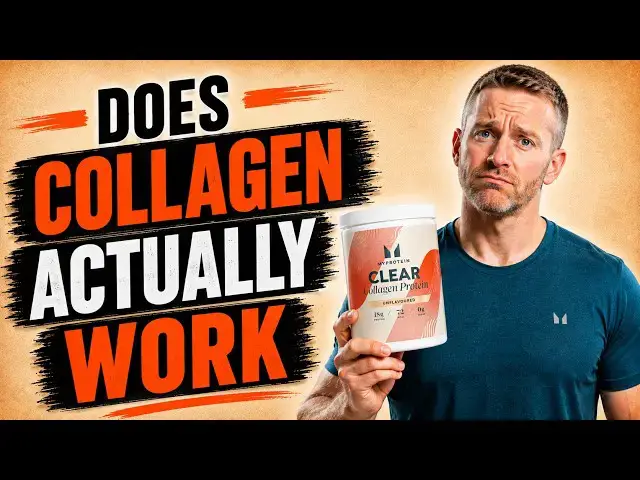
Is collagen actually worth taking? Collagen supplements are marketed for skin health, joints, tendons, bones, recovery, and even muscle growth, but what does the scientific evidence actually say about collagen supplementation?
In this video, expert nutritionist Dr Richie Kirwan breaks down how collagen works, the potential benefits of collagen peptides, and whether adding a collagen supplement to your diet is actually worth your money.
Key Facts:
Collagen is the most abundant protein in the human body and is an important structural component of skin, bones, tendons, ligaments, and cartilage.
Collagen supplements are usually sold as hydrolysed collagen or collagen peptides.
Research suggests collagen supplementation may provide benefits for skin and certain aspects of joint and connective tissue health.
Collagen is not a complete protein and is relatively low in essential amino acids needed for muscle protein synthesis.
For building muscle, high-quality complete proteins such as whey are generally a better choice than collagen.
Whether collagen is worth taking ultimately depends on your goals and what benefit you're expecting from the supplement.
FAQ:
Q: Do collagen supplements actually work?
A: Evidence suggests collagen peptides may provide modest benefits for areas such as skin and joint health, although results depend on the outcome being studied.
Q: Is collagen good for your joints?
A: Some research suggests collagen supplementation may help improve joint-related symptoms, particularly when combined with appropriate exercise and rehabilitation.
Q: Does collagen help build muscle?
A: Collagen provides protein, but it has a less favourable essential amino acid profile for stimulating muscle protein synthesis than high-quality complete proteins such as whey.
Q: Is collagen worth taking?
A: It depends on your goal. Collagen may be worth considering for certain skin, joint, or connective tissue goals, but it shouldn't be viewed as a replacement for a balanced diet or high-quality dietary protein.
#myprotein #wheyprotein #protein #nutrition
*********************************
Myprotein is Rated Excellent on Trustpilot
🔔 Subscribe to our channel: https://www.youtube.com/user/MyproteinUK?sub_confirmation=1
📲 Download the Myprotein app: https://myprotein.onelink.me/IYeO/o2erh9hb
The UK & Europe's Number 1 Online Sports Nutrition Brand, Myprotein.
Show More Show Less View Video Transcript
0:00
Will collagen smooth your skin, fix your
0:02
joints, heal your gut, and basically
0:04
turn back time? Let's talk about that.
0:09
How's it going, guys? My name is Richie
0:11
Kerwin. I'm a registered nutritionist,
0:12
researcher, and university lecturer in
0:14
nutrition and exercise physiology.
0:16
Today, we're going to go through the
0:18
real science of collagen. What it is,
0:21
where it comes from, and the big one,
0:23
what the evidence actually says about
0:25
what it does. Basically, [music] the
0:27
honest answer is a bit more mixed than
0:29
what social media would have you
0:30
believe. So, first off, what actually is
0:32
collagen? Well, it's a protein just like
0:36
the protein in meat or milk or beans.
0:38
But it's a particularly important one
0:40
because it's the main structural protein
0:42
in your body. It's [music] in your skin,
0:44
your tendons, your ligaments, your
0:46
bones, and your cartilage. In fact, it's
0:48
the most abundant protein in the human
0:50
body, making up somewhere from around a
0:53
quarter [music] to a third of all the
0:55
protein you have. And here's a fun
0:57
little fact to show you just how
0:58
important collagen is. Scurvy, the
1:01
disease sailors used to get on long
1:03
voyages across the sea, is caused by a
1:05
lack of vitamin C. And the reason that
1:08
wrecks your body is that you [music]
1:09
need vitamin C to make collagen. No
1:12
vitamin C, no new collagen. And
1:14
eventually your connective tissue loses
1:16
integrity, your gums bleed, and your
1:18
joints literally start to fall apart.
1:20
Now notice I said [music] make collagen
1:23
because your body can make it on its
1:25
own. You don't actually need to eat
1:27
collagen [music] to make collagen in
1:29
your body. If you did, vegans would be
1:31
fallen to bits, but they're doing just
1:33
fine as long as they have enough
1:34
protein, vitamin C, and other nutrients.
1:37
So the long story short is [music] you
1:39
don't necessarily need to get extra
1:41
collagen in your diet. Because here's
1:43
the thing a lot of people get wrong
1:44
about collagen. When you eat it, it
1:47
doesn't necessarily travel directly to
1:49
your skin or your joints. Just like any
1:52
other protein, it gets digested, broken
1:55
down into amino acids and small
1:56
peptides, and then your body uses those
1:58
bits for whatever it needs. So, the idea
2:01
that if you swallow collagen and it
2:03
[music] magically becomes skin collagen
2:06
is just not how digestion works. Now,
2:09
some of those small peptides might have
2:12
some interesting effects once they're
2:13
absorbed, but we'll get into that a
2:16
little bit later. Now, you're probably
2:17
wondering where all that collagen comes
2:19
from in the first place. So, collagen is
2:22
basically a byproduct of the meat,
2:24
[music] poultry, and fish industry.
2:26
Certain parts of the body which are
2:28
particularly rich in collagen, like the
2:29
bones, the skin, the connective tissue,
2:31
even fish scales, collagen gets
2:34
extracted right from these [music]
2:35
parts. If you've ever made stock from
2:37
bones at home and you see that jelly
2:39
that sets on top once it cools down,
2:42
that's gelatin, which is collagen that's
2:44
been broken down. [music] And just to be
2:45
very clear, being a byproduct isn't a
2:48
problem at all. Whey protein, which is
2:49
one of the highest quality proteins you
2:52
can buy, [music]
2:52
started life as a byproduct of the
2:54
cheesem industry. So, that's what
2:56
collagen is and where it comes from. The
2:59
real question is what it actually does
3:01
once it's in your body. And the only
3:04
real way to answer that is to [music] go
3:05
through the claims one at a time because
3:08
collagen is sold for almost everything.
3:11
And each one of those promises needs
3:13
[music] its own evidence. So let's start
3:16
with the one most of you watching this
3:18
are probably here for building muscle.
3:20
And it's where we need to be [music]
3:22
very very realistic right from the
3:24
start. If your main goal is building
3:26
muscle, collagen is not the protein you
3:29
want to reach for. And here's why. To
3:32
build muscle, you need to trigger a
3:34
process called muscle protein synthesis
3:36
or MPS. That's basically your body's
3:39
signal [music] to repair and build
3:40
muscle tissue after you train. And the
3:43
thing that drives that signal hardest is
3:45
a specific set of amino acids called the
3:47
essential amino acids and one in
3:49
particular called Lucy. The problem is
3:51
that collagen is what we call an
3:53
incomplete protein. It's actually
3:55
missing one essential amino acid
3:57
completely, tryptophan, and it's low in
3:59
several of the others, including Lucy.
4:03
So, when it comes to flipping that
4:05
muscle building switch, collagen is just
4:08
not very good at it. Now, compare that
4:10
to the [music] proteins that are great
4:12
at this, whey is the classic one. It's
4:14
fast digesting and absolutely loaded
4:17
with lucine. Then, you've got casein,
4:20
soy, egg, and a good blend of plant
4:22
proteins. These are all far better at
4:26
driving muscle protein synthesis than
4:28
collagen. And honestly, they often work
4:30
out cheaper for serving, too. So, if
4:33
muscle is the goal, that's where your
4:35
protein budget should go. Now, I want to
4:38
be really fair here because this is
4:39
where it gets a bit more interesting
4:41
than the old line of collagen does
4:43
nothing for muscle. There's actually a
4:45
decent body of research looking at
4:47
collagen peptides taken alongside
4:50
resistance training. And when you pull
4:52
it all together, there is a small but
4:54
real [music] increase in what's called
4:56
fat-free mass. So on paper, people
4:58
taking collagen and lifting weights
5:00
gained a bit [music] more lean tissue
5:02
than those just lifting weights and
5:04
taking a placebo. Usually nothing at
5:06
all. But there's a catch, and it's
5:08
[music] an important one. Fat-ree mass
5:11
isn't necessarily the same as pure
5:13
muscle. Fat free mass is actually
5:15
everything in your body that isn't fat.
5:17
So that includes your tendons, your
5:19
ligaments, connective tissue, and water.
5:22
And in some situations, that may be
5:24
genuinely useful, but it's not the same
5:26
as building bigger biceps. So, where
5:29
does that leave us? If you're training
5:31
[music] hard and you want to put on
5:32
muscle, collagen is not your go-to
5:35
protein. Get your total daily protein up
5:37
first from food and from high quality
5:39
protein like whey, casein, soy, and
5:41
that's what's going to move the needle.
5:43
Right? So muscle isn't where it shines,
5:46
but the next one might be where collagen
5:48
actually starts getting a little bit of
5:50
my attention, and that's joint [music]
5:52
pain, specifically in osteoarthritis.
5:55
Now, osteoarthritis is often described
5:57
as the wear and tear type of arthritis,
6:00
although that's a bit of an
6:01
oversimplification.
6:03
It's a condition where the whole joint
6:05
gradually changes over time, including
6:08
the cartilage, bone, and the surrounding
6:10
tissue. It can cause pain, stiffness,
6:12
and difficulty moving. And it's
6:14
incredibly common, especially as people
6:17
get older. And this is where some of the
6:20
more interesting collagen research
6:22
actually lives. So, when you pull
6:23
together the trials on collagen for
6:25
osteoarthritis, and we're [music]
6:27
talking a very decent number of them at
6:29
this point, the results tend to point in
6:32
collagen's favor. Overall, people taking
6:34
collagen derivatives seem to get a small
6:37
to moderate reduction in pain and a
6:40
small improvement in how well the joint
6:42
functions and moves. In one recent trial
6:45
sequential meta analysis, the
6:46
improvement in joint function came out
6:48
as high certainty evidence, which in
6:51
research terms [music] is relatively
6:53
strong. Pain reduction was also rated as
6:55
moderate certainty, so a notch below
6:57
that, but still meaningful. Put simply,
7:00
the people taking collagen tended to
7:03
move a bit better and hurt a little bit
7:05
less. Now, here's the part that does my
7:08
head in a little bit, but in a good way.
7:10
We still can't fully explain why this
7:13
might work. If this were simply about
7:15
supplying amino acids, you might expect
7:17
any decent protein source to do the same
7:19
job, but osteoarthritis is not a muscle
7:22
protein [music] synthesis problem. And
7:24
collagen may be doing something a little
7:26
bit more specific here. One [music] idea
7:28
is that some collagen derived peptides
7:30
survive digestion, get absorbed, and may
7:32
act as signals in [music] the connective
7:34
tissue. For under denatured type 2
7:36
collagen, another proposed mechanism is
7:38
oral tolerance, where the immune system
7:41
may become less reactive to cartilage
7:43
related proteins. Oh So, these
7:46
mechanisms [music] are still being
7:47
worked out, but the outcome data in
7:49
osteoarthritis are more promising than
7:52
they are for many other collagen claims.
7:54
And this is a theme I'm going to come
7:56
back to all the time. Mechanisms tell us
7:59
how something might work, but outcomes
8:02
tell us whether it actually does. And
8:05
for osteoarthritis, the outcomes are
8:07
pointing more in collagen's favor than
8:08
they are for a lot of other claims made
8:10
about it. What these studies generally
8:12
don't tell us though is whether collagen
8:14
is better than simply increasing intake
8:16
of other protein sources. because the
8:19
comparison is usually a placebo or
8:21
another joint health treatment, not
8:23
whey, casein, soy, or another complete
8:26
protein. So, the practical takeaway is
8:27
this. Among the major claims made for
8:30
collagen, osteoarthritis related joint
8:33
symptoms are one of the areas where the
8:35
science is most on its side. Now, that
8:37
doesn't mean that collagen is magic.
8:39
It's not going to rebuild your knee and
8:41
it's not a replacement for the things
8:43
with the strongest evidence like staying
8:46
active or strengthening the muscles
8:48
around the joint and managing body
8:49
weight where relevant. But as something
8:51
to add on top of those basics, collagen
8:54
is one of the more reasonable
8:56
supplements to try for a few months if
8:58
you have osteoarthritis related joint
9:00
pain. And if your joints feel a bit
9:02
better afterwards, fantastic. So joints
9:05
are one of collagen's stronger hands.
9:07
But this next one is probably the reason
9:10
collagen became such a big deal in the
9:12
beauty and wellness world in the first
9:14
place. And that's skin. Smoother skin,
9:16
fewer wrinkles, better hydration, the
9:19
whole anti-aging [music]
9:20
pitch. So what does the evidence
9:23
actually say? Well, in general, the hype
9:25
looks reasonably positive, but with some
9:28
real strings attached.
9:32
When you pull the skin trials together,
9:34
collagen supplementation [music] does
9:36
seem to improve a few things. Skin
9:38
hydration, skin elasticity, and in some
9:40
cases, even the appearance of wrinkles.
9:43
So, this isn't nothing. But here's where
9:47
we have to put our science hats on.
9:50
[clears throat] But here's where we have
9:51
to put our science hats on and be a bit
9:53
annoying. These skin studies are still a
9:57
mixed bag when it comes to quality. A
9:59
lot of them are really, really short,
10:01
often just 8 to 12 weeks. Many use a
10:04
small number of participants, and a fair
10:06
few are funded by the companies that
10:08
actually make the products, which
10:10
doesn't automatically make them [music]
10:12
bad, but it's something you always have
10:14
to know about. One of the bigger issues
10:16
is the outcomes themselves are more
10:18
technically fiddly to measure. Skin
10:21
hydration, elasticity, and wrinkle depth
10:24
can be measured with specialist tools.
10:27
So, it's not just people like looking in
10:28
the mirror and guessing, but they are
10:31
still messier outcomes than something
10:33
like body weight or grip strength or a
10:35
one rep max. That can make the results
10:37
[music]
10:38
a little less solid. On top of that, a
10:40
lot of what affects your skin has
10:42
nothing to do with what you're
10:44
swallowing. Sun exposure is the big one.
10:46
Then there's smoking, [music]
10:47
sleep, stress, skincare routines, even
10:50
hormones. Some trials try to control for
10:53
these things, but [music] they are
10:54
difficult to control for perfectly,
10:56
especially over several weeks or months.
10:58
That makes it harder to be absolutely
11:00
sure how much of the benefit is really
11:01
down to collagen itself. There's also
11:04
the absorption question. Again, just
11:06
like with joints, collagen doesn't have
11:08
a special direct line directly from your
11:10
mouth to your face. It gets digested
11:13
into amino acids and smaller peptides
11:15
just like other proteins. But the
11:17
leading idea is that some collagen-
11:19
derived peptides are absorbed and may
11:21
act as signals to skin cells called
11:23
fiberblasts, nudging them towards
11:25
producing or maintaining components of
11:27
the skin matrix, including collagen and
11:29
elastin. [music] That's plausible and
11:32
the skin results are promising, but I'd
11:35
still put this [music] in the promising
11:37
but not fully settled category rather
11:40
than case closed, everyone needs it
11:42
category. So, where does that leave you?
11:45
If smoother skin and [music] fewer fine
11:47
lines is what you're after, manage your
11:50
expectations with collagen. The effects
11:53
in [music] studies are modest, not
11:55
dramatic. And the single most powerful
11:58
thing you can do for your skin doesn't
11:59
come in a tub, a sache, or an expensive
12:02
little bottle. It's wearing sunscreen
12:04
and not smoking. So [music] maybe do
12:07
those first. Then if you want to add
12:09
collagen on top and see how you get on
12:11
over a couple of months, that's a pretty
12:13
reasonable thing to try. So far, we've
12:15
done muscle, joints, and skin. But
12:18
collagen gets sold for a lot more than
12:20
that. So, let's do a very quick run
12:22
through on some of the others because
12:24
this is where you really start to see
12:26
the gap between what's claimed and
12:28
what's actually been shown. First,
12:29
[music] tendons and connective tissue.
12:31
This one is interesting because on paper
12:33
it makes a lot of sense. Tendons are
12:36
collagenrich tissues. So, the idea that
12:38
collagen peptides might support tendon
12:39
adaptation isn't a stretch at all. But
12:42
the important bit is that tendons adapt
12:44
mainly to load, not supplements alone.
12:48
So, most of the more interesting work
12:50
around this area pairs collagen with
12:53
targeted loading or resistance training.
12:56
And there is some early evidence
12:57
suggesting collagen may support tendon
12:59
structure, particularly tendon
13:01
morphology or tendon [music] shape.
13:02
problem is that the certainty is still
13:05
very low and the mechanical property
13:07
data, how the tendons [music] behave,
13:09
are less convincing. So, it's a
13:11
promising idea and one I'd genuinely
13:13
like to see [music] more research on,
13:14
but it's nowhere near settled. If you're
13:17
an athlete dealing with a niggly tendon,
13:19
it may be a reasonable thing to trial
13:22
alongside your rehab, but don't expect
13:24
it to do the heavy lifting on its own.
13:26
Then there's exercise recovery and
13:28
muscle soreness. the idea that collagen
13:30
helps you bounce back faster after a
13:32
hard session. And here [music] the
13:35
picture is pretty underwhelming. When
13:37
you look at soreness in a day when you
13:40
look at soreness in the day or two after
13:42
training, collagen mostly doesn't show a
13:44
meaningful benefit over placebo. There
13:47
is a small signal for reactive strength
13:50
recovery after 48 hours, but the
13:52
certainty again is low and recovery
13:55
findings are not consistent across all
13:57
the studies. So, if you're buying
13:59
collagen specifically to feel less sore
14:01
tomorrow, the evidence just isn't there
14:03
yet. And [music] then we get to the
14:06
research on bones. Again, this one is
14:08
genuinely interesting, but uh narrower
14:10
than the marketing often makes it sound.
14:13
There is one solid year-long trial in
14:16
post-menopausal women who already had
14:18
age- related reductions in bone density.
14:20
[music] They took 5 grams per day of a
14:23
specific collagen peptide [music] and
14:25
improved bone mineral density at
14:27
specific bone regions compared with a
14:30
placebo which was [music] just plain old
14:32
malttodextrin.
14:33
Now this is interesting but it's a very
14:36
specific population one specific
14:39
ingredient and one very specific [music]
14:41
outcome. I wouldn't assume it applies to
14:43
a 25-year-old who lifts or to every
14:45
collagen product on the shelf. And then
14:47
you've got the real long shots. Collagen
14:50
for your gut, thicker hair, stronger
14:52
nails, heart health, blood sugar, and
14:55
[music] whatever else gets added to the
14:57
label. For most of these, the evidence
14:59
is either early, thin, mixed, based on
15:02
small, or uncontrolled studies, or just
15:04
not strong enough to justify the
15:06
confidence of some claims on the
15:08
internet. It's not that any of it is
15:10
impossible. It's that people's
15:11
imaginations have sprinted out way ahead
15:15
of the science. So, here's the pattern I
15:18
want you to notice. The further you get
15:20
from a few plausible targets like
15:22
joints, skin, and tendons, the weaker
15:25
the evidence becomes, but the confidence
15:28
of some people online doesn't drop one
15:30
bit. Which brings us to the most
15:32
important part of this whole video. How
15:35
good is this evidence really? And how
15:37
should you make sense of it? So, we've
15:39
gone through a pretty big list of
15:40
claims, and you've probably spotted the
15:42
theme. For a few things, joints
15:44
specifically, the evidence is
15:46
interesting, but by no means certain.
15:48
For a lot of the rest, there isn't much
15:51
evidence at all. But to really make
15:52
sense of collagen, you need to
15:54
understand one thing about the [music]
15:56
research itself. Most collagen studies
15:59
compare it to a placebo. Usually, a
16:02
cheap carbohydrate like malttodextrin
16:04
that tells you collagen works when
16:06
you're comparing it to not much else. It
16:09
doesn't tell you the thing you actually
16:10
care about, which is whether collagen
16:12
beats just having a bit more of any
16:14
other decent protein. Give someone an
16:16
extra scoop of whey or just more food,
16:19
and would they get the same result for a
16:20
fraction of the price? Most of these
16:23
studies never test that. So, we can't
16:25
[music] say collagen is particularly
16:27
special, only that it beats a spoon of
16:29
sugar. On top of that, a lot of the
16:31
trials are small, short, [music] and
16:33
funded by the very companies that are
16:35
trying to sell the products. Now, that
16:37
doesn't make the findings fake or it
16:40
doesn't make the companies villains
16:41
either. [music] Good companies fund good
16:43
research all the time, but it does mean
16:46
you want independent, higher quality
16:49
studies backing things up. And for
16:52
collagen, those are [music] exactly
16:53
what's thin on the ground. Which brings
16:56
me to a really big review that made
16:58
headlines recently, uh, an umbrella
17:00
review. Basically, a study of studies of
17:03
studies. It pulled together 16 reviews,
17:07
[music] over a 100 different trials,
17:08
nearly 8,000 people, and the headline
17:11
was really, really upbeat. And when the
17:13
[music] authors crunched all of the
17:14
numbers together, a few results
17:17
genuinely came out in favor of collagen.
17:21
But here's the catch. Of those 16
17:23
studies it was built on, [music] only
17:25
one was rated as high quality. Most were
17:28
low or critically low quality. And the
17:31
[music] review can only ever be as
17:33
strong as what it contains. So, it's not
17:36
that the review was wrong, it's that a
17:39
tidy, positive headline can hide [music]
17:42
a lot of mess when it comes to research.
17:44
Let me be clear, though. I'm not
17:46
trashing collagen. There's some
17:48
genuinely interesting science here,
17:50
especially around joints and tendons,
17:52
and it may well turn out to have real
17:54
benefits. But if this were [music] a new
17:57
medicine showing up with this level of
17:59
evidence, we'd call it promising. and
18:01
ask for better trials. We wouldn't claim
18:04
it does everything under the sun.
18:06
So, I really hope that this video has
18:08
cleared up some of the collagen
18:10
confusion. As always, if you've got any
18:12
questions, let me know in the comments
18:13
below. And remember to like and
18:15
subscribe to the My Protein YouTube
18:16
channel for more great evidence-based
18:18
nutrition information.
Sports