Up next in 10



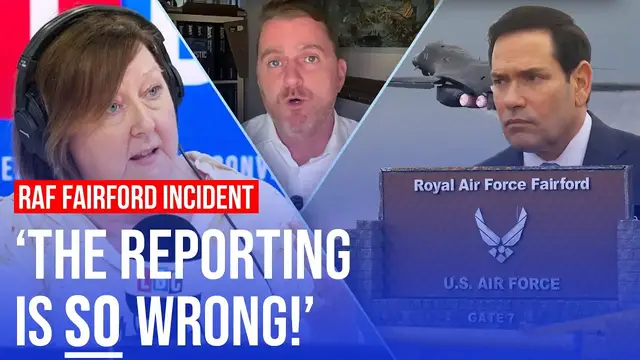
The removal of US bombers from RAF Fairford is not directly tied to the arrests of five men over a suspected terror plot at the airbase, the US Secretary of State has said.
Asked about the US decision to remove its B-1 bombers from the Gloucestershire base, Marco Rubio said the US Department of Defence regularly reallocates resources where they're needed.
He added: "We've documented what happened last week. I wouldn't directly tie that to the move that was made." He said "new planes coming in, old planes going out" was normal.
When probed on whether he still had confidence in security at RAF Fairford, Mr Rubio said that Washington still has confidence in the security of all of its bases.
The statement clashes with rumours circulating online, as well as claims by Nigel Farage, that the US was 'fleeing' the base after the suspected terror plot nearby.
Shelagh and Tom Sharpe, former Navy Warship Captain, discuss.
#shelaghfogarty #military #nigelfarage #ukpolitics #marcorubio #usa #uspolitics #airforce #navy #lbc #Fairford
Show More Show Less View Video Transcript
0:00
Department of War is constantly reallocating resources where they need to be. There's regular rotations that happened as well. So I think you guys are just well, I mean, we've documented what happened last week. I wouldn't directly tie that to the move that was made. The only reason why you guys are focused on how many planes are at Fairfield is because of the threat that happened last week. But it's not unusual to see rotations happen and movement of assets to different parts of the world based on exercises, redeployments, people changing out and new people coming in, new planes coming in
0:29
in old planes going out so crews are changing all the time you guys are just really focused on that
0:34
now because of the threat last week still have confidence in british security at the base and
0:39
generally oh we have confidence in the security of all of our bases because all of our bases are
0:43
theoretically could be threatened at any moment um and that's why there's so much security built
0:47
around them and with the brits we've worked very closely for a very long time including on this
0:51
investigation and they couldn't be more cooperative let's talk to tom sharp former navy warship
0:56
captain and daily telegraph columnist to boot good afternoon to you tom thanks for joining me
1:02
um stiff the wind for us here a bit would you what's been going through your mind about this
1:06
well i never expected to come on the show and agree fully with marco rubio which is what's
1:11
just happened okay this this to me is is really clear this is a natural rotation of u.s strategic
1:17
assets i did some packet maths last night in the last five years 70 of the time has had zero
1:26
aircraft at Fairford. So effectively what's happened here is we've returned to normal state
1:33
They're expensive jets, they're difficult to maintain, they're very precious, they've got about between 45 and 50, you know, they'll want them back. So there are some really good lessons
1:41
to learn from this, but the reporting over the hurried exit has been so exaggerated and some of
1:46
it's so wrong as well, you know, they don't need refueling. The idea that they left without the
1:51
tankers being ready is a nonsense. So I think, and besides, all their ground crews, all their
1:57
support crews, a load of other aircraft, also at Mildon Hall and Lake and Heath are still in place
2:04
If there was a genuine terror threat to those bases, then they would all be moving. So
2:08
I think this is something of nothing, but because of what happened a week ago, it's been made into
2:13
an awful lot of a storm. Well, I was going to say, given that that's your view, let's put this
2:17
departure to one side and talk about the bigger picture of security and security cooperation
2:22
because my assumption has always been that even at the worst moments, like, say, for example
2:28
when Keir Starmer said no to full on active support in the Iran war or when Trump was on his tariff rants and you know various times when he was going on about NATO spending and everything and it got a bit bitter
2:42
My understanding was that for all that, for all the sort of, you know, the circus
2:46
that beneath that surface events, all the deep, long held and deep connections between the US
2:55
and the UK at the level where it really counts, which is security, intelligence, that not much
3:04
changed? That's correct. I mean, those bases, Mildenhall and Lakenheath in particular, were
3:09
being used throughout the period where allegedly we said we weren't sure. And I think Fairford
3:16
probably didn't have the B1s at that point. But really, we're talking about a window of days here
3:20
where there was some ambiguity, at least that was what was presented
3:25
when in reality, as you say, this rumbled on and we continue to support the US as a close ally. Now
3:31
you can have a great long argument as to whether or not we should. But the reality is, as Epic
3:36
Fury spun up in the very early days of March, you know, we were offering the use of our air bases
3:42
pretty much throughout that. Those long existing ties, diplomatic, intelligence, security
3:52
I mean, they really matter to our security, don't they? Particularly when, as we've seen
3:57
more recently, you have Russia making sort of saber rattling comments. You have Iran
4:03
clearly having increasing reason to try and push back against the UK more than it's already been
4:09
doing in myriad hybrid ways in our communities already. Those American US security links are
4:16
still as important. Are they still as alive and vibrant as ever, in your view
4:23
Yes, I think they are. I think beneath the maelstrom of the high level politics and the
4:28
occasional name calling. That's the word I was looking for earlier when I came up with circus
4:32
Thank you. I think it's alive and well. And you just look at the way we're interacting with the
4:37
Americans in the high north now with our ships. You look at the way our submarines are cooperating
4:41
with their submarines. Well, I mean, that's partly because we have to. But the point is, they're stepping up into these roles. So I think if you take away the noise at the top level
4:50
and it was interesting that it was Rubio who's coming this time to go, look, this is a standard
4:54
rotation. I'm slightly surprised we haven't done the same here. I mean, we really could have poured
5:00
oil on this one So what we mustn do is through bad communications allow the calmness of the the military to military relationship be ruffled And every time these things happen and everyone generates their own theories and then proliferates them online
5:16
sometimes with thousands, tens of thousands of followers, we just slightly jeopardise that. But
5:21
in my view, the mill to mill relationship, which is the bedrock of our security, remains sound
5:28
And we know that UK-Israel relations are strained, to say the least, at the moment
5:34
And yet we've still got some intelligence from Israel before whatever happened at Fairfoot happened, didn't we
5:42
Well, intelligence relations, I mean, that's not my partnership, so to speak
5:45
But I do know that there are decades in the making and can be undone very, very quickly
5:50
So it's in everyone's interest to keep those relationships in place. I mean, literally everyone's interest
5:55
Likewise, the US having access to our air bases here for access, basing and overflight is absolutely in their interest
6:02
The idea that they could withdraw back to continental USA and retain that level of outreach projection and influence around the world is for the birds
6:11
So it is in everyone's interest, which is why I think it still holds, despite the occasional shouting and hair pulling that goes on above
6:19
And we've seen already measures that European nations, various European nations are increasing their defence spending. Ours is very slowly, you know, showing the amount of spending and the timing of it. But we don't really have that full spending information yet, do we, on defence here in the UK. Is that frustration for you and others
6:42
Yeah, it's deeply frustrating. We seem to be very poor at learning the lessons that are
6:48
unfolding around us, which is namely a visibly increasing threat. And instead, we're talking
6:54
about increasing the greatest rate of defence expenditure since the end of the Cold War
6:59
That's not difficult when that's been in decline all these years. So actually, if you use RAF
7:03
base security as an exemplar of this, we know our bases aren't that secure. We know the
7:08
fences are poor. The paint splashing at Bryson-Alton last year is a case study. We've got to be
7:14
more robust. We've got to put hardened shelters, counter drone technology, intelligence agencies
7:20
are still in place. And then you look at our ports, for example, on which the survival
7:25
of our country depends, and they are completely undefended. So we've got to look at this holistically
7:31
from a national security perspective and spend money on it quickly and be much, much more
7:35
aggressive than we are. But we are still in the you know let hope for the best mode Let not commit because that costs a load of money that we may or may not have and so on and i think we use things like raf uh fairford what happened here with the terrorist attack we should really use those as examples alleged alleged yeah sorry well fuel fuel whatever
7:55
it was whatever the hell was going on yeah we don't right there are still many bits of that
7:59
jigsaw that are missing for me but you can still learn from it the problem is that we get distracted
8:04
by these subplots at one level it doesn't matter who they were does it correct that they got that
8:08
That fence is still inadequate. Now, of course, there's a layer inside that of US security because they provide their own force protection for their own assets
8:15
Of course they do. But again, we mustn't get distracted by the politics of this and focus on what we actually need to do
8:22
And there's a danger with things like the sort of US evacuation as if the sky's falling in
8:29
And that detracts from or distracts, sorry, from the things we really should be learning
8:33
And because of this, particularly the rhetoric that Donald Trump has used for years now about Europe standing on its own two feet a bit more, I wonder whether that's why the reaction to the Fairford B1s flying off in the dead of night has been what it's been, particularly after the events which are still being investigated
8:55
I wonder whether there's a nervousness, certainly in Britain and perhaps more widely in Europe and parts of Europe, about whether America will, under NATO arrangements, still come to our aid
9:07
Yeah, I mean, there absolutely is. But then again, he's right. You know, we do need to be taking this more seriously
9:14
For decades, we sat under the umbrella of Uncle Sam and that was mutually beneficial
9:20
but probably from the mid 90s onwards, we started to take the mickey out of that arrangement
9:25
No question, as a European continent, we started to take the mickey
9:29
And we've got to reverse that and we've got to do it. And that's not to challenge the US because there are still so many bits of this
9:35
We really can't do very well without them. So we've got to do it together. But we also need to take ownership of our own security
9:42
And it's very, very clear when you look at our armed forces today that we have not done that for decades
9:47
we must reverse that and we must do it in lockstep with the Americans. It's not a zero-sum game
9:52
We've got to do this together. Thank you very much, Tom. Good to talk to you, Tom Sharp, former Navy warship captain and Daily Telegraph columnist
9:58
And thanks again to Thea Rickard, our reporter. Well, given that both Tom, Downing Street and Marco Rubio
10:06
have all essentially said it's routine, I don't know if it is or it isn't
10:11
but three very different sources there telling us that the removal of those B1 fighter jets is routine
news