Up next in 10



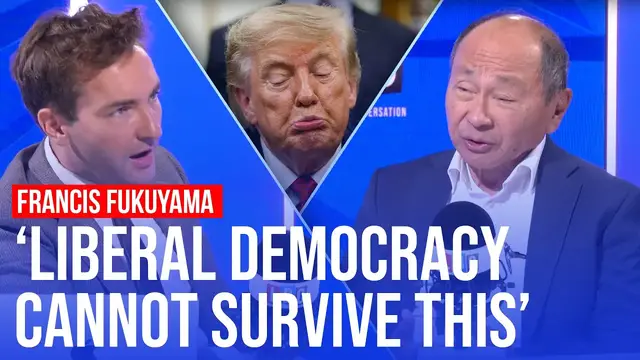
Lewis Goodall sits down with legendary political scientist Francis Fukuyama to discuss the threats to democracy and its future.
US President Donald Trump suggested on Friday that the US had a fresh concrete proposal aimed at ending the war, which is now in its fifth year
Russian spokesman Dmitry Peskov told TASS news agency that President Vladimir Putin would meet Witkoff and Kushner in the Kremlin later on Saturday.
The US envoys are then expected to visit Kyiv the following day.
US President Donald Trump suggested on Friday that the US had a fresh concrete proposal aimed at ending the war, which is now in its fifth year.
He did not, however, elaborate on what that proposal would be.
Witkoff and Kushner landed at Moscow's governmental airport where they were met by Russian presidential envoy Kirill Dmitriev.
A motorcade then took the three men into the city, a Reuters witness said.
Dmitriev, who told Reuters in June that he had remained in contact with the US negotiators during a pause in their visits to Russia, took part in all their previous meetings with Putin alongside Putin's foreign policy aide Yuri Ushakov.
He also played a role in negotiating US sanction waivers for Russian oil this year.
Listen to the full show on the all-new LBC App: https://app.af.lbc.co.uk/btnc/thenewlbcapp
#lewisgoodall #trump #putin #xijinping #china #russia #politics #debate #democracy #debate #LBC
LBC is the home of live debate around news and current affairs in the UK.
Join in the conversation and listen at https://www.lbc.co.uk/
Sign up to LBC's weekly newsletter here: https://l-bc.co/signup
Show More Show Less View Video Transcript
0:00
The world's most influential political thinkers, the author of perhaps the most famous and perhaps most misunderstood phrase in modern political thought
0:06
In 1989, Soviet communism, of course, began to collapse. Francis Fukuyama, as a young man, I like to say that because I think he was my age now
0:13
asked whether humanity had reached the end of history, not the end of events, of course, or wars or upheaval
0:19
but the point at which the clash of civilizations of different political systems had ended
0:25
and that liberal democracy had been left without a more compelling universal rival
0:30
Of course, 37 years later, Donald Trump is in the White House. China offers an authoritarian model of modernity
0:35
Russia's at war in Europe. Liberal democracy appears to be losing confidence even in the countries which invented it
0:41
And in his new memoir, which I'm holding now, in the realm of the last man, Fukuyama, Professor Fukuyama, revisits what he got right, what he got wrong
0:48
and whether history in some sense began again. Professor Fukuyama, thank you so much for joining us on the show this morning
0:55
Of course, what is it like, just in a general sense, you achieve something that most, 99.9% of political scientists or indeed academics never achieve, which is notoriety and fame
1:06
But of course, it was always being associated with that phrase, the end of history, which, as I say, has been misunderstood
1:12
What is it like having that phrase go with you everywhere you go
1:16
It's a little bit frustrating because people do misunderstand it. if I post something on Instagram, somebody will say
1:24
well, I thought it was the end of history. History goes on
1:28
In fact, I got one of those this morning. So that's frustrating, but it's also something that's pretty easy to ignore
1:34
I've written 10 books since the end of history, and I've gotten into a lot of other subjects
1:39
and I've been able to change the conversation, I think. And people, of course, forget the question mark
1:46
You weren't asserting that it definitely was true, but you are asserting the possibility that liberal democracy would become hegemonic
1:54
Well, also the title of the book version was The End of History and The Last Man
1:59
Yes. And very few people actually read the last five chapters, which are the chapters on The Last Man
2:04
where I talk about the ways that democracy could break down in the future
2:08
And I think actually a lot of that was quite prophetic. Because that argument was to say that without almost a clash, without a struggle
2:15
the men and women who inhabited liberal democracies would not have that competition
2:20
that had enabled them to succeed and would atrophy in some way
2:24
And you think that has been, I mean, that does seem to me to be broadly correct. Yeah, and they would basically be content
2:31
with peace and prosperity and they wouldn't have higher aspirations. And the argument, so the last man phrase
2:38
was that of the philosopher Nietzsche who hated the idea of the end of history
2:42
because he said human beings aspire to more. You know, they're not going to be
2:47
or they shouldn't be content with just peace and prosperity. And that flattening of the human horizon
2:54
was really the big challenge. And I think, you know, people are reacting to it as we speak
2:59
What do you think, in terms of obviously how history has unfolded in the 37 years since
3:03
what do you think you got right and what you got wrong? Well, I got a lot of things wrong
3:07
Everybody does. I've written several books. Talking to a political journalist, we get everything wrong
3:12
Yeah. You know, there are several issues. So one is that at the time I wrote The End of History, I did not understand the importance of having a modern state
3:23
I did not understand the possibility of political decay that is things going backwards And those are issues that I wrote about in this two Political Order series that I wrote
3:34
because I think that the challenge of creating a modern state is actually greater than the challenge of creating a democracy
3:41
And that's where many, many countries have failed, including the United States
3:46
I think perhaps the most surprising thing that's happened is what's gone on in the United States
3:51
because I thought that compared to Europe, American voters were actually much more rooted in their democratic traditions
4:00
and yet they managed to re-elect a man that didn't accept the peaceful transfer of power
4:05
He lost the election in 2020, and he's done everything he can to cling to power
4:11
and then they voted for this guy a second time. I'm intrigued by that
4:15
Is there an argument, because of course you could sort of posit that, as you've just done, Professor
4:18
which is to say that perhaps actually Americans aren't especially attached to those democratic values in the first place or those democratic institutions
4:26
But I wonder if there is another way of looking at it, which is and this may be it may be that they're wrong in this view
4:30
But maybe American voters actually fundamentally on some level believe that American political institutions are so robust that you can elect someone like that
4:39
And actually, yes, they may push the boundaries of those institutions, but fundamentally they'll be contained
4:44
You can also see perhaps European dalliances with populist parties in the same way that fundamentally, as I say, they may be wrong about this
4:52
Voters sort of think, well, the institutions will constrain these people. Yeah. Well, look, the most positive spin you could put on what happened is that the United States, as well as other democracies, have become what I label vitocracies, meaning the systems are so complicated
5:08
complicated. There are so many legal checks. There are so many rules that it becomes very
5:13
hard to do anything like build high-speed rail, which has been a failure both in the U.S.
5:18
I think, and here in Britain as well. And people say, well, we need a strong man. We need somebody
5:23
like Trump that'll just cut through all the nonsense and get things done. I don't think
5:30
however, that the people that felt that way necessarily wanted a president that actually
5:37
who's willing to violate the law and violate the Constitution as readily and as often as Donald Trump has
5:44
And so I think it's actually provoked a real reaction whose results we're going to see in the midterm election in November
5:51
How much do you see Donald Trump as an ideological figure, a sort of systemic figure
5:58
Because, of course, he is surrounded, or there is an ideological movement around him
6:02
and it's not just an ideological movement, arguably, within the United States. A lot of these people, J.D. Vance, would definitely fall into this category, but lots of others, well, Steve Bannon
6:09
They sort of see themselves as a transnational movement, nationalist movement, trying to restore nationalism and how they would see it as the importance of nation states to democracies
6:19
Often a bit of a nativist agenda in there as well. But how much do you think for Trump? Is that contingent
6:23
Is he an ideological figure or is it actually just much more about his own personal interests
6:27
I don't think that he's ever had a consistent set of ideas in his head other than his love of tariffs
6:34
and also I think he's got this strange fascination with Russia and the former Soviet Union
6:40
But it's remarkable how little you can explain, especially his foreign policy behavior in terms
6:46
of ideas I think most people voted for him certainly his core MAGA supporters voted for him on the assumption that he was an isolationist and he was going to keep America out of forever wars like Iraq and Afghanistan And yet he starts a new war in which he basically
7:03
locked in a position where, you know, the United States is going to be fighting Iran for
7:08
the foreseeable future. He promised that he'd lower prices and yet he's done
7:13
things that have increased prices, you know, the tariffs and the war
7:18
So it's very hard to explain that other than in terms of personal psychology
7:23
He is really driven, I think, not by a vision of the United States, but by a vision of his own, you know, dominance and his own self-interest, including his family's financial interests
7:36
and he latched on to this invasion of or attack on Iran
7:42
really because he hadn't realized what a powerful military instrument he had
7:48
He was reluctant to attack Iran last summer. He did it. He got away with it. He snatched Maduro
7:54
And then, you know, it's like this light went off in his head. Hey, you know, I've got this great tool that I can use and I'm going to use it now
8:01
And that's what got him into trouble in the Middle East. I suppose one of the ways in which history, curiously enough, has reasserted itself, and I don't know if you thought about this very much at the time or what you make of it now, is that obviously you were talking in the late 80s, early 90s about the dominance of liberal democracy or the potential dominance of it
8:19
But, of course, one of the weird things is that liberal democracy has not only been challenged from the outside, but perhaps principally it's been challenged from within
8:25
I mean, Trump is part of this, for sure. And where perhaps just about most elites or voters are attached to within these liberal democracies, still attached to the democratic bit, but not so much to the liberal bit
8:38
I mean, I think you heard when I was interviewing a politician here in the last half an hour or so, you know, we saw someone basically being attacked more or less at his party conference
8:46
And he just sort of said, well, what do you expect? Now, I think most liberal democratic politicians wouldn't go along with that
8:53
But he does. There is a change, isn't there? And it's a challenge from within. Has that surprised you
8:58
Oh, absolutely. No, I think that's the most important thing. And I think you're right that the challenge is not to the democratic part of liberal democracy
9:04
It's to the liberal part, meaning the rule of law. I think many contemporary people on the right think that our governments are too constraining
9:14
You know, you can't build infrastructure. You can't exercise, you know, power in the international stage because you've got all this burden of rules that perhaps not totally wrong about that
9:24
And there's actually something to it. I think the problem is that the answer to that is not a dictator that just does whatever, you know, he wants
9:33
But you actually need to reshape those rules, make them more rational and, you know, take some of the constraints off of modern governments
9:40
What do you think, again, taking the broad sweep of competing political visions and systems
9:45
over the 20th and 21st century. Is the challenge from authoritarian China
9:50
which is obviously this curious mix of capitalism but are still a sort of politically rooted sort of communism and authoritarianism
9:58
is that a more profound challenge to liberal democracy now than communism was
10:03
Oh, it's absolutely the leading challenge. And I think it's more threatening in a way because it's better than communism
10:10
I mean, the communists couldn't get the economy right. that by the 1970s and 80s they were falling seriously behind in semiconductors and computers and all the things that make for a modern economy The Chinese have shown that they really at the top of that game and they completely competitive in these high fields because you know they don
10:30
they issued central planning, they've got a partially marketized economy. And, you know
10:36
the fact that they are authoritarian allows them to make decisions much more decisively than
10:42
Western democracy. So you see that in their Belt and Road Initiative that, you know, they put up a
10:48
COVID hospital over a weekend, something Britain and the United States would struggle to do in a
10:54
year. If you, and again, perhaps you're reluctant to make predictions, given that how sometimes
11:02
people misunderstand you and the predictions you made in the past. But still, do you think that
11:06
if you had to be a betting man, do you think that we're living through a sort of temporary
11:09
democratic recession or liberal democratic recession, where liberal democracy is just struggling a bit? Or do you think we're actually in the early stages of a post-liberal age
11:18
I think it's much more the former because I already see a backlash against this kind of populist nationalism brewing
11:27
You know, you saw the first real evidence of this with the—well, actually in Poland three years ago, but I think the Hungarian election last April was a sign that people really don't like the kind of governance they get when they elect one of these populist nationalist parties
11:42
I think that that will apply here in Britain, you know, with reform. I mean, the question of whether they can actually govern, because it's very easy to take this anti-establishment position when you're out of power and criticize, you know, the status quo
11:57
But, you know, most parties, when they actually are responsible for, you know, seeing that the trash is collected and the roads are paved, fail at that
12:06
And I think that's going to be a limitation, you know, for all of them
12:10
And it's certainly leading to what I think is going to be a pretty substantial rebuke of Trump in the midterm elections in the United States in November
12:19
One final question. I mean, just in terms of the future of liberal democracy throughout the rest of the 21st century and even into the rest of this decade for that matter
12:27
Liberal democracy, it seems to me, does rely on a certain assumption among electorates and among elites of having a basic level of facts, a public realm in which we can all broadly believe
12:41
Now, we know that that has already come in to, has diminished enormously over the course of the last decade
12:47
But with the advent of AI and with, we're about to enter a world, we're probably already in it, where we cannot truly belong, no necessarily believe anything that we see in our, the thing that we take most of our information from, i.e. our phones or our screens or our tablets
13:03
Can liberal democracy survive that? No, no, it's not going to survive under those technological conditions
13:09
If you can't basically agree on empirical facts like, is the COVID vaccine safe
13:14
Who won the last election? Yeah, democracy comes apart. It also comes apart if the livelihoods of ordinary people are taken by machines and there's really no substitute for them
13:26
You know, so liberal democracy is not immune to, you know, these big external shocks and especially those brought about by technology
13:34
I think social media really had a very devastating effect on the nature of this
13:38
Can those forces be tamed? Well, I think that there's going to be an attempt to govern these new technologies
13:44
Certainly there's going to be an effort to do it with artificial intelligence
13:49
That's going to be a big political struggle, and I'm not sure who's going to win that one
news