Up next in 10



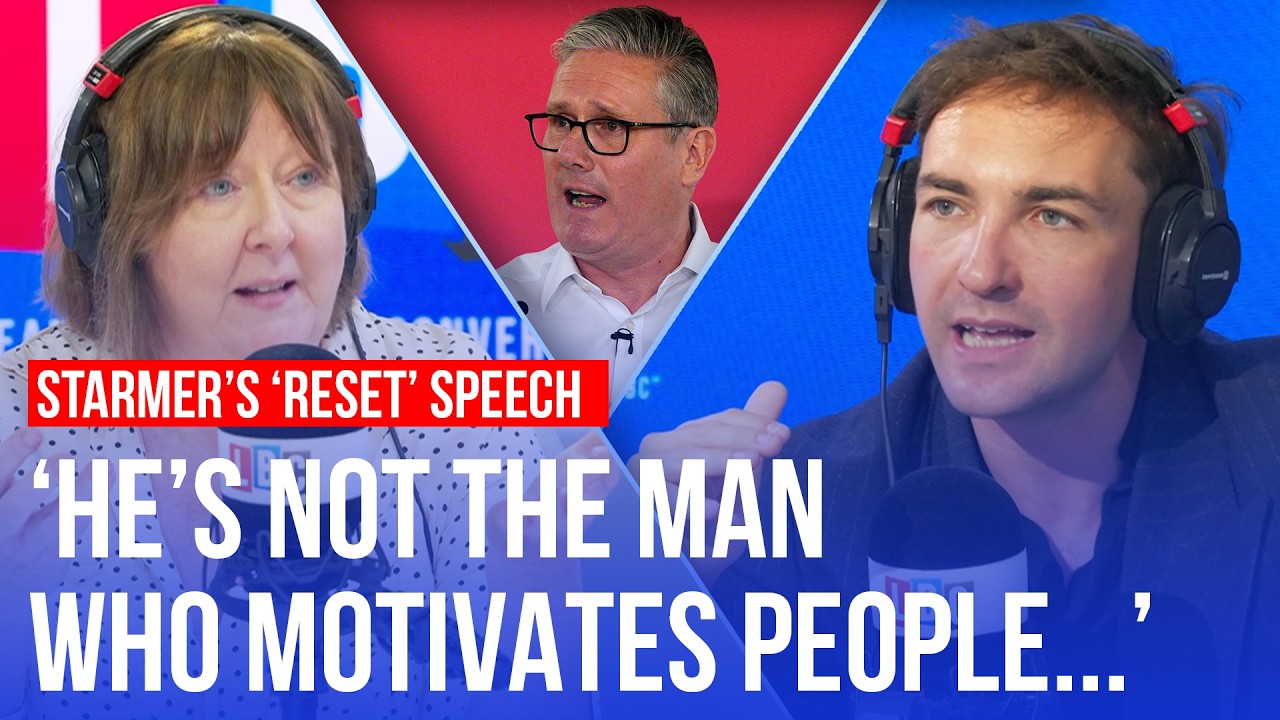
Shelagh Fogarty and The News Agents co-host Lewis Goodall unpack Keir Starmer’s ‘reset’ speech. In a speech to Labour members today, the Prime Minister vowed to prove his 'doubters' wrong as he fought back against calls for him to quit. In his speech, he pledged to nationalise British Steel, as well as put the UK 'at the heart of Europe.' Yet Lewis Goodall is unconvinced, saying he's 'not the man to motivate the Labour Party'. On whether he can turn around the Labour Party's recent local election defeat, where they lost over 1400 English council seats, Lewis tells Shelagh he's not inviting MPs to think he's the man for the moment. Listen to the full show on the all-new LBC App: https://app.af.lbc.co.uk/btnc/thenewlbcapp #lewisgoodall #shelaghfogarty #starmer #britishpolitics #ukpolitics #reform #LBC LBC is the home of live debate around news and current affairs in the UK. Join in the conversation and listen at https://www.lbc.co.uk/ Sign up to LBC’s weekly newsletter here: https://l-bc.co/signup
Show More Show Less View Video Transcript
0:00
the speech wasn't enough
0:01
And I think, in fairness, I think it was very unlikely and difficult to ever imagine how it would be enough
0:05
I mean, all these make and break speeches or make or break speeches, how many times did they ever make
0:10
Normally, they nearly always break, particularly for Keir Starmer, who even, I think
0:14
his most ardent defenders would say, you know, he is not one of the great orators
0:19
of our time or, frankly, any time. You know, that's just not his style
0:23
It's not what he is. He can make a good speech. I've been at party conferences in a particular way, you know
0:27
he has made good speeches, but it's not his forte. And I think one of the problems was, in a way, it was very classic Keir Starmer, which is that he alighted upon precisely the right diagnosis for the problem, which is if we were to condense, to boil down, to distill that speech, we would say that what he was saying is that what this party, what this movement, what this government desperately needs is an argument
0:53
We've talked before, Sheila, how, certainly I think, and I think a lot of people would say
0:57
that politics is a battle of ideas. And arguments in that battle are your primary weapon
1:02
And he was saying, we need an argument. Unfortunately, he then didn't proceed to describe
1:07
what that argument would be. He just identified the fact that they need an argument
1:11
And what the PLP were desperately looking for was not just the fact that they need an argument
1:16
they know that, but to hear what the Prime Minister thinks that it ought to be. I was thinking this morning, I was chatting to somebody
1:21
in the kitchen upstairs about this that I'm always a bit nervous ahead of his speeches because
1:26
there's a bit of a cringe factor often not always as you say but I'm nervous because for a number
1:31
of reasons but one of them is that he speaks as though he's outside of the things he's describing
1:38
as opposed to him being in the thick of them as you say arguing for them feeling them he says I
1:43
feel it I get it but there's no sense that that's true it would be a bit like you and me saying
1:47
hello good afternoon we're on the radio and what happens here is that we come on the radio
1:51
I ask you to call me, you call me, then we have a conversation. Sometimes my colleagues like Lewis come in and we have a conversation as well
1:58
0345 6060 973. Nobody would ring for that. It's a bit like what
2:02
He sounds a little bit like the old Microsoft paperclip. Do you remember that? It's like, how can I help you? And then just proceeds to give the description
2:07
Look, I think that, I think the problem is, is that in a way, again
2:13
I think a lot of Labour MPs would completely agree with the diagnosis
2:17
but again, not the prescription. Because the diagnosis is, Prime Minister's absolutely right
2:21
we need an argument to take to extremist forces. He's absolutely right to say that the stakes are
2:29
very very high He absolutely right and he chimes and aligns with exactly where the PLPR which is a belief that if the Labour Party does not get this right over the next 24 months or 36 months or however long it is that not only will the pendulum of politics just swing back
2:45
in the other direction, but actually the entire machine will be broken, that you will have
2:50
something completely new and consequences from that, flowing from that, that many Labour MPs
2:56
are genuinely terrified about. Therefore, the stakes are high, he identifies that, and he also
3:02
says rightly that what we need is stories, not spreadsheets. What we need is
3:08
massive change, not incremental change. And then you have Labour MPs listening to
3:12
the Prime Minister going, he's right, the stakes are high. He's right
3:16
that we need big change, not incremental change. He's right to say that
3:20
we need stories, not spreadsheets. And then they go, is this the guy
3:24
to meet those challenges, to meet those stakes, to provide stories, not spreadsheets
3:28
and to provide change, not incrementalism and most of them have concluded that he is not that guy because you know keir
3:35
starmer um look he spoke with great passion and and he did and he spoke with him with with some
3:40
you know emotion and and so on but he is who he is you know he is mr incrementalism that is the
3:49
entire kernel of his politics that is what he has anchored and based his politics around he is the
3:57
man who provides a sense of, when he's talking about his politics, he is the man
4:03
who is about that kind of steady technocratic, instrumental incremental change. He is
4:09
not the man who turns up and motivates via the, you know
4:13
via stunning imagery and talking about the vision of a burning city on a hill
4:17
And if that's what the Labour Party thinks it needs, frankly, if that's what
4:21
Keir Starmer thinks the moment needs, which is basically what he said in
4:25
In his speech, he is almost inviting his MPs to move to the conclusion
4:30
that he ain't the man for the moment, however unfortunate or unfair as that might be
4:35
And I would add to that that what he did in the speech when he set out the problem
4:38
was then repeat every error he's ever repeated in terms of style and substance
4:43
So he then described the EU policy as an incremental policy, not a dramatic change
4:49
he talked about British Steel in a way that was subject to public consultation and stuff like this
4:55
You know, isn't leadership about putting yourself full square at the solution
5:01
and making the world turn around that rather than seeing how the world turns and operate within that
5:07
Sometimes leadership is about that, isn't it? What the Labour Party has been looking for for a long time now, Sheila
5:11
and is even more in search of and desirous of after the events of last week is actually a very straightforward question which is what and who are we for What are we about Who are we for What is our coalition Just
5:28
actually given several questions, but they're basically all part of the same question. What is the Labour Party in 2026? And if you talk to Labour MPs, their fear is, and I don't
5:41
think this is entirely unfair or unjustified is that Keir Starmer does not really have the answer
5:47
or certainly the comprehensive answer to that question or if he does he doesn't quite know how
5:52
to plot out the politics and route to get there but I think someone I think we've all got to
5:56
remember this about about about Keir Starmer and his leadership it was always particularly in its
6:02
earliest days it was always meant to be an internal project you know Starmerism insofar as it existed
6:08
was about the purification of the Labour Party, as they might see it
6:13
or certainly the transformation, to put it a bit less pejoratively, of the Labour Party
6:17
It was about ridding the party, as they saw it, of the problems and personnel of Corbynism
6:24
That's what it was meant to be about. And frankly, if they could get to the next election and improve the position of the Labour Party
6:31
then so much the better. Now, what actually happened in the end was that, thanks to the calamities of the Conservative government at the time
6:41
they collapsed, and almost by default, Starmer and his party were handed not just an opportunity for government
6:49
but an enormous majority. The truth, though, is that because it was always an internal project led by a man who, frankly
6:57
as I know from my own experience, is almost hostile about political ideas and ideology
7:03
He doesn't think that that's what politics is about. As I say, he is Mr. Incremental Political Change
7:08
You've basically been in a position where the party, faced by these enormous political forces around it
7:13
and these new insurgent forces, where Keir Starmer and his government have had to be doing the thinking
7:19
about what the politics and government looks like on the hop in government
7:23
That is very, very hard. hard and I think they have paid a price for the fact that so much of his politics and the politics
7:31
of that project was unclear and inchoate from the very beginning. And can I ask you just a word on
7:38
Nigel Farage's Reform UK and that idea of building a coalition? What's started to become clear since
7:43
last Thursday is that reform are proving capable of building a coalition of very working class
7:51
traditional labour areas and some you know there still growth to be done but some more metropolitan city urban areas as well Think of Hackney for example
8:04
What, Reform? Reform, yeah. Reform didn't do that. Oh, sorry, Green was Hackney, wasn't it
8:08
Green, yeah, yeah, yeah. But think of St Helens as an example. Yes, certainly metropolitan areas
8:12
Yeah, yeah, yeah. Brexit voting. Yeah, obviously in order to get to a general election
8:17
they have to expand that. Of course, they've still got to change it. but they're building something of a new coalition for themselves, aren't they
8:24
Well, yeah, or you could look at it as almost an old coalition, which is the Boris Johnson coalition
8:29
which propelled the Tory party in 2019 to victory, certainly in those areas
8:35
I mean, you could look at what we saw on Thursday as almost a kind of that coalition coming back from abeyance
8:40
Because, of course, what happened is, 2019, a lot of these people left the Labour party to vote for Johnson
8:44
or stayed at home. 2024, a lot of those same people stopped voting for the Conservative party
8:49
or stayed at home, and in a lot of those seats that you mentioned in the Red Wall, the Labour vote doesn't go up that much
8:54
but the Conservative vote absolutely collapses. And you see reform standing in some of those places as well
8:59
And even then, even though they were still quite sort of protean at that time, they still do reasonably well split the Conservative vote
9:04
You could look at what happened last Thursday as that coalition and that vote reassembling behind Farage
9:11
Now, I would add one caveat to that, though, which is to say that the Boris Johnson coalition in 2019 was far stronger
9:16
and far, you know, if you're talking about them polling in the plus 44
9:21
you know, they were at like 44%. If we look at the Farage vote, the reform vote
9:25
nationally they're allowed out 26% or so. If you extrapolated it out
9:29
So the reform vote, look, it was a very impressive performance. It wasn't insurmountable
9:35
And this is, I think, something else that Labour MPs are thinking about. They are worried that if this continues, if this momentum continues
9:41
then it's going to become the settled will of the country to settle for reform
9:45
But that there is a window and there is a window for however long it is open
9:49
where the Labour Party does not have to do that much more. It can if it improved in 5%, 6%, 7%, 8% in the polls or whatever it is
9:57
Suddenly the whole game is looking very different. Now, that would mean taking back some of the Green vote
10:02
Yes, it would mean taking back some of these reform voters or getting their vote back out who stayed at home last Thursday
10:08
But the situation is not lost. And that is why the Labour Party, that herd is starting
10:13
It's moving slightly gingerly, perhaps. They're not quite the wildebeest of the Tory party
10:17
They're sort of more gazelles or something like that. They're moving a little bit more slowly. But they are moving because they are motivated by the idea that it is not lost
10:25
that things are not lost, but it will likely require action. And they are not convinced that the Prime Minister is the person to deliver it
10:31
They're certainly not wildebeest. I see meerkats. Yes, maybe, perhaps. I see meerkats
10:36
Sweet, sweet
#news