Up next in 10


What if you fell into Jupiter. Not the movie version. On December 7, 1995 the Galileo probe hit at 47.4 kilometers per second, lasted 58 minutes, and never found a floor.
0:00 The first second
0:42 The Only Thing That Tried
1:55 Radiation Before The Clouds
3:08 Two Point Five G And No Exit
4:20 The Ammonia Ice Deck
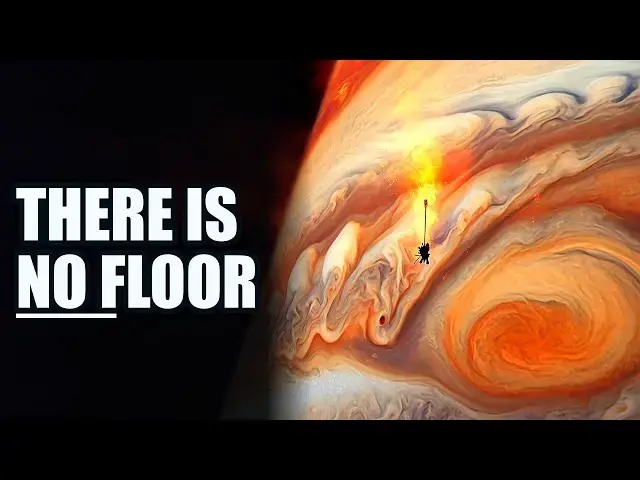
5:35 There Is No Floor
6:48 And It Gets Worse
8:00 Metallic Hydrogen
9:15 What Does Not Happen
10:25 The Fuzzy Core
Public-record thought experiment using NASA and peer-reviewed numbers. Interior depths and core pressures are model estimates. Not flight advice.
#Jupiter #WhatIf #NASA #GalileoProbe #JunoMission #GasGiant #SpaceScience #Astronomy
Visuals are original AI-generated stills. Narration is synthetic. Not medical, legal, or financial advice.
Show More Show Less View Video Transcript
0:00
On December 7th, 1995, at 22:04 UTC, a
0:04
337 kg NASA probe slammed into Jupiter
0:07
at 47.4 km per second. That is about
0:11
106,000 mi an hour. The carbon heat
0:14
shield reached 16,000° C
0:16
and shed 80 kg of itself in under 2
0:18
minutes. Peak deceleration was 228 g.
0:22
Then the radio lasted 58 minutes. You
0:24
would not last 58 seconds. And here is
0:27
the turn nobody puts on the poster.
0:29
The probe never hit a floor because
0:31
Jupiter does not have one.
0:33
The only thing that tried
0:36
Hughes Aircraft built that probe in El
0:38
Segundo. Galileo released it on July
0:40
13th, 1995, still about 80 million
0:44
kilometers from the planet, and it
0:46
coasted 5 months with no engine and no
0:48
second chance. You are not that machine.
0:51
You are a body in a suit, and the first
0:53
physical second is a wall of hydrogen
0:55
hitting you at 47 km per second. Entry
0:58
angle 8.4°.
1:00
Peak heating near 30 kW per square
1:02
centimeter. A 2.5 m parachute opened
1:05
after the shield did its job, and six
1:08
instruments started talking through 156
1:10
km of atmosphere. Mix molecular hydrogen
1:14
and helium, almost no water. Winds about
1:17
640 m per second. At roughly 180 km
1:21
below the entry ceiling, pressure sat at
1:23
22.7 atmospheres, and the transmitter
1:26
quit. Jupiter's equatorial radius at the
1:29
1 bar level is 71,492
1:33
km. The probe sampled about 0.22% of the
1:36
way to the center. That is the entire
1:39
human catalog of falling in. One dry
1:41
hotspot, one hour, one dead radio.
1:46
Radiation
1:47
Before the clouds
1:49
You do not start at the clouds, you
1:51
start in a magnetosphere. Jupiter's
1:53
field is about 20,000 times Earth's
1:55
dipole moment. On the sunward side, the
1:58
magnetopause sits 50 to 100 Jovian radii
2:01
out, 3 to 7 million kilometers of
2:03
charged real estate. Inside it,
2:05
electrons at tens of MeV and protons
2:08
past a GeV spiral on field lines.
2:11
Unshielded, a lethal dose arrives in
2:13
seconds. Your visor does not fog. Your
2:16
blood just stops being a working
2:18
instrument. Io orbits at about 422,000
2:22
kilometers and dumps roughly 1,000
2:24
kilograms of sulfur and oxygen into that
2:27
field every second. The Io plasma torus
2:30
is a donut of ionized volcano at 100,000
2:33
to a million Kelvin. You fall or rue it.
2:36
Your avionics arc. Galileo found an
2:38
intense belt about 50,000 kilometers
2:41
above the clouds. That is still vacuum.
2:43
You are dying in empty space that
2:45
happens to belong to Jupiter before the
2:47
first ammonia crystal ever touches
2:49
glass. Two, 0.5 G and no exit. Cloud top
2:54
gravity is 24.79
2:56
meters per second squared. Call it 2.5
2:59
G. A 70 kilogram body weighs about 175
3:02
kilograms at the one bar level and that
3:04
weight climbs as you sink toward more
3:06
mass. Escape velocity is 59.5 kilometers
3:10
per second, about 133,000 miles an hour.
3:13
Earth asks 11.2. You are not jumping
3:16
back. Equatorial spin is 12.6 kilometers
3:19
per second. A day is 9 hours 55 minutes.
3:22
Equatorial radius 71,492
3:25
kilometers. Polar radius 66,854.
3:28
The planet is 318 Earth masses and 1,321
3:32
Earth volumes. Mean density 1.33 grams
3:35
per cubic centimeter, about the density
3:37
of milk. That number is the first
3:39
physics insult. Something that large
3:41
should be rock. It is hydrogen with a
3:43
helium mixer, helium mass fraction about
3:46
0.23 and some of that helium is already
3:48
raining inward. Solar irradiance at
3:50
Jupiter is 50 watts per square meter
3:52
against Earth's 1,361.
3:55
The Sun is a dim coin. The planet makes
3:57
its own heat. The ammonia ice deck.
4:01
The one bar level is 165 Kelvin, minus
4:04
108 Celsius. Astronomers call it a
4:07
surface because they need a zero. 50 km
4:10
above it, the tropopause sits near 0.1
4:13
bar and 110 Kelvin. Scale height is 27
4:17
km. You hit ammonia ice first, white and
4:20
thin, then ammonium hydrosulfide, then
4:23
water ice if the column is wet. On
4:25
December 7th, 1995, it was not wet.
4:29
Galileo fell into a downdraft hot spot
4:32
and measured water below 3% of solar
4:34
abundance at 12 bars. Equatorial jets
4:37
run 150 m/s. The Great Red Spot is a
4:41
high-pressure storm at least 300 years
4:43
old, currently about 1.3 Earths across.
4:46
Rim winds near 120 m/s. You are a grain
4:50
in a shear layer, not a visitor. At 10
4:53
bars, about 90 km down, temperature is
4:56
already near 340 Kelvin. Room
4:58
temperature with no air. Volume mix
5:00
about 90% molecular hydrogen, 10%
5:03
helium. Methane around 3,000 parts per
5:06
million. Ammonia around 260. Mean
5:09
molecular weight 2.02. Your lungs fill
5:12
with a gas that has no oxygen. You
5:14
asphyxiate in a fog that looks like
5:16
weather and is actually the planet.
5:19
There is no floor.
5:21
This is still a logistics problem. You
5:23
packed for a landing. Boots, struts, a
5:26
place to stand. There is nothing to land
5:28
on. Hydrogen's critical point is 33
5:31
Kelvin and 13 bar. Jupiter blows past
5:34
that in the first few hundred
5:35
kilometers.
5:37
After that, gas and liquid are the same
5:39
substance, a supercritical fluid that
5:41
fills like a gas and packs like a
5:44
liquid.
5:45
Density at one bar is 0.16 kg per cubic
5:49
meter, thinner than Earth air. Then it
5:51
climbs without a phase change you can
5:53
point at. No splash, no crater, no, and
5:56
then you hit.
5:58
Juno entered orbit on July 4th, 2016,
6:01
after 2.8 billion kilometers. Its
6:03
gravity data showed the visible belts
6:05
and zones reach about 3,000 km down.
6:08
That is whether thicker than the drive
6:10
from Boston to Miami stood on end. You
6:13
fall through a storm with no basement.
6:15
The 10-bar level is paperwork. Below it,
6:18
the word atmosphere stops meaning
6:20
anything, and the word ocean has not
6:21
started yet. And it gets worse.
6:24
The part that actually matters is not
6:26
the cold. It is the squeeze. Galileo
6:29
died at 23 atmospheres, a scuba number.
6:32
A few thousand kilometers in, you are
6:34
looking at thousands of bars, then tens
6:36
of thousands. Temperature follows a dry
6:38
adiabat because heat can only leave by
6:41
convection. Around a million
6:43
atmospheres, molecular hydrogen breaks.
6:45
Electrons unbind. The fluid starts
6:48
conducting like a metal. Temperature
6:50
there is 5,000 to 10,000 Kelvin. You do
6:53
not crush like a soda can. You dissolve.
6:56
Carbon, nitrogen, the iron in your
6:59
blood, the calcium in your teeth, they
7:01
stop being anatomy and start being
7:03
impurities in a hydrogen solvent.
7:05
Terminal velocity is a joke because the
7:08
medium densifies under you faster than
7:10
you can fall. At some depth, your
7:13
density matches the fluid. You stop
7:15
sinking as a person and start mixing as
7:17
chemistry. That is not a landing. That
7:20
is a recipe. And the recipe does not
7:23
reverse. Metallic hydrogen.
7:25
That conducting ocean is the dynamo. It
7:28
is most of the interior. Currents in
7:30
spinning metallic hydrogen build the
7:32
magnetosphere that killed you on the way
7:34
in. Equatorial field about 4.3 Gauss
7:38
against Earth's 0.3. The magnetotail can
7:41
stretch towards Saturn's orbit up to
7:43
about 7,000 Jovian radii. Jupiter
7:46
radiates roughly 1.7 times the energy it
7:49
absorbs from the Sun. The extra is
7:51
leftover formation heat plus
7:53
Kelvin-Helmholtz contraction of about 1
7:55
mm of radius per year.
7:58
You are falling through a planet that is
7:59
still shrinking and still glowing from
8:01
the inside. There is no sunlight down
8:03
here. There is the infrared of
8:05
compressed hydrogen red, then yellow,
8:08
then white lighting the inside of a
8:10
visor that no longer has a face behind
8:12
it. Juno found the field is lopsided,
8:15
north not matching south, which means
8:17
the conducting layer is not a neat
8:19
sphere. You are inside a stirred metal
8:21
that does not keep a guest book. What
8:24
does not happen Earth does not get
8:26
pulled in tomorrow.
8:28
Jupiter sits at 778 million kilometers
8:30
from the Sun, 5.2 AU, orbital speed 13.1
8:35
kilometers per second, and it stays
8:37
there. Your house does not feel 2.5 G.
8:40
The Great Red Spot does not relocate to
8:43
Kansas. The 1995 probe did not open a
8:46
hole. Juno's 2016 insertion did not
8:50
crack a floor that was never there.
8:52
Comets do hit. Shoemaker-Levy 9 struck
8:55
in July 1994. About 21 fragments punched
8:59
dark scars that faded in months. That is
9:02
the public record analog of falling in
9:04
and the planet ate them and kept its
9:06
belts. You do not bounce. You do not
9:09
tunnel through to the other side. You do
9:11
not find a cavern of rock. You also do
9:13
not light a star. Core temperature is
9:15
about 20,000 Kelvin. The Sun's core is
9:18
15 million. Jupiter is short of fusion
9:20
by a factor of about a thousand in mass.
9:22
It is a planet. It remains a planet. The
9:25
solar system does not end because you
9:27
jumped. The fuzzy core Juno's gravity
9:29
harmonics killed the clean textbook. The
9:32
old picture was a compact rock-ice
9:34
kernel of maybe 10 Earth masses with a
9:37
sharp edge. The new picture is a dilute
9:39
core, heavy elements mixed into hydrogen
9:42
reaching perhaps 50 to 63% of the
9:45
radius. Central pressure around 40
9:47
million bars. Temperature around 20,000
9:51
Kelvin. There may be no surface even
9:53
there, just a gradient of rock-forming
9:55
stuff fading into metal. If anything of
9:58
you still had density left, you would
10:00
not stand on it. You would blend into
10:02
it. That is the last number.
#News