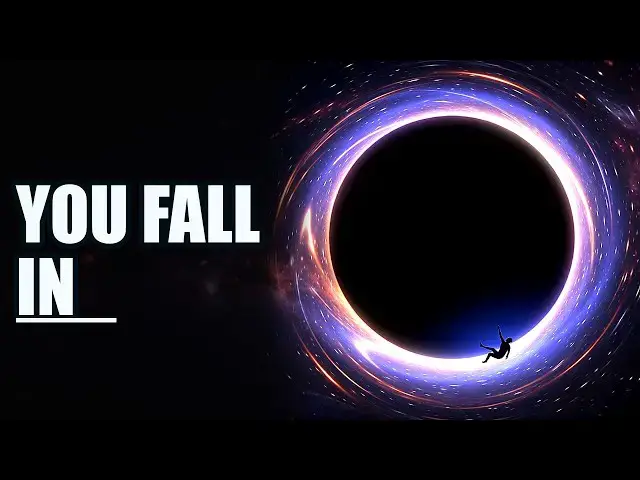
Up next in 10


What actually happens if you fall into a black hole — the clock, the stretch, the horizon, and what does not happen tomorrow.
0:00 The Clock Starts
0:45 One Solar Mass
2:10 Crossing the Horizon
3:40 Spaghettification
5:20 Time From Outside
7:00 And It Gets Worse
8:30 Cygnus X-1, 1971
10:10 What Does Not Happen
11:40 After the Last Light
This is a science thought experiment, not a recap of a movie. Numbers are public-record physics. Estimates use "about."
#blackhole #space #astronomy #eventhorizon #science #whatif #physics #nasa
Visuals are original AI-generated stills. Narration is synthetic. Not medical, legal, or financial advice.
Show More Show Less View Video Transcript
0:00
On April 10th, 2019, a telescope array
0:02
published a ring of light 55 million
0:05
light-years away. That ring was about 42
0:08
billion kilometers across. You are not
0:10
looking at it. You are already past it,
0:13
and your watch still thinks it is t o
0:15
equals zero.
0:17
The clock starts.
0:19
At t o equals zero, you are in free fall
0:22
toward a black hole with the mass of the
0:24
sun. No engines, no radio. The
0:26
Schwarzschild radius of that object is
0:29
about 3 kilometers. That is the event
0:31
horizon. The sphere where even light at
0:34
299,792
0:37
kilometers per second cannot climb back
0:39
out. At t equals 1 second, you have not
0:42
hit anything. There is no wall. There is
0:45
a gradient. Gravity at your feet is
0:47
already stronger than gravity at your
0:49
head if you are falling feet first. At t
0:53
equals 5 seconds, the difference is
0:55
still small if you started far out. The
0:57
part that matters is not a bang. It is a
1:00
clock that will not agree with anyone
1:02
left behind. One solar mass.
1:05
A solar mass black hole is the worst
1:07
kind to fall into if you care about
1:09
staying a person. Tidal forces scale
1:11
steeply as you get close. For a
1:13
3-kilometer horizon, the stretch between
1:15
your head and your feet becomes lethal
1:18
well before you reach that 3-kilometer
1:20
mark. Estimates put the fatal tidal
1:22
gradient for a human body at tens of
1:25
thousands of g per meter near a stellar
1:27
mass hole. Your bones do not get
1:30
immediate cartilage, then muscle, then
1:32
the column of blood in your legs, then
1:34
the tissue between your ribs. You are a
1:37
length, not a shape. A supermassive hole
1:40
is different. Sagittarius A star, the
1:43
object at the center of the Milky Way,
1:45
is about 4.3 million solar masses. Its
1:48
event horizon is on the order of 12
1:51
million kilometers across, about 17
1:53
times the sun-to-Earth distance if you
1:55
measure diameter the way astronomers it.
1:58
And the tidal gradient at that horizon
2:00
can be gentle enough that you might
2:02
cross it still looking like a person.
2:04
That is the term. The bigger the hole,
2:06
the less the horizon itself kills you.
2:08
The small one kills you on the way in.
2:11
The giant one lets you in, then owns the
2:13
rest of your future.
2:15
Crossing the horizon.
2:17
You do not feel a membrane. Locally, if
2:19
the hole is huge, the crossing can feel
2:21
like more falling. Light from behind you
2:24
still reaches you for a while. Light you
2:26
send outward, aimed at the people who
2:29
dropped you, never makes it.
2:31
The photon you fire at 299,792
2:34
km per second still moves at that speed
2:38
next to your hand. Space is the thing
2:40
that changed. The outgoing null
2:42
direction now points inward. From your
2:44
seat, T keeps ticking. From Earth, the
2:47
last frame they get is you slowing,
2:50
reddening, freezing near a surface they
2:52
will never watch you pierce. You do not
2:55
hover there. That freeze is their
2:57
coordinate bookkeeping, not your body.
3:00
You are through.
3:02
There is no reverse thruster that works
3:04
after that because every future-directed
3:06
path now ends at the singularity. That
3:08
is not poetry.
3:10
In the Schwarzschild math, R = 0 is in
3:14
your future the way tomorrow morning is
3:16
in your future on Earth. You can wiggle.
3:18
You cannot not arrive.
3:20
Spaghettification.
3:21
This is the logistics problem first.
3:23
Your body has a height. Call it 1.8 m.
3:27
The gravitational field is not the same
3:29
at both ends of that 1.8 m. The
3:31
difference in acceleration is the tidal
3:33
field. Near a stellar mass hole, that
3:36
difference grows until it exceeds the
3:38
tensile strength of bone, which fails
3:40
around 100 MPa
3:42
in compression and far less in tension
3:45
along a long axis. You become a thread.
3:48
The name is ugly and accurate,
3:50
spaghetti. Atoms are still atoms for a
3:52
stretch of the fall. Then the gradient
3:55
eats the binding. If instead you fell
3:58
into a hole of 4 million solar masses,
4:01
that spaghetti moment can wait until you
4:03
are well inside the horizon in a region
4:05
no outside telescope will ever see.
4:08
Either way the sequence is the same in
4:10
kind. Feet or head first, then a meter
4:13
of you, then a centimeter, then the
4:15
chemistry that used to be a person. You
4:17
do not get a last breath at the center.
4:20
You do not remain a you long enough to
4:22
report it.
4:23
Time from outside.
4:26
Pick a sister ship parked at a safe
4:28
orbit. Their clocks run. Yours, as they
4:31
reconstruct it from the photons you
4:33
still emit on the way in, appears to
4:35
crawl.
4:36
Gravitational time dilation near the
4:38
horizon goes to infinity in
4:40
Schwarzschild coordinates. A signal you
4:43
send at 1 second of your proper time,
4:45
close enough in, can take years of their
4:48
coordinate time to crawl out. Stretched
4:50
into radio, then into nothing they can
4:52
lock onto. They never receive a ping
4:54
from inside. Hawking radiation, if you
4:57
want the quantum footnote, is a
4:59
temperature. For a solar mass hole, that
5:01
temperature is about 60 nanokelvin,
5:04
colder than the cosmic microwave
5:06
background at 2.7 kelvin. So, a stellar
5:09
hole in today's universe is still a net
5:12
eater, not a glowing coal. M87 star, the
5:16
hole in that 2019 image, is about 6.5
5:20
billion solar masses. Its shadow was
5:22
measured at about 42 micro arc seconds.
5:25
That is a public record number from the
5:27
Event Horizon Telescope paper, not a
5:30
movie. You falling into that one would
5:32
look, from the outside, like a fade, not
5:35
a splash. And it gets worse.
5:38
The part that actually matters is not
5:40
the stretch. It is the loss of a shared
5:42
now.
5:43
After you cross, there is no experiment
5:46
you can run that sends a result to the
5:48
sister ship. Causality is a one-way
5:51
valve. Your world line has a finite
5:54
proper time left for a solar mass hole
5:57
from horizon to singularity. That
5:59
remaining proper time is on the order of
6:01
microseconds if you fell from rest at
6:04
the horizon in the simplest model. About
6:08
10 microseconds is the scale people
6:11
quote for radial free fall remaining
6:14
time inside a 3 km Schwarzschild radius.
6:18
10 microseconds is not a speech. It is
6:21
not a prayer you finish. It is less time
6:24
than a nerve signal needs to cross your
6:26
spinal cord.
6:28
For Sagittarius A* that remaining proper
6:31
time can be on the order of a minute,
6:33
about 20 seconds to a minute depending
6:36
on how you fall.
6:37
A minute is long enough to notice the
6:39
sky has gone wrong. The stars pile into
6:43
a shrinking patch above you. Aberration
6:46
and gravitational lensing crush the
6:48
universe into a disk, then a point in
6:51
the direction you still think of as out.
6:54
The rest of the view is darkness that is
6:57
not night. Night has stars, this does
7:00
not. Cygnus X-1 1971,
7:04
December 1971 is the mini case. Cygnus
7:07
X-1 had been an X-ray source in the
7:10
northern cross.
7:11
By the end of 1971
7:13
the mass estimates for the compact
7:15
object in that binary were high enough
7:18
that a team including Tom Bolton at the
7:20
University of Toronto argued it was too
7:23
heavy to be a neutron star. About 15
7:25
solar masses is the modern ballpark for
7:28
the hole itself with a companion HDE
7:31
226868
7:33
pouring gas. The horizon of a 15 solar
7:36
mass hole is about 45 km across. If you
7:39
had been dropped towards Cygnus X-1 in
7:41
December 1971, nobody on Earth would
7:44
have had a picture of a shadow.
7:47
They had spectra, periods, and an
7:49
argument. The physics for your body
7:52
would have been the stellar mass script.
7:54
Title death outside the horizon, then
7:57
the rest of you as a stream of debris on
7:59
a path with no exit. Stephen Hawking
8:02
later bet against the black hole
8:04
interpretation and paid with a
8:06
subscription.
8:07
The object is still there.
8:09
It did not wait for the 2019 photograph.
8:13
It has been eating for as long as that
8:15
binary has existed, on the order of
8:17
millions of years for the system as we
8:19
model it, not a Hollywood countdown.
8:22
What does not happen?
8:25
Tomorrow morning, Earth does not fall
8:27
into Sagittarius A* That object is about
8:30
27,000 light-years away.
8:33
It's gravity at the Sun is a tiny
8:36
perturbation compared with the disc of
8:38
the Milky Way that already holds the Sun
8:41
in orbit. You do not get spaghettified
8:43
in your kitchen. The event horizon of
8:45
the Sun, if the Sun were crushed to that
8:48
size, would be 3 km. But, the Sun is not
8:51
doing that. And the white-hot
8:53
photosphere you actually have is 1.4
8:56
million km across. No one on the night
8:59
side is going to watch a freeze-frame of
9:02
a neighbor hovering on a glowing ring.
9:05
Hawking evaporation of a stellar mass
9:07
hole takes about 10 to the 67th years,
9:11
vastly longer than the present age of
9:13
the universe at 13.8 billion years.
9:16
It is not a bomb on a timer you can
9:18
hear.
9:19
GPS satellites already correct for a few
9:22
microseconds a day of gravitational time
9:25
dilation around Earth, which is a weak
9:27
field cousin of the same math, and that
9:30
correction does not mean a portal opened
9:33
under Denver.
9:34
The 2019 image did not move the hole
9:37
closer. It measured a shadow that was
9:40
already there.
9:41
After the last light you in the scene at
9:44
t = 0 on your watch at the horizon of
9:47
the giant hole still a shape. At t = 1
9:51
second the outside universe is a bright
9:54
ring getting thinner.
9:56
At t = 5 seconds if this is Sagittarius
10:00
A star and you fell hard you may already
10:03
be deep into the minute you have left.
10:05
There is no landing.
10:06
There is no floor.
10:08
The singularity in the classical theory
10:10
is a density that goes without bound. A
10:13
curvature that rips the meaning out of
10:16
where.
10:17
Quantum gravity might smear that last
10:19
tick.
10:20
Nobody has the lab for that. What you
10:22
can say without a new theory is this.
10:25
Information that falls in does not come
10:27
back out as a letter. If it comes back
10:29
at all it comes back scrambled on time
10:31
scales that do not help the person who
10:34
fell. The sister ship writes a report.
10:36
The report has a last photon. After that
10:39
the file is closed from their side. The
10:41
universe you left is still there. Clocks
10:43
on Earth still tick 86,400 seconds in a
10:46
day. Kids still miss the bus. The hole
10:49
does not send a receipt. If a fall like
10:52
that is the end of every path inside the
10:54
horizon. What do you do with the fact
10:56
that you are still on the outside with a
10:58
whole future still in front of you? The
11:01
gospel part is short and only here.
11:03
The story Christianity tells is that
11:05
Jesus already walked into the grave and
11:07
came back which is a claim about a
#News