Up next in 10


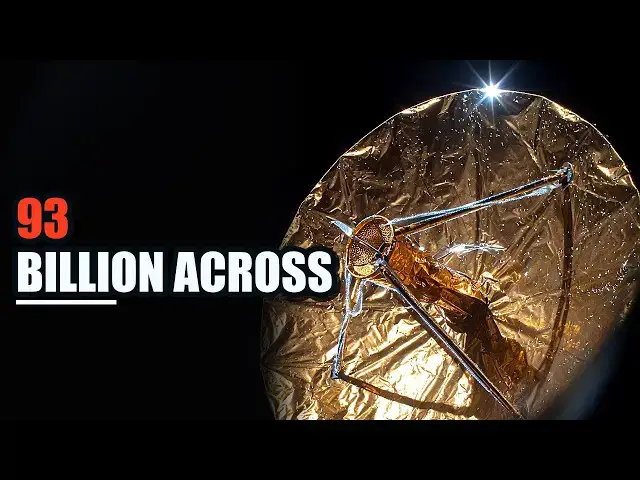
On November 18, 2026, Voyager 1 reaches one light-day from Earth — about 16.1 billion miles after 49 years. That is still not a scratch on a 93 billion light-year observable universe.
This is a scale walk, not a slogan. One light-day. The nearest star. The galaxy. Andromeda. Why 93 billion. Then the expansion problem, a named Webb galaxy from 2024, and what does not happen tomorrow.
0:00 The 16 billion mile machine
0:48 One Light Day
1:51 The Nearest Star
2:44 Across The Galaxy
3:41 The Neighbor Galaxy
4:38 Why 93 Billion
5:50 And It Gets Worse
7:07 What Webb Actually Saw
8:24 What Does Not Happen
9:24 The Edge You Cannot Cross
Numbers are approximate public-record figures. Expansion rates, galaxy counts, and merger odds are active research. This is not a prediction that the night sky ends.
#universe #space #voyager1 #cosmology #astronomy #jameswebb #milkyway #observableuniverse
Visuals are original AI-generated stills. Audio may be synthetic. Not medical, legal, or financial advice.
Show More Show Less View Video Transcript
0:00
On November 18th, 2026, at 2:16 in the
0:03
morning, Pacific time, a machine no
0:05
bigger than a small car will sit 161
0:09
billion miles from Earth. That is one
0:12
light day. Light itself needs 24 hours
0:15
to cover the gap. Voyager 1 left Cape
0:18
Canaveral on September 5th, 1977.
0:21
It will have been flying for 49 years, 2
0:24
months, and 11 days to travel a distance
0:26
light covers while you sleep once. NASA
0:29
timed the crossing to the second. 2:167
0:32
a.m. The radio whisper that proves the
0:35
machine is still alive will take a full
0:37
day to crawl home. Here is the turn.
0:40
That is the farthest any human object
0:42
has ever gone. And it is not even a
0:45
scratch on the universe. One light day.
0:49
You are standing in a dishyard in the
0:51
California desert at night. The air
0:53
stings your nose. The antenna metal is
0:55
colder than the sand. The dish is the
0:58
size of a house locked on a patch of
1:00
black that looks empty. Voyager's
1:02
transmitter puts out about 23 watts. A
1:05
refrigerator bulb. In 2024, when a
1:08
computer on board glitched, engineers
1:10
sent a command and then waited 22 and
1:13
1/2 hours for it to arrive. Then another
1:16
22 and 1/2 hours for the reply. 45 hours
1:19
to know if a spacecraft the size of a
1:21
car even heard them. That is the
1:24
logistics of distance. Light wraps the
1:26
Earth about 7.5 times in one second. It
1:29
hits the moon in about 1.3 seconds. It
1:32
hits the sun in eight minutes and 20
1:34
seconds. Mars on a typical day is about
1:37
12 light minutes away. Voyager after
1:40
half a century is one light day. The
1:43
nearest star Proxima Centauri is about
1:46
4.24 light years from here, about 25
1:49
trillion miles. You cannot feel that
1:52
number. So do this instead. Take Voyager
1:55
speed about 17 km a second 38,000 m an
1:59
hour faster than any rifle bullet you
2:02
have ever heard. Pointed at Proxima. Do
2:04
not slow down. Do not turn. You arrive
2:07
in about 74,000 years. Every city on
2:10
Earth will have been dust for longer
2:12
than writing has existed. Voyager is not
2:14
even aimed at Proxima. It is headed
2:16
toward a star called Gleisa 445, more
2:20
than 17 light years out. and it will not
2:22
get there in any lifetime that has a
2:24
name. This is still the front yard of
2:26
one star in a disc 100,000 lighty years
2:30
wide. And you have not left the
2:31
driveway.
2:33
Across the galaxy, the Milky Way is a
2:36
flattened disc about 100,000 lightyears
2:39
across and about 1,000 light years thick
2:42
through the middle. You live about
2:44
27,000 lighty years from the center in a
2:47
spiral arm on a rock that takes about
2:49
230 million years to go around once.
2:52
That is one galactic year. If you could
2:55
freeze the galaxy and cross it at light
2:57
speed, coast to coast is a 100,000
2:59
years. No stopping, just a beam. There
3:02
are about 100 to 400 billion stars in
3:05
this one galaxy. On a clear night, the
3:07
band you see is the inside of the disc,
3:09
edge on, like standing on a street and
3:11
seeing only the street. The halo of
3:14
stray stars around it stretches toward a
3:16
million lighty years. Astronomers have
3:19
found RR Lray stars more than a million
3:21
lighty years out, almost halfway to the
3:23
next big galaxy. The neighbor galaxy,
3:26
Andromeda, sits about 2.5 million lighty
3:29
years away. That is the nearest major
3:32
galaxy. On a moonless night, far from
3:34
street lights, you can see it with a
3:36
naked eye as a faint smudge. That smudge
3:39
is about a trillion stars. The light
3:41
hitting your retina left Andromeda 2.5
3:44
million years ago when early humans were
3:47
still in Africa. If you sent a radio
3:49
hello today, a reply, if anyone
3:52
answered, would come back in 5 million
3:54
years. Andromeda is moving toward us at
3:56
about 110 km a second. A June 2025 study
4:00
put the chance of a collision in the
4:02
next 5 billion years under 2%. The sun
4:05
will be a red giant long before that
4:07
math comes due. This is still the local
4:10
group. The universe is what starts when
4:12
the local group stops being able to hold
4:14
on. Why 93 billion? The universe is
4:18
about 13.8 billion years old. That
4:21
number comes from the leftover heat of
4:23
the Big Bang, the cosmic microwave
4:25
background, plus the ages of the oldest
4:28
stars. Light has had 13.8 billion years
4:31
to travel. So, the naive map says the
4:34
farthest thing you can see is 13.8
4:37
billion lighty years away, and the whole
4:39
bubble is 27.6 billion lightyears
4:41
across. That map is wrong. Space has
4:45
been stretching the entire time the
4:46
light was in flight. The photon did not
4:49
fly through a frozen hallway. The
4:51
hallway grew. The matter that emitted
4:54
the oldest light we can still catch, the
4:56
microwave glow from about 380,000 years
4:59
after the Big Bang, was only about 42
5:02
million lighty years away when that
5:03
light set out. Today, that same matter
5:06
sits about 46 billion lighty years away.
5:09
Radius about 46.5 billion. Diameter
5:13
about 93 billion lightyear. That is the
5:16
observable universe. Not the whole
5:18
universe, the part whose light has had
5:20
time to reach you. A lightyear is 5.88
5:24
trillion miles, 93 billion of those end
5:27
to end. And it gets worse. And it gets
5:30
worse. Expansion is not a one-time
5:32
shove. It is still happening. The Hubble
5:35
constant is about 70 kilometers per
5:37
second for every mega parseek of
5:39
distance with two camps fighting over 67
5:42
versus 73. That fight does not change
5:45
the size enough to save you. past about
5:47
14 billion lightyears, space between us
5:50
and a galaxy is stretching faster than
5:52
light can close the gap. Relativity is
5:55
not broken. The galaxies are not flying
5:57
through space faster than light. Space
5:59
itself is getting longer. The cosmic
6:02
event horizon sits around 16 billion
6:04
lighty years away. Light that a galaxy
6:07
beyond that line emits today will never
6:09
reach Earth. Not in a million years. Not
6:12
in a trillion. You can see those
6:14
galaxies anyway because the light you
6:16
are catching now left when they were
6:18
closer. You are looking at their past.
6:21
Their present is already leaving. Dark
6:24
energy is making the stretch accelerate.
6:27
In the far future, galaxies outside our
6:29
local group redshift until they fade out
6:31
of every instrument we will ever build.
6:34
The sky gets lonier. Not tonight. On a
6:36
clock you do not own. what web actually
6:40
saw. On May 30th, 2024, NASA announced
6:44
that the James Webb Space Telescope had
6:46
confirmed a galaxy called Jadis GS
6:49
Zesttor 190. In January 2024, the
6:53
spectrograph stared at it for almost 10
6:55
hours. The red shift came back at about
6:58
1432. That light left when the universe
7:01
was about 290 million years old, less
7:03
than 300 million years after the Big
7:06
Bang, about 2% of the age of everything.
7:08
The galaxy is more than 1,600 light
7:11
years across and already hundreds of
7:13
millions of times the mass of the sun.
7:16
In March 2025, two teams found oxygen in
7:19
it, which means stars had already lived
7:21
and died before we ever took the
7:24
picture. And even that galaxy is not at
7:26
the edge of the 93 billion. Its light
7:29
traveled about 13.4 billion years to get
7:32
here. And while it flew, the space
7:34
behind it kept stretching. The Hubble
7:37
Ultra Deep Field, released March 9th,
7:40
2004, put about 10,000 galaxies in a
7:43
patch of sky smaller than a grain of
7:45
sand held at arms length. Scale that
7:48
patch over the whole sky, and the number
7:50
climbs toward two trillion galaxies in
7:53
the observable bubble alone. What does
7:56
not happen?
7:57
What does not happen tomorrow morning?
7:59
The sun does not go out. The night sky
8:01
does not go black. Voyager does not fall
8:04
off a cliff. Proxima does not lurch
8:06
closer. Andromeda does not arrive. Your
8:09
GPS satellites still lock. The moon
8:11
still takes 1.3 seconds for a laser
8:14
bounce. The 93 billion light-year number
8:16
does not mean the ground under you is
8:19
racing away. Gravity holds the solar
8:21
system. Gravity holds the galaxy.
8:24
Gravity holds the local group. Expansion
8:26
wins on the scales between clusters. Not
8:29
in your kitchen, not on your street, not
8:31
in the orbit of Earth. You will not lose
8:34
the constellations this year or this
8:36
century or in the lifetime of anyone you
8:39
will ever meet. The microwave background
8:41
will still be about 2.7° above absolute
8:44
zero. The universe is large. It is not a
8:47
bomb under the floor. The edge you
8:50
cannot cross. The part that actually
8:53
matters is this. There is a difference
8:55
between how far light has already
8:57
traveled and how far you can ever go.
9:00
Even if you left Earth today at the
9:02
speed of light, you could not reach a
9:04
galaxy that is presently more than about
9:06
18 billion lighty years away. Expansion
9:08
would stretch the remaining road faster
9:10
than you could eat it. Most of the 93
9:13
billion is not a destination. It is a
9:16
museum of light that has already been
9:17
sent. You can look. You cannot visit.
9:20
Voyager will still be a light day out,
9:23
then a light week, and it will never
9:25
leave the suburbs of One Star. The
9:27
golden record on its side is a 12-in
9:30
goldplated copper disc aimed at no one
9:33
in particular because no one in
9:34
particular is close enough to pick it
9:36
up. Stand outside tonight. The silence
9:39
is not empty. It is delay. Every star
9:41
you see is a time stamp. The smudge of
9:44
Andromeda is 2.5 million years late. The
9:47
glow of the big bang is
#News