
Experts warn Elon Musk's satellites could 'end astronomy' and 'light up the night sky' 2/2.
Jul 2, 2026
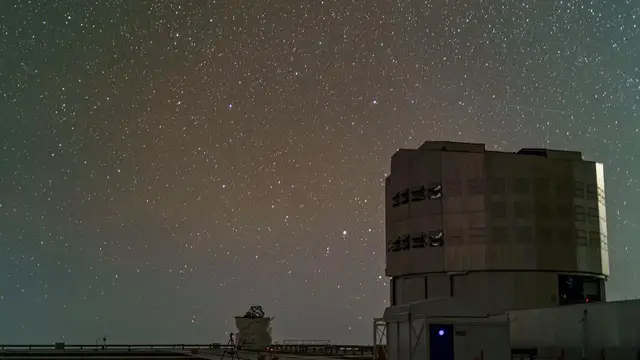
Credit: F. Kamphues, ESO/M. Kornmesser/Cover Images Astronomers have warned that Elon Musk and others’ plans to put millions of satellites in orbit risk “devastating” astronomy and cutting us off from the stars. The claim comes as timelapse footage from the European Southern Observatory (ESO) in Chile’s Atacama Desert shows the extent to which even the planet’s darkest skies are already lit up by manmade objects in orbit. A new study says that future plans, led by Musk’s SpaceX, to launch more than 1.7 million satellites into orbit could end astronomy as we know it - even as the newly minted trillionaire promises to send humans to Mars. They say the number of satellites circling the Earth should be limited to no more than 100,000 faint objects, below the threshold of naked-eye visibility, in order to protect modern astronomical observations. The study is the first to calculate the full impact that large satellite constellations could have on the brightness of the night sky. Concerns have also been raised about the potential effects of such projects on human health and the environment. Since 2019, the number of satellites in orbit has risen sharply to more than 14,000, largely driven by the deployment of SpaceX’s Starlink communications network. At the same time, plans for future satellite constellations have expanded significantly. "Until now we have managed, but it's getting worse," said Olivier Hainaut, an astronomer at ESO who has spent more than three decades studying the issue and is the author of the peer-reviewed research, which has been accepted for publication in Astronomy & Astrophysics. While companies including SpaceX have taken steps to reduce the brightness of their satellites, Hainaut said current proposals were going “beyond the limit” of what astronomy can withstand. Among the most ambitious plans is a SpaceX proposal to place one million additional satellites in orbit to support space-based data centres. According to the study, such a constellation would dramatically alter the appearance of the night sky. For large parts of the night, hundreds of satellites would be visible at once, with several thousand appearing during certain periods — a number comparable to the stars visible to the naked eye under ideal viewing conditions. Other proposed constellations, including E-Space’s Cinnamon network and China’s CTC-1 and CTC-2 projects, would add hundreds of thousands more satellites. The study also examined plans by US start-up Reflect Orbital, which aims to use giant mirror-like satellites to reflect sunlight onto parts of the Earth at night. The company intends to launch a prototype satellite this year and hopes to expand its fleet to 50,000 spacecraft by 2035. Hainaut’s calculations suggest the completed constellation would fill the sky with hundreds of exceptionally bright satellites. Viewed from within one of the reflected light beams, a satellite could appear four times brighter than the full Moon. Even when not directing light towards an observer, each satellite would shine as brightly as Venus. In heavily light-polluted cities, such as Munich, the satellites could become the only visible points of light in the night sky. Researchers warn that these and other planned constellations could significantly hinder observations of faint astronomical objects, including distant galaxies, Earth-like exoplanets and potentially hazardous asteroids. One problem for astronomers is the bright streaks satellites leave across telescope images. Hainaut explains that "satellites, illuminated by the Sun, are much brighter than distant galaxies. When a satellite crosses what we observe, it makes a bright streak on our image, zapping whatever is behind it." To assess the impact, researchers simulated the positions, movement and brightness of existing and proposed satellite constellations. The study found that dozens of satellite trails could appear in every image taken by ESO’s Very Large Telescope (VLT) in Chile around two hours after sunset. This could result in losses of up to 28% of the telescope’s field of view. If satellites are only slightly brighter than current assumptions, some instruments could be affected even more severely. The camera at the Vera C. Rubin Observatory in the United States, for example, could see most of its images rendered unusable for several hours each night. Even without directly targeting observatories, Reflect Orbital satellites could have a major impact. The study found that a single mirror satellite could spoil an observation made with Rubin Observatory’s camera. With the full constellation in operation, every image captured while the satellites remained illuminated by the Sun would be lost. The researchers also highlight a less obvious effect: overall sky brightening. Even satellites too faint to be seen directly contribute diffuse light, while brighter satellites scatter light through the atmosphere. Together, these
Show More Show Less #news