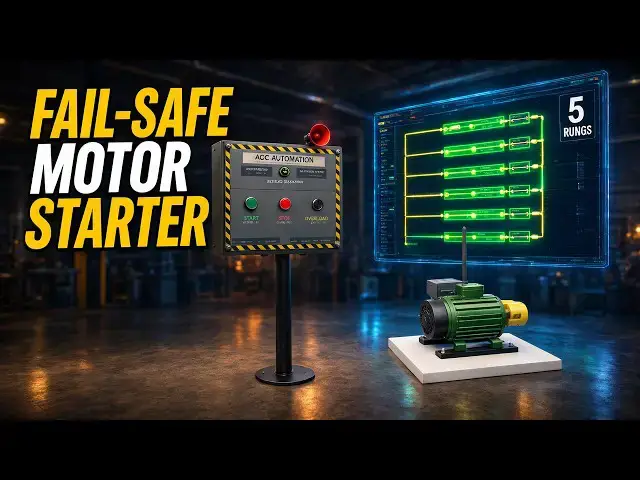

Motor Starter Logic: Build a Fail-Safe System in 5 Rungs
Nov 2, 2026

PLC motor starter in five rungs: a seal in for a momentary start, normally closed stop and overload that fail safe on a broken wire, and a 2 second warning horn.
⚡ QUICK ANSWER
Three signals control almost every motor in a plant: start, stop and overload. The seal in solves the first problem. A start button is on for the half second your finger is on it, so a contact from the output goes in parallel with start and the rung holds itself true. The only way out is to break something in series with it, which is where stop and the overload sit. Both are wired normally closed, so their inputs read on while nobody is touching them, and a cut wire reads as a pressed button. The failure stops the motor instead of leaving it running. Because they are on when healthy, the program examines them with normally open contacts: the contact asks only whether the bit is on. The warning horn is an on delay timer driven by the sealed in request, not by the start button, because a press is far shorter than two seconds and a timer on start would reset before it ever finished.
📖 FULL STEP-BY-STEP + DOWNLOADS (example program, Structured Text file)
https://accautomation.ca/motor-starter-ladder-logic-seal-in-warning-horn/
⏱️ TIMESTAMPS
00:00 Motor Starter Logic: Build a Fail-Safe System in 5 Rungs
00:42 The Across-the-Line Starter
01:06 The Seal-In
01:28 Why the Stop Button Is Normally Closed
01:51 Read the State, Not the Label
02:13 The Warning Horn
02:35 Step One, Define the Task (PLC Program Development)
03:01 Step Two, Define the I/O
03:30 Step Three, the Sequence
03:57 Step Four, the Program
04:48 The Structured Text Version
05:13 Step Five, Testing
06:49 Five Rungs, One Motor Starter
07:11 Try It Yourself
📚 WHAT YOU'LL LEARN
✅ Hold a momentary start with a seal in, and know that the only way out is breaking something in series with it
✅ Wire stop and overload normally closed so a cut wire reads as a pressed button and the motor stops on the failure
✅ Examine a normally closed device with a normally open contact, because the contact only asks whether the bit is on and on means healthy
✅ Drive the warning timer from the sealed in request rather than the start button, since a press is shorter than the preset and would reset the timer every time
✅ Prove the program by trying to break it: stop during the warning, an overload trip and reset, and a start button held down
❓ FREQUENTLY ASKED
Q: Why is a stop button wired normally closed?
A: So its input is on while nobody is pressing it. A normally open stop reads a cut wire exactly the same as a button not pressed, and the motor keeps running. A normally closed stop reads the broken wire as a press, so the fault stops the motor.
Q: If the stop button is normally closed, why does the program use a normally open contact?
A: Because a contact asks one question, which is whether the bit is on. The normally closed device holds its input on while everything is healthy, so a normally open contact passes power in the healthy state. Put a normally closed contact there instead and start does nothing unless somebody is also holding stop down.
Q: Why time the warning horn from the start request instead of the start button?
A: A button press lasts a fraction of a second and the preset is two seconds, so a timer driven by the button resets long before it finishes and the horn never completes. The sealed in request stays on, so the timer runs through to its preset even if the operator lets go immediately.
Q: Does the motor restart by itself after an overload is reset?
A: No, and it must not. Resetting the overload only allows a start. The motor stays stopped until somebody presses start again, and the horn sounds first.
👉 Full step-by-step, example program and Structured Text file: https://accautomation.ca/motor-starter-ladder-logic-seal-in-warning-horn/
🧪 TRY IT YOURSELF
Load the motor starter example in the simulator, then change the stop contact to normally closed and see what happens.
▶ Example ladder logic: https://accautomation.ca/simulator/acc-example-motor-starter.json
▶ Structured Text version: https://accautomation.ca/simulator/acc-example-motor-starter.st
🔗 MORE RESOURCES
▶ Free ACC PLC Simulator, runs in your browser: https://accautomation.ca/simulator/
▶ PLC Timers Explained — TON, TOF and RTO: https://accautomation.ca/plc-timers-explained-ton-tof-rto/
▶ PLC Beginners Guide: https://accautomation.ca/programming/plc-beginners-guide/
▶ Free eBooks and new scenes: https://accautomation.ca (subscribe for download)
💬 Questions? Drop a comment below.
🔔 New tutorials every Monday — Subscribe and hit the bell!
#PLC #LadderLogic #IndustrialAutomation #PLCProgramming #ACCAutomation #MotorControl #MotorStarter #FailSafe #PLCTutorial #LearnPLC
Regards,
Garry
ACC Automation
http://www.accautomation.ca
Show More Show Less