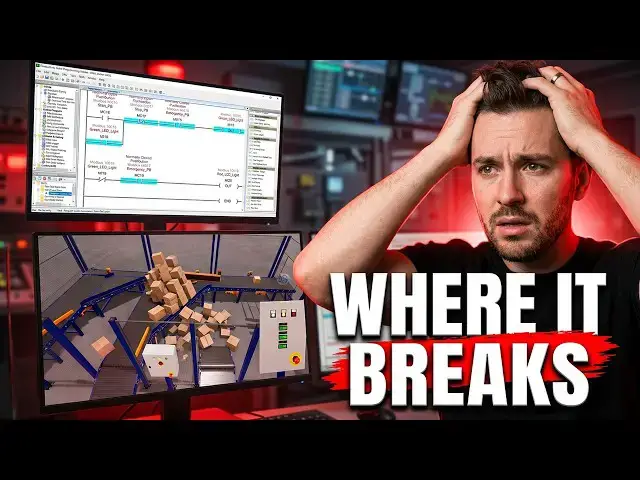

The Biggest Obstacles in PLC Programming Nobody Mentions!
Jul 13, 2026
The six real challenges that trip up new PLC programmers — machinery, the scan cycle, ladder logic, timers, planning, and debugging — and one free fix.
⚡ QUICK ANSWER
PLC programming is hard less because of the instructions and more because you're writing software that moves real machinery. Beginners hit the same six walls: it controls real machinery (safety comes before the first rung), the invisible scan cycle (the source of stuck outputs and race conditions), contacts vs coils (a normally-closed contact on screen isn't the same as a field device wired normally closed), timers/counters/memory (sketch a timing diagram; know retentive vs non-retentive), planning first (writing code is step 4 of 5, not step 1), and live debugging (no breakpoints — you go online and watch the rungs). What they share is that the logic is invisible until you watch it run — which is exactly what a simulator fixes. The full breakdown is in the written guide below.
🎮 TRY THE FREE ACC PLC SIMULATOR (no install, no login — right in your browser)
https://accautomation.ca/simulator
📖 FULL WRITE-UP + RESOURCES
https://accautomation.ca/the-biggest-obstacles-in-plc-programming-nobody-mentions/
⏱️ TIMESTAMPS
0:00 - Why PLC Programming Is Actually Hard
0:48 - Challenge 1: It Controls Real Machinery
1:19 - Challenge 2: The Invisible Scan Cycle
1:54 - Challenge 3: Contacts vs Coils (Ladder Logic)
2:31 - Challenge 4: Timers, Counters & Memory
3:00 - Challenge 5: Planning First (The Five Steps)
3:40 - Challenge 6: Debugging Live
4:13 - The Free Fix: The ACC PLC Simulator
4:44 - The Five Simulator Scenes
5:02 - Try It: Build a Start-Stop Circuit
📚 WHAT YOU'LL LEARN
✅ Why PLC programming challenges are about machinery, not instructions
✅ How the invisible scan cycle causes stuck outputs and race conditions
✅ Why a normally-closed contact on screen ≠ a field device wired normally closed
✅ Timing diagrams for timers, and retentive vs non-retentive memory
✅ The five steps to PLC program development — why coding is step 4, not step 1
❓ FREQUENTLY ASKED
Q: Why is PLC programming hard for beginners?
A: Not because the instructions are complex, but because the code moves real machinery and the scan cycle is invisible — so beginners get stuck on things reading can't fix. The full breakdown is in the guide.
Q: What is the scan cycle and why does it matter?
A: The PLC reads all inputs, solves the whole program top to bottom, and updates all outputs — hundreds or thousands of times a second. Most beginner bugs (stuck outputs, race conditions) trace back to not picturing it.
Q: What's the best free way to learn PLC programming?
A: A simulator you can watch — the free ACC PLC Simulator runs in your browser with no install or login, so you write ladder logic and see the scan solve and drive a 3D machine live.
👉 Full write-up & resources: https://accautomation.ca/the-biggest-obstacles-in-plc-programming-nobody-mentions/
🔗 MORE RESOURCES
▶ Free ACC PLC Simulator: https://accautomation.ca/simulator
▶ PLC Beginners Guide: https://accautomation.ca/programming/plc-beginners-guide/
▶ The Five Steps to PLC Program Development: https://accautomation.ca/programming/plc-beginners-guide/
▶ Free eBooks: https://accautomation.ca (subscribe for download)
🛒 RECOMMENDED HARDWARE
▶ Shop: https://www.automationdirect.com/
▶ Parts Guide: https://www.accautomation.ca/purchase-find-parts/
💬 What tripped you up when you started? Drop a comment below.
🔔 New tutorials every Monday — Subscribe and hit the bell!
#PLC #LadderLogic #IndustrialAutomation #PLCProgramming #ACCAutomation #LearnPLC #PLCSimulator #ScanCycle #PLCBasics #AutomationDirect
Regards,
Garry
ACC Automation
http://www.accautomation.ca
Show More Show Less