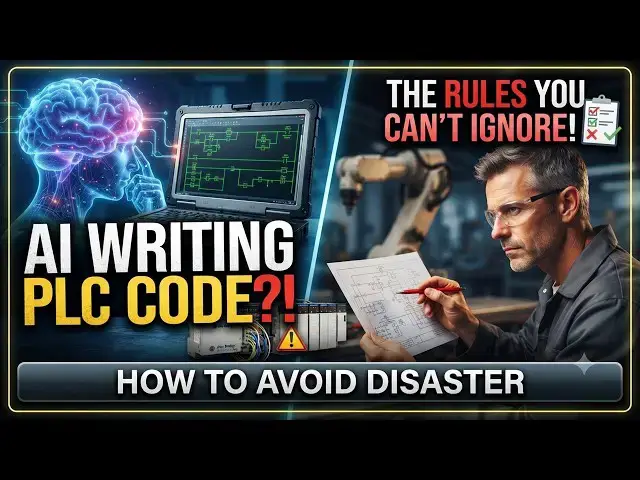

DO NOT Use AI in PLCs Until You See This!
Aug 3, 2026

AI is a helper for PLC code, not a programmer and never a safety system. Here are the 22 rules I follow every time I let AI near a PLC — plus the golden rule.
⚡ QUICK ANSWER
AI is a genuinely useful helper when you are writing PLC code, but it is a helper, not a programmer, and definitely not a safety system. Used well it saves you time and teaches you a lot; used carelessly it will eventually bite you. Never let AI-generated logic control a real output until you have verified it yourself, with the field wiring disconnected. AI does not know your safety requirements, and true safety functions belong in safety-rated hardware. You are the programmer of record, you never paste AI logic into a running machine, and you assume it can be confidently wrong. Above all, the golden rule: if you cannot explain what a rung does, do not download it to a PLC. The full 22 rules are in the pinned comment and the written guide below.
🛑 SAFETY COMES FIRST (rules 1 to 4)
Verify AI logic yourself before it controls a real output. AI does not know your safety requirements — E-stops, safety relays, light curtains and interlocks are your responsibility. True safety functions belong in safety-rated hardware, not the PLC or the AI. You decide the fail-safe design.
🤖 ASSISTANT, NOT AUTHORITY (5 to 8)
You are the programmer of record. Never paste AI logic into a running machine. Make the AI explain its logic in plain English and check it. Assume it can be confidently wrong — invented instructions, wrong addressing, logic that fails on the first edge case.
📝 GIVE IT GOOD INFORMATION (9 to 12)
Tell it your exact PLC and language. Describe every input and output, the wiring, and the sequence. Work in small pieces, one rung at a time. State your constraints upfront.
🔍 VERIFY BEFORE IT RUNS (13 to 16)
Cross-check every instruction and address against the manual. Prove the concept in a free online ladder simulator first, then test with outputs isolated. Test the edge cases. Watch for logic races, missing seal-ins, and one-shots that fire twice.
🔒 PROTECT YOUR DATA (17 to 18)
Do not paste proprietary code, passwords, IP addresses or plant details into public AI. Check your company's AI policy first.
📈 GET BETTER, DON'T SKIP LEARNING (19 to 22)
Ask why, not just what. Let it draft documentation, but read it. Use it to review and troubleshoot existing code. Keep a human in the loop, and back up before you change anything.
⭐ THE GOLDEN RULE
If you cannot explain what a rung does, do not download it to a PLC. AI can help you write it, understand it and check it — but you are the one who has to stand behind it.
📖 FULL WRITTEN GUIDE + ALL 22 RULES + REFERENCES + CODING SAMPLES
https://accautomation.ca/do-not-use-ai-in-plcs-until-you-see-this/
⏱️ TIMESTAMPS
0:00 Introduction — AI is a helper, not a programmer
0:55 Safety comes first (rules 1 to 4)
1:47 Treat AI as an assistant, not an authority (5 to 8)
2:30 Give the AI good information (9 to 12)
3:21 Verify everything before it runs (13 to 16)
4:22 Protect your data and your company (17 to 18)
5:03 Use AI to get better, not to skip learning (19 to 22)
5:49 The Golden Rule
📚 WHAT YOU'LL LEARN
✅ Why AI is a helper for PLC code — not a programmer, and never a safety system
✅ The non-negotiable safety rules for AI-generated logic
✅ How to give AI the information it needs to be useful
✅ How to verify AI logic against the manual, a simulator and the edge cases
✅ The golden rule: never download a rung you cannot explain
❓ FREQUENTLY ASKED
Q: Can I use AI to write PLC code?
A: Yes — as a helper. It is useful for drafting logic, explaining instructions, documenting and troubleshooting, but it is not a programmer and not a safety system. You verify everything and never let unverified AI logic control a real output.
Q: What is the golden rule for using AI in PLCs?
A: If you cannot explain what a rung does, do not download it to a PLC. AI can help you write, understand and check it, but you are the one who has to stand behind it.
👉 Full write-up: https://accautomation.ca/do-not-use-ai-in-plcs-until-you-see-this/
🔗 MORE RESOURCES
🎮 Free ACC PLC Simulator (3D scenes, no install): https://accautomation.ca/simulator/
▶ Using ChatGPT AI to Program a Click PLC: https://accautomation.ca/using-chatgpt-ai-to-program-a-click-plc/
▶ PLC Beginners Guide: https://accautomation.ca/programming/plc-beginners-guide/
▶ Free eBooks: https://accautomation.ca (subscribe for download)
🛒 RECOMMENDED HARDWARE
▶ Shop: https://www.automationdirect.com/
▶ Parts Guide: https://www.accautomation.ca/purchase-find-parts/
💬 Questions? Drop a comment below.
🔔 New tutorials every Monday — Subscribe and hit the bell!
#PLC #LadderLogic #IndustrialAutomation #PLCProgramming #ACCAutomation #AIinPLC #PLCSafety #ArtificialIntelligence #AutomationDirect #ChatGPT
Regards,
Garry
ACC Automation
http://www.accautomation.ca
Show More Show Less #Programming
#Jobs & Education