Up next in 10



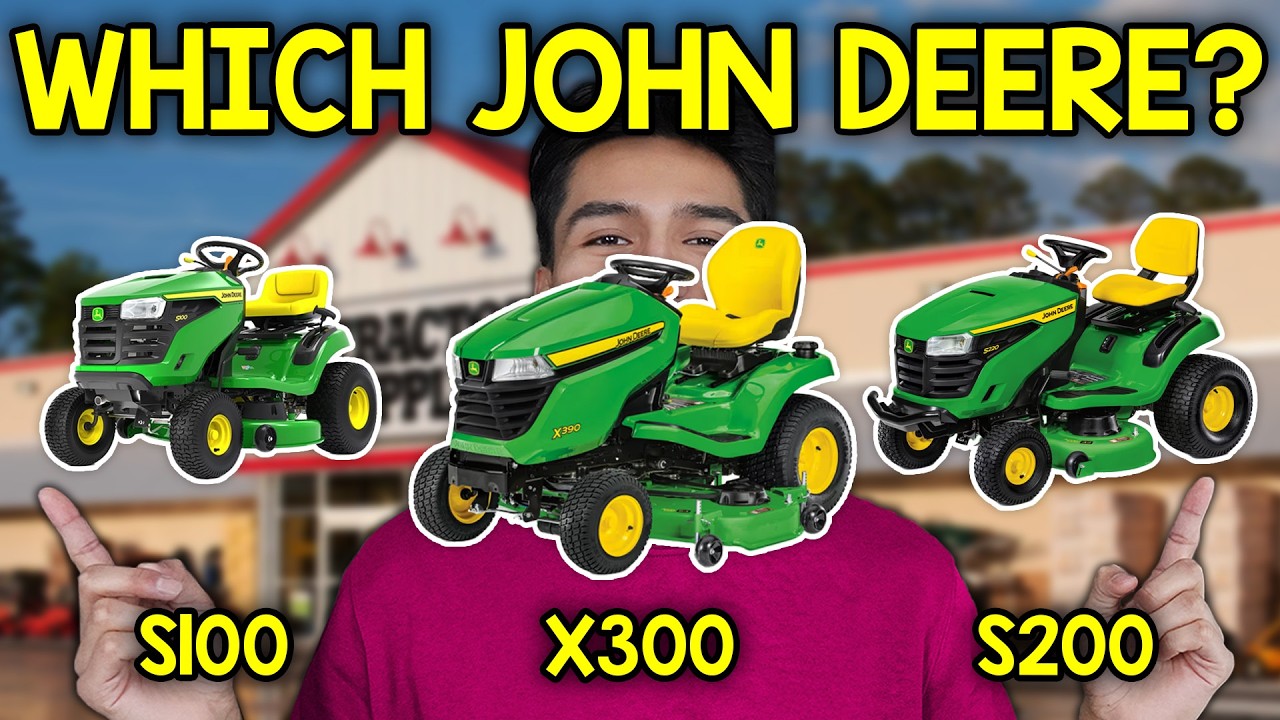
In this video, I go over the differences in John Deere lineups for the S100, S200, and X300 series. Want FREE Shipping With Amazon Prime? Get a 30-DAY FREE TRIAL by signing up here http://www.amazon.com/tryprimefree?tag=thechrisreview-20 DISCLAIMER: This video and description contains affiliate links, which means that if you click on one of the product links, I’ll receive a small commission. This helps support the channel and allows us to continue to make videos like this. Thank you for the support! 0:39 Which Series Fits Your Land? 1:28 S100 - Ideal for small to mid lawns 4:22 The S200 Series - When You Want a Little More 6:53 The X300 Series – For Bigger Jobs and Longer Years 9:39 PowerGard Protection Plan
Show More Show Less View Video Transcript
0:00
Across the S100, S200, and S300 series alone, John Deere offers 19 different riding mower models
0:07
and at first glance, a lot of them look nearly identical. Same green paint, same yellow seat
0:13
same overall design. The problem is that once you start shopping, the differences aren't always
0:19
obvious. You can compare specs all day, but that still doesn't tell you which mower is actually
0:23
the best for your yard. So in this video, I'm going to keep things simple and focus on what
0:27
really separates the S100, S200, and X300 series. And if you've been wondering whether models like
0:33
the S200 or X354 are worth the extra money, we'll answer that too. But before we get into the
0:41
differences, start with the size of your property. Because honestly, that one number is going to
0:46
narrow down your choice faster than anything else. If you're mowing less than an acre, like a typical
0:52
suburban yard, then the S100 series is usually all you need. That's exactly the kind of property it
0:57
was designed for. But if your property is closer to two acres then you'll want to bump it up to the
1:02
S200. The S100 can still handle the job but the S200 is built to deal with that workload a little
1:09
more comfortably over the long run. And for those of you dealing with three, four, or more acres
1:14
especially with some hills mixed in the x300 is the way to go. And I'll explain exactly why shortly
1:20
but the short version is that the x300 is just built tougher. Keep that in the back of your head
1:25
as we walk through each one. Now let's get into the S100. It's the entry point into John Deere's
1:33
riding mower lineup, but don't mistake entry level for cheap. This is still a John Deere
1:38
and these machines are built to last. It's just not the best choice for properties with a lot of
1:43
rough or hilly terrain. And at the time of this recording, the lineup has eight models from the
1:47
S100 up to the S180, and prices stay pretty friendly starting at around $2,600 and topping
1:55
off at around 3800 as you move up the line. And between those, you're looking at engines from
2:00
roughly 17.5 to about 25 horsepower, with deck sizes from 42 to 54 inches, so there's a lot of
2:07
room to match the mower to the size of your yard. That's the only engine option in this line, and I
2:11
wouldn't call it the fanciest name out there, but there's a good reason John Deere uses it here
2:16
You've got a brand that's been around for over 100 years, parts are easy to find, and most repair
2:21
already know how to work on them. Now one feature I really like on the S100 line
2:26
is the easy change oil system. It turns an oil change into a quick cartage swap that takes about 30 seconds which means you can skip the drain pan and forget about crawling underneath the mower Just keep in mind that it only available on
2:40
select S100 models. Move up to the S200 or X300 and you're back to a traditional oil change
2:48
Now the S100 lineup also comes with what John Deere calls the Edge Deck, and this is a stamped
2:53
steel deck, so it's light, simple, and does a good job on regular weekly mowing, but it isn't
3:00
a heavy-duty deck. So it's really meant for home lawns rather than all-day type of abuse
3:06
And another thing worth mentioning is that the S100, S110, and S120 still use a manual PTO
3:14
so you're pulling a lever to bring the blades on. And anyone who wants an electric PTO with a simple
3:20
switch has to step up into the S130 and above. Now this is a small detail, but a lot of people
3:26
have a clear preference on this. Now if I had to choose just one model from this lineup, it'd have
3:32
to be the S170. And Consumer Reports backed it up giving it the highest score in the series and
3:38
that's not something to ignore. It earned top marks for cut quality and mulching along with an
3:43
overall score of 80. But what really helps the S170 stand out is its engine. You're getting a 24
3:50
horsepower twin cylinder Briggs and Stratton so the power comes on smoother than it does with a
3:55
single cylinder setup. Now the one real drawback with the S100s is gonna be the warranty. You're
4:01
looking at two years of coverage compared with three on the S200 or four on the X300. So if
4:08
you're grabbing an S170 and want a little extra peace of mind, it's worth at least asking about
4:13
the power guard protection plan. And I'll explain more about that towards the end. But if that still
4:17
makes you hesitate, then the S200 series is probably the better move. And this is the middle
4:25
ground choice for people who want something nicer but aren't ready to jump all the way
4:29
to the top of the line. And for the roll, it works really well
4:33
Now there's only two models here, the S220 and the S240, so it's a much smaller lineup
4:39
than the S100. Horsepower sits between 21.5 and 22, so on paper it doesn't look like a huge leap and
4:46
honestly that's fine because the horsepower number isn't really what you're paying for here
4:51
Where things actually start to step up is the deck. Instead of the S100's edge deck, the S200 gets an Acel deep deck
4:59
It's built deeper to improve airflow so the grass stands up and blades cut more evenly
5:04
and the clippings get thrown out more cleanly And that helps the machine run smoother while staying less prone to clogging especially when the grass is thick or slightly damp and you can get it in 42 or 48 inches
5:17
depending on how much ground you want to cover per pass and John Deere also adds a flip up spindle
5:22
covers which lets you clear debris and grease from spindles more easily now it's a small detail
5:27
but it does make maintenance a lot less annoying and on top of that the S200 models use a K46
5:34
heavier-duty hydrostatic transmission, so they're a little bit more solid than the entry-level
5:39
machines. Now, from the seat, it feels a bit more grown-up too. The choke and throttle are on
5:45
separate levers instead of sharing one, which makes the controls more deliberate. You've also
5:50
got cruise control, RIO for mowing in reverse, an electric PTO on the S240, and a basic dash
5:57
showing hours and fuel. Nothing fancy, but everything you need is there. But even within the S200
6:03
series, the two models aren't exactly the same. The S220 gets a 22 horsepower Briggs & Stratton V-twin
6:10
while the S240 uses a 21.5 horsepower Kawasaki FR series. Now in normal mowing, that small horsepower
6:18
difference doesn't really show up in real world use. The bigger question is how these engines hold
6:23
up over time. Kawasaki has earned a strong reputation for powering commercial and higher
6:28
end equipment that's expected to handle years of regular use. So if you're planning to keep your
6:33
mower for a long time, then the S240 has a pretty strong case going for it. Of course, the S200 isn't
6:40
as cheap as the S100 and you'll typically spend about $300 to $500 more depending on the model
6:46
But if your budget can stretch that far, you're getting a more capable mower, not just a pricier
6:51
one. So now let's step into the X300 series. And if you just go by the numbers, it doesn't look all
7:00
that different from the S200. The deck options are similar, the horsepower increase is fairly modest
7:06
and both lineups share a lot of the same basic features. So where does the extra money really go
7:13
It really comes down to two things, the frame and the dash. So let's start with the first thing
7:18
the frame, because that's what really separates these two. The S100 and S200 use full-length
7:24
welded steel frames and for flat, well-kept lawns, that setup works pretty fine
7:30
The X300, however, switches it to a heavier welded steel frame, extra reinforcement in key areas and a cast iron front axle
7:38
And that upgrade may not jump out on a perfect lawn but on rougher yards with dips slopes roots or soft spots then the x300 has the stronger foundation that you gonna want for years of mowing now as for the dash the s100 and
7:52
s200 keep things pretty simple you're mostly seeing hours fuel and basic warning lights the
7:59
x300 however takes that a step up with a more informative digital display it's gonna show you
8:05
engine speed, fuel level, battery status, PTO status, operating hours, warning lights, and even
8:12
some basic diagnostic information. Now it's a small upgrade but it does give you a much better idea of
8:18
what the tractor is doing. And another highlight is the controls. If you're coming from something
8:24
like an S240 then the X300 will still feel familiar. You have separate throttle and choke
8:29
controls on many models, electric PTO, cruise control, RIO for mowing in reverse, and hydrostatic
8:37
foot pedals. But now those controls sit on a stronger tractor with a better display in front
8:42
of you. And the lineup includes the X330, X350, X350R, X354, X370, X380, X384, X390, and X394
8:54
And for a simple recommendation, I'm going to start with the X354
8:58
Consumer Reports scored the X354 an 84 overall, and under the hood is a two-cylinder Kawasaki engine with 726cc of displacement
9:08
And it's the kind of engine that rarely feels short on power, even when the mowing gets more demanding
9:13
Now, the X354 also scored five in every major performance category. So whether you're discharging, bagging, or just trying to leave a clean finish
9:22
the mower is ready for all of it. Now the fuel tank is 3.3 gallons compared with 2.4 gallons on the S240, so you also stop for fuel less often on big properties
9:33
And with available mulch control, switching between mulching and aside discharging is much easier
9:40
Now before we wrap it up, let's quickly revisit the Power Guard Protection Plan
9:45
And this is John Deere's extended coverage option for buyers who want protection beyond the standard warranty
9:51
And after the factory warranty period, it may help with certain parts and labor costs on covered repairs
9:57
Now, availability applies across all three series, but the details can change depending on the dealer, the plan, and whether pickup or delivery coverage is included
10:07
So if long-term peace of mind matters to you, then bring it up before you make the purchase
10:12
And that's all for the day. I hope this made the lineup easier to understand. And if you want to learn more, make sure to hit that subscribe button
10:18
And thanks for watching
#Computers & Electronics