Up next in 10



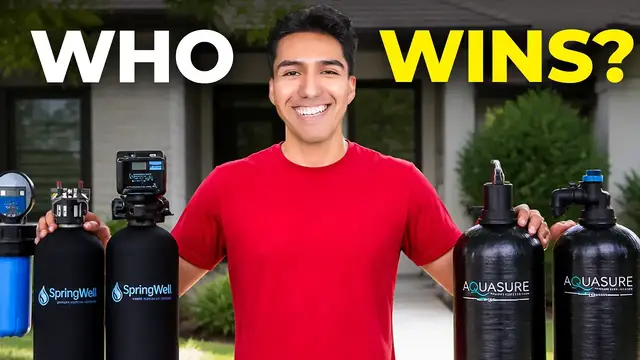
In this video, I go over the differences between the SpringWell and Aquasure water softners. Check them out here Springwell SS - https://geni.us/QVoS Aquasure Harmony - https://geni.us/MZTxkBG Want FREE Shipping With Amazon Prime? Get a 30-DAY FREE TRIAL by signing up here http://www.amazon.com/tryprimefree?tag=thechrisreview-20 DISCLAIMER: This video and description contains affiliate links, which means that if you click on one of the product links, I’ll receive a small commission. This helps support the channel and allows us to continue to make videos like this. Thank you for the support!
Show More Show Less View Video Transcript
0:00
Springwell and Aquashore are two of the biggest names in water softeners, and honestly, both are excellent salt-based systems
0:07
But don't let that fool you into thinking you can't go wrong with either one
0:11
Dig a little deeper, and you'll find that they're built for very different priorities
0:15
and a random choice could leave you with regretting your decision for years
0:19
So let's compare the two and find out which one is the best water softener for your home
0:24
And before we get into the comparison, it helps to understand what you're dealing with
0:29
Hard water is simply water with a high concentration of minerals like calcium and magnesium
0:34
and the hardness of water is measured in grains per gallon or GPG. Anything above 7 GPG is
0:41
considered hard, and a lot of households in the US are sitting anywhere between 10 to 25 GPG
0:46
and some areas with well water can go even higher. Now the problem is that those minerals don't just
0:52
disappear as water flows through your home. They build up. Inside your pipes, they form what's called
0:58
a lime scale. And that's a hard chalky deposit that slowly narrows the pipe opening and restricts
1:03
flow. Inside your water heater the scale acts as insulation which makes the heater work harder and
1:09
use more energy to heat on the same amount of water. On your dishes and glass shower doors you
1:14
get white spots. On your skin and hair the minerals block moisture from getting in so even hot showers
1:20
can leave you feeling rough. And a salt-based water softener solves this by using a process called
1:25
ion exchange. Inside the system, there's a tank filled with tiny resin beads that have a negative
1:30
charge. When hard water passes through, the positively charged calcium and magnesium ions
1:35
stick to the resin and are swapped for sodium ions, which don't cause the same scaling problems
1:40
The result is genuinely soft water coming out of every tap in your home. And both Springwell
1:45
and AquaSure use the same ion exchange method. Where they differ is how they build the system
1:51
what kind of resin they use, how smart the regeneration is, and what kind of support you
1:56
get afterward. So now let's start with the resin. And this is the material that grabs the hard
2:02
minerals in your water and holds them until the system regenerates and flushes them away
2:07
The resin is made from tiny polystyrene beads, but not all the resin is the same. One of the
2:13
biggest differences is the cross-link percentage, which determines how durable and resistant those
2:18
beads are to chlorine oxidation and long wear Springwell uses 10 cross resin in its softeners while Aquashure standard Harmony models come with 8 So why does this number matter There are two main reasons First
2:32
a higher crosslink percentage makes the resin beads tougher and more resistant to physical wear
2:37
over time. Second, it improves resistance to chlorine, which is commonly found in treated
2:42
city water. And over the years, chlorine and other oxidants gradually break down resin beads
2:47
causing them to shrink, crack, and lose some of their ability to remove hardness minerals
2:52
As a result, standard 8% cross-link resin typically lasts around 8 to 15 years
2:57
while 10% cross-link resin can often reach 10 to 20 years under similar conditions
3:03
especially in homes with chlorinated water. That said, AquaShore does have an advantage here that's worth mentioning
3:09
Its optional fine mesh resin is specifically designed for well water with elevated iron levels
3:14
The standard Harmony system is rated for up to 2 ppm of iron, while the fine mesh version can handle up to 10 ppm
3:22
Springwell's SS system, by comparison, is rated for up to 7 ppm of iron without requiring a fine mesh upgrade
3:29
So if iron removal is a major concern, both brands are going to offer capable solutions, but Aquashure's fine mesh option provides a bit more capacity
3:39
Next is grain capacity, and the two brands don't give you the same lineup of options here
3:43
And grain capacity tells you how much hardness a softener can remove before it has to regenerate
3:49
If the system is too small, it'll regenerate a lot and waste extra salt and water
3:54
But if it's too large, you pay for capacity you don't need. And Springwell's SS Series comes in three sizes, 32,000, 48,000, and 80,000 grains
4:04
Now the 32,000 model is designed for homes with one to three bathrooms
4:08
the 48,000 model covers four to six bathrooms, and the 80,000 model is made for larger homes with seven or more bathrooms
4:15
Now, Aquashure's Harmony series is available in 32, 48, 64, and 72,000 grains, so the main difference is sizing flexibility
4:24
Aquashure offers more choices in the middle of the lineup, while Springwell's 80,000 model provides a higher maximum capacity for larger households or homes with extremely hard water
4:34
And if you aren't sure which size to buy the general rule is to multiply your daily water usage by the number of people in your home
4:40
Then by your water hardness in GPG and finally by seven So for a four household with about 20 GPG that gonna point straight to a 40 system by either brand next let talk about flow rate because this is something you actually notice in everyday use
4:58
flow rate is measured in gallons per minute or gpm and it tells you how much softened water
5:03
the system can deliver without causing a drop in pressure springwell's ss series ranges from 11 gpm
5:09
on the 32 000 grain model to 20 000 gpm on the 80 000 grain model and aquashurners harmony lineup
5:16
delivers between 10 and 20 GPM depending on the size you choose. So both systems provide more than
5:21
enough flow for most households. Whether you're running a shower, dishwasher, or washing machine
5:26
at the same time, neither brand is likely to become a bottleneck. So when it comes to flow rate
5:31
this category is essentially a tie. And now we get to regeneration, which is how a water softener
5:38
cleans itself and restores the resin ability to remove hardness minerals. Because regeneration
5:43
uses both salt and water, the way a system decides when to regenerate has a direct impact on operating
5:48
costs. And there's two main approaches here, time-based regeneration and demand-based regeneration
5:54
A time-based system regenerates on a fixed schedule, such as every three or four days
5:59
regardless of how much water you actually use. That means the system may clean itself even when
6:04
the resin still has plenty of capacity left, and that can waste water and salt in the process
6:09
Now, a demand-based system works differently. It tracks your household's water usage and only regenerates when the resident is getting
6:16
close to full. So if you use less water one week, the system waits longer
6:21
And if you have guests staying over and water usage spikes, it regenerates sooner
6:25
And since it responds to actual water consumption, demand-based regeneration is the more efficient
6:30
option for most homes. And here's the good news. Both Springwell and AquaShore support demand-based regeneration so you aren't giving up efficiency
6:38
with either option. The main difference is how you manage those settings
6:41
Because Springwell uses a Bluetooth enabled control head that connects to an app on your phone, you can see when the next regeneration is scheduled, how much capacity is left, and
6:50
change the regeneration time or settings without walking over to the unit
6:54
That makes it much easier to keep the regeneration cycle turned to how your household actually
6:57
uses water. And Springwell also includes what they call vortex technology in the backwash stage of
7:03
regeneration cycle. And the basic idea is that instead of just flushing water straight through the resin bed
7:09
The design creates a more aggressive stirring action that lifts and moves the resin beads more effectively A more thorough backwash means the resin gets cleaned more completely each cycle which helps it stay in good working condition for longer Now Aquashore on the digital hand relies on a digital display and a few buttons on the valve You can use the built screen to
7:28
program things like hardness, capacity, and regeneration time. And anytime you want to check
7:32
or fine-tune the schedule, you need to walk back to the unit and step through the menu again
7:37
In fact, that's how most water softeners have worked for decades, and for a lot of people
7:41
that's perfectly fine. But if your softener is in a crawlspace, a garage, or a utility room that you
7:47
rarely visit, having to go there for every small adjustment feels pretty annoying
7:53
Next up, installation. And if you were hoping one of them was significantly easier to set up than
7:58
the other, the answer is not really. Both Springwell and Aquashore are friendly to homeowners with
8:04
basic plumbing experience, and the main parts come in the box, but your setup may still require extra
8:09
fittings, hoses, or adapters. And if you're comfortable working with pipes, the installation
8:14
can take a few hours. But if cutting into your main water line sounds stressful, then hiring a
8:20
plumber is going to be money well spent. It's going to cost more upfront, but it's a lot cheaper than
8:24
dealing with water leaks a week later. Finally, we come to the price, and the gap here is big enough
8:31
to change how we weigh everything else. Springwell is the more expensive option, and its SS series
8:36
starts around $1,600 for the 32,000 grain model, and can climb to roughly $2,700 for the 80,000
8:43
version. And for that money, you're getting premium features like Bluetooth controls
8:47
app connectivity, and a lifetime warranty on the tanks and control valve. Springwell also backs
8:52
the system up with a six-month money-back guarantee, which is usually generous in this category
8:57
and Aquashore's Harmony series is far more affordable. Even the largest 72,000 grain model
9:02
is typically priced around $800. And this one comes with a five-year warranty with the option
9:07
to extend coverage by another two years. So yeah, Aquashore is the clear winner on price
9:12
And if maximizing value is your top priority, it's hard to ignore how much capacity you get
9:17
for the money. But price alone shouldn't make the decision for you. Water hardness, iron levels
9:23
household size, and long-term durability all matter too. That's really the takeaway here
9:28
Neither system is usually better. They just work for different buyers. And once you know which group you're in, the answer is going to come easier
9:35
And that's all for today. I hope this video helped you find the right water softener
9:39
And links to all softeners mentioned are going to be in the description below. Thanks for watching
#Computers & Electronics