Up next in 10



Intel outlined its next chapter for PCs, gaming devices, and AI infrastructure.
Show More Show Less View Video Transcript
0:00
Silicon, the foundation of modern technology
0:06
Every transistor placed with purpose. Every watt wrestled from physics. Where every instruction set earns its right to execute
0:16
And now, ladies and gentlemen, please give a warm welcome to the CEO of Intel, Liv Poo-Chan
0:24
Yep, I think first of all, I think delighted to be here
0:28
and this is an important event and I'd like to get started
0:36
And about nearly six decades ago, a group of brilliant and highly motivated engineers and venture capitalists
0:49
including Arthur Rock, Don Valentine and many others, they found companies like Intel, Apple and others
0:57
broadly set the motion, the largest economic known to mankind, create what became known as Silicon Valley
1:09
And this is a very exciting time, and that is the very same ambition and mindset
1:17
with the semiconductors make across the ocean that sparked the creation of Silicon Island right here in Taiwan
1:27
And I have been very fortunate to associate with the creation of semiconductor industry in Taiwan 40 years ago
1:35
Intel has continuously increased the pace of progress across all PC segments
1:42
Workstations, desktops, creators, gamers, premium and mainstream laptops. Every major segment, every major segment is driven by an Intel system solution
1:57
With that vast coverage in mind, we're adding another dimension to scale these products even more effectively
2:06
The Intel 18A process is now at full scale. We have a full lineup of products with hundreds of design wins to prove that
2:18
At CES, we launched the Core Ultra Series 3, Intel's first product built on 18A process technology
2:27
It's setting a new standard for premium mobile performance and battery life
2:33
The Ultra Series 3 enables great user experiences across any tasks, with a very fast response CPU, a highly improved GPU, low power processing NPU, and the latest multimedia capabilities
2:49
It's a perfect blend of IP, performance, and power for any AI and agentic experience Let look at some of the capabilities of the Core Series 3 And we can start with battery life The great user experience is if your PC lasts longer than your workday
3:08
And that's exactly what we're delivering in all segments. And we support ample number of ports for all of your connectivity needs
3:18
Unlike some of our competitors who only have one USB-C interface. but I'll let you be the judge of that one
3:26
Now, the next proof is scaling 18A IP into growing markets. And the fastest growing portion of the PC market is the handheld gaming
3:35
This is the Arc G3. The G3 is derived from the Core Ultra Series 3
3:41
and the Arc G3 is a tuned, high-performance GPU specifically for handheld gaming
3:48
And it's providing great battery life. The performance tested across multiple games is consistent and stable versus competition
3:58
We are more than 40% faster, 40% faster. And at the same performance, we're half the power
4:06
And on top of that, we're running all AAA games at 1080p resolution, many of them above 120 frames per second
4:16
Now that is giving gamers a great user experience. All of these devices will be available later this month, and this is just the beginning
4:27
We're going to have plenty more designs coming throughout the year. In February, we launched Perplexity Computer
4:34
Computer is an AI operating system. It creates a team of agents, uses up to 20 different AI models
4:42
and it orchestrates across models, tools, and files in one single system
4:51
The agent harness inside computer is model agnostic. Perfectly balancing intelligence, accuracy, privacy, and cost
5:03
is the orchestration problem it solves. Let's say I'm an associate at a private equity firm
5:10
and I'm working on something that has a confidential project codename Project Falcon
5:16
So think of it as me trying to understand if a certain private company is worth $1.1 billion
5:25
and I'm feeding it confidential deal materials. The work begins on the laptop
5:33
It sees that Project Falcon has private deal room files and an NDA a local leverage buyout financial model a whiteboard diagram and
5:47
bilingual transcripts that are very confidential you don't want these materials to be shipped to the server so what the local model does on the core ultra series 3 is it first decides this is all very important work and shouldn be sent to the server It reads the files classifies what is sensitive and what is not and then computer decides what should leave the device and what shouldn
6:13
And each of these things is done with local AI. That is why we are excited to have Intel Xeon 6 Plus introduced at Computex this week
6:23
It has 288 e-cores, a massive 576 megabytes of L3 cache built with our Intel 18A technology
6:36
and we can't emphasize enough the value of Intel technology that brings to data center products
6:44
Most importantly, it delivers efficiency and density, which enables our partners to save very precious real estate
6:55
have more compact servers and the racks. So this is a leadership compute for the next era of cloud and network infrastructure
7:06
The way AI inference works is straightforward. We take a prompt. It gets fed into an LLM where it spends most time reasoning about the prompt
7:15
We've all seen this. We've done this thousands of times. and out comes an answer
7:21
In this case, a lot of time is spent computing the large language model
7:24
which is mostly GPU and compute intensive. Now, the way agentic AI works is radically different
7:31
It's given goals rather than prompts. So we've all seen the different types of loop that people are running on this agentic AI
7:40
It's also very iterative in nature, but also prompted by automation. and thinking, planning, acting, and reflecting
7:48
are a natural way of these agents interacting with us. Have a traditional AI inference set up
7:54
on the left-hand side of the screen. Let's send a request. Write a Python function that calls an OpenAI
8:00
compatible chat completions API. The model gets the response, generates code, and sends the request back
8:08
Take a look at the slider on the top of the screen. GPU dominates nearly 7 to 1 GPU heavy
8:14
In contrast, let's take a look at an agentic AI system. Across the top, look at the pipeline stages
8:22
Green is GPU work. Blue is CPU work. Linting is happening on our Xeon 6 Plus processor with efficiency cores
8:32
Webfetch and compile is happening on our Xeon 6 performance cores. And unit testing is coming back and running on our Xeon 6 Plus efficiency cores
8:42
The right class CPU for each stage of the pipeline. Take a look at the slider across the top again
8:50
We're near parity but CPU heavy this time. What's this look like when we multiply that
8:55
by millions of queries a day As you mentioned each Xeon 6 Plus processor has up to 288 cores That 576 cores per two socket server When we look at that from a rack scale perspective
9:10
that gives us over 36,000 cores per 32 use of compute space. This is the SM50 Samba rack we
9:18
announced earlier this year, rack scale AI infrastructure built for agentic workloads
9:24
It uses Intel Xeon 6 processors with Salmonova SM50 RDUs and shipping to customers later this year
9:32
Today, we're also excited to demonstrate the world's first heterogeneous disaggregated inference
9:39
using Salmonova's RDU with Intel's CPU and NVIDIA GPUs. The one on the left is GPUs, RDUs, and CPUs disaggregated inference
9:52
And this one on my right is GPUs on their own. They both get fed the same prompt in the same model, just different stacks
10:03
The disaggregated inference stack is taking off. And what's happening here is you have the Xeon 6 processors doing all the tooling execution
10:13
You have Salmonova RDUs doing the decode and generating all of the tokens
10:18
and then you've got the GPUs performing the prompt caching and the faster pre-fill reducing overall time
10:26
When all three chips are working together, you dramatically reduce the end-to-end latency
10:31
and the agents for the fastest for energetic AI. Google and Intel have gone into a partnership
10:38
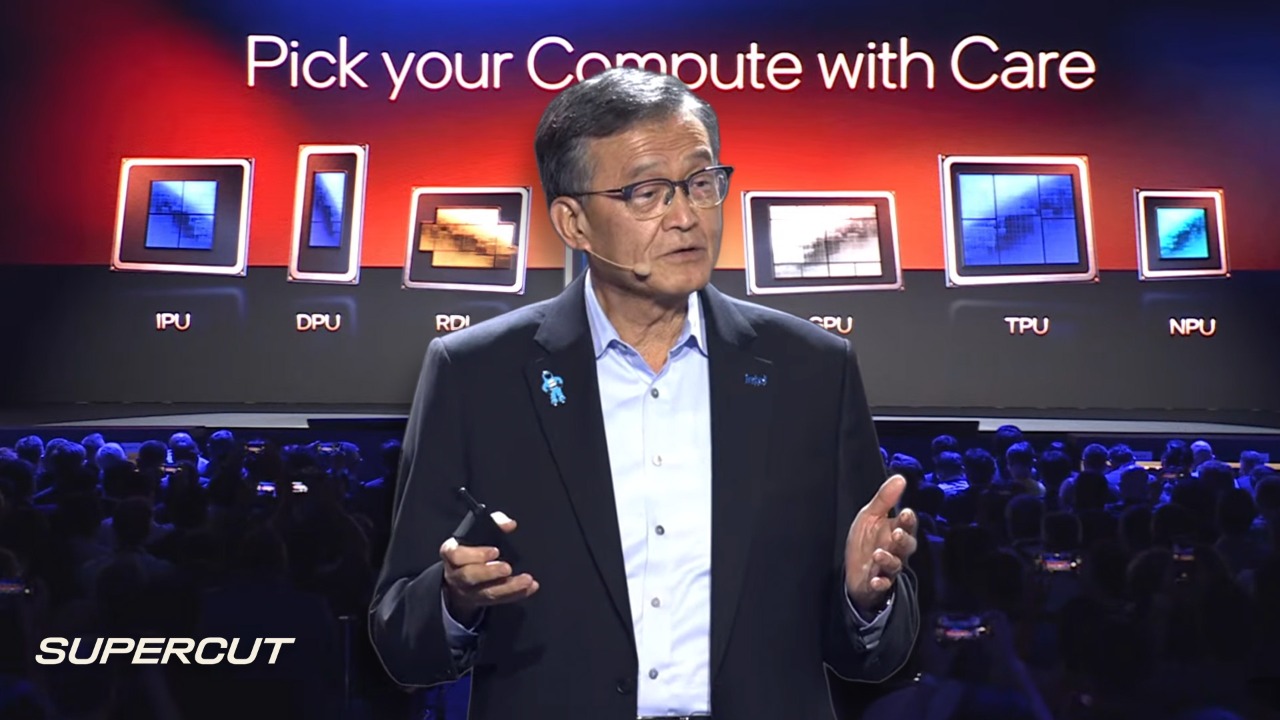
where Intel is delivering what is called the infrastructure processing unit. I would call it Intel processing unit, actually
10:46
But infrastructure processing unit, which is a piece of silicon very vital for hyperscalers' performance
10:53
And the journey continues. And by the way, this is a deployment today. So it is not just something that we are doing
10:59
but it's already designed and being deployed. While this is working on
11:05
Intel as a company has been pretty active in the telco market
11:09
And in this telco market, another marquee customer, Ericsson, has been partnering with us
11:15
And Ericsson chooses us wherein we deliver, or Intel delivers, the next generation infrastructure silicon at a global scale for them across the board
11:24
It is a happy year of transformation for Intel. We ramp our 18A to high volume with multiple products
11:35
We are executing well on our advanced packaging milestones. We make tremendous progress on engaging customers and building our foundry business
11:47
We introduce new SOCs for all major compute platforms from premium mobile to high-density
11:56
cloud and 5G
Celebrities & Entertainment News