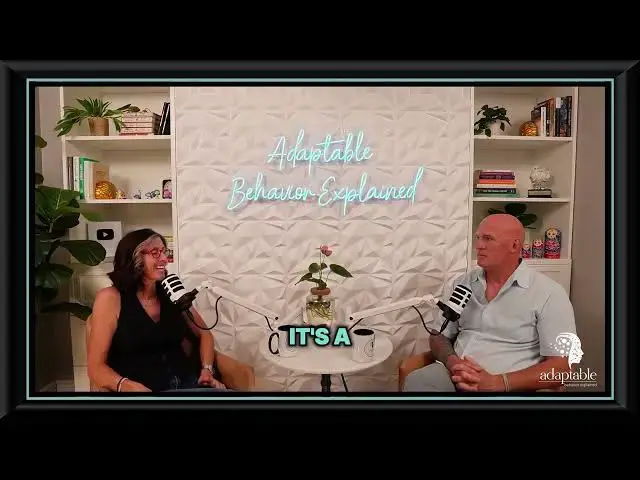
Up next in 10


What if behavior makes more sense when we understand what it’s protecting?
In this episode, we explore addiction through a different lens—looking beneath behavior to understand how emotional pain, trauma, and survival patterns can shape coping.
Healing can begin when we shift from asking “Why the behavior?” to “What purpose did it serve?”
Watch the full episode here: https://youtu.be/DWy9Ghxi7hA
#AdaptableBehaviorExplained #AddictionRecovery #TraumaHealing #MentalHealth #NervousSystem #HealingJourney
Show More Show Less View Video Transcript
0:00
When we take that factor out, then when
0:03
we can look at a client and they come in
0:04
and they say, "I struggle with this
0:06
addiction or this behavior."
0:09
Instead of saying, "Well, that's clearly
0:12
wrong. Let's give you a framework to no
0:14
longer do that. I self-identify as
0:16
someone that's defective or broken or
0:18
does something bad." And sit there and
0:21
say, "Well, what's the good thing about
0:22
this? Like, when you when you do use the
0:24
substance or you do do this process,
0:26
like, what do you get from it? What is
0:27
great about it?"
0:28
>> are the positive feelings now associated
0:31
with that? And in the next episode, I'm
0:33
going to go in more deeply to how all of
0:36
those work. But, it's I have found that
0:38
some of the most interesting and and
0:40
honestly fun work to do with people
0:42
because they don't understand how that's
0:44
coupled.
0:45
>> I recently I'm working with a client
0:48
that is is working on some sexual
0:50
process issues and just seeking of
0:53
comfort. And you know, is it deviant? Is
0:57
it an appetite issue? Like, what is the
0:59
cause of this? And And you know,
1:00
ultimately, we've been able to you know,
1:02
the conceptualization of this person's
1:06
story and how connection is manifested
1:09
in in his life. And
1:12
>> does not receive consistent attunement
1:15
and connection and an and an available
1:18
nurturing mother enough of the time,
1:21
there's a deficit. There's a neediness
1:23
and there's a gap. And that is just part
1:25
of what happens when we don't have
1:26
really secure attention and love from
1:29
primarily the mother. And so, what
1:32
happened to you?
1:33
>> Yeah.
1:33
>> That's the question we want to start
1:34
asking.
1:35
>> And sometimes, you know, there's whether
1:37
it's whether it's a chemical or a
1:38
process addiction, I think it's in the
1:41
questions and not like, "What are the
1:43
behaviors? Let me map them out. Do they
1:44
correlate to some you know, matrix that
1:47
says where you are or how we treat you."
1:50
But, actually looking at it, looking at
1:52
the good components of it and then the
1:54
predecessor lived state. Like,
1:56
oftentimes what I'm checking for also
1:59
is, you know, I'll I'll hear clients
2:00
say, "Well, I was I'm bored." You know,
2:02
when do you see this activity happening?
2:04
When you when you see you need to use
2:06
porn or masturbate or seek couple
2:11
connection or use a drug, and they'll
2:13
say boredom. And I think boredom really
2:15
needs to be broken down
2:17
>> It's an It's a nervous system state.
2:18
It's honestly like a an absence of
2:21
tolerance of calm. It's a an It's a
2:25
phobia to being calm, which is what ends
2:27
up being labeled boredom. I can't
2:30
tolerate not having something to do. I
2:32
can't be slow enough and be totally
2:34
present in my body not doing something.
2:37
Then I have to immediately pivot towards
2:39
something else. So, while I agree with
2:41
you that it's not a pleasure-seeking
2:43
circuit, initially, it does end up
2:46
compounded with that.
2:48
>> It looks like a pleasure-seeking
2:50
circuit.
2:51
>> it starts as a relief-seeking behavior.
2:55
Almost always. I won't say always. There
2:56
are some people that just happen into a
2:59
addictive behavior because of time and
3:01
place, and then they just can't get
3:02
enough of it, and it wasn't necessarily
3:04
from, you know, the trauma story of
3:06
their early years, but it certainly
3:08
isn't the most common, and it's not the
3:10
norm.
3:10
>> But even then, like, let's say a
3:12
previous example in the past episode we
3:14
were talking about cigarettes, right?
3:15
Nicotine. And you know, in my own story,
3:18
there was a component of there was a
3:19
very social aspect
3:23
>> Connection.
3:23
>> of of going to the smoke break and
3:25
having connection and getting to to meet
3:27
and talk to people and just identifying
3:29
who your tribe was.
3:30
>> My experience in doing feeling state
3:33
addiction protocol is the number one
3:35
uncoupling emotion we have to do
3:38
first.
#People & Society