Up next in 10



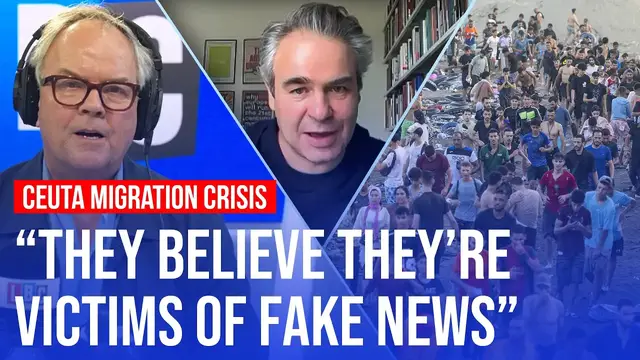
Matt Frei is joined by foreign affairs expert Mark Leonard after thousands of migrants stormed across the border into Spain's North African enclave of Ceuta.
The group which consisted mostly of young men entered Ceuta, while members of the Moroccan auxiliary force responsible for security on the ground withdrew as the young people passed.
The sitaution is send to be 'under control' but Spain has attacked the 'selfish' response of some EU countries.
Listen to the full show on the all-new LBC App: https://app.af.lbc.co.uk/btnc/thenewlbcapp
#TypeInPresenterName #TypeInTopic #LBC
LBC is the home of live debate around news and current affairs in the UK.
Join in the conversation and listen at https://www.lbc.co.uk/
Sign up to LBC's weekly newsletter here: https://l-bc.co/signup
Show More Show Less View Video Transcript
0:00
They say that an image speaks a thousand words
0:02
An image also speaks louder than a thousand statistics. So the image of 60,000 Moroccans swimming through the Mediterranean waters
0:12
in the Straits of Gibraltar and then clambering onshore in the Spanish exclave of Theuta, you know, was extraordinary
0:20
And the facts are also mind-blowing, which is that in 24 hours
0:24
60,000 migrants came across. Very tragically, 77 of them died, most of them drowning
0:31
But this was the biggest incursion of migrants into EU territory in one day ever. Now
0:39
the Spanish authorities, Spanish Prime Minister Pedro Sanchez, who's had a policy on migration
0:44
that has been criticised by some in Europe and especially by Donald Trump in terms of finding a
0:50
path towards legalization that others haven't. But this is mainly aimed at Latin American migrants
0:56
coming from Latin America, moving to Spain, similar language, etc., all that stuff
1:02
He was clearly panicking and he went straight down to Theota and gave a press conference and
1:07
tried to manage the situation. At the same time, Ursula von der Leyen, the president of the
1:12
commission, said this is unacceptable. You had the French government closing the border between Spain
1:17
because they were afraid that people might come across into Spain again, into France
1:22
They're facing, you know, the government there, Macron is facing a threat from the far right, from Marine Le Pen and her party
1:31
and that is a lot about immigration. The Italians then threatened to suspend the Schengen Agreement
1:35
I mean, there's a lot of politics around this. And I just would like to unpack what exactly happened
1:41
and whether the response was right or not. So let's speak to Mark Leonard, co-founder and director of the European Council on Foreign Relations
1:49
Mark, good morning. Hi, it was lovely to be with you. Great to have you on the programme
1:54
So, I mean, I'm sure you were as shocked as we all were by these images
1:59
Do we know exactly what happened? Because it does seem to be a very large number of people coming in in a very short space of time
2:07
And a lot of things are pointing to Morocco and the Moroccan authorities in terms of collusion in this
2:12
So I think the best accounts we know of, though obviously we're still in the fog of war as it were
2:21
is that there was a court that made a ruling in Spain about the idea of migrants being able to come over by sea
2:35
And the way that was reported, particularly on social media with fake news
2:39
was that the border had been opened up. And as a result of that, there was a spontaneous surge of people
2:47
who wanted to try and make the journey from Morocco to Ceuta
2:51
and that stampede was something that the Moroccan authorities were very very slow to react to
3:01
There are some speculation that this might have been a deliberate policy
3:05
because the Moroccans were upset about meetings between the Spanish government and Algeria
3:12
but other people think it was just a cock-up. It happened to be throne day in Morocco
3:20
And people say that the king was a series of big ceremonies and that people didn't want to bother him and get him to make a decision
3:31
But anyway, as a result, it took two days for the Moroccans to start cracking down on the border and deploying police
3:38
And you had this extraordinary surge that you're talking about, which was completely overwhelming for Théuta
3:43
It's a tiny place with only 80,000 people. So, you know, you can only imagine how extraordinary it must have felt having 60,000 people coming across the border
3:58
And that kind of crisis then, as you said, fed into some sort of muscle memories in a lot of different countries of 2015
4:07
and the political crisis around this asylum surge, which had, you know, very, very damaging political consequences in many countries
4:17
So you had lots of governments who didn't want to go back to a situation
4:22
where it looked like their borders were out of control, coming out, criticising things
4:28
And, you know, it took quite a while for the situation to get brought back under control
4:35
but what happened was that Feuta itself was locked down, shops were closed, people had nothing to eat
4:42
they couldn't get anywhere. It is sealed off. You can't just find your way from Feuta
4:51
into the mainland of Spain without showing documents And the Spanish authorities started working with the moroccan government to to repatriate people and i think now um the vast majority of people have have gone back to morocco
5:07
there is still uh a number of people who are minors um i think six to ten thousand people left
5:15
who are still in filter. And it's more difficult to repatriate them
5:22
than it is for adult people. But I think there is a sense that the situation is under control
5:27
But the political ramifications haven't ended yet. And the Spanish are very, very upset
5:34
They feel that rather than getting solidarity from other countries, they've been victims of political posturing
5:44
and fake news and they're really angry and the spanish prime minister has written to the president
5:48
of the european commission and the european council and the irish presidency of the eu and
5:53
asked to have an immediate meeting uh by video conference of interior ministers to talk about
6:00
what's going on and then as you kind of said in your intro a lot of different european countries
6:06
are in the middle of election campaigns yeah and this doesn't try to make hay out of this crisis
6:13
I mean, you mentioned that the key word is control, isn't it? I mean, what was so effective about the Brexit campaign, remember that, was take back control
6:21
This idea that, you know, we are at the mercy of, you know, migration flows that we can't do anything about
6:27
whether legal in the single market or, you know, illegal coming across, you know, the channel
6:33
Again, the thing that upset the Germans in 2015 when Angela Merkel said
6:38
we can do this was the germans who love a plan didn't have one to deal with this you know unfettered
6:44
migration and here in theuta in one day you had the ultimate nightmare image of uncontrolled
6:52
population flows that's why they panicked in rome paris berlin and brussels absolutely it was uh
7:01
it's a neuralgic, you know, it's a neuralgic memory that people have of 2015. And that's
7:10
something that nobody wants to go back to. But at the same time, there is a lot of politics going on
7:17
in different places In Sweden they in the end of an election campaign So it was obvious against far right parties with far right parties being a kind of important component of it In Finland there be elections next year So they kind of using it
7:33
In France, people, you know, the battle is going to be with Marine Le Pen and the national rally
7:40
So everybody is coming into this. And one of the things about Spain is that, as you said in your intro as well, Pedro Santos has had a much more liberal approach to migration than many other countries and has made a virtue of his approach to migration and the way that it's led to record levels of growth for Spain
8:03
So there is some settling of scores going on as well. But we should also, I think, just as we were struck by the images of people washing up and clambering onto the shores of Teotra, we should, you know, dwell on the images of them being led back, you know, like by the Pied Piper back into Morocco through the open gates
8:23
Because, as you say, the vast majority have returned. The Spanish Prime Minister was..
8:29
I mean, that's the other interesting thing that they, you know, it's not that they were, they weren't rounded up by the army and kind of put into it
8:37
They found that they couldn't get any further. They were hungry. They were tired
8:42
They were disappointed. Yeah. And I think it's because, I mean, again, it's very important to dwell on the facts as well as the images
8:51
The facts are that in the last year, from the whole of North Africa into the whole of the EU, fewer migrants arrived
8:59
have then entered on one day into Teotihuacan. I think it's 55,000 versus 60,000
9:04
So actually, Europe has been relatively effective at keeping people at bay. I think the Spaniards have had something like 12,500
9:10
coming across in the last year, despite their more tolerant policy. We've had many more than that
9:17
coming over on small boats across the channel. So let's not lose sight of that
9:22
Absolutely. I think, you know, we have seen a political revolution around migration over the last decade
9:31
which was triggered by, you know, the refugee crisis in 2015 and the Brexit referendum
9:37
and the election of Donald Trump. And there's been a toughening up
9:42
There are all sorts of measures in place. In 2016 or 2015, you know
9:48
it looked like some governments were in denial about the public concern about migration
9:54
And that's definitely not the case now. Thank you
#news